What this blog covers
Meta Collaborative Ads, known as CPAS, connect a brand’s Facebook and Instagram ads to products sold on a retail partner, with the partner’s catalogue and conversion data closing the loop. This explainer shows what CPAS is and where it fits, how it differs from sending Meta traffic to Amazon or buying retail media on a marketplace, and why Amazon, Flipkart and Meta each need their own playbook. Practitioners get the Four-Link Collab Model, Catalogue, Creative, Conversion, Control, so marketplace media and Meta spend get planned and measured as one system.
Table of Contents
- What CPAS is, and where it fits
- The closed loop that sets collaborative ads apart from traffic ads
- Why Amazon, Flipkart and Meta need three different playbooks
- The data and attribution terms to agree before you spend
- Running a CPAS campaign on a marketplace: the Four-Link Collab Model
- The Framework explained
- Why collaborative ads belong in the same budget as retail media
- Client proof point: ASICS on Amazon
- Key takeaways
- The CXO takeaway
Collaborative ads let a brand buy attention on Meta and sell on a retailer’s shelf, with the retailer’s data closing the loop. The magic happens when the retailer becomes a partner, far beyond a landing page.
Quick answer: A CPAS campaign on a marketplace, now called Collaborative Ads, lets a brand run Meta ads that promote products from a retail partner’s catalogue and measure sales through the partner’s conversion data. It differs from sending Meta traffic to an Amazon listing, which gets measured separately, and from retail media on the marketplace itself. Agree catalogue, creative, attribution and reporting terms with the partner before launch, and judge results with incrementality tests alongside platform reports.
What CPAS is, and where it fits
CPAS stands for Collaborative Performance Advertising Solution, and Meta now calls it Collaborative Ads. The brand pays for Facebook and Instagram ads, the retailer provides the catalogue and conversion data, and the sale lands on the retailer’s website or app.
That structure sets it apart from the two routes brands usually compare it with. Sending Meta traffic to an Amazon listing is ordinary traffic, measured once on Meta and again on Amazon. Retail media buys a sponsored slot on the retailer’s own results page. CPAS sits right between them: Meta media, retailer data.
The momentum is real. Meta’s own India update on how Collaborative Ads are fuelling the quick commerce boom introduced a CPAS playbook for retail and quick commerce, and the Meta and WPP consumer report found quick commerce powered 45% of festive shopping. Those are vendor figures, so read them as the vendor’s view. The bigger shift is clear either way: retail media is now a core budget line, as the full map of India’s retail media networks shows.
Be precise about availability. Which retailers support CPAS, in which categories and with which settings, depends on retailer enablement and Meta’s programme at the time. Confirm with both before you plan a rupee.
The closed loop that sets collaborative ads apart from traffic ads
The closed loop is the whole point. With ordinary traffic ads, Meta sees the click and loses the shopper at the retailer’s door. With collaborative ads, the retailer shares a catalogue segment and conversion data, so campaigns optimise toward actual sales of those products. Media connects to a sale.
The mechanics set the rules. The retailer enables the brand in Meta, only the retailer can change the catalogue segment, and conversions count only for catalogue items. Shared data is typically aggregated and anonymised. Plan creative and promotions around what the retailer’s catalogue can show.
That is why the channel belongs inside the media mix. Paid search, paid social and shopping each play a distinct role, and CPAS adds a fourth: social discovery with retail-verified sales. Use it for products where the retailer is the main place of purchase and the story needs a visual.
Treat the retailer as a partner with its own targets. Agree who owns data, creative, budget and reporting upfront, and keep a separate Meta account per retail partner. Misaligned partners stall in approvals. Settle roles first.
Why Amazon, Flipkart and Meta need three different playbooks
Each platform rewards different behaviour, as our marketplace growth strategy across Amazon, Flipkart and Myntra explains. Run one plan per platform with shared measurement, instead of one plan copied three times.
On Amazon, Meta traffic is its own route. Amazon Attribution reports detail-page views, add-to-carts, purchases and sales from tagged external traffic. Those purchases may sit outside Meta’s view, so read Meta and Amazon reports together before judging performance. Reconcile the two reports and keep the tag identifier beside the ad.
Routes from Meta and marketplace media to a marketplace sale
On Flipkart and Myntra, the Meta relationship is evolving fast. In June 2026, Flipkart Group launched Meta affiliate partnerships, letting creators tag Flipkart and Myntra products in Facebook posts and Reels. That is a creator and affiliate route with commissions, separate from CPAS. Ask your Flipkart contacts which options exist for your category.
Marketplace retail media stays the backbone. Sponsored ads capture intent that already exists, while Meta builds intent earlier. Our Meta Pixel and Conversions API guide connects on-site events to Meta, and the same discipline applies to off-site journeys. Different routes. One scorecard.
The data and attribution terms to agree before you spend
Attribution decides what you think you bought. Collaborative ad reporting depends on the click and view windows agreed with the retailer, and partners can offer different options. Get the windows in writing and record them beside every report. Every number travels with its window.
Data sharing needs care. Conversion and purchase data flows between you, the retailer and Meta, and each party carries duties. Check how the retailer shares data and how your privacy notice covers it. The principles in server-side tracking and CAPI in a privacy-first world apply to your side of the exchange, so bring legal in early.
Agree the catalogue rules. Which products, how prices and stock sync, who fixes errors and how fast. A catalogue showing out-of-stock items burns spend, and only the retailer can edit it. Set a fix service level, one working day works well.
Define success before launch: the primary outcome (catalogue sales), secondary outcomes (new-to-brand customers), review dates and the results that would stop, change or scale the campaign. Written rules, shared with the partner.
Running a CPAS campaign on a marketplace: the Four-Link Collab Model
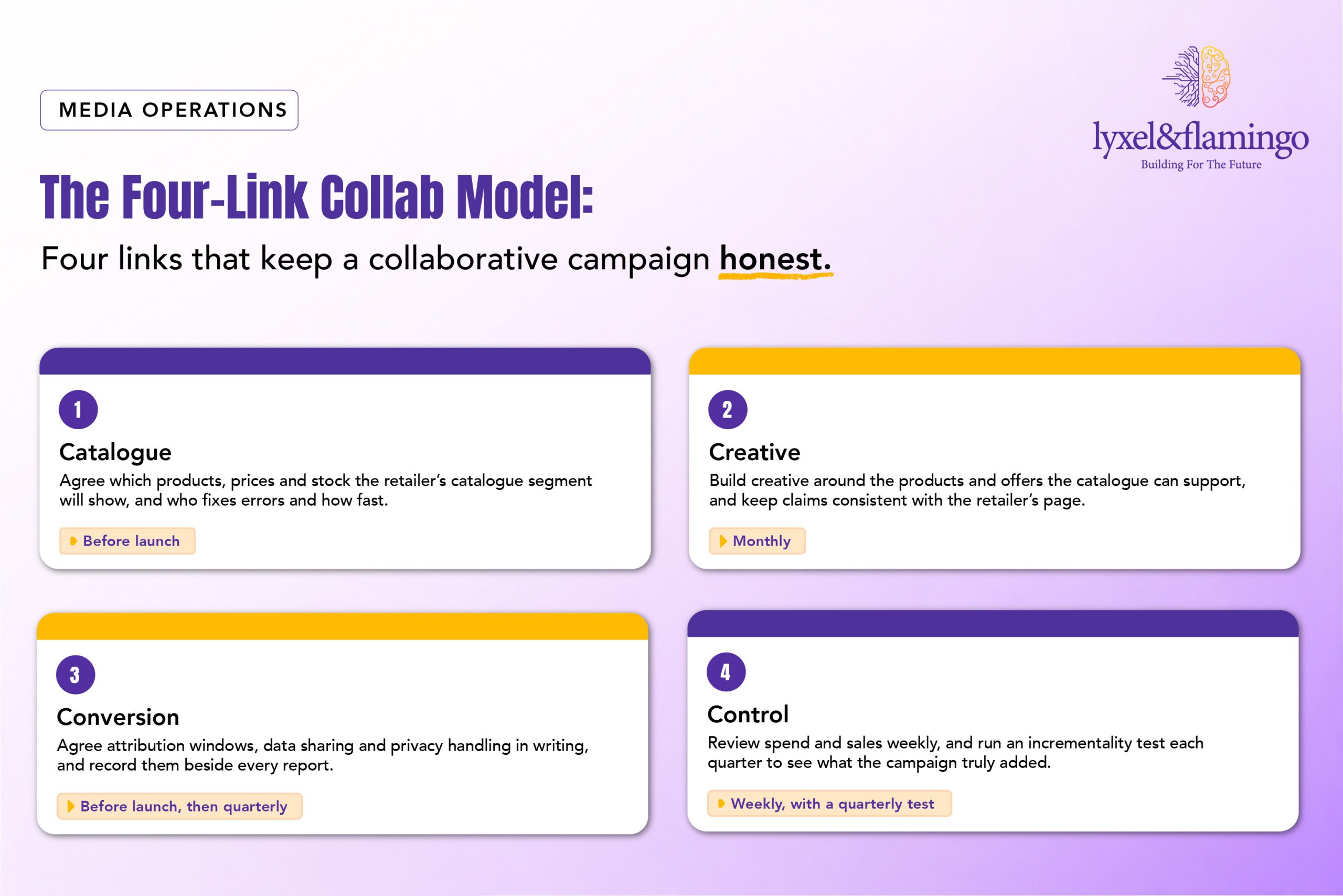
Four links, closed in order, keep a collaborative campaign honest.
The Framework explained
Catalogue: The catalogue is the product the campaign sells, so settle it first. Agree inclusions, price and stock sync, and error ownership. Since only the retailer can edit the segment, set a service level for fixes. Promoting an out-of-stock or mispriced item wastes media and dents trust on both sides.
Creative: Build creative for the retailer destination. Show the products and offers the catalogue supports, keep claims and prices identical to the retailer’s page and refresh monthly, testing two or three angles at a time. The shopper meets the retailer’s page next, so the story must carry through.
Conversion: Write down how conversions get counted: attribution windows, eligible products, data-sharing terms and privacy coverage. Put it in a shared document attached to every report. Agreed terms give both partners one truth that finance can trust.
Control: Run the programme with a weekly check and a quarterly experiment. Review spend, sales and catalogue health weekly. Each quarter, hold out a set of products or regions and compare total sales, so you see what the campaign added beyond baseline. Move budget on that evidence.
Why collaborative ads belong in the same budget as retail media
Collaborative ads and marketplace ads feed each other. Meta creates demand that the marketplace converts, and marketplace ads capture it. Budget them together by product role and test the combination, using geo experiments for enterprise marketing to design the holdout. Believe the test over either platform’s report.
Compare cost per incremental sale alongside ROAS. A collaborative campaign may show strong attributed sales by reaching shoppers already buying, while retail media may look weaker because it captures demand created elsewhere. Demand creation versus demand capture explains why both matter. An incrementality test settles the debate.
Keep creative consistent across the journey. A shopper who sees one promise on Instagram and another on the retailer’s page loses trust. Align offers, claims and pricing across Meta, the marketplace listing and the brand site. One promise, three surfaces.
Report the system to leadership on one page. The thinking in every KPI is green and your board should still worry applies: total sales, cost per incremental sale and margin beside the platform metrics.
Client proof point: ASICS on Amazon
The closest verified Lyxel&Flamingo work here is Amazon sponsored advertising for ASICS, shared as adjacent marketplace media proof. ASICS entered Amazon advertising in India as a late entrant against heavily marketed rivals, and focused on brand keywords, sports where it leads and sub-brands like Kayano and Nimbus.
- 60% lower ACoS in 3 months, best in category
- 100%+ growth in AMS-attributed sales within a year
- 38M+ impressions in just over 3 months
- 40%+ month-on-month organic traffic to the brand store
Read the full story in the ASICS AMS launch and performance case study.
Key takeaways
- CPAS, now Collaborative Ads, connects Meta ads to a retail partner’s catalogue and conversion data.
- It differs from Meta traffic to Amazon, measured through Amazon Attribution, and from marketplace retail media.
- Availability depends on the retailer and Meta, so confirm both before budgeting.
- Agree catalogue, attribution and data terms in writing before spending.
- Judge results with incrementality tests and review collaborative and marketplace media together.
The CXO takeaway
Ask your media lead for one page mapping every route from Meta and marketplace spend to a marketplace sale, with the attribution window and data owner for each. Confirm with Meta and each retailer which collaborative options exist for your categories. Release budget only once attribution and catalogue terms are in writing. Fund one incrementality test per quarter across collaborative and marketplace media, and make one person accountable for the whole route to sale.
A question for your next media review: if Meta and your marketplace both claimed the same sale, which report would finance believe?
The Lyxel&Flamingo media operations team plans Meta and marketplace media as one system. Start the conversation and we will map your routes to sale.
Frequently Asked Questions
CPAS stands for Collaborative Performance Advertising Solution, which Meta now calls Collaborative Ads. It lets a brand run Meta ads promoting products from a retail partner’s catalogue, with the sale and conversion data sitting with the retailer. The retailer must enable the brand and share a catalogue segment.
Check before you assume. Brands sending Meta traffic to Amazon usually measure it with Amazon Attribution, which reports detail-page views, add-to-carts and purchases from tagged traffic. That is a different set-up from collaborative ads, so confirm the options for your account and category with Meta and Amazon.
Retail media buys a slot on the retailer’s own results page, mostly capturing shoppers already searching. CPAS buys attention on Meta and uses the retailer’s catalogue and data to close the loop. They play different funnel roles, so plan, measure and test them together.
Run a holdout test: change spend on one set of products or regions, hold another steady and compare total retailer sales. Platform-reported sales can include buyers already on their way. Repeat quarterly and report cost per incremental sale beside ROAS.
Confirm the partner supports collaborative ads in your category, shares a catalogue segment and conversion data, and fixes catalogue errors quickly. Ask about attribution windows, reporting access and data handling, and review stock and checkout quality on the retailer’s page.