What This Blog Covers
Mental and physical availability, being easy to think of and easy to buy, explains category growth more reliably than loyalty-driven brand strategy. This piece breaks down what each half of the model actually means in media terms, why most brands over-invest in one at the expense of the other, and how to build both deliberately into a media plan.
Quick Answer: Mental availability means a brand comes to mind in the moments a category need arises, built through distinctive brand assets and broad reach media. Physical availability means the brand is easy to find and buy once it comes to mind, built through distribution and retail presence, online and offline. Category growth comes overwhelmingly from expanding both, not from deepening loyalty among existing customers, which is why media plans built around retention alone consistently underperform those built around broad, consistent reach.
Table of Contents
Why Loyalty Is Not the Growth Lever Most Decks Assume
Most brand strategy decks still centre on deepening loyalty among existing customers, on the assumption that a small base of devoted buyers drives disproportionate growth. Long-running category research from the Ehrenberg-Bass Institute consistently shows the opposite: brands grow mainly by winning light and occasional buyers, the shoppers a category has many of, not by extracting more from an already loyal few.
This matters directly for media planning, because a strategy built around loyalty tends to concentrate spend on retargeting and existing customers, channels that are efficient to measure yet structurally too small to drive category growth. The buyers who actually move market share are the ones who are not yet thinking about the brand at all.
Mental Availability in Media Terms
Mental availability is the probability that a brand comes to mind in a buying situation, and it is built through two things working together: broad reach media that touches as many category buyers as possible, and distinctive brand assets, a colour, a sound, a visual style, consistent enough that the brand gets correctly attributed even without the logo in frame.
Reach matters more than frequency here, which runs against the instinct to concentrate budget on a smaller, already-engaged audience, a point the IPA has reinforced repeatedly in its own long-term effectiveness research. A media plan optimised purely for engagement metrics, high click-through, high watch time, on a narrow audience will often build less mental availability than a broader, lower-engagement plan that simply touches more of the category.
Physical Availability in Media Terms
Physical availability is how easy a brand is to find and buy once it comes to mind, and in a digital-first market that means far more than shelf presence. It includes how the brand shows up in a search results page, whether it is stocked and visible on the marketplaces a category buyer actually shops on, and whether the path from intent to purchase has any unnecessary friction in it.
This is where retail media networks matter more than most media plans give them credit for: they sit at the exact intersection of mental and physical availability, capturing a buyer at the moment their brand recall turns into a purchase decision on the platform where that decision actually happens.
Why Most Brands Over-Invest in One Half
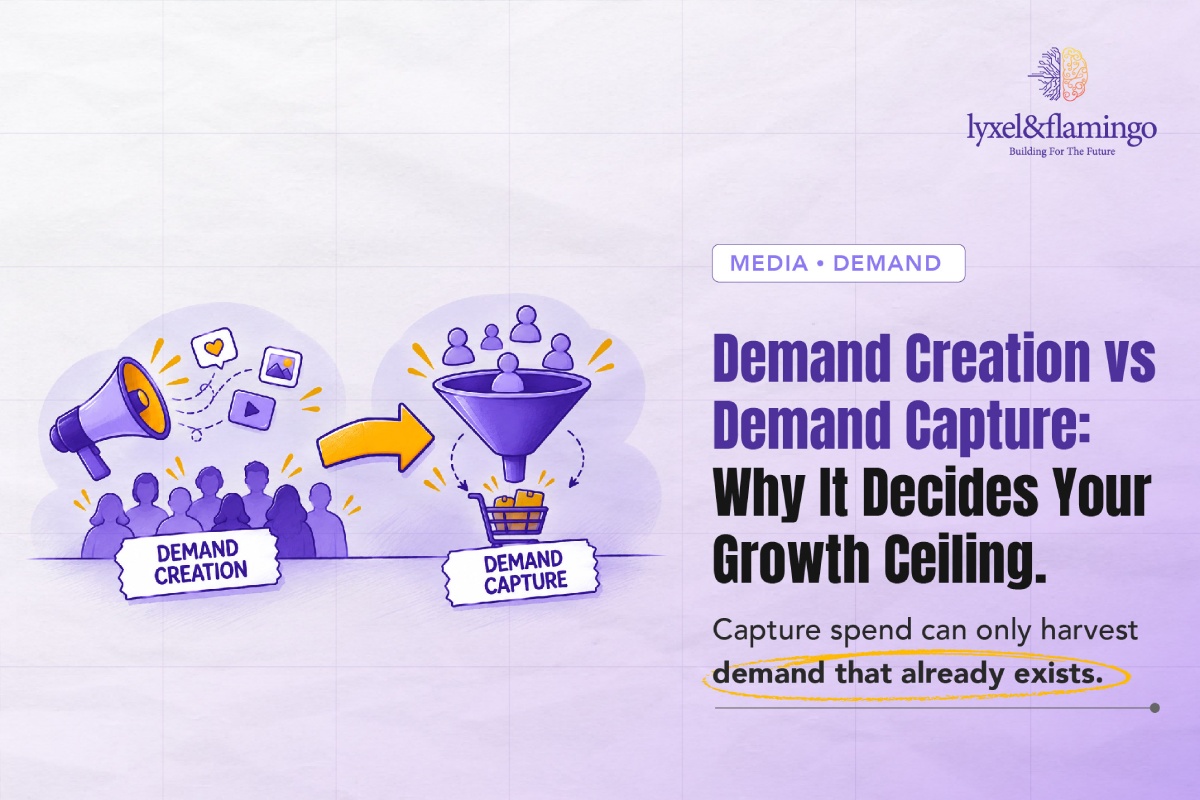
Performance-heavy brands tend to over-invest in physical availability, easy to buy, without building enough mental availability to fill the top of that funnel, which is why performance CAC eventually plateaus even as conversion-path friction keeps improving. There is only so much efficiency to extract from a demand pool that is not growing.
Brand-heavy, reach-focused brands make the opposite mistake: building recall without making the path to purchase equally easy, so a buyer who does think of the brand at the right moment hits friction and buys a more available competitor instead. Both halves have to move together, which is the same underlying argument covered in why brand and performance marketing need to be balanced rather than traded off.
The Mental and Physical Availability Framework
Translating the model into a media planning checklist makes it actionable rather than academic.
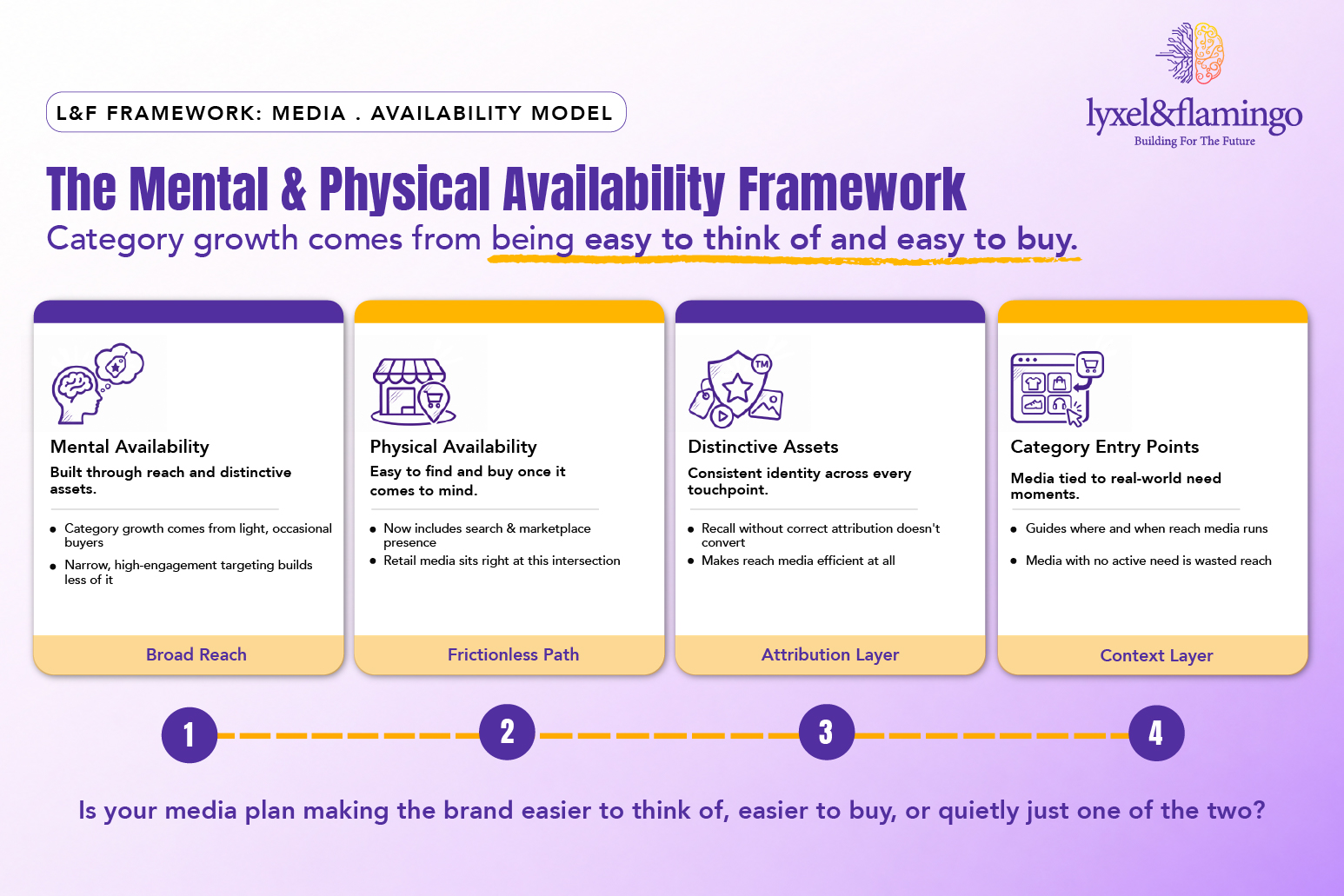
Framework Explained
Mental Availability: Built through broad, consistent reach rather than narrow, high-engagement targeting, since category growth comes from light and occasional buyers, not the already-engaged few.
Physical Availability: Built through distribution and a frictionless path to purchase, with retail media and marketplace presence increasingly central to this in digital-first categories.
Distinctive Assets: The mechanism that makes reach media efficient at all, since recall without correct brand attribution does not convert into consideration.
Category Entry Points: The real-world moments and contexts a category need arises, which should guide where and when reach media actually runs.
CAPABILITY NOTE: Lyxel&Flamingo builds category-presence and retail-visibility work into client media plans, including marketplace launch strategy that combines broad-reach visibility with point-of-purchase availability, as part of full-funnel and third-party marketplace engagements. A single case study isolating mental-versus-physical-availability outcomes is not yet published, so this reflects an applied planning approach rather than a standalone proof point.
Building Both Into a Media Plan
The practical shift for most media plans is smaller than it sounds: audit current spend against the four rows in the framework above, and check whether reach and distribution are genuinely growing together or whether one is being starved to fund the other. A plan that is 90% performance-driven is very likely under-building mental availability; a plan that is mostly brand-driven with weak marketplace or search presence is very likely under-building physical availability.
Neither half needs to dominate permanently. They need to be reviewed together, on the same schedule, so a CXO can see whether the brand is becoming easier to think of, easier to buy, or both.
Key Takeaways
- Category growth comes mainly from light and occasional buyers, not from deepening loyalty among existing customers.
- Mental availability is built through broad reach and consistent distinctive assets, not narrow, high-engagement targeting.
- Physical availability now includes search visibility and marketplace presence, not just physical distribution.
- Over-investing in either half without the other caps growth, just through a different mechanism.
- Review both halves together on the same planning cycle rather than treating them as separate strategies.
CXO Takeaway
Is your media plan making the brand easier to think of, easier to buy, or is it quietly optimising only one of the two?
Talk to Lyxel&Flamingo about building a media plan that grows mental and physical availability together, not as competing budgets.
Frequently Asked Questions
Yes. Mental availability shows up as being the brand a buying committee thinks of first when a category need arises; physical availability shows up as how easy the brand is to find, evaluate and procure once it does.
Related, yet not identical. Awareness measures whether people have heard of a brand; mental availability measures whether it comes to mind specifically at the moment a category need arises, which is a narrower and more useful signal.
Retail media sits at the intersection of both halves, since it reaches a buyer at the exact moment mental availability, thinking of the brand, needs to convert into physical availability, being able to buy it immediately on that platform.
Neither in isolation for long. A short-term focus on whichever half is weaker is reasonable, however sustained growth requires both moving together over time.