What this blog covers
Branded search volume is one of the earliest, most reliable demand signals available to a marketing team, moving weeks or months before conversion and revenue numbers reflect the same trend. This piece explains why branded search leads rather than lags, how to read rising or falling volume correctly, and how to build it into a monthly reporting habit instead of an annual brand-tracking exercise.
Quick Answer: Branded search volume is a leading demand indicator: it typically rises or falls two to eight weeks before conversion and revenue numbers reflect the same shift, because it captures intent forming before a purchase decision is made. Rising branded search means upper-funnel spend is converting into demand; falling branded search, even with stable performance ROAS, usually predicts a coming CAC increase. Reading it monthly alongside performance metrics catches problems before they show up in revenue.
Table of Contents
Why Branded Search Leads Instead of Lags
A conversion or revenue number reports what already happened. Branded search volume reports intent that has not yet turned into a transaction, someone who saw an ad, heard a recommendation, or noticed the brand somewhere, and went looking for it by name before deciding to buy. That gap between search and purchase is exactly why the metric leads.
This is also why branded search is harder to game than most performance metrics. It cannot be bought directly the way a click can; it can only be earned by media and experiences that actually register with someone enough to make them go looking. Teams serious about improving brand search volumes treat it as the clearest available proxy for whether upper-funnel spend is genuinely building demand.
What Rising Volume Actually Tells You
A sustained rise in branded search volume, distinct from a single-week spike tied to a promotion, usually means upper-funnel media is successfully building category presence. The useful follow-up question is not just whether volume rose, and whether performance CAC fell in the weeks after, which confirms the demand is actually convertible rather than just curious.
A rise that does not eventually show up as improved performance efficiency is worth investigating separately, since it can mean the demand being created is not the audience performance media is set up to capture, a mismatch between who the brand campaign is reaching and who the performance funnel is built to convert.
What Falling Volume Actually Tells You
Falling branded search, especially when performance ROAS still looks stable, is the earliest and most easily missed warning sign in a media plan. Performance channels can keep converting the existing pool of aware shoppers for a while even as that pool stops being replenished, which is exactly why the ROAS number lags the real problem by weeks or months.
This is where thinking about measurement beyond a single last-click ROAS number becomes practical rather than theoretical. A media lead who only checks ROAS will not see the problem coming; a media lead who checks branded search monthly will see it two or three months before it hits revenue.
Where to Pull the Data From
Google Search Console gives the most direct read for owned branded queries, segmented by exact match and near-match variants of the brand name. Google Trends adds a directional, normalised view useful for spotting the trend shape rather than absolute volume. GA4’s direct and unattributed traffic, sessions with no referral source, correlates closely with branded search and is a useful secondary check when Search Console data is thin, though that same unattributed bucket is increasingly where AI referral traffic hides too, a separate measurement gap covered in fixing GA4 for AI referral traffic.
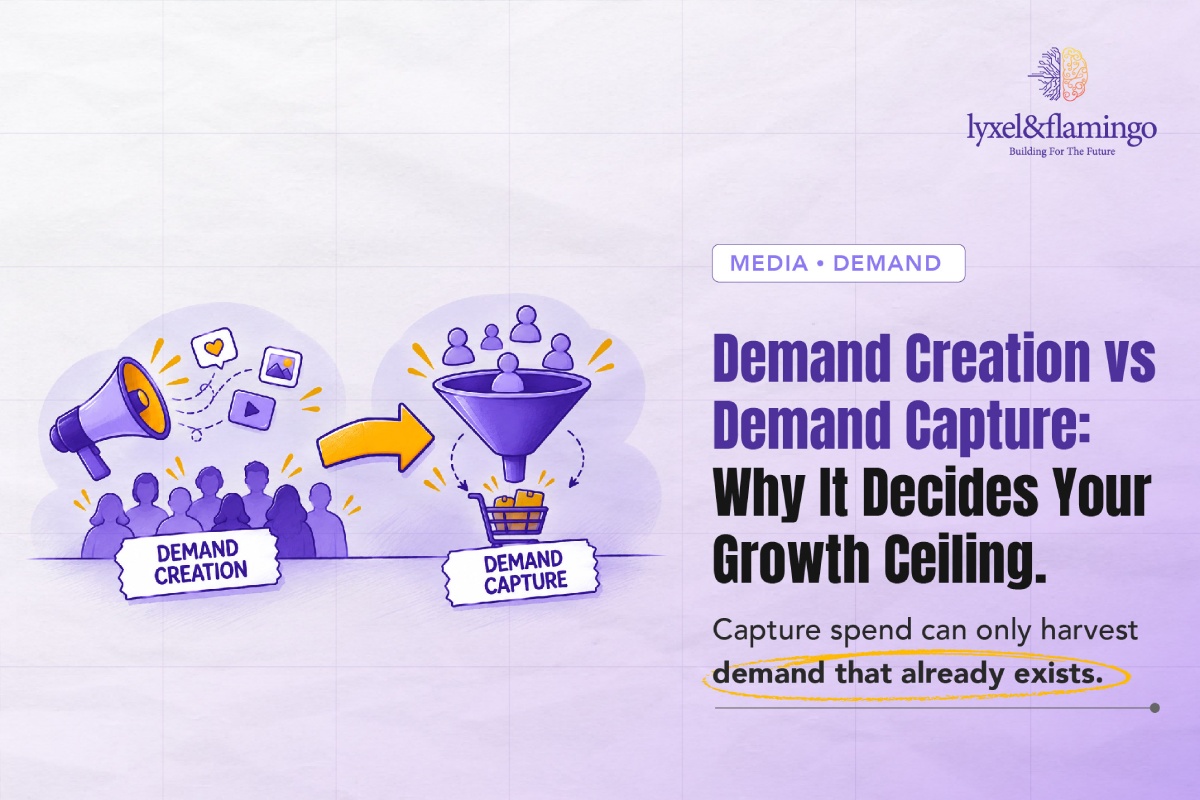
The practical habit is a simple three-line monthly tracker: branded search volume, direct traffic, and performance CAC, read side by side. None of the three tells the full story alone. Together, they show whether demand creation and demand capture are moving in the same direction, and whether upper-funnel spend is allocated the way the media mix growth-stage matrix would actually recommend for the brand’s current stage.
The Brand-Search-as-Leading-Indicator Framework
Turning the signal into a repeatable habit means knowing what each movement typically means and what action it calls for.
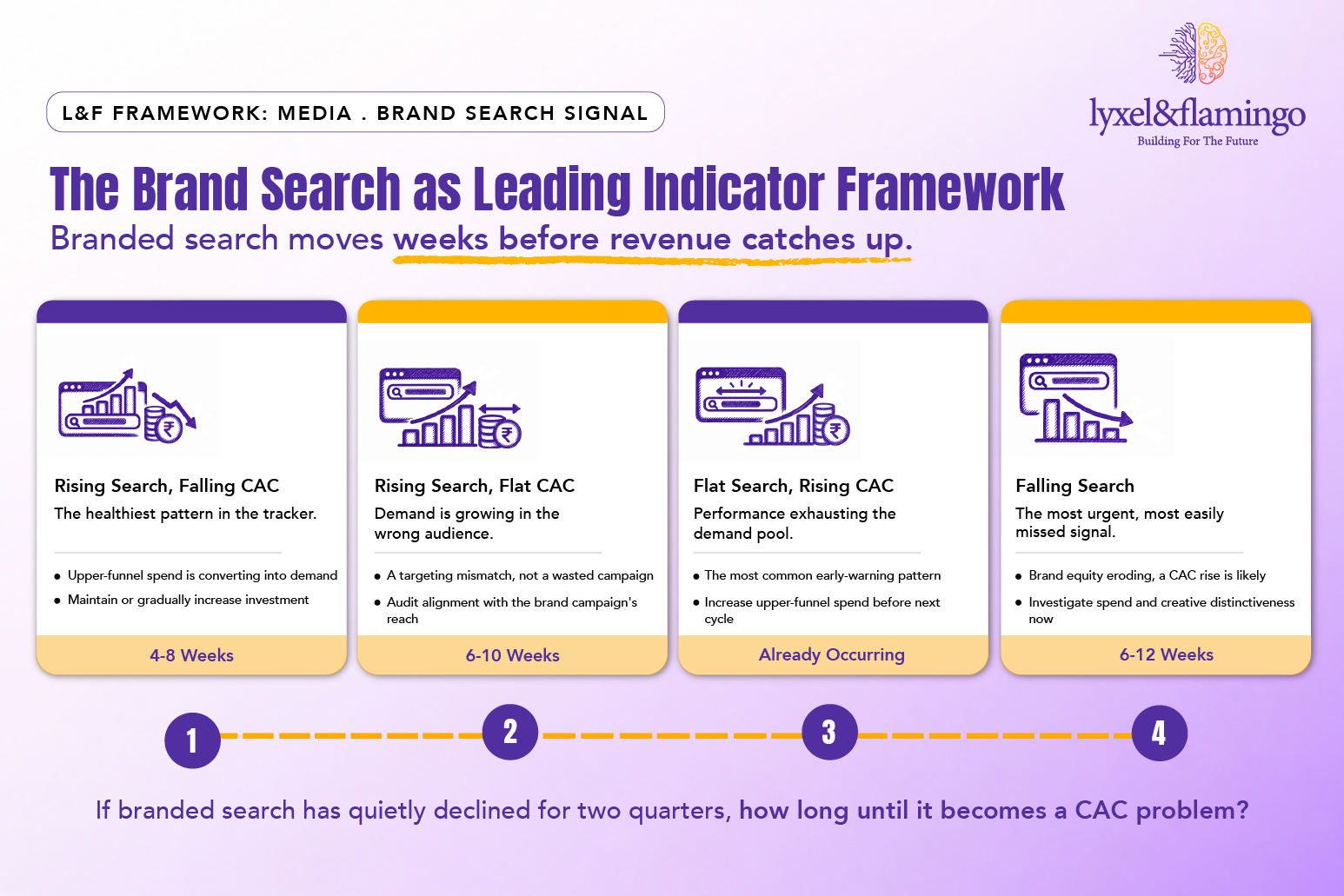
Signal: Branded search rising, CAC falling. What it usually means: Upper-funnel spend converting into efficient demand. Typical lag to revenue impact: 4-8 weeks. Action: Maintain or gradually increase upper-funnel investment.
Signal: Branded search rising, CAC flat. What it usually means: Demand growing in an audience performance isn’t capturing. Typical lag to revenue impact: 6-10 weeks. Action: Audit performance targeting alignment with brand campaign reach.
Signal: Branded search flat, CAC rising. What it usually means: Performance exhausting existing demand pool. Typical lag to revenue impact: Already occurring. Action: Increase upper-funnel spend before the next planning cycle.
Signal: Branded search falling. What it usually means: Brand equity eroding, CAC increase likely. Typical lag to revenue impact: 6-12 weeks. Action: Investigate brand spend levels and creative distinctiveness immediately.
Framework Explained
Rising search, falling CAC: The healthiest pattern, confirming upper-funnel spend is building demand performance can efficiently capture.
Rising search, flat CAC: A targeting mismatch worth investigating before assuming the brand spend isn’t working.
Flat search, rising CAC: The most common early-warning pattern, showing performance is working harder against a demand pool that has stopped growing.
Falling search: The most urgent signal, and the one most teams catch latest because it takes months to fully show up in revenue.
Capability Note
Lyxel&Flamingo builds branded search and direct-traffic tracking into ongoing GA4 and reporting work across client accounts, as part of media operations and full-funnel measurement engagements. A dedicated published case study isolating brand-search-signal outcomes alone is not yet available, so this reflects an active reporting capability rather than a standalone proof point.
Building the Monthly Habit
The single biggest obstacle to using branded search as a working signal is not access to the data, most teams already have Search Console connected, it is that nobody owns checking it on a schedule. Assign it to whoever owns full-funnel reporting, review it alongside CAC and ROAS in the same monthly meeting, and track the trend line over six months rather than reacting to any single month’s number.
Once the habit is in place, branded search becomes the earliest warning system a media team has, catching demand problems while there is still time to adjust the plan, rather than explaining a CAC increase after it has already happened.
Key Takeaways
Branded search volume typically leads revenue and conversion numbers by four to twelve weeks.
Falling branded search with stable ROAS is the most commonly missed early-warning sign in a media plan.
Google Search Console, Google Trends, and GA4 direct traffic together give a reliable monthly read.
Rising search without falling CAC signals a targeting mismatch, not a wasted brand campaign.
The signal only works as a habit, reviewed monthly alongside performance metrics, not as an annual check-in.
CXO Takeaway
If branded search volume has been quietly declining for two quarters, how many more months until that shows up as a CAC problem your team can no longer explain away?
Talk to Lyxel&Flamingo about building branded search tracking into your monthly reporting alongside CAC and ROAS.
Frequently Asked Questions
Typically four to twelve weeks, depending on category purchase cycle length. Considered purchases show a longer lag than impulse categories.
Usually not on its own. Look for a sustained two-to-three-month trend before treating it as a real signal, since single-month volume can be affected by seasonality or a competitor’s campaign moment.
Not directly. It reflects genuine search intent, which makes it a harder metric to game than most performance numbers and a more trustworthy proxy for real demand.
Google Search Console for exact branded query volume, Google Trends for directional trend shape, and GA4 for direct and unattributed traffic as a secondary confirming signal.