What this blog covers
Micro-frontends split a website into independently built and deployed pieces, each owned by a different team, and they have become a fashionable answer to slow storefront delivery. This decision guide shows what the approach is, why the case for it rests on team structure and measured release bottlenecks, and where the costs land in page speed, duplication and testing. Engineering leaders and the marketing leaders who depend on them get the Split-or-Stay Test, Teams, Tempo, Speed, Seams, so architecture gets decided on evidence about delivery and conversion.
Table of Contents
- What micro-frontends are, and the problem they solve
- The org chart that decides whether splitting pays off
- Why the cost shows up in page speed and conversion
- The seams worth cutting in an e-commerce storefront
- Micro-frontend architecture for ecommerce: the Split-or-Stay Test
- The framework explained
- Why a modular monolith is the honest alternative
- Key takeaways
- The CXO takeaway
Micro-frontends solve an organisation problem before they solve a technology problem. When your teams flow freely, splitting the storefront simply adds cost.
Quick answer: A micro-frontend architecture for ecommerce pays off when several teams need to release independently to the same storefront and shared release trains are a measured bottleneck. The bill arrives as duplicated code, heavier integration testing and slower pages, which in e-commerce means lost conversion. Run the Split-or-Stay Test on teams, tempo, speed and seams, and choose a modular monolith when teams are few or performance is your edge.
What micro-frontends are, and the problem they solve
Micro-frontends extend microservices to the browser. Instead of one large front end built and released by one team, the storefront splits into smaller front ends, search, product page, cart, checkout, each owned by a team that builds, tests and deploys on its own timeline. ThoughtWorks first flagged the technique on its Technology Radar, and Cam Jackson’s widely cited article on martinfowler.com set out the patterns.
The problem they solve is coordination. When many teams ship to one front end, releases queue, merge conflicts multiply and one team’s change delays another’s. With a split, a cart change goes live on its own. That freedom is the benefit, and it is an organisational one.
Keep the wider architecture separate in your head. Decoupling the front end from the commerce backend, covered in headless commerce for enterprises, is a different decision from splitting the front end itself. A brand can go headless with one front end, or stay on a platform with several.
Symptom first, pattern second. Ask your engineering lead how many days a typical change waits for release, and why. A few days and a short checklist? Your current setup is working. Weeks and a queue of teams? Now you have a case.
The org chart that decides whether splitting pays off
Micro-frontends reward a particular shape of organisation: several teams, each owning a distinct business domain, all needing to release independently to the same product. Practitioner guides suggest four or more teams and caution against the pattern below three. Rules of thumb, with a clear point: the pattern needs teams to split between.
Conway’s law applies. Systems mirror the communication structure of the teams that build them, so a split that ignores team boundaries creates friction. If one team owns search, catalogue and checkout, three front ends add seams and zero autonomy. Align architecture with the teams you actually have.
For a CMO, this is about speed to market. Do campaigns, tests and new journeys wait on a release train, and is the wait measured? App versus PWA choices raise the same issue: channels multiply, and so do teams. A storefront three teams touch for every promotion is a candidate. One that changes quarterly is a stay.
Measure the bottleneck before designing the fix: lead time from approved change to live, releases blocked by another team and rollbacks, over a full quarter. Evidence first, architecture second.
Why the cost shows up in page speed and conversion
The costs are real, and in e-commerce they land on revenue. Practitioner guidance consistently lists duplicated dependencies, heavier integration testing and harder performance management. A well-built single front end usually beats a micro-frontend set-up on bundle size and load time. Speed is a storefront feature.
Connect that to the shopper. The science behind a landing page that converts treats load time and clarity as conversion factors, and Google’s Core Web Vitals put numbers on the experience. A split that adds half a second to a product page can cost more than the release delays it removed. Put the trade-off in rupees.
Duplication carries a technical and a design cost. When each team ships its own copy of a framework, or a slightly different button, bundles grow and the brand drifts. Manage it with a shared design system, shared dependencies loaded once and strict performance budgets per piece.
Look for friction beyond speed. A UX friction audit shows where shoppers stall, and fragmented pages add their own friction: a cart count that updates in one piece and lags in another. Test the whole journey. The shopper sees one site.
The seams worth cutting in an e-commerce storefront
If you split, split along business domains, ahead of technical layers. Natural storefront seams: search and discovery, the product page, cart and checkout, account and loyalty, and content. Each has its own team, data and rate of change. Cut where teams already think separately.
Integration approaches compared: independence, speed and fit
Keep shared experiences whole. The header, design system and user session belong to every piece, and splitting them multiplies the places they can break. Own them centrally. A shared shell, many slices.
Plan measurement across the seams. One goal, many funnels shows how correct tracking proves a design works, and that discipline becomes essential when several pieces fire events independently. Agree one event schema for every piece, owned centrally, so analytics tells one story about one journey.
Choose the integration method per page. Server-side composition suits content-heavy, search-critical pages. Runtime composition suits app-like experiences where independent deployment matters most. Match the method to the page, ahead of fashion.
Micro-frontend architecture for ecommerce: the Split-or-Stay Test
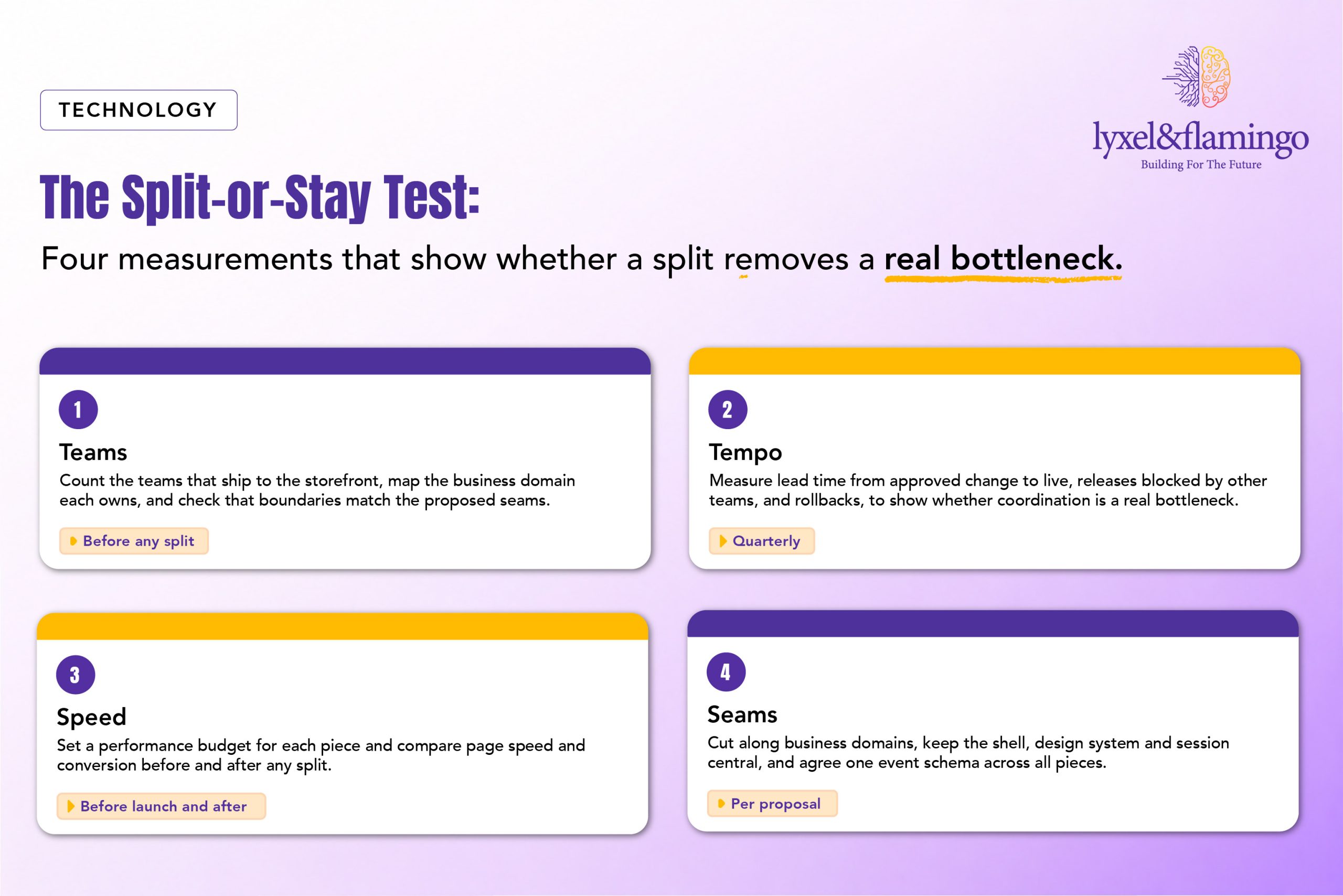
Four measurements, taken before any architecture work, show whether a split would remove a real bottleneck.
The framework explained
Teams: List every team that changes the storefront and the domain it owns. A split needs several teams with distinct domains and a real need to release independently. When one team owns most of the storefront, the pattern adds seams and little autonomy. Architecture that fights the org chart loses.
Tempo: Measure delivery before designing the cure. Track how long a change waits, how often one team blocks another and how many releases roll back, across a full quarter including a peak season. Short waits and few blocks point to a modular monolith. Weeks of queueing make the case.
Speed: Treat page speed as a conversion issue. Set a performance budget per piece, including shared library weight, and compare speed and conversion before and after. Approve designs that share dependencies through a clear plan. In e-commerce, the checkout judges the architecture.
Seams: Decide where to cut: search, product page, cart, account. Keep the shell, design system and session central, agree one event schema and choose the integration method page by page. Start with one reversible slice and measure it.
Why a modular monolith is the honest alternative
A modular monolith keeps one deployable front end with strict internal boundaries, separate ownership folders and shared standards. Most teams get most of the clarity they want, minus the cost of independent deployment. For a storefront with two or three teams, it is often the better answer. Start here. Earn the split.
The real test: is independent deployment a hard requirement? Use micro-frontends when several teams ship to the same application and waiting on a shared release train costs more than the added complexity. Write that sentence for your business, with numbers. If the numbers stay vague, stay put.
If you do split, go gradually. Carve out one domain behind a clear contract and measure speed, conversion and delivery time before and after. The discipline in Shopify conversion optimisation applies: one change at a time against a baseline.
Document the decision and the exit: why you split, the metrics that justify it and the point at which you would merge again. Revisit the record yearly.
This is how the Lyxel&Flamingo technology team approaches storefront architecture, from the Coffee Island app and web build to the 5,000-page Medanta platform: structure follows teams, and speed protects conversion.
Key takeaways
- Micro-frontends solve a team-coordination problem. With free-flowing teams, a modular monolith wins.
- The case needs several teams with distinct domains and a measured release bottleneck.
- The costs land on duplicated code, integration testing and page speed, which means conversion.
- Cut along business domains and keep the shell, design system and event schema central.
- A modular monolith is the honest default for most storefronts. Earn the split with evidence.
The CXO takeaway
Ask your engineering lead for three numbers: how many teams ship to the storefront, how long an approved change waits to go live, and how often one team blocks another. Short waits? Fund the modular monolith. Long waits? Ask for a pilot on one domain with a performance budget and a conversion baseline. Report page speed and conversion beside delivery time, and make architecture a joint call between engineering and marketing, since campaigns feel every delay.
The question to take into your next planning meeting: if your storefront split into five pieces tomorrow, which team would ship faster, and what would the checkout cost you?
Share your release numbers with Lyxel&Flamingo and we will run the test with you.
Frequently Asked Questions
Micro-frontends divide a website’s front end into smaller, independently built and deployed pieces, each owned by a different team. A product page, a cart and a search feature can each ship on their own schedule, while the shopper still sees one site. The idea extends microservices to the browser.
Practitioner guides suggest four or more teams that need to deploy independently, and advise against the pattern below three. Treat that as a rule of thumb. The stronger test is whether releases are measurably blocked by other teams; when they are free-flowing, a modular monolith serves better.
They can, because duplicated dependencies and extra integration add weight, and a well-built single front end usually wins on load time. Shared libraries, performance budgets and server-side composition reduce the cost. Measure page speed and conversion before and after any change.
Carve out one business domain, such as the product page or checkout, behind a clear contract. Set a performance budget and conversion baseline first, keep the change reversible and record the point at which you would merge again. Learn from one slice before splitting more.
Engineering owns the technical design, while the decision affects marketing, product and finance. Make it jointly: engineering brings delivery and performance data, marketing brings the cost of delays and the conversion impact, and finance weighs cost of ownership. Review the decision every year.