
What This Blog Covers
Every media budget quietly splits into two very different jobs, and most brands only fund one of them properly. Demand capture, paid search, retargeting, marketplace ads, meets a buyer who’s already searching and converts them efficiently. Demand creation, brand, reach media, category education, expands how many buyers are searching at all. A brand that only funds capture eventually hits a hard ceiling: it can get more and more efficient at harvesting a pool of demand that stops growing. Here is the model, and a real luxury-category rebuild that shows what building demand, not just capturing it, actually requires.
Quick answer: Demand capture meets existing intent efficiently, and it has a hard ceiling equal to however many people are already searching. Demand creation expands that pool by building category awareness and mental availability, the only lever that raises the ceiling capture alone cannot touch. Categories where brand spend sits meaningfully below roughly 40% of total budget tend to plateau on capture efficiency, unable to grow the demand they’re harvesting from.
Table of Contents
- The Ceiling Every Capture-Only Strategy Eventually Hits
- Why the Two Jobs Get Funded So Unevenly
- What Demand Creation Actually Requires
- The Demand Creation vs Capture Model: four signals that decide which lever a growth ceiling needs
- The Framework Explained
- A Real Rebuild for a Category With Almost No Existing Search Demand
- Key Takeaways
- The CXO Takeaway
- The Question to Sit With
- Closing
The Ceiling Every Capture-Only Strategy Eventually Hits
Paid search and retargeting are, rightly, where most performance teams start. They meet a buyer at the exact moment of intent and convert that intent efficiently, with a clear, attributable cost per acquisition that makes the spend easy to defend in a budget review. The problem shows up later, once a brand has captured most of the efficient, high-intent demand already searching for its category.
At that point, every additional rupee of capture spend chases increasingly marginal, lower-intent traffic, and CAC rises accordingly. The ceiling isn’t a failure of execution. It’s the mathematical limit of a strategy built entirely around meeting demand that already exists.
It’s the same ceiling a rising CAC on an otherwise healthy-looking ROAS is usually pointing at, your ROAS looks perfect, that’s the problem walks through why.
Why the Two Jobs Get Funded So Unevenly
Demand capture is easy to defend in a budget review because its return is immediate and directly attributable. Demand creation, brand campaigns, reach media, category education, pays back on a much longer, harder-to-attribute timeline, building mental availability that shows up in search volume and conversion efficiency months later, not in this week’s dashboard.
That attribution gap is precisely why most media budgets under-fund creation relative to capture. It’s not that creation doesn’t work, it’s that its return is genuinely harder to defend in the same meeting where a capture campaign’s ROAS is sitting right there on the screen.
Distinctive brand assets and community are exactly the kind of creation spend this describes, how community, assets and activation compound into performance is the fuller model.
What Demand Creation Actually Requires
Demand creation isn’t simply “more brand spend” as an undifferentiated line item. It’s specific investment in reach media and category education that builds mental availability, the likelihood a buyer thinks of a brand at all, before they’ve opened a search bar or an AI chat window. That’s a fundamentally different creative and media job than a retargeting ad optimised for a click, and it needs to be planned, budgeted and measured on its own terms rather than folded into the same weekly performance review.
Done well, the payoff is structural rather than incremental: a larger pool of buyers who are already searching by the time a capture campaign ever reaches them, lowering the CAC of the capture spend that follows it.
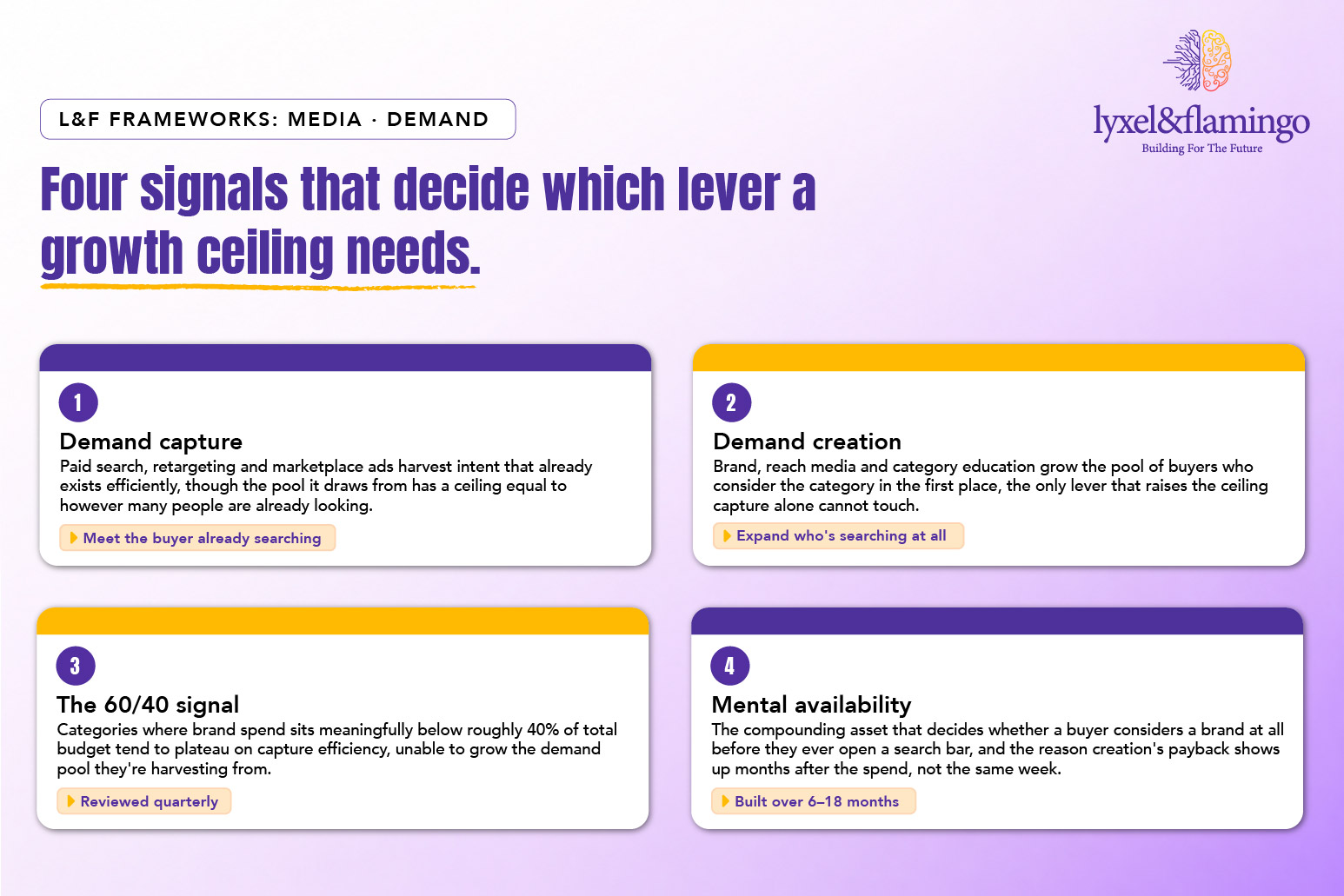
The Demand Creation vs Capture Model: four signals that decide which lever a growth ceiling needs
The Framework Explained
- Demand capture: Demand capture is the lever every performance dashboard is built to reward, and for good reason: it’s fast, measurable and directly attributable in a way that makes it easy to justify in any budget conversation. The mechanism is straightforward, meet a buyer at the exact moment they’re already searching, already comparing, already close to a decision, and convert that intent as efficiently as the auction dynamics allow. What a capture-only strategy cannot do, no matter how sophisticated the bidding or how tight the targeting, is create a single additional buyer who wasn’t already in-market. It’s a harvesting mechanism, extremely good at what it does, entirely dependent on the size of the field it’s harvesting from.
- Demand creation: Demand creation is the only lever capable of growing that field, and it works on a fundamentally different mechanism and timeline than capture does. A reach campaign, a piece of category-education content, a brand moment that lands with a new audience, doesn’t convert anyone directly in the way a retargeting ad does. It plants the specific, memorable association that determines whether that person thinks of the brand at all, months later, the moment they finally do develop the need this category solves. That delay is exactly why creation gets systematically under-funded relative to its actual importance: its payoff never shows up in the same reporting period as its spend, making it the easiest line item to cut when a budget review is looking for something to trim.
- The 60/40 signal: This ratio is less a rigid rule than a useful diagnostic for a specific, common failure mode: a brand pouring more and more spend into capture channels while wondering why CAC keeps climbing, without noticing that the underlying pool of searchers simply isn’t growing anymore. Categories where brand investment has drifted well below this rough threshold tend to show a specific signature, capture efficiency that used to improve now flatlining or reversing, because there’s no new demand left to capture more efficiently. Restoring some balance toward creation doesn’t show results in the next reporting cycle. It shows results two, three quarters out, as search volume for the category itself starts to grow again.
- Mental availability: Mental availability is the compounding asset underneath all of this, and it’s worth naming explicitly because it’s the variable that makes demand creation’s slow payback worth the wait rather than a sunk cost. A buyer with high mental availability for a brand doesn’t need to be captured through an elaborate funnel, they arrive already leaning toward that brand the moment a need appears, making the eventual capture campaign that reaches them dramatically cheaper and more efficient than one reaching a buyer with zero prior brand association. This is why the two levers aren’t actually in competition for the same budget, properly understood. Creation lowers the cost of every future capture campaign it precedes, an ROI that never shows up in the creation campaign’s own attribution, only in the capture campaign’s improving numbers months later.
A Real Rebuild for a Category With Almost No Existing Search Demand
Artize, a luxury bathware brand competing in a category most buyers never actively search for until a specific renovation moment arrives, needed its digital presence to do demand-creation work, not just capture work, since there was comparatively little existing search intent to efficiently harvest. L&F rebuilt the brand’s digital experience to match the refinement of the product itself, closing the gap between a genuinely premium physical offering and a digital presence that wasn’t yet building the same mental availability. The brief was explicitly about creating the category consideration a luxury, considered-purchase brand needs long before a search ever happens, the exact problem a capture-only strategy has no mechanism to solve. (L&F client work, luxury bathware, digital brand experience.)
Our Media services team plans and budgets demand-creation media as its own growth lever, measured on its own terms rather than folded into a weekly performance review.
Key Takeaways
- Demand capture meets existing intent efficiently, and it has a hard ceiling equal to however many buyers are already searching; every additional rupee past that ceiling chases increasingly marginal traffic.
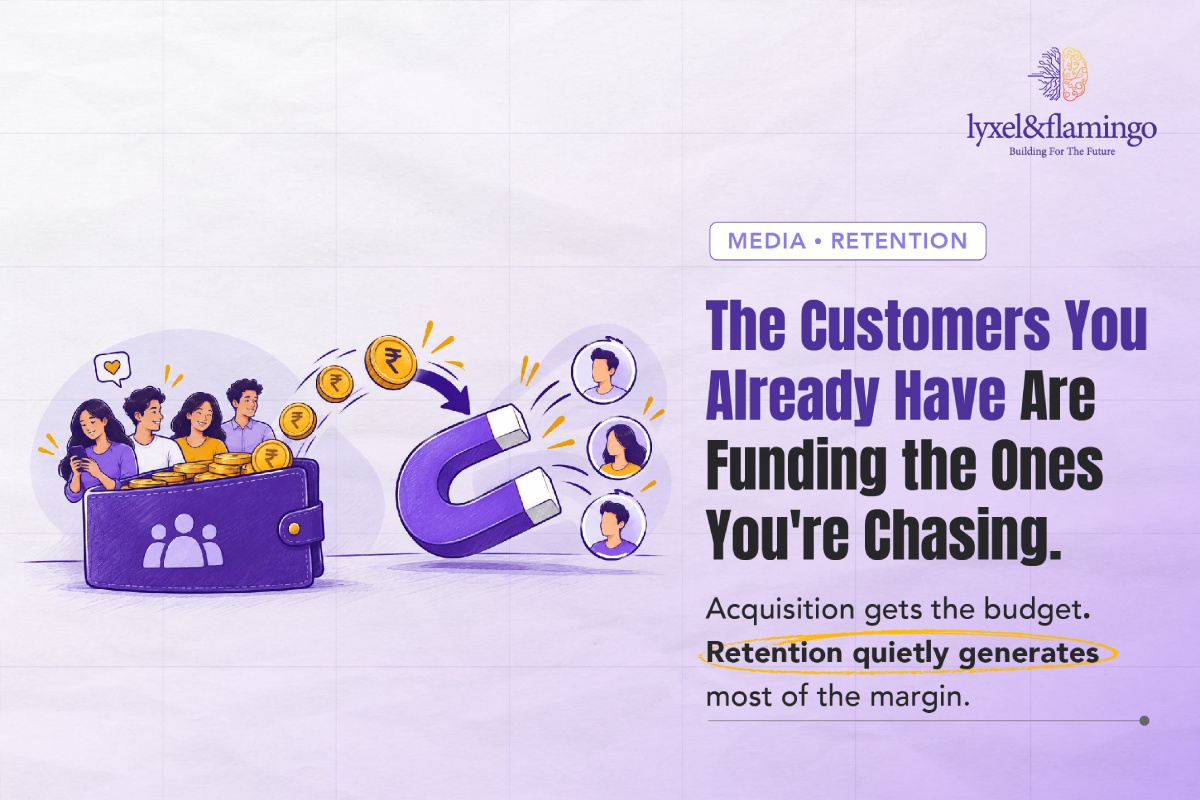
- Demand creation is the only lever that grows the size of the demand pool itself, and it’s systematically under-funded because its payback shows up months after the spend, not in the same reporting period.
- Categories where brand spend sits well below roughly 40% of total budget tend to show a specific signature: capture efficiency flatlining because there’s no new demand left to capture.
- Mental availability is the compounding asset that makes creation’s slow payback worth it: it lowers the CAC of every capture campaign that follows it, an ROI that shows up in capture’s numbers, not creation’s own.
- The Artize rebuild shows what demand-creation work looks like for a genuinely low-existing-search category: building mental availability before a search ever happens, not optimising a search that isn’t happening yet.
The CXO Takeaway
For a CXO watching CAC climb despite tighter targeting and better bidding, the uncomfortable, useful question is whether the ceiling is an execution problem or a demand-pool problem. Sharpening capture spend further cannot fix a demand pool that’s stopped growing. That fix requires funding a lever with a genuinely different, longer payback horizon, and defending that investment in a budget conversation built to reward only what shows up this week.
The Question to Sit With
The question worth sitting with isn’t how efficient your capture spend is. It’s whether the pool of buyers you’re capturing from is actually growing, or whether you’ve simply gotten very good at harvesting a field that’s stopped expanding.
Closing
Lyxel&Flamingo plans and budgets demand-creation media as its own measurable growth lever, not an afterthought funded from whatever’s left over. Want a clear read on whether your growth ceiling is an execution problem or a demand-pool problem? Start that conversation with L&F →
Frequently Asked Questions
The clearest signal is capture efficiency, CAC, ROAS, that used to improve steadily now flatlining or reversing despite continued or improved targeting and bidding discipline, with no obvious external cause like new competition.
Early-stage brands in categories with abundant existing search demand can often run capture-first successfully for a period. The ceiling tends to appear once that existing demand pool has been substantially harvested, which varies by category maturity.
Typically 6 to 18 months, showing up first as gradual growth in branded search volume, then as improving efficiency in capture campaigns that reach a more brand-aware audience.
No, it's a directional diagnostic, not a rule. The right ratio varies by category maturity and existing brand strength. It's still a useful check for whether a brand has drifted too far toward capture-only spending.
Not with identical metrics. It can still be measured properly: branded search volume growth, share of search, and brand-lift studies are all legitimate, trackable proxies, even though none convert as cleanly as a last-click attribution model.