
What This Blog Covers
Reallocating budget mid-campaign is a different decision than cutting it, and it needs a different trigger. Using a real app-growth case as the reference point, this covers when to move budget, how much, and how to do it without breaking a channel that’s actually still working.
Quick Answer: Reallocate when a channel’s marginal return drops below your next-best alternative for two consecutive reporting periods, not after a single bad week. Move 15 to 20 percent of the underperforming channel’s budget at a time rather than the full amount, so you can confirm the new channel absorbs it efficiently before committing further. This is a reallocation decision, not a budget cut. The total spend stays the same; only where it goes changes.
Table of Contents
Reallocation Is Not the Same Decision as Cutting
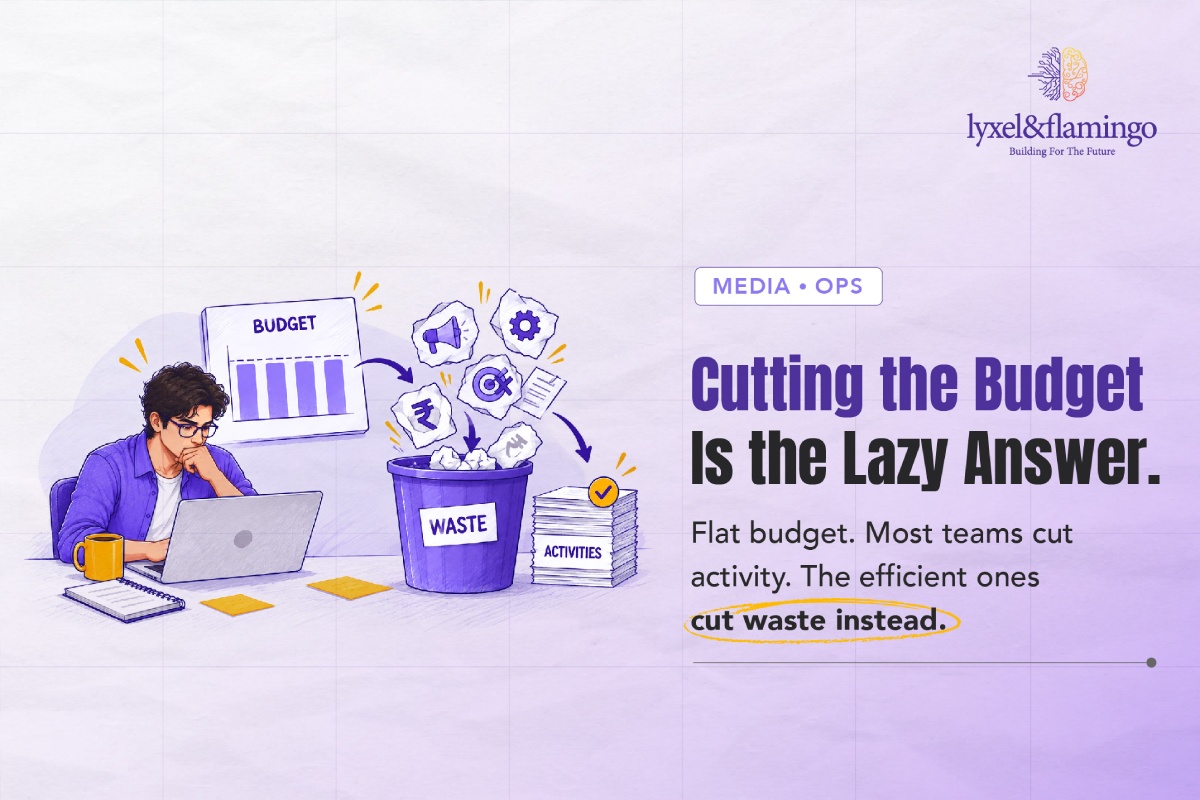
Cutting a channel’s budget is a defensive move, made when a team has lost confidence in a channel entirely. Reallocation is an offensive move: shifting budget toward whatever is currently returning more, while the total spend stays flat. These get treated as the same conversation in a lot of quarterly reviews, and that’s exactly why the discipline discussed in cutting the budget is the lazy answer matters here too: the lazy version of this decision is cutting the underperformer and calling it optimization, when the actual opportunity is moving that same money toward what’s working right now.
A growth-stage app or D2C brand mid-quarter has real-time signal on which channel is compounding and which has plateaued. Waiting for the formal quarterly review to act on that signal means leaving weeks of better-performing spend on the table. This is the same tension at the center of the 60/40 rule for balancing brand and performance budgets: the split only holds if someone is actually watching whether performance spend is still earning its share mid-quarter.
The Trigger: When to Actually Move Money
A single bad week isn’t a trigger. Auction dynamics, seasonality and even day-of-week effects can make one week look worse than it is. Two consecutive reporting periods of marginal return below your next-best channel is a more reliable signal, because it filters out noise while still acting faster than a quarterly cycle.
The second trigger worth watching is a channel hitting audience saturation, visible as rising CPMs alongside flat or declining conversion volume. That’s a structural signal, not a performance dip, and it usually means the channel needs a strategic pause rather than a budget trim.
What RupeeRedee’s Growth Curve Shows
App growth campaigns surface this problem faster than most categories because install cost and engagement data update daily, not weekly.
RupeeRedee’s engagement growth work with Lyxel&Flamingo is a useful reference precisely because a fintech app’s user acquisition funnel makes the cost of standing still visible almost immediately: a channel that’s stopped converting shows up in the engagement data within days, not at quarter-end.
Acting on that signal mid-quarter only works if the attribution feeding it is trustworthy, which is exactly the problem covered in attribution windows are lying to you during festive season.
The broader lesson translates well beyond fintech. Any brand running multiple paid channels simultaneously has the same real-time signal available. Most just aren’t set up to act on it mid-quarter.
The Mid-Quarter Reallocation Framework
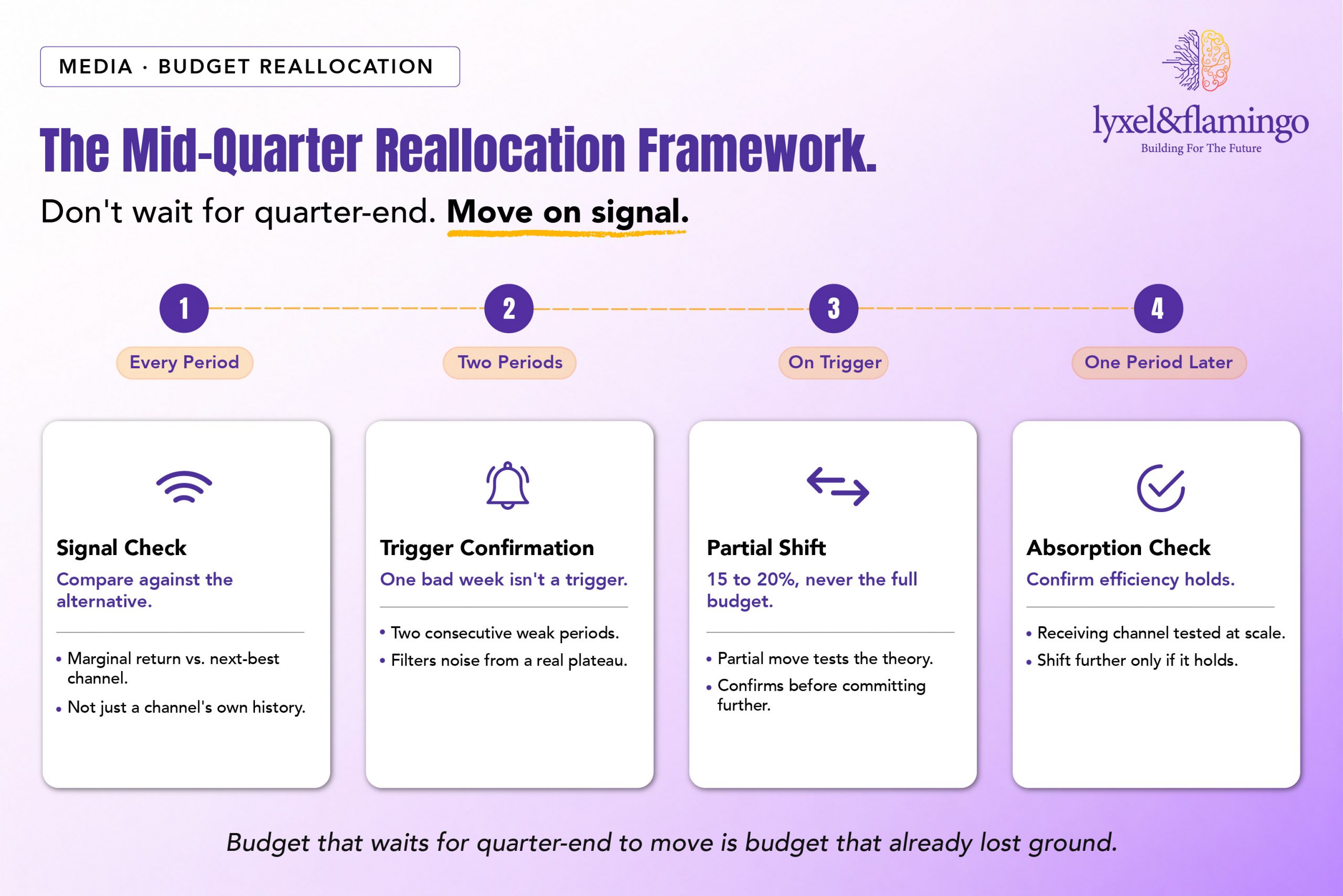
Framework Explained
- Signal Check: Comparing a channel only against its own past performance misses the real question, which is whether that budget would work harder somewhere else in the account right now.
- Trigger Confirmation: Two consecutive periods filter out the noise of a single unusual week while still acting well before a quarterly cycle would.
- Partial Shift: Moving the full budget at once risks overwhelming the receiving channel’s efficient scale; a partial shift tests the theory before committing the rest.
- Absorption Check: If the receiving channel’s efficiency holds at the new spend level, shift further; if it degrades, the plateau wasn’t really about the losing channel, it was about total addressable demand.
How Much to Move, and How Fast
The 15 to 20 percent partial-shift rule exists because most channels have a point past which additional spend stops converting at the same rate. Moving the full budget at once makes it impossible to tell whether a drop in efficiency came from over-saturating the new channel or from the reallocation decision being wrong in the first place.
A one-period absorption check between shifts is enough to catch a bad reallocation before it compounds, without slowing the response down to a quarterly pace. The same signal also feeds CPA campaign design at scale, since a channel absorbing new budget efficiently is a channel that is also holding its target CPA, not just its raw conversion volume. Watching brand search volume as a demand signal alongside the reallocation data helps separate a channel that is truly compounding from one simply riding a temporary demand spike.
Making the Case to Finance
Finance teams are usually more comfortable with a cut than a reallocation, because a cut has a clear, bounded cost. Reallocation asks them to trust that the same money will work harder elsewhere, which requires showing the marginal-return comparison, not just the underperforming channel’s own numbers in isolation.
The clearest way to make that case is showing the trigger and the partial-shift data side by side: what the losing channel was actually returning, what the receiving channel absorbed it at, and the net efficiency gain across the two periods.
Key Takeaways
- Reallocation and cutting are different decisions; reallocation keeps total spend flat and moves it toward better returns.
- The trigger is two consecutive periods of underperformance against the account’s next-best channel, not one bad week.
- Move budget in 15 to 20 percent increments and confirm absorption before shifting further.
- Real-time signal exists in most accounts already; the gap is usually process, not data.
CXO Takeaway
A marketing team that only reallocates budget at quarter-end is leaving compounding returns on the table for weeks at a time. Ask for the signal-check cadence in this framework, not just the quarterly reforecast.
If your team can name your best-performing channel this week, can they also name which one they’d move 15 percent of budget away from right now?
Talk to Lyxel&Flamingo about building a reallocation cadence that catches the moment a channel plateaus, not just the quarter it happened in.
Frequently Asked Questions
Reallocation keeps total spend the same and shifts it toward a better-performing channel. Cutting reduces total spend, usually as a defensive response to sustained underperformance with no clear alternative.
Two consecutive reporting periods where a channel’s marginal return falls below the account’s next-best alternative, rather than reacting to a single unusual week.
15 to 20 percent of the underperforming channel’s budget, confirmed to absorb efficiently in the receiving channel before shifting further.
Install cost and engagement metrics update daily rather than weekly, so a channel that’s stopped converting becomes visible within days instead of waiting for a full reporting cycle.