What This Blog Covers
India’s Digital Personal Data Protection Rules were notified in November 2025, and most obligations on businesses begin around 13 May 2027, with penalties of up to ₹250 crore for failing to keep personal data secure. This article explains what that timeline means for a D2C brand in practice, why consent now reaches every marketing touchpoint, and how breach response, retention and vendor contracts become board-level questions. It gives founders and CXOs a four-lock readiness model they can run with legal, technology and marketing teams, so the work starts now while there is time to sequence it properly and not rush it in the last quarter.
QUICK ANSWER: Under the DPDP Rules notified on 13 November 2025, consent-manager provisions begin around November 2026 and most business obligations, including notice, consent, security and breach reporting, begin around 13 May 2027. A D2C brand should map the personal data it holds, rebuild notices and consent at every touchpoint, secure its systems and rehearse breach response, and set retention and erasure rules. Penalties reach ₹250 crore for failing to take reasonable security safeguards, so start with security and consent.
Table of Contents
- What the DPDP Deadlines Mean for a D2C Brand Today
- The Consent Rebuild That Reaches Every Marketing Touchpoint
- Why Security Safeguards Carry the Largest Penalty
- The 72-Hour Breach Clock That Needs a Rehearsal Before It Starts
- What the Four-Lock Readiness Model Asks You to Do
- Framework Explained
- Why Retention and Erasure Are Marketing Decisions Too
- Key Takeaways
- The CXO Takeaway
What the DPDP Deadlines Mean for a D2C Brand Today
The Digital Personal Data Protection Rules were notified on 13 November 2025, and they switch on in three steps. The Data Protection Board provisions applied at notification, the consent-manager provisions follow about a year later, around 13 November 2026, and most obligations on businesses follow about 18 months after notification, around 13 May 2027. As of September 2026, one legal tracker found no notification shortening that period, after a proposal floated in January 2026. Plan to the May 2027 date and watch for any amendment.
The penalty ceilings explain why this belongs at the top of the agenda. The Act’s schedule sets up to ₹250 crore for failing to take reasonable security safeguards and up to ₹200 crore for failing to notify a breach or for breaching children’s data duties. Those are ceilings and not predictions, and the Data Protection Board decides each case. Even so, the size of the numbers moves the topic from the legal team’s desk to the leadership table.
Most of the work sits in places a lawyer does not control: your store, your apps, your ad pixels and your CRM. The guide to website security as a brand asset makes the case that security is a trust issue for the whole business, and DPDP turns it into a legal one. Marketing, technology and legal each hold part of the answer. None can finish it alone.
Start with one question for each team: what personal data do we collect, for what purpose, and who can see it? The answers form your data map, and every later step depends on it. Expect surprises: old forms, forgotten tools, exports in shared drives. Found by you, not a regulator.
The Consent Rebuild That Reaches Every Marketing Touchpoint
Under the Act, consent must be free, specific, informed and unambiguous, and the Rules require a clear notice in plain language before you collect data. That standard reaches sign-up forms, checkout, newsletter pop-ups, WhatsApp opt-ins, loyalty enrolment and every tracking script on your site. A pre-ticked box or a bundled consent no longer holds up. Each touchpoint needs its own purpose and its own record.
The shift also changes how you build audiences. The signal-based marketing playbook shows how consented first-party data, with server-side tracking, can replace cookie-dependent targeting and improve attribution at the same time. Consent becomes an asset because it gives you a legitimate match key. A brand with clean consent records keeps its targeting when others lose reach.
Cookies are not named in the Act, yet cookies and trackers that collect data about an identifiable person fall within its consent rules, according to legal commentary. Treat analytics, advertising and personalisation as separate purposes with separate choices. Offer a real way to refuse and an equally easy way to withdraw. Granular, and reversible.
Test the experience as a shopper would. Walk through sign-up, checkout and your first marketing message on a phone, and note every place where data is collected without a clear notice. Give your growth team a short list of changes to fix first. Each fix is also a trust signal.
Why Security Safeguards Carry the Largest Penalty
The highest ceiling, ₹250 crore, attaches to failing to take reasonable security safeguards, and Rule 6 sets out the minimum measures a business must put in place. That puts infrastructure squarely in scope. The argument in why security, servers and payments decide brand trust now has a legal edge, because the weakest link in your stack is also your largest exposure. Review the basics first: access controls, encryption, logging and vendor access.
The Rules also require businesses to retain logs and personal data for a minimum of one year for detection and investigation. That requirement sits beside the duty to erase data that is no longer needed, so retention needs an explicit design and not a default. Ask your technology team how long logs are kept today and who can read them. Do not assume the answer.
Third parties multiply the exposure. Every ad platform, analytics tool, review app, payment gateway and agency that touches customer data is part of your risk, and you remain responsible for the data you share. Build a vendor register with the data each party receives, the purpose and the contract terms. A short register beats a long argument after an incident.
People are the entry point for many breaches, so training counts as a safeguard. The risks described in the perils of social engineering apply to support teams, finance teams and agencies alike. Run short, regular awareness sessions and test them with simulated attempts. Security is a habit before it is a tool.
The 72-Hour Breach Clock That Needs a Rehearsal Before It Starts
Under Rule 7, a business must inform the Data Protection Board without delay when a personal data breach occurs, and provide detailed information within 72 hours of becoming aware. It must also inform each affected person. A 72-hour window leaves no time to decide who is in charge. Write the playbook before the incident, not during it.
A workable playbook names an incident lead, a legal contact, a technology responder and a communications owner. It defines how severity is judged, what evidence is preserved and who approves each message. It also lists the customers, partners and regulators you would need to contact. Keep it to two pages that people can use at midnight.
Your tracking set-up belongs in the plan. The approach in server-side tracking and CAPI in a privacy-first world gives you control over which events leave your systems and which identifiers travel with them. Less data in fewer places means a smaller breach surface and a simpler notice. Collect what the purpose needs, and no more.
Rehearse once before the deadline. Run a tabletop exercise with legal, technology, marketing and customer service, using a realistic scenario such as a compromised marketing tool. Time the response and write down every gap. A rehearsal turns the policy into muscle memory.
What the Four-Lock Readiness Model Asks You to Do
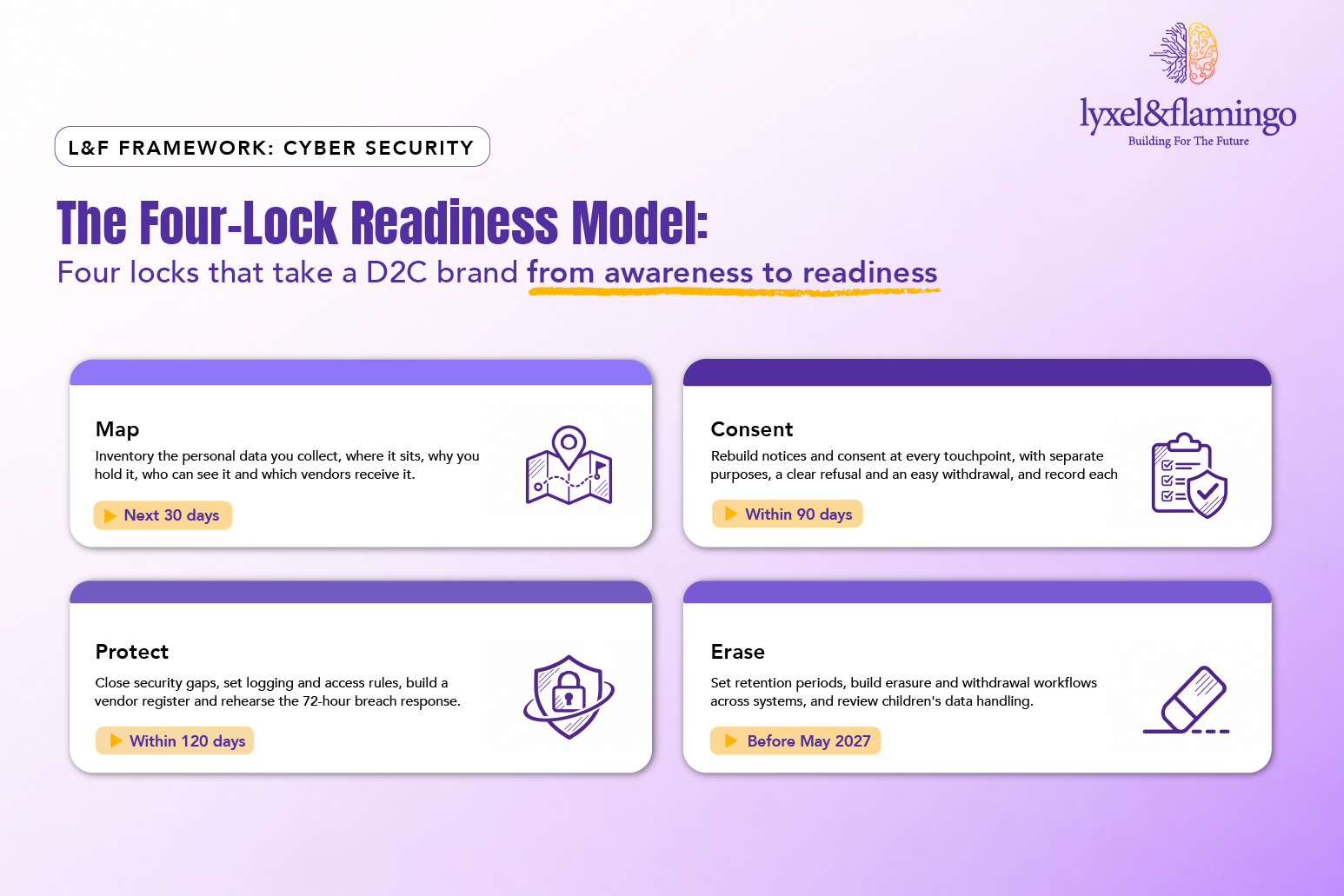
Four locks, closed in order, take a D2C brand from awareness to readiness. The cadences are a recommended plan, not a legal requirement.
Framework Explained
Map: Build the data inventory first, because every later step depends on it. Record what personal data you collect, through which forms, tools and integrations, why you hold it, who can see it, which vendors receive it and how long it stays. Include marketing tools, review apps, ad pixels and exports in shared drives. Expect surprises, and fix the ones that carry the most risk first.
Consent: Rebuild notices and consent at every touchpoint, from sign-up and checkout to WhatsApp and loyalty enrolment. Use plain language, a separate choice for each purpose, a clear way to refuse and an equally easy way to withdraw. Keep a record of what each person agreed to, and when. Test the flows on a phone, because that is where most of your customers meet them.
Protect: Close the security gaps that carry the largest penalty ceiling. Review access controls, encryption, logging and vendor access, and keep logs for the period the Rules require. Build a vendor register, and write a two-page breach playbook with named roles that fits the 72-hour window. Rehearse it once with legal, technology, marketing and customer service in the room.
Erase: Set retention periods for each data set and build erasure and withdrawal workflows that reach every system. One request can touch your store, CRM, email tool, support desk and ad platforms, so map the systems before promising deletion. Review children’s data handling, and apply the three-year inactivity rule if your user base reaches the threshold. Review the schedule every year.
Why Retention and Erasure Are Marketing Decisions Too
Data kept without a purpose is a liability. The Rules oblige businesses to erase personal data when consent is withdrawn or the purpose has been served, and the Third Schedule sets a specific rule for large e-commerce entities: those with two crore or more registered users in India must erase data after three years of inactivity, after giving the person 48 hours’ notice. Many D2C brands sit below that threshold, yet the principle applies to everyone. Decide how long each data set is needed.
A retention schedule needs one version of the truth about your customer data. A single source of truth for marketing data shows where customer records live and which teams can change them. Without it, an erasure request reaches one system and misses five others. Map the systems before you promise erasure.
Children’s data carries heightened duties under Rule 10, including verifiable parental consent for people under 18. If any part of your range or content attracts younger shoppers, review sign-up, marketing consent and personalisation for that audience. Decide now whether to restrict, verify or avoid the activity. The penalty ceiling for failing here is ₹200 crore.
Handled well, this becomes a commercial advantage. The customers you already have fund the ones you chase, and customers who trust how you treat their data stay longer and share more. Present the changes as part of the brand promise. A trust asset, not a cost.
Key Takeaways
- Plan to the May 2027 date for most obligations and watch for any amendment, since a proposal to shorten the period was floated in January 2026.
- The ₹250 crore ceiling attaches to security safeguards, so start with security and access.
- Consent must be specific and recorded at every touchpoint, from checkout to WhatsApp.
- A 72-hour breach window needs a written, rehearsed playbook.
- Retention and erasure need a data map first, because one request can touch many systems.
The CXO Takeaway
Ask your leadership team for three items within 30 days: a one-page map of the personal data you collect and where it sits, a list of the vendors that receive it, and the name of the person accountable for each. Put DPDP readiness on the board agenda beside security, with a milestone and a date for each lock. Fund the consent and breach-response work before the festive season, when traffic and data volumes peak. Ask legal counsel to confirm which obligations apply to your business and your user base. Make marketing a named participant, since consent and tracking sit in its stack. Review progress monthly until the May 2027 date.
Frequently Asked Questions
Yes, if you process digital personal data of people in India, the Act applies whatever your size. Some duties, such as the three-year erasure rule, apply only to large e-commerce entities with two crore or more registered users. Notice, consent and security safeguards apply to every business that decides why and how personal data is processed. Ask legal counsel to confirm how the Act applies to you.
The Act does not name cookies, yet cookies and trackers that collect personal data fall within its consent rules according to legal commentary. Treat analytics, advertising and personalisation as separate purposes and ask for consent for each before non-essential tracking starts. Offer a clear way to refuse and an equally easy way to withdraw. Confirm the exact design with legal counsel.
Under Rule 7, inform the Data Protection Board without delay, provide detailed information within 72 hours of becoming aware and inform each affected person. Preserve evidence, record the timeline and stop the cause of the breach. Prepare the playbook and the contact list before an incident, since 72 hours leaves little time to decide who leads. Rehearse the steps at least once.
Keep personal data only for as long as the purpose needs it, and erase it when consent is withdrawn or the purpose ends. Logs and associated data must be kept for at least one year for investigation under the Rules. Large e-commerce entities with two crore or more registered users face a three-year inactivity rule, with 48 hours’ notice before erasure. Set a retention schedule for each data set and review it yearly.