What This Blog Covers
Most D2C brands built a native app because everyone else did, then found that installs are expensive, retention is uneven and two codebases cost more than one. This article explains what has changed for progressive web apps in 2026, including web push on iPhone, why install friction decides who reaches your shoppers, and where a native app still earns its place. It gives a founder or CMO a four-part channel-fit scorecard that compares reach, return, capability and cost, so the choice between a PWA and a native app rests on your own data and not on habit or fashion.
QUICK ANSWER: A progressive web app is the better default for most D2C brands whose shoppers arrive through search, social and ads, because it removes the install step and runs from one web codebase. A native app earns its cost when you need deep device features, high repeat frequency or a loyalty programme that lives on the home screen. Score reach, return, capability and cost with your own data before you commit to either.
Table of Contents
- What Has Changed Since the Native App Became the Default
- The Install Wall That Keeps Most Shoppers Out of Your App
- Why a PWA Now Reaches Further Than Many Founders Assume
- The Capabilities Where a Native App Still Wins
- What the Channel Fit Scorecard Asks You to Score
- Why the Decision Belongs in Your Retention Plan, Not Your Technology Roadmap
- Key Takeaways
- The CXO Takeaway
What Has Changed Since the Native App Became the Default
For a decade, the native app was the default answer to mobile commerce, and many D2C brands built one before they knew who would install it. The default made sense when mobile websites were slow and the home-screen icon was the only way to earn repeat visits. Both conditions have shifted. A modern web app loads quickly, works on weak networks and sits on the home screen with its own icon.
On iPhone, the biggest change arrived with iOS 16.4 in March 2023, when Apple added push notifications and badges for web apps installed to the Home Screen. Installation is still manual on iOS, because there is no automatic prompt, and push works only after the shopper has added the site. Android has supported richer install and push behaviour for longer. The practical effect is that the web can now do most of what a retention channel needs.
The business question has moved as well. The comparison in App vs PWA: which delivers more value for your business frames the choice as value per rupee and not as features per platform, which is how a CMO should read it. A native app has to earn its install, its store listing and its second codebase, and a PWA has to earn its home-screen add. Neither is free.
Treat the app as an investment case and not as a brand statement. Ask what share of your traffic would ever install, what those installers would do that web shoppers cannot, and what the build and upkeep would cost. If you cannot answer, you are deciding on fashion. An expensive habit.
The Install Wall That Keeps Most Shoppers Out of Your App
Every app starts with a wall: the shopper must leave the page, find a store listing, wait for a download and open something new. Each step loses people, and the shoppers you lose are often the ones you paid to bring. A web experience has no such wall, because the first visit is already the product. For a brand that buys traffic, that difference is a cost-of-acquisition difference.
Run a friction audit on your own funnel before you design the app, so you know where shoppers already drop on the mobile web. If the drop sits in speed, forms or payment, an app does not fix it; a better web experience does. An app that copies a slow checkout is a slow checkout with an icon.
The strongest public evidence comes from India. Google’s published case study of Flipkart Lite, the company’s mobile web app, reported that shoppers who arrived through the Add to Home Screen icon converted 70% more than average users, spent 3.5 minutes on site against 70 seconds before, and used three times less data than the native app. The case dates from 2016 and the web platform has matured since, so read it as direction and not as a forecast for your store. It still shows why low-friction access matters where storage and data are scarce.
Measure your own wall. Compare installs with unique mobile visitors, then compare the install rate with the share of visitors who buy. The result tells you how many shoppers an app will ever reach. Small number, large bill.
Why a PWA Now Reaches Further Than Many Founders Assume
The patterns in why app UI/UX is not web UI/UX explain why a web app must be designed for thumbs, speed and short sessions, and why a copied desktop layout fails. A PWA is judged on those same patterns, so the design work carries across. That is a saving, because one team and one design system serve both the browser and the home screen. A compounding saving.
A PWA is installable from the browser, can work with limited connectivity through caching, and can send push notifications once installed. It is also discoverable by search, which a store listing is not, since every page has a URL a crawler can read. For a brand that relies on organic and paid web traffic, that discoverability is a growth channel. A native app has no equivalent.
Build and upkeep matter as much as reach. One web codebase serves every device, and an update ships the moment you publish it, with no store review. A native app needs an iOS build, an Android build, a release process and a review cycle. Standing costs, all of them.
Fit the choice to the shopper and not to the platform. The way personas reshape website UI/UX shows how different shopper groups use the same screen in different ways, and that applies to install behaviour too. A price-led shopper arriving from an ad rarely installs anything, while a loyal repeat buyer is the likely installer. Design the channel for the segment you most need to retain.
The Capabilities Where a Native App Still Wins
A native app still wins where the product depends on the device or on constant presence. Deep hardware access, such as Bluetooth devices, advanced camera features or background location, remains stronger on native. A food, grocery or subscription brand with daily use cases gains from a home-screen presence that a shopper opens without thinking. These are real advantages, and they belong in the scorecard.
App stores also carry distribution and trust. A store listing is a discovery channel for some categories, and a store rating works as a public proof point. The cost is that the stores set the rules, the review timelines and the fees on in-app purchases. Treat those terms as part of the cost of the channel.
If your roadmap needs both a fast web storefront and a rich app, the architecture decision comes first. The trade-offs in headless commerce for enterprises show how one commerce backend can serve a web front end, an app and other channels. Decoupling adds cost and complexity, so justify it with a plan and not with enthusiasm. Architecture first, channel second.
Be honest about frequency. An app earns its place when shoppers return often enough to justify the icon, and most D2C categories buy a few times a year. A brand with low purchase frequency spends heavily to occupy a home screen that stays quiet. Match the channel to the rhythm of the category.
What the Channel Fit Scorecard Asks You to Score
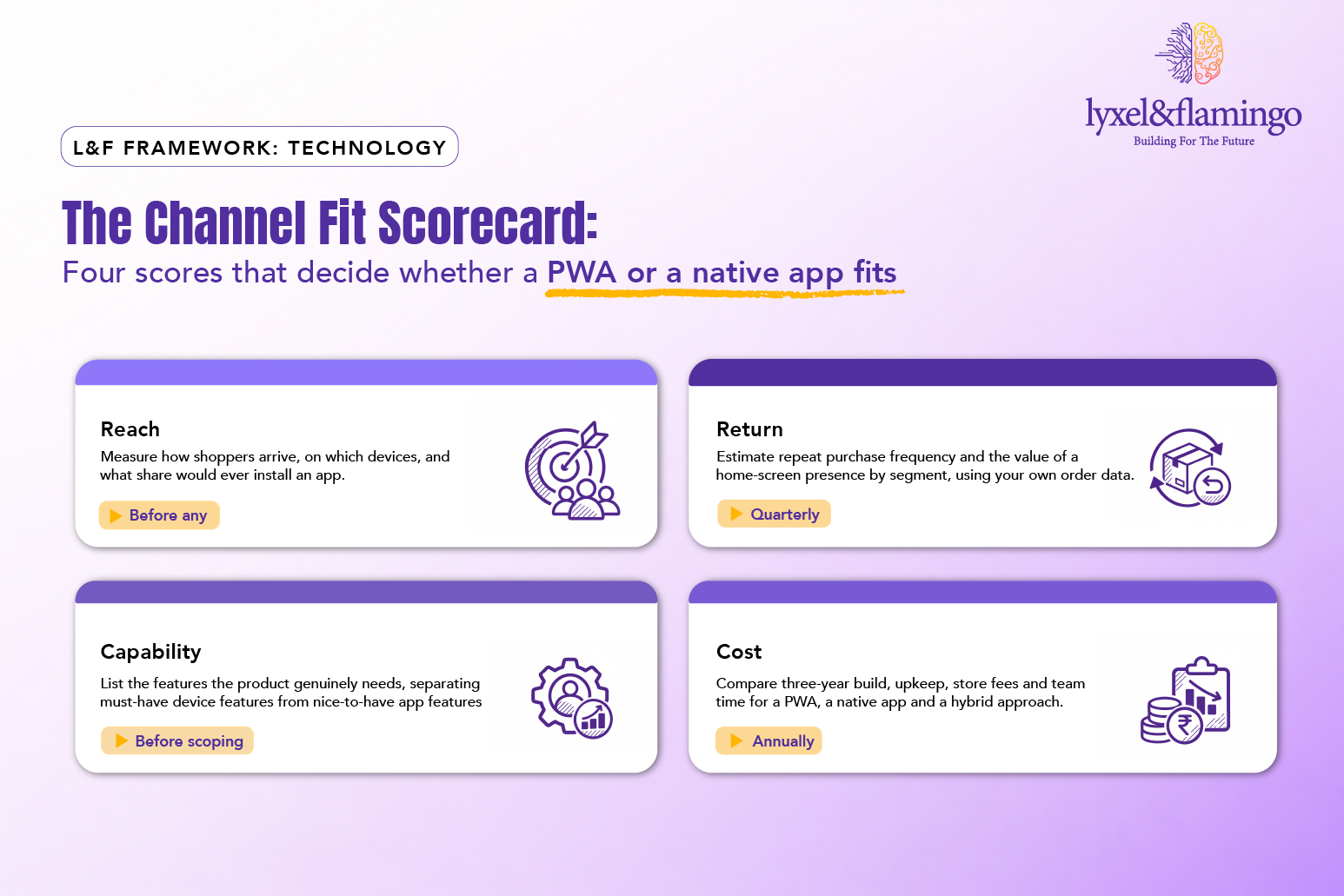
Four scores, taken in order, decide whether a PWA, a native app or both fit your brand. The cadences are a recommended working pattern.
Framework Explained
Reach: Start with how shoppers actually arrive. Break traffic into search, social, paid, email and direct, split by device and by new versus returning, and estimate what share would ever install an app. A brand whose growth comes from ads and search to first-time buyers gains reach from a web experience, while a brand fed by loyal repeat buyers can justify an app. Let the numbers set the question.
Return: Estimate how often each segment buys and what a home-screen presence is worth to it. Use your own order data to calculate purchase frequency, time between orders and repeat rate by cohort. A category with habitual purchase gives an icon real value, and a category with one or two purchases a year does not. Put a rupee value on a returning shopper before you price the channel.
Capability: List the features the product needs, and separate must-haves from preferences. Device features such as Bluetooth pairing, advanced camera use or background tasks point to native, while push, installability and offline browsing are available to a PWA. Hold each requested feature to one test: which shopper behaviour does it change, and what is that change worth? Cut the rest from scope.
Cost: Compare three-year ownership for a PWA, a native app and a hybrid approach. Include build, maintenance, store fees, release management, testing across devices and the team that supports each, and add the opportunity cost of delay. Present the comparison to finance in one table, so the choice rests on a number and not on enthusiasm.
Why the Decision Belongs in Your Retention Plan, Not Your Technology Roadmap
The channel decision is a retention decision. Decide first how you want shoppers to come back, whether by push, email, WhatsApp or a loyalty programme, then choose the technology that supports it. A PWA with web push and a strong email programme covers many brands, while a subscription or loyalty-led brand can need more. Plan the return path before you plan the build.
Measurement keeps the decision honest. Before launch, agree the events that matter and track them the same way across web and app, as set out in how correct tracking proves your UI/UX is working. Without shared events, you will compare two channels on two definitions. Define success once.
Pilot before you commit. Add install prompts and push to the web experience, measure opt-in and repeat purchase for 60 to 90 days, and compare the result with your app assumptions. The pilot costs a fraction of a native build and gives you your own evidence. Evidence, not opinion.
Keep optimising the web layer either way. The testing discipline in Shopify conversion optimisation applies to a PWA as much as to a storefront, and every gain on the web carries into the home-screen experience. A strong web base lowers the risk of any later app. Build the foundation once.
Key Takeaways
- A PWA is a sound default for brands whose shoppers arrive through search, social and ads, because it removes the install step.
- Web push now works on iPhone for home-screen installs, so a PWA can serve as a retention channel.
- A native app earns its cost with deep device features, high purchase frequency or a loyalty programme that lives on the home screen.
- Score reach, return, capability and cost with your own data before you commit to either channel.
- Pilot web push and install prompts for 60 to 90 days before you fund a native build.
The CXO Takeaway
Ask your product and growth leads for three numbers before any app budget is approved: the share of mobile visitors who would install, the repeat purchase rate of the segment you want on the home screen, and the three-year cost of owning a native app. If any answer is missing, the proposal is a preference and not a plan. Fund a 60 to 90 day PWA pilot with web push and install prompts first, and judge it on repeat orders. Put web and app on one measurement framework, so results are comparable. Name one owner for the channel decision, ideally inside the retention plan. Revisit the decision once a year, since browser capabilities keep moving.
Frequently Asked Questions
Usually, because one web codebase serves every device and updates ship without store review. A native app needs separate iOS and Android builds and a release process for each. The saving depends on how much custom device functionality you need. Compare three-year ownership cost, not build cost alone.
Yes, from iOS 16.4 onwards, though only after the shopper adds the site to the Home Screen. A normal Safari tab cannot send push. Because iOS gives no automatic install prompt, you need clear in-page guidance that shows shoppers how to add the site. Plan the opt-in journey as carefully as the notification content.
No, you can run both. The real test is whether a native app earns its cost. Some brands start with a PWA and add a native app once repeat behaviour justifies it, while others keep the PWA permanently and use the saving elsewhere.
Track home-screen add rate, push opt-in rate, repeat purchase rate and conversion for home-screen visits against browser visits. Set the baseline before launch and run the pilot for 60 to 90 days. Compare the results with the assumptions in any app business case, and share one scorecard so finance sees both channels on the same terms.