What This Blog Covers
India’s D2C brands routinely lose 15-20% of potential revenue in the narrow stretch between cart and payment confirmation, driven by payment-method mismatches, form friction, weak trust signals, and slow mobile checkout. Fixing this “checkout leak” is less about redesigning the funnel from scratch and more about auditing it line by line: which payment methods are missing, which fields ask for too much, and where mobile shoppers give up. Brands that treat checkout as a revenue-leak audit, not a one-time build, recover margin faster than any new acquisition channel can deliver it.
Quick Answer: Checkout drop-off in Indian D2C typically stems from four fixable leaks: a payment mix that does not match how India actually pays (UPI, COD, wallets), forms that ask for more than a mobile shopper will tolerate, missing trust signals at the exact moment a stranger is about to hand over card details, and mobile checkout speed that lags the rest of the site. Auditing these four in that order, rather than rebuilding the whole funnel, recovers revenue the fastest.
Table of Contents
The Real Cost of a Silent Leak
Most D2C teams track conversion rate as one number, top of funnel to purchase. That single metric hides where the buyer actually gave up. A brand can be excellent at driving traffic and mediocre at holding onto it in the last sixty seconds, and the blended number will never say so directly.
The scale of the problem is well documented. Across global e-commerce, only 1.6% of sessions convert to a completed order, and a large share of that loss happens after the buyer has already decided to purchase, at the cart and checkout stage rather than earlier in discovery. That is the expensive kind of drop-off: the customer wanted the product. Something in the last mile talked them out of it.
For an India D2C brand spending real money on performance media, this is the highest-leverage place to look before the next campaign brief gets written. Recovering a fraction of checkout drop-off is, in effect, free revenue on traffic already paid for.
Leak One: Payment Method Mismatch
India does not pay the way a default Shopify checkout assumes. UPI, the real-time payment rail governed by the National Payments Corporation of India, now accounts for the majority of digital retail transactions in the country, and a checkout that buries UPI behind a generic “online payment” button, or omits it entirely, is asking a large share of buyers to work harder than they will.
Cash on delivery still matters too, particularly for first-time buyers in tier-2 and tier-3 markets who have not yet built trust with a new D2C brand. Removing COD to protect margin is a legitimate strategy, however doing so without replacing it with a lower-friction alternative, such as a small prepaid discount or a trusted wallet option, simply moves the lost sale to a competitor who still offers it.
The fix starts with data, not opinion: pull the payment method split from GA4 or the payment gateway dashboard, compare it against the options actually surfaced at checkout, and close the gap. Guides to improving website conversion rate consistently flag payment variety as a top-three lever, ahead of most design changes.
Leak Two: Form Friction
Every additional field on a checkout form is a small tax on intent. A shopper who has already decided to buy will tolerate name, address, phone, and payment. Anything beyond that, an optional company name field, a mandatory account creation step, a CAPTCHA that fails on the first try, gives an already-committed buyer a reason to reconsider.
Auto-fill is the cheapest win available. Pin code should populate city and state automatically. Saved addresses should persist across sessions for returning buyers. Guest checkout should be the default, not a buried link beneath a forced sign-up form.
The test is simple: time how long it takes a new team member, unfamiliar with the product, to complete checkout on a mid-range phone. If it takes more than 90 seconds, the form is the leak.
Leak Three: Missing Trust Signals
The moment before a stranger enters card details is the single most trust-sensitive point in the entire customer journey, and it is also where many D2C storefronts offer the least reassurance. No visible return policy. No real delivery date. No security badge near the payment field. No way to reach a human if something goes wrong.
This matters more, not less, for newer and challenger brands without decades of category trust behind them. Established players borrow trust from brand recognition. A two-year-old D2C label has to build it into the page itself, in the specific ninety seconds before payment.
Practical fixes include a visible SSL/security marker beside the card entry field, a one-line return and refund policy directly on the checkout page rather than buried in a footer link, and a real, dated delivery estimate rather than a generic “5-7 business days.” The Baymard Institute’s checkout usability research has documented these exact trust-signal gaps as a recurring cause of abandonment across markets, not just an India-specific pattern. Interface-level trust cues are increasingly central to conversion design, as covered in Lyxel&Flamingo’s look at AI-first UX for D2C and B2B brands.
Leak Four: Mobile Checkout Speed
Most Indian D2C traffic is mobile, much of it on mid-range devices and inconsistent 4G rather than office wifi. A checkout that was tested and approved on a laptop can still be unusably slow on the connection most customers actually have.
Every extra second of load time at checkout compounds the effect of every other leak on this list. A slow page makes form friction feel worse, makes a missing trust signal feel more suspicious, and gives an undecided buyer more time to close the tab and compare a competitor on a marketplace instead.
The fix is technical and unglamorous: compress checkout-stage assets, defer non-essential scripts until after payment, and cut the step count to two screens wherever the platform allows it. Full-funnel conversion audits that include real-device mobile testing, not just desktop QA, catch this leak before it shows up as a quarter of missed revenue.
Running the Audit, Not the Redesign
The instinct when checkout underperforms is to commission a full redesign. That is usually the wrong first move. A redesign takes months, ties up the product and design team, and often reintroduces new friction the team cannot yet see. An audit takes days and tells the team exactly which of the four leaks above is doing the most damage, in order.
Start narrow: pull 90 days of checkout-stage drop-off data, segment it by device and payment method, and map every abandon point against the four leaks. Fix the single biggest leak first, measure for two weeks, then move to the next. This sequence protects the team from redesigning parts of the funnel that were never actually broken.
The Checkout Leak Audit Framework
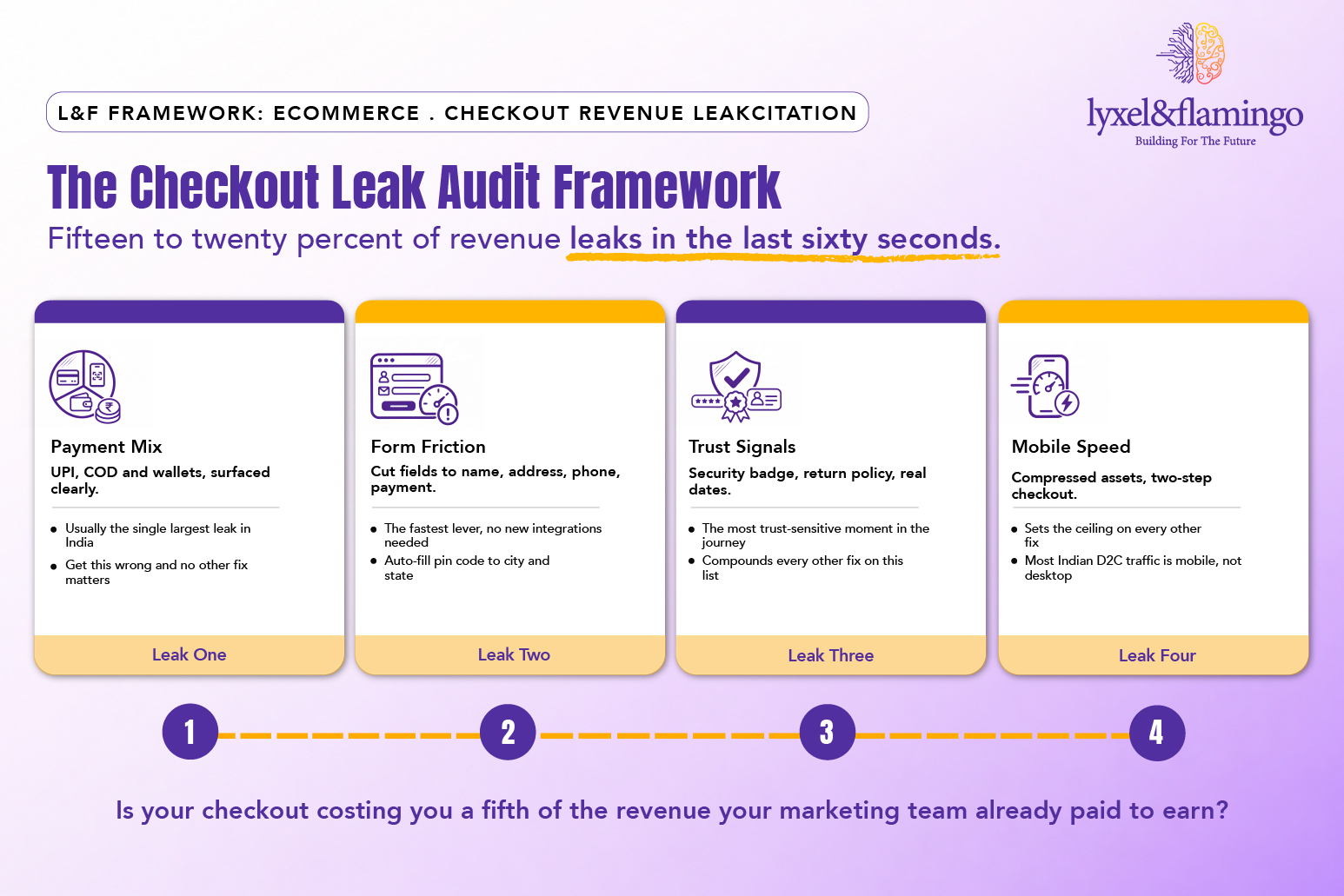
Framework Explained
Payment Mix: Decides whether the buyer can pay at all in the way they trust; get this wrong and no other fix matters.
Form Friction: Is the fastest lever to pull because it usually requires no new integrations, only removing fields.
Trust Signals: Compound every other fix; a fast, simple checkout with no reassurance still loses hesitant first-time buyers.
Mobile Speed: Sets the ceiling on everything above it, since a slow page erodes patience for even a well-designed form.
CAPABILITY NOTE: Lyxel&Flamingo’s technology team runs conversion-focused audits across D2C storefronts, including Shopify and Shopify Plus builds, diagnosing exactly this kind of checkout-stage drop-off as part of ongoing technology and UX engagements. We do not have a published case study isolating checkout-recovery numbers alone at the time of writing, so this is flagged as a working capability rather than a proven-result claim.
Key Takeaways
- 15-20% of D2C revenue commonly leaks between cart and payment, concentrated in four fixable areas.
- Payment method mismatch, especially missing or buried UPI, is usually the single largest leak in the Indian market.
- Form friction and weak trust signals compound each other; fixing one without the other caps the recovery.
- Mobile checkout speed sets the ceiling on every other fix, since most Indian D2C traffic is mobile.
- An audit that fixes leaks in order beats a full redesign on both speed and risk.
CXO Takeaway
Is your checkout costing you a fifth of the revenue your marketing team already paid to earn? Before the next campaign budget gets approved, an honest audit of the four leaks above usually pays for itself inside a single sales cycle. Lyxel&Flamingo’s technology and website team builds and audits D2C storefronts for exactly this kind of recovery.
Frequently Asked Questions
Industry patterns commonly point to a 15-20% loss between add-to-cart and completed payment, though the exact figure depends on category, price point, and how mobile-heavy the traffic mix is.
For most new and challenger D2C brands, yes, particularly outside metro markets where trust with a new brand takes longer to build. Removing COD works best alongside a prepaid incentive, not as a standalone cut.
Reducing form fields to the essentials (name, address, phone, payment) with auto-fill enabled, since it requires no new integrations and can often be shipped within days.
Quarterly at minimum, and immediately after any platform migration, payment gateway change, or major traffic-source shift, since each can silently reintroduce friction.