What this blog covers
Quick commerce has taught Indian shoppers to expect delivery in minutes, and D2C brands shipping in days now compete against a promise that is hard to match everywhere. This playbook shows where a 30-minute edge pays, how four delivery models trade speed, control and cost, and which inventory moves make a fast promise credible. Founders and operations directors get the Local Speed Ladder: Promise, Place, Partner, Prove, turning speed into a margin-aware decision instead of an arms race with platforms running thousands of stores.
Table of Contents
- What quick commerce has changed about delivery expectations
- The catchment maths that decide where speed pays
- Why your delivery model is a margin decision
- The inventory moves that make a fast promise credible
- Your D2C rapid delivery fulfillment strategy: the Local Speed Ladder
- The framework explained
- Prove the edge before you scale it
- Key takeaways
- The CXO takeaway
Competing with ten-minute delivery takes one thing: a delivery promise you can keep, in the few catchments where speed changes the order.
Quick answer: A smart D2C rapid delivery fulfillment strategy competes with quick commerce by offering a 30-minute promise only where demand is dense, repeat purchase is high and stock can sit close to the shopper. Choose the delivery model by speed, control and cost to serve, place inventory by catchment, and prove the edge through conversion, repeat rate and cost per order before you scale.
What quick commerce has changed about delivery expectations
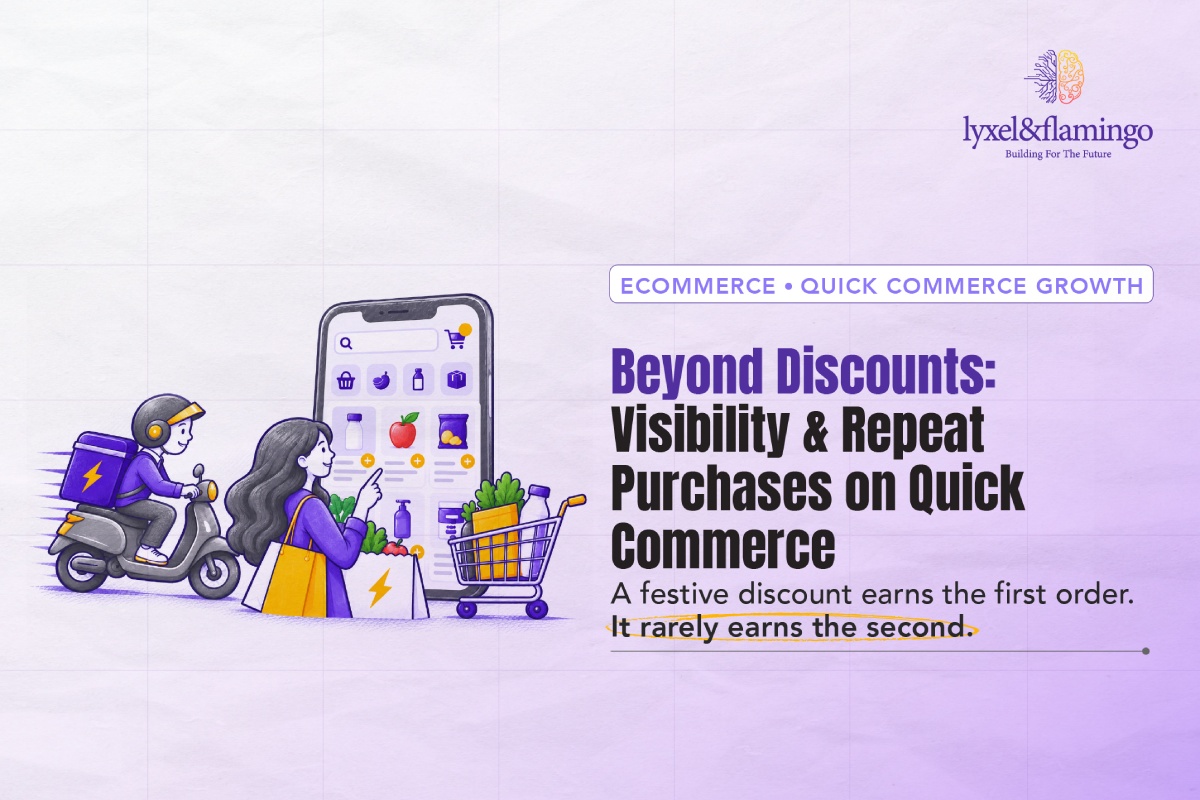
Quick commerce has reset what “fast” means in Indian cities. Platforms run small neighbourhood fulfilment centres, dark stores, that typically hold 800 to 2,500 products and sit close enough to homes to deliver in minutes. Shoppers who get groceries in ten minutes start expecting speed from every brand. Delivery time is now part of the category.
The network behind that expectation keeps growing. Business Today’s deep dive on dark stores tracks the race, and industry trackers put Blinkit, Instamart and Zepto together at over 5,000 dark store locations by mid-2026. The quick commerce market is forecast to grow around 40% in 2026. A D2C brand wins with a different footprint: focused, dense and profitable.
The smarter question: where does speed change behaviour? Our quick commerce marketing guide explains why shoppers on these apps choose from the first few products shown. Speed wins impulse and replenishment orders. Considered purchases follow different rules.
Start with the order, then the warehouse. Which products are bought on impulse or on repeat, in which cities, how often? If that is a small share of revenue, the 30-minute edge is a niche play. Size it like one. Fast, only where it counts.
The catchment maths that decide where speed pays
Speed pays where orders are dense. A fast promise needs enough orders per hour inside a small radius to keep riders, pickers and stock productive, and that density exists in a handful of neighbourhoods per metro. Spread across a whole city, every order carries the cost of an empty vehicle. Concentrate, and cost per order falls.
Use your own order data to find those pockets. Rank pin codes by orders, repeat rate and average basket, then check how much volume already flows through platforms. Reading the signal when quick commerce cannibalises other channels shows how a rise on one channel can hide a fall on another. Know what you are shifting before you invest.
Then price the promise. Cost to serve includes picking, packing, last mile, returns and the stock held closer to demand. Set it against the order margin and the value of the repeat purchase it earns. A fast promise on a low-margin, low-repeat product is a subsidy.
Lock a catchment threshold before committing: minimum weekly orders, minimum repeat rate, maximum cost to serve. Review it quarterly as platforms add stores. Small list. Firm rules.
Why your delivery model is a margin decision
Every fast-delivery model trades speed, control and cost. A platform listing gives the fastest reach in covered pin codes, while the platform owns the shelf, the customer relationship and the ad auction. Out-of-stock products lose their place, as availability as marketing lays out. Your fulfilment plan and your media plan are one plan.
A hyperlocal partner or dark-store-as-a-service provider gives speed within a radius on flexible terms, billed per order or per stored unit. Ship-from-store turns stores or partner retailers into mini-warehouses, ideal for brands with an offline presence. Both keep more customer control than a platform listing, with more operational work attached. Choose by capability, ahead of headline speed.
Four ways to offer a fast promise: trade-offs for a D2C brand
Own micro-fulfilment delivers the most control and the highest fixed cost. It earns its keep only where a catchment has dense, repeat demand and a range narrow enough to hold close to the shopper. Pilot one site. Learn one lesson.
Peak season tests every model. Festive inventory and availability planning shows how stock cover decides who stays visible when demand spikes. Decide in advance which stores or partners hold deeper cover for festive weeks. Plan for the peak.
The inventory moves that make a fast promise credible
A fast promise is only as strong as the stock behind it. Place a narrow range of high-velocity products near dense demand and hold the long tail centrally. Platforms cap dark-store ranges for the same reason: shelf space near the shopper is expensive. Choose your fast range like a retailer.
Replenish on a rhythm, ahead of alarms. Dark stores are typically topped up from central warehouses several times a day, and a D2C brand can run a similar cadence per catchment at smaller scale. Set minimum cover by product and catchment, and review weekly.
Allocate stock with a rule. The logic in festive inventory and buy-box strategy works at smaller scale too: reserve stock for the channel and catchment where it earns the most, release the rest on schedule. A rule written in advance beats a decision made mid-stock-out.
Show the promise honestly. Display delivery times by pin code with a clear cut-off, because a missed 30-minute promise costs more trust than a slower promise kept. Track promise compliance from day one. A kept promise is the product.
Your D2C rapid delivery fulfillment strategy: the Local Speed Ladder
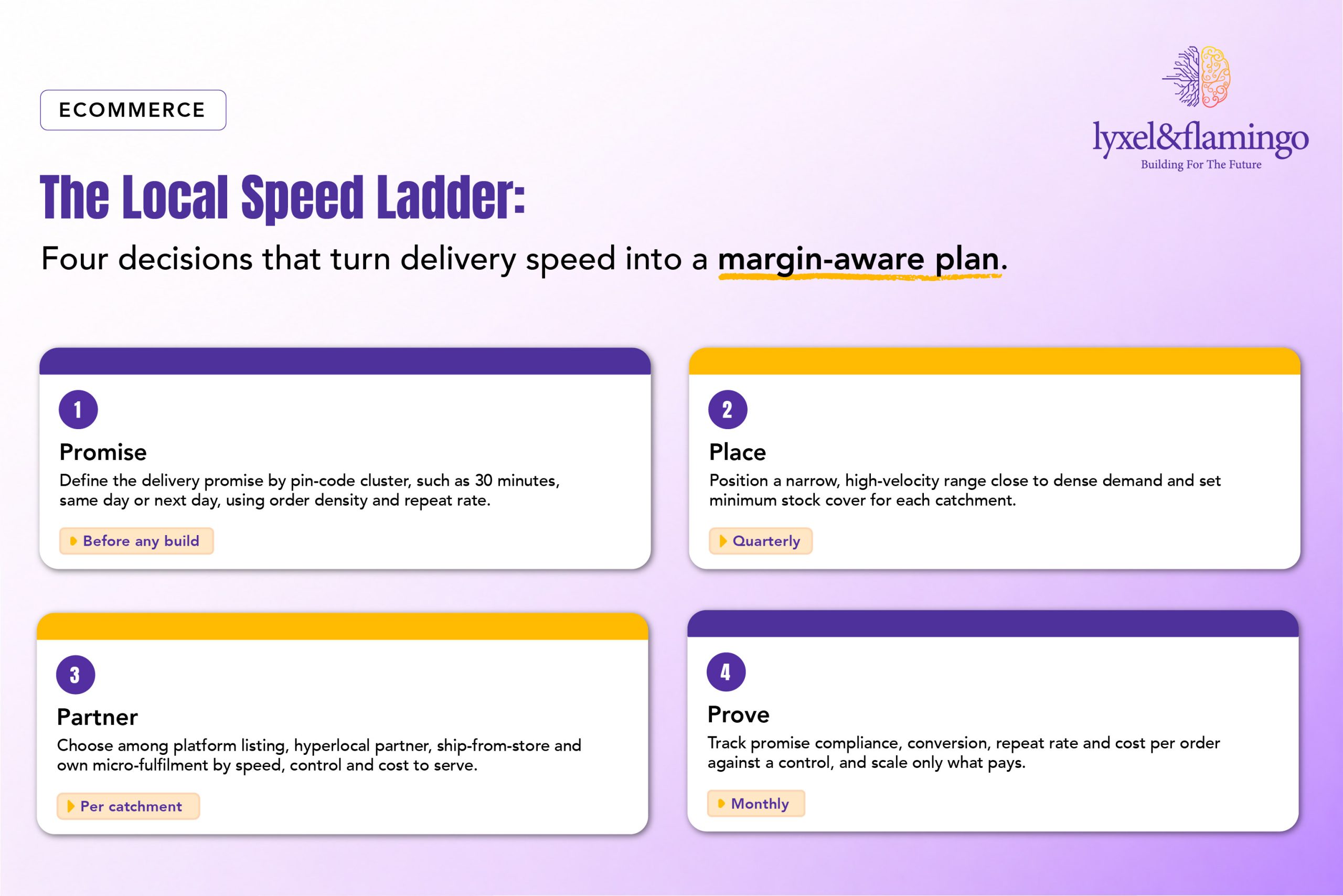
Four decisions, taken in order, turn delivery speed from a slogan into a margin-aware plan.
The framework explained
Promise: Decide what you will promise, and where, before you build. Rank pin codes by order density, repeat rate and basket, then match a promise to each cluster: 30 minutes in the densest, same day in the next tier, standard elsewhere. Set the promise from capacity, and let ambition follow.
Place: Put a narrow, high-velocity range close to dense demand and keep the long tail central. Set minimum cover by product and catchment, replenish on a fixed rhythm and review fast-range stock-outs weekly. The goal is a credible network where speed changes the order.
Partner: Choose the delivery model catchment by catchment. Compare platform listing, hyperlocal partner, ship-from-store and own micro-fulfilment on speed, customer control and cost to serve. Ask each partner for promise-compliance data and data-access terms. Use the lightest model that keeps the promise.
Prove: Run each catchment as an experiment. Compare exposed shoppers with a control on conversion, order value, repeat rate and cost per order over at least two purchase cycles, counting stock, returns and management time. Scale what pays, narrow what struggles, and report one page to leadership every month.
Prove the edge before you scale it
Treat the first 30-minute catchment as an experiment with a control group. Compare conversion, order value and repeat rate for shoppers who see the fast promise against a similar control group, across two purchase cycles. The result tells you what speed is truly worth.
Value the edge in retention. The customers you already have fund the ones you are chasing, and fast delivery can lift their repeat purchase. A fast first order is welcome. A faster second order is the return. Brands like Kimirica show how much of D2C growth rides on repeat customers.
Count the full cost: stock held closer to demand, markdown risk, returns and management time. Set the total against margin and repeat value. When the sum turns negative, narrow the catchment or change the model.
Report speed to leadership with a short scorecard, promise compliance, conversion, repeat rate and cost per order, in the style of the marketplace KPIs every CXO should track. Put it beside the platform channels you already run. One page. One decision.
The Lyxel&Flamingo marketplace and quick commerce team helps D2C brands decide where to compete on speed and where to let platforms carry the load, alongside high-conversion funnels on Blinkit, Zepto and Instamart.
Key takeaways
- Quick commerce has made delivery speed part of the category. Decide where speed changes the order.
- A 30-minute promise pays in dense catchments with high repeat purchase.
- Platform listing, hyperlocal partner, ship-from-store and own micro-fulfilment each trade speed, control and cost differently.
- Place a narrow, high-velocity range near demand and keep the long tail central.
- Prove the edge with a control group before you scale it.
The CXO takeaway
Ask your operations director for a one-page catchment table: pin codes ranked by orders, repeat rate, average basket and current delivery time. Mark the five where a faster promise would change behaviour, and cost the promise per order. Pilot one catchment with a control group for two purchase cycles, with a stop rule agreed upfront. Make one leader accountable for the promise across operations, marketing and customer service.
The question to carry into your next review: in which five pin codes would a faster promise change what your customers buy?
Start the conversation with Lyxel&Flamingo and we will help you find them.
Frequently Asked Questions
Yes, in a limited number of dense catchments and with the right partner. A hyperlocal delivery partner or ship-from-store model delivers speed on flexible terms, catchment by catchment. Start with one catchment and a narrow range, and test the result before widening it.
Listing gives fast reach in covered pin codes, while the platform owns the shelf, the data and the ad auction. Many brands use platforms for reach and build their own promise where they want the customer relationship. Compare commission, ad cost, fill-rate obligations and data access with your own cost to serve, catchment by catchment.
Pick products with high order velocity, steady repeat purchase and a size and shelf life suited to hyperlocal handling. Leave out slow movers and high-return items. Review the range monthly using sell-through and stock-out data by catchment.
Track promise compliance, conversion, repeat rate, order value and cost per order for exposed and control groups, plus stock-out rate on the fast range. Read results over at least two purchase cycles, because the return from speed shows up in repeat orders.
Set the return policy and pick-up or drop-off route before launch, since a fast outbound promise raises expectations on returns too. Count returns in cost to serve, track them by catchment and offer simple options like a pick-up window or partner drop point.