
What this blog covers
What the Meta Pixel and the Conversions API (CAPI) actually do, why client-side tracking alone is no longer enough, and a practical model: the Pixel Feedback Loop that turns event data into design and creative decisions rather than leaving it to optimise ad delivery in the background.
Table of Contents
Pixel and CAPI, defined: client signal and server signal
The Meta Pixel is a piece of code on your website that records user actions, page views, add-to-carts, and purchases from the browser. The Conversions API (CAPI) does the same job from your server, sending events directly rather than relying on the browser. Together they give you two views of the same behaviour: the pixel captures what happens in the interface, CAPI captures what your systems confirm actually happened, and the two are reconciled through event de-duplication. The point of both is not only to feed ad platforms; it is to build an accurate, durable record of how people move through your experience.
Why client-side tracking alone stopped working
For years, the browser pixel was enough. It is not anymore. Privacy changes Apple’s App Tracking Transparency, browser restrictions on third-party cookies, and ad blockers mean a growing share of browser-side events never fire, so a pixel-only setup is measuring a shrinking, biased sample of reality. CAPI exists to close that gap by sending events server-side, where those restrictions do not apply. This matters for design, not just media buying, because UX decisions made on incomplete data are decisions made on a distorted picture of user behaviour. And the cost of that distortion is real: when a 0.1-second speed improvement can lift conversions by 8.4% (Deloitte/Google, 2020), you need accurate event data to know whether a change helped – and much of the 70.19% of carts that are abandoned (Baymard Institute, 2024) can only be diagnosed if the events leading up to the drop-off were reliably captured.
Where pixel setups fail
- Pixel-only, no CAPI: Relying on the browser alone means missing a large and growing share of events and not at random, which biases every conclusion drawn from the data.
- No event de-duplication: Running pixel and CAPI without proper de-duplication double-counts conversions, inflating results and corrupting optimisation.
- Events designed for ads, not for UX: When the only events tracked are the ones ad platforms need, the interface moments that would inform design micro-conversions and hesitation points go unrecorded.
- Fire-and-forget: Pixels installed once and never audited drift out of accuracy as the site changes, silently degrading every downstream decision.
- No loop back to design: The most common failure of all: event data optimises ad delivery automatically, but never reaches the team designing the experience, so the feedback loop is never closed.
Framework: The Pixel Feedback Loop
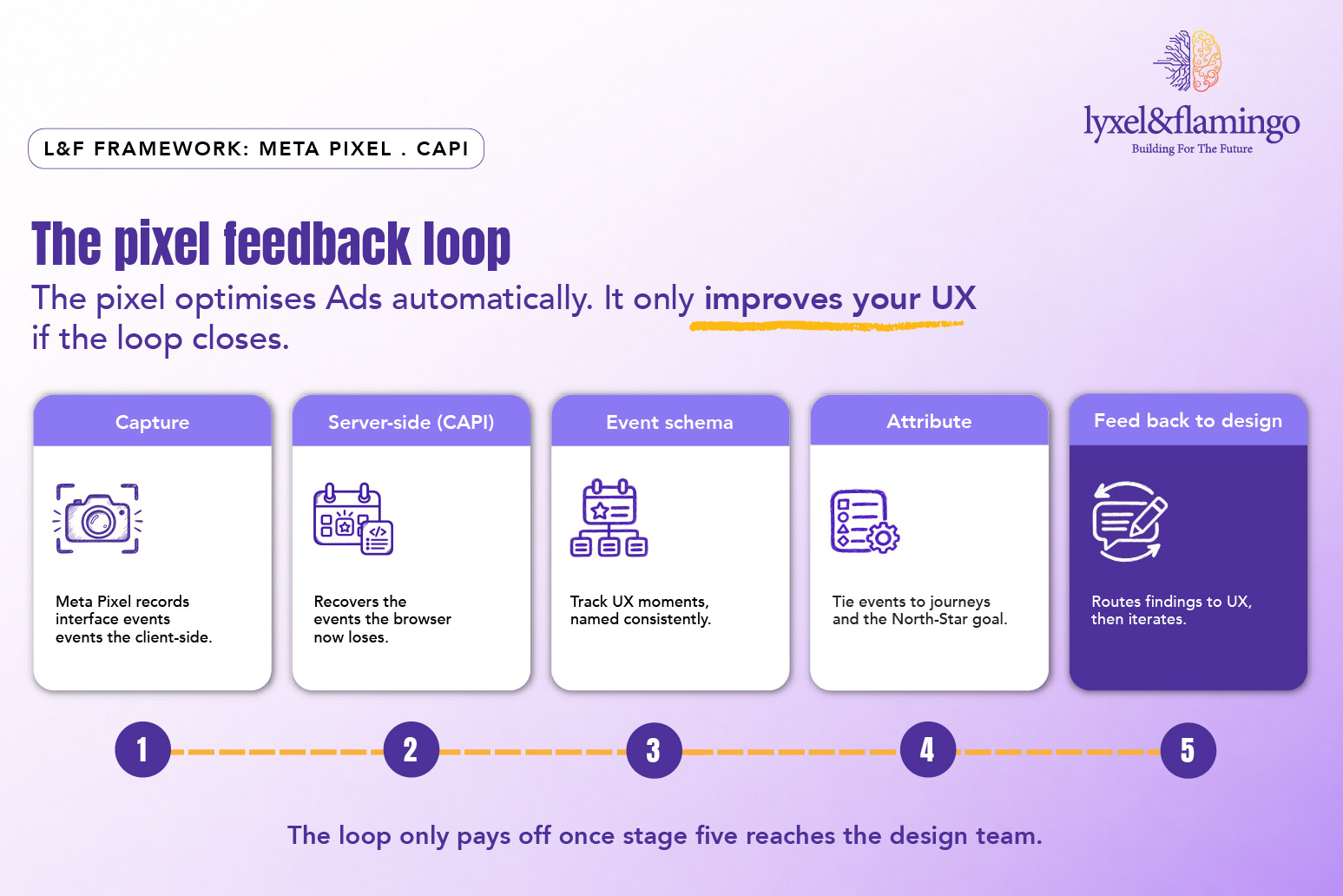
The loop only creates value if stage 5 happens. A pixel that optimises ads but never informs design is a sensor with the wires cut before they reach the control room.
Framework: The Pixel Feedback Loop
The Framework explained
Capture:The familiar part: the Meta Pixel sits in the browser and records the events you define: views, add-to-carts, form starts, purchases. It is necessary but no longer sufficient, because the browser is exactly where modern privacy controls intervene. Treating the pixel as the whole solution is what leaves most businesses measuring a partial, skewed sample without realising it.
Reinforce server-side: Is what makes the record trustworthy again. CAPI sends the same events from your server, where App Tracking Transparency and cookie restrictions do not reach, and de-duplication reconciles the two so nothing is counted twice. The combination is not redundancy; it is resilience a measurement setup that keeps working as the browser environment keeps tightening. This is a core part of how a modern full-funnel marketing operation stays measurable at all.
Define the event schema: Is where measurement stops serving only the ad platform and starts serving design. The default instinct is to track the events Meta wants for optimisation; the more valuable discipline is to decide which interface moments reveal how users behave – where they hesitate, which micro-conversions precede a purchase, which steps shed users and to name those events consistently so they can be analysed. A schema designed for UX questions, not just ad delivery, is what turns the pixel into a design instrument.
Attribute: Connects events to journeys and to the single outcome that matters. Isolated events are trivia; events assembled into a path and tied to the North-Star conversion become a story about how, and where, people convert or fall away. This is where pixel data and your broader analytics setup have to speak the same language, so the picture is coherent rather than two tools disagreeing.
Feedback to design: Is the stage that justifies all the others and the one most often skipped. Event data flows automatically into ad optimisation, so teams assume the job is done, but the same data, routed to the people designing the interface, is what tells them which screen to fix, which step to remove, which hesitation to address. Closing that loop behaviour observed, design changed, behaviour observed again is what makes the pixel a UX feedback loop rather than an invisible ad-tech utility.
Real-world scenario: SRL Diagnostics
SRL Diagnostics, one of India’s leading diagnostics brands, ran a franchise-acquisition campaign where the entire commercial outcome depended on accurate event capture and disciplined optimisation. L&F concentrated the media on Meta and built the campaign around lead-form events, deliberately capturing only the minimum information needed and then optimising against the events that actually predicted conversion rather than vanity engagement. Targeting was tightened to audiences with genuine relevance to the diagnostics category, and the creative and flow were tuned against what the event data revealed.
The result was a 4% conversion rate on the campaign, a strong outcome for a considered, lead-based decision achieved precisely because the measurement was treated as a feedback loop: events captured, read, and used to refine audience, creative, and flow, rather than left to run untouched. It is a clean illustration of the principle at the heart of this blog. The pixel and its events are not a reporting afterthought; they are the sensor that tells you what is working while there is still time to act on it. The same loop that sharpened a Meta lead campaign is the one that should be informing on-site UI/UX and build decisions.
Going deeper: The pixel and event audit
Before trusting pixel data for design decisions, verify:
- Meta Pixel is firing correctly on all key pages and events
- CAPI is implemented and sending server-side events
- Event de-duplication is configured and validated (no double-counting)
- The event schema includes UX-relevant moments, not only ad-optimisation events
- Events are named consistently and align with your GA4 event design
- Consent and privacy compliance (GDPR, regional rules) are correctly handled
- A defined process routes event findings to the UX and creative teams
- The pixel and event setup is re-audited after every significant site change
Key takeaways
- The pixel is best understood as a UX sensor, not just an ad tag; it tells you what users actually did.
- Client-side pixels now miss a large, non-random share of events; CAPI recovers them by sending events server-side.
- De-duplication is essential: pixel plus CAPI without it inflates and corrupts your numbers.
- Design an event schema around UX questions, not only the events ad platforms want.
- The loop only pays off when findings reach the design team. SRL’s 4% conversion came from events read and acted on, not left to run.
The CXO takeaway
For a CXO, the shift here is from thinking of the pixel as a marketing utility to treating it as shared measurement infrastructure that both media and design draw on. The privacy landscape has quietly degraded the browser-only setups most businesses still rely on, which means many leaders are making UX and budget decisions on a biased sample without knowing it. A pixel-plus-CAPI setup, with a UX-aware event schema and a real process for feeding findings back to the people who design the experience, restores an accurate picture and closes the loop between what users do and what the business builds next. The brands that treat behavioural data as a design input, not just an ad input, compound an advantage their competitors cannot see because their competitors are not measuring it.
Frequently Asked Questions
Yes, they are complementary. The pixel captures rich browser-side context, CAPI recovers the events the browser loses, and de-duplication reconciles them. Most robust setups run both.
No, while the Pixel and CAPI are Meta’s tools, the principle client plus server-side event capture, feeding both media and design applies across platforms. The feedback-loop discipline is platform-agnostic.
When the same conversion is reported by both the pixel and CAPI, de-duplication ensures it is counted once. Without it, results are inflated and optimisation is trained on corrupted data.
Pixel/CAPI and GA4 should use a consistent event vocabulary so the two tell the same story. Divergent event definitions are a common source of dashboards that disagree.
It can be, when implemented with proper consent management and data handling. Server-side tracking is a technical method, not a way around consent GDPR and regional rules still apply and must be built in.