
What this blog covers
This blog explains server-side tracking and the Conversions API (CAPI), and how to implement them well in a privacy-first environment. It covers why browser-only tracking now leaks signal, what server-side tracking actually does, the event blueprint that keeps data accurate and de-duplicated, how consent fits in, and the mistakes that waste the effort. It closes with a self-check and the questions practitioners ask most.
Table of Contents
- Why the pixel sees less than it used to
- What server-side tracking and CAPI do
- The Server-Side / CAPI Event Blueprint
- Getting de-duplication right
- Consent and first-party data
- The mistakes that waste the effort
- Why this feeds everything downstream
- Self-check: is your tracking privacy-ready?
- Key takeaways
- Closing
- Want measurement that holds as cookies fade?
Why the pixel sees less than it used to
For a decade, a browser pixel was enough. It sat on the page, watched what visitors did, and reported it back to the ad platforms using third-party cookies. That world has been closing for a while: iOS privacy prompts, browser tracking prevention, ad blockers, and the retirement of third-party cookies have all cut into what a client-side pixel can observe. The result is missing conversions, weaker optimisation and a fuzzier picture of what media is doing the measurement gap that a post-cookie measurement framework has to close.
Server-side tracking is the answer the industry has settled on. Rather than relying only on the browser to report events, the business sends them from its own server, where cookie limits and ad blockers do not apply. The signal that the pixel now misses is recovered, and the platforms get a fuller, more reliable view to optimise against.
Related Blog: The Friction Audit: A UX Method for Finding Where Revenue Leaks
What server-side tracking and CAPI do
Server-side tracking means collecting the record of a customer action on your own server and sending it to the ad platform directly, rather than depending on the browser to do it. The Conversions API (CAPI on Meta, with equivalents on Google and other platforms) is the channel that carries those server-sent events. In practice, most brands run the pixel and CAPI together: the pixel still fires client-side where it can, and the server sends the same events as a reliable backstop for everything the browser misses.
The benefit is accuracy and resilience. Conversions that a blocked or cookie-less browser would have dropped still arrive, so optimisation improves and reported results line up more closely with reality. It also lets a brand send events the browser never saw at all an offline purchase, a call-centre sale, a CRM status change by firing them from the server when they happen. The measurement stops being limited to what a page can observe.
The Server-Side / CAPI Event Blueprint
Server-side tracking helps only if the events are built correctly. The blueprint has three moving parts working together.
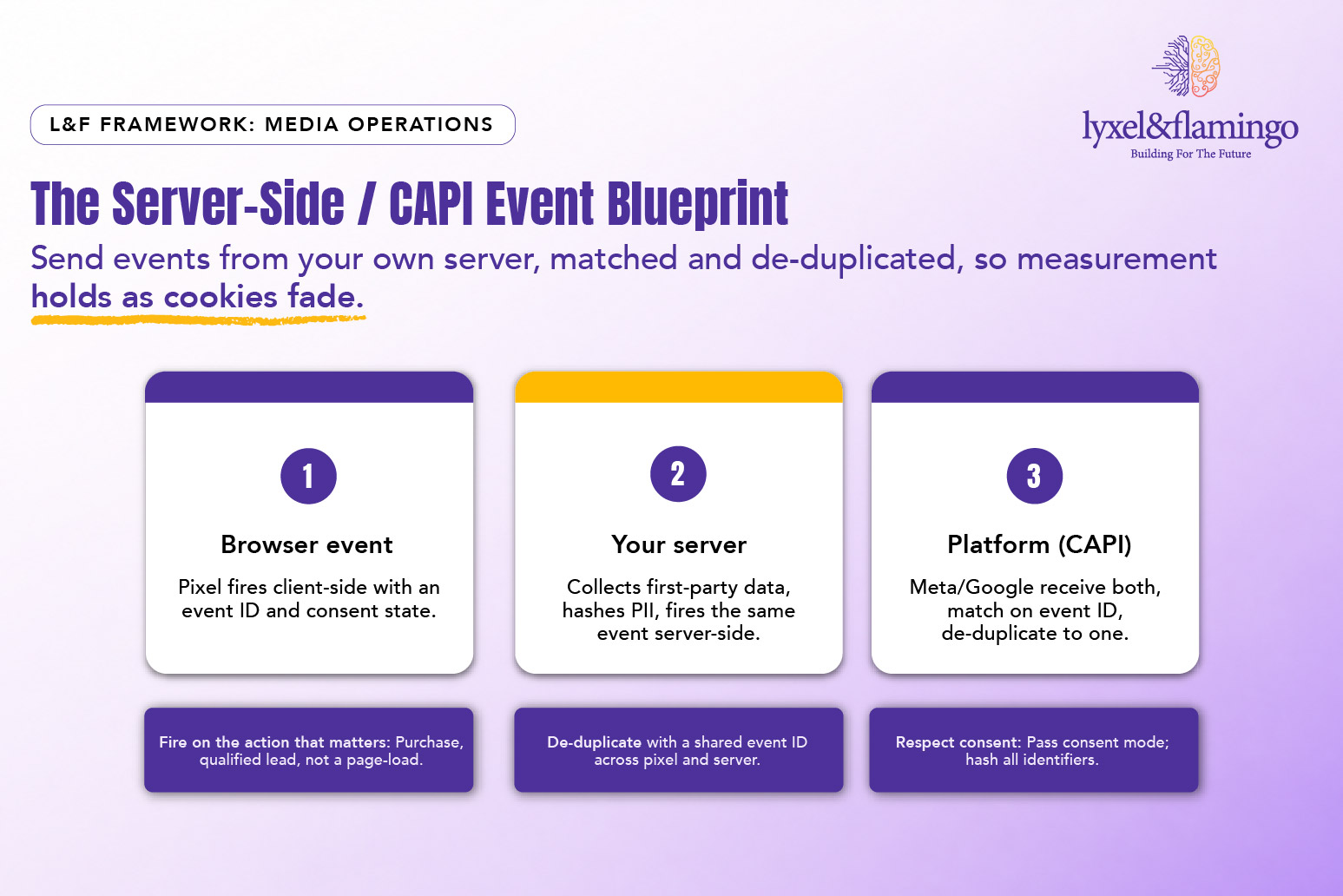
Framework: The Server-Side / CAPI Event Blueprint: browser and server events, matched and de-duplicated.
The flow runs from the browser to the server to the platform. Client-side, the pixel fires as it always has, but now stamped with a shared event ID and the visitor’s consent state. Server-side, your server collects the first-party data, hashes any personal identifiers such as email or phone, and fires the same event with the same event ID. The platform then receives both the browser and the server version, recognises them as one event by matching the shared ID, and counts it once. Get those three parts right: a shared ID, hashed identifiers, and events fired on the action that matters – and the platform receives a complete, accurate, privacy-respecting record without inflating the numbers.
Getting de-duplication right
The single most important detail in a server-side setup is de-duplication, because running the pixel and CAPI together means the same conversion is sent twice: once by the browser, once by the server. Without a way to recognise them as the same event, the platform counts both, and a brand ends up optimising toward doubled, fictional conversions. The fix is a shared event ID: the pixel and the server fire the identical event with the same unique identifier, and the platform uses it to collapse the pair into one. It is a small piece of engineering with an outsized effect, and skipping it turns a measurement upgrade into a measurement error.
Consent and first-party data
A privacy-first setup is not only about recovering signal; it is about doing so within the rules and with the customer’s consent. Two practices carry most of the weight. The first is consent mode: the events should carry the visitor’s consent state, so that data is collected and used in line with what they agreed to, and modelling fills the gaps where consent is withheld. The second is first-party data handled responsibly: identifiers such as email and phone are hashed before they leave your server, so the platform can match a customer without ever receiving readable personal data. Done this way, server-side tracking strengthens measurement and respects privacy at the same time, which is the standard a modern setup has to meet.
The mistakes that waste the effort
Server-side tracking rewards precision and punishes shortcuts. The most common mistake is skipping de-duplication, which inflates conversions and corrupts optimisation. Another is firing events on the wrong trigger a page load rather than the real action, such as a completed purchase or a qualified lead which teaches the algorithm to chase the wrong outcome. Sending thin or poorly matched customer data weakens the platform’s ability to attribute the event, wasting much of the accuracy the setup was meant to deliver. And ignoring consent state creates compliance risk that no measurement gain justifies. Each of these turns a worthwhile upgrade into wasted engineering, and each is avoidable with a disciplined event taxonomy mapped to real business actions.
Why this feeds everything downstream
Clean server-side events are the foundation every other measurement effort stands on. The attribution models, the blended efficiency metrics, the incrementality read-outs, and the optimisation the platforms perform all run on the events you send them, so if those events are thin, duplicated, or fired on the wrong trigger, everything above them inherits the error. This is the unglamorous base layer of a single source of truth. Get the events right, and the rest of the stack has honest inputs to work with; get them wrong, and it reports fiction with confidence. It is also the first-party-data groundwork that pairs naturally with a clean GA4 and tag-manager setup.
Related Blog: From Persona to Pixel: Building a Persona-Led CRO Programme.
Self-check: is your tracking privacy-ready?
Score your own setup one point per yes:
- You run server-side tracking (CAPI or equivalent) alongside the pixel
- Browser and server events share an event ID and are de-duplicated
- Events fire on the action that matters, not a page-load
- Personal identifiers are hashed before they leave your server
- Consent state is passed with every event
- Offline and backend conversions are sent server-side where relevant
- You have a documented event taxonomy mapped to business actions
Five or more and your tracking is privacy-ready. Three or fewer and you are likely losing signal or double-counting it.
Key takeaways
- Cookie loss, browser prevention, and ad blockers mean a client-side pixel now misses a growing share of conversions.
- Server-side tracking sends events from your own server; CAPI is the channel that carries them to the platforms.
- Run the pixel and CAPI together, with a shared event ID so the platform de-duplicates them into one.
- Hash identifiers and pass consent state – stronger measurement and privacy compliance at once.
- Clean server-side events are the base layer every attribution, efficiency, and incrementality number depends on.
Closing
The tracking that carried marketing through the last decade is quietly running out of road, and the brands that notice late will spend the next few years optimising on a shrinking, distorted signal. Server-side tracking and CAPI restore what the browser can no longer see, but only when the events are built with care: shared IDs, hashed data, the right triggers, consent throughout. Done properly, it is the foundation that makes every number above it trustworthy. Done carelessly, it is expensive engineering that measures the wrong thing with new confidence.
Want measurement that holds as cookies fade?
L&F builds server-side tracking and CAPI de-duplicated, consent-aware, mapped to real business actions – for consumer brands across India and worldwide. We will set up the events the rest of your stack depends on. Talk to L&F about measurement infrastructure and stop losing signal to the browser.
Frequently Asked Questions
Server-side tracking means collecting the record of a customer action on your own server and sending it directly to the ad platforms, rather than relying only on a browser pixel to report it. Because it originates from your server, it is not affected by cookie limits, browser tracking-prevention or ad blockers - so it recovers conversions a client-side pixel would miss, and can send events the browser never saw, such as offline or backend sales.
The Conversions API, or CAPI, is the channel that carries server-sent events to a platform - CAPI is Meta's name for it, and Google and others have equivalents. It works alongside the browser pixel: the pixel fires client-side where it can, and the server sends the same events through CAPI as a reliable backstop. Together they give the platform a fuller, more accurate view of conversions than the pixel alone can in a privacy-constrained environment.
In most cases, yes - the pixel alone now misses a growing share of conversions because of cookie loss, browser prevention and ad blockers. Running CAPI alongside the pixel recovers that missing signal, improves optimisation, and lets you send offline and backend events the browser never sees. You do not replace the pixel; you run both together with de-duplication, so the platform sees a complete picture without counting anything twice.
When you run the pixel and CAPI together, the same conversion is sent twice - once by the browser, once by the server. De-duplication is how the platform recognises them as one event and counts it once, using a shared event ID that both the pixel and the server attach to the identical event. Without it, conversions are double-counted, and the algorithm optimises toward inflated, fictional numbers. It is the single most important detail in a server-side setup.
It can be, and done properly it strengthens both measurement and compliance. The key practices are passing consent state with every event, so data is used in line with what the customer agreed to, and hashing personal identifiers such as email and phone before they leave your server, so the platform can match a customer without receiving readable personal data. Server-side tracking is a tool; whether it is compliant depends on implementing consent and data handling correctly.
Prioritise the actions that matter to the business - completed purchases, qualified leads, sign-ups, high-value events - fired on the real action rather than a page-load. Beyond the standard web events, server-side tracking lets you send things the browser never sees: offline store purchases, call-centre sales, CRM status changes. The guiding principle is a documented event taxonomy mapped to genuine business outcomes, so the platform optimises toward what you actually care about.
It is the foundation everything else stands on. Attribution models, blended efficiency metrics, incrementality reads and the platforms' own optimisation all run on the events you send. If those events are thin, duplicated or fired on the wrong trigger, every number above them inherits the error. Clean, de-duplicated, well-triggered server-side events give the whole stack honest inputs - which is why this base layer is worth getting right before investing in anything more advanced.