What This Blog Covers
A low cost per acquisition is easy to buy at small volume and hard to hold as spend grows, because scale pulls in weaker audiences and flatters averages. This article explains why the definition of an acquisition is the real strategy, how quality-adjusted CPA keeps targets honest, and why first-party signals, clean conversion events and stepped budgets protect efficiency. It ends with a four-rung ladder a CMO can use to scale acquisition without trading away customer quality or the trust of your finance team, including the incrementality test that proves the spend was worth it.
QUICK ANSWER: A CPA campaign strategy starts with a precise definition of an acquisition, then prices quality into the target, feeds the platform clean first-party signals, and scales budget in steps while defending with fresh creative and incrementality tests. The discipline, not the bid setting, is what scales. Review quality-adjusted CPA weekly and prove incrementality at least once a year.
Table of Contents
- What Counts as an Acquisition, and Why the Definition Is the Strategy
- The Quality Gap Between Your Reported CPA and Your Real One
- Why First-Party Signals and Clean Events Hold Efficiency
- The Scaling Guardrails That Keep Efficiency Intact as Budgets Grow
- What the CPA Scale Ladder Asks You to Do at Each Rung
- Framework Explained
- Why Your CPA Must Prove It Is Incremental to Finance
- CLIENT PROOF POINT
- Key Takeaway
- The CXO Takeaway
What Counts as an Acquisition, and Why the Definition Is the Strategy
A cost-per-acquisition target means little until you define the acquisition. Is it an install, a first purchase, a repeat purchase or a booking? Each choice trains the platform to find a different person. That makes the definition a strategic decision, not a campaign setting.
Pick the event closest to value that you can measure reliably and in volume. Optimising for a shallow event gives a cheap CPA and a poor customer. Optimising for a deep event can starve the algorithm of data. The right answer sits between the two and depends on your volume.
Write the definition down and share it with finance. Every later argument about performance depends on it, including the way your best customer can get counted three times across platforms and flatter your CPA. De-duplicated counts are the only counts worth presenting. Ask for them.
Agree one owner for the definition. Changing it mid-quarter resets comparison and erodes trust in the numbers. A short working session with finance, sales and marketing to agree the event, the quality measure and the ceiling is time well spent, because it prevents months of debate about results. Review it once a year, not once a campaign.
The Quality Gap Between Your Reported CPA and Your Real One
As budgets grow, platforms reach deeper into less qualified audiences. CPA can hold steady while customer value falls, so a blended average hides the damage. Track a quality-adjusted CPA that includes return rate, repeat rate or booking value. Without it, you are scaling a number, not a business.
Look past last-click. Performance marketing that scales profitably beyond last-click ROAS sets out the measures that survive growth. Ask your team which of them are on the weekly report today. A CMO who can show a quality-adjusted trend is far better placed to defend a larger budget than one who can show only a falling average CPA.
Set a floor for quality. If quality-adjusted CPA worsens for two consecutive weeks, pause the next budget step. A written trigger removes argument at the moment of greatest pressure. Rules before results.
Compare cohorts, not averages. A new cohort that churns faster than the one before is the early warning. Cohorts, not averages. Share the comparison in the monthly review.
Why First-Party Signals and Clean Events Hold Efficiency
Platforms optimise toward what you tell them is valuable, so the event you pass back sets the audience you buy. First-party data, meaning customer and booking data you own, gives the platform a sharper signal to optimise against. It also reduces dependence on third-party signals that are fading. This is also where your relationship with agencies and platforms is tested, so ask each partner to explain, in business terms, which signals feed the bidding and who checked them.
Keep events consistent. Changing the conversion definition mid-flight resets learning and muddies comparison. Stable events, clean learning. Document every change with a date.
Server-side tracking and CAPI recovers conversions that browsers lose, so the platform learns from complete data and your CPA reflects reality. Complete data keeps bidding honest. Ask your agency or analytics lead what share of conversions the platform currently sees.
Join media data to your own order and booking records at least monthly. The comparison shows whether platform-reported acquisitions match what the business banked. Reconcile them.
The Scaling Guardrails That Keep Efficiency Intact as Budgets Grow
Raise budgets in controlled steps and let performance settle at each level. Large jumps push the platform back into learning and inflate CPA for reasons unrelated to demand. Hold a rule for when to pause a step. Steps, not leaps.
Creative wears out as reach grows. Ad fatigue gives the signals to watch and the refresh cadence to plan. Build the creative pipeline before you need it. Waiting for performance to fall is paying twice.
Spread risk across channels so you do not depend on one auction. Test each channel against its own baseline. A single-channel plan is a single point of failure. Put a diversification target in the annual plan.
A weekly creative pipeline beats a panic rebuild, and getting the paid search, social and shopping mix right shows how to rebalance when one channel tires. Rebalance gradually, not in a panic. Small, steady moves hold efficiency. Document each step, its date and its result, so the next planning cycle starts with a record of what scale cost in efficiency and how it was recovered.
What the CPA Scale Ladder Asks You to Do at Each Rung
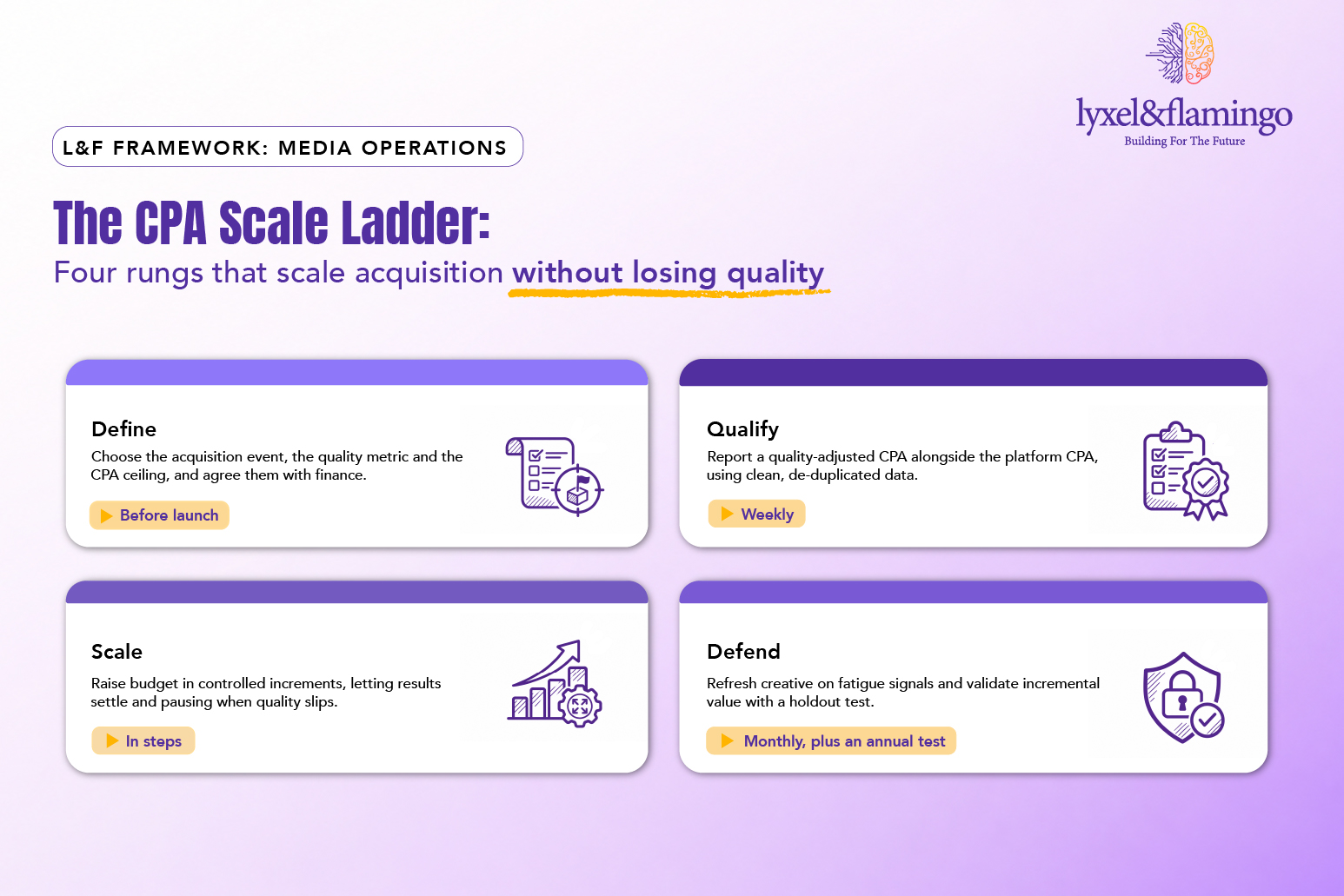
Four rungs for taking an acquisition target from pilot to scale without losing quality. The cadences are recommendations.
Framework Explained
Define: The target is only as good as the event behind it. Choose a signal close to value that is available at volume, set the CPA ceiling and the quality metric together, and agree both with finance. Record the definition so that later results are compared on the same basis.
Qualify: A low CPA with weak customers is a false win. Report a quality-adjusted CPA beside the platform figure each week, built on de-duplicated data, and compare new cohorts against earlier ones. The comparison shows whether growth is bringing in customers as valuable as the last batch.
Scale: Steps protect learning. Raise budget in controlled increments, let performance settle at each level and document the rule for advancing and the rule for retreating. When quality-adjusted CPA slips for two consecutive weeks, hold the step until the cause is understood.
Defend: Scale invites creative fatigue and over-attribution. Refresh creative when fatigue signals appear, spread spend across channels and run a holdout or geo test at least once a year. The test confirms the acquisitions you are paying for would not have happened anyway.
Why Your CPA Must Prove It Is Incremental to Finance
A CPA that looks efficient can be capturing buyers who would have purchased anyway. Validate with an incrementality test at least once a year, using a holdout or geo design. The test answers the question finance will ask: would these customers have arrived without the spend? Plan it before the budget is set.
Report in terms finance trusts: cost per qualified acquisition, payback period and contribution. Why an all-green KPI dashboard should still worry your board explains how reporting can hide a real problem. It builds trust.
Keep the evidence consistent across teams. Agree one calculation for CPA and CAC, and reconcile them each month. One number, one meaning. A yearly incrementality test, reported in plain language, gives your board a reason to trust the numbers and your team a reason to keep investing where the evidence is strong.
Review the full programme each quarter: definition, quality, signal, scale step and test result. That review is where a CPA target becomes a strategy. Keep the minutes.
CLIENT PROOF POINT
IndiGo (Google UAC): IndiGo wanted to grow sales and profitability from its app by acquiring users and driving bookings among an audience inclined towards online travel aggregators. Google and our team devised a full-funnel approach for long-term user acquisition, using first-party data in Google UAC campaigns, an install campaign that encouraged in-app actions, re-engagement campaigns for existing users and a thematic campaign structure.
36% increase in mom bookings · 35% increase in mom revenue · 40% decrease in mom cac
Source: L&F case study, IndiGo Airlines reduces customer acquisition cost by 40% and boosts revenue by 35%. The source reports results month on month and does not state a fixed window.
Key Takeaway
- Define the acquisition event first; every later CPA decision depends on it.
- Price quality into the target with a quality-adjusted CPA, since scale pulls in weaker audiences.
- First-party data and clean events give the platform the signal to hold efficiency.
- Report cost per qualified acquisition and payback in the language finance already uses.
- Validate with a holdout test at least yearly so your CPA reflects incremental value.
The CXO Takeaway
Ask for your CPA and a quality-adjusted CPA side by side for the last six months of budget growth. If the gap is widening, you are scaling a number, not a business. Pause the next budget step until the definition and the data are fixed.
Put both figures in every budget review from here on, with the definition of a quality conversion agreed in writing by marketing and finance. Release each budget increase only when the quality-adjusted CPA holds steady, not when the headline CPA looks healthy. Then confirm with a holdout test that the conversions you are paying for are incremental, so your next growth decision rests on customers you have earned rather than customers you have counted.
Frequently Asked Questions
CPA usually refers to the cost of a defined conversion event inside an ad platform, while CAC covers the full cost of acquiring a customer. Report both and reconcile them regularly.
Use controlled steps and let performance settle at each level. Large jumps send the platform back into learning and inflate CPA. The right step size depends on your volume and platform.
Optimise for the deepest event you can measure at enough volume. Installs are cheaper and often lower quality, so pair them with campaigns that encourage in-app actions.
Run a holdout or geo test that compares exposed and unexposed groups. If the exposed group does not convert meaningfully more, part of your reported CPA reflects buyers who would have purchased anyway.
Marketing and finance should own it jointly, with the CMO accountable for the final call. Marketing knows which events signal intent; finance knows which customers retain and pay back. Agree the definition in writing, review it each quarter, and change it only when retention or revenue data shows the current event no longer predicts value.