What This Blog Covers
Not all schema types carry equal weight for AI citation, and treating them as an undifferentiated checklist wastes engineering time on markup with weak evidence behind it. This piece breaks structured data into three tiers by evidence strength, covers the entity-linking layer that turns a brand into a recognizable authority node, and gives a practical implementation order for teams starting from scratch.
Quick Answer: For schema markup for AI search, the types with the strongest evidence for supporting AI citation are Organization, Product, and Article schema, since they establish clear entity identity and factual content an AI model can extract with confidence. FAQPage and HowTo schema show plausible, mixed evidence. Speculative additions like llms.txt currently show weak evidence. The practical implementation order is: establish entity identity first (Organization schema, consistent across every page), then content-type schema (Article, Product), then question-format content (FAQPage), treating anything beyond that as experimental rather than foundational.
Table of Contents
- Why Each Schema Type Carries Different Weight for AI Citation
- Tier 1: Organization, Product, and Article Schema
- Tier 2: FAQPage and HowTo Schema
- Tier 3: Speculative and Unsupported Markup
- The Entity-Linking Layer That Ties It Together
- A Practical Implementation Order
- Framework Explained
- Key Takeaways
- CXO Takeaway
Why Each Schema Type Carries Different Weight for AI Citation
Schema markup gets discussed as a single line item on an SEO checklist; however, the evidence for different schema types’ actual effect on AI citation varies considerably. Some types establish foundational entity clarity a model can build confidence on; others are largely unproven additions that consume implementation time without a clear payoff.
This matters practically because engineering time for structured data is finite. A team that spends its schema budget on speculative markup before establishing solid Organization and Product schema has its priorities backwards, a gap directly explored in does schema markup affect AI citations.
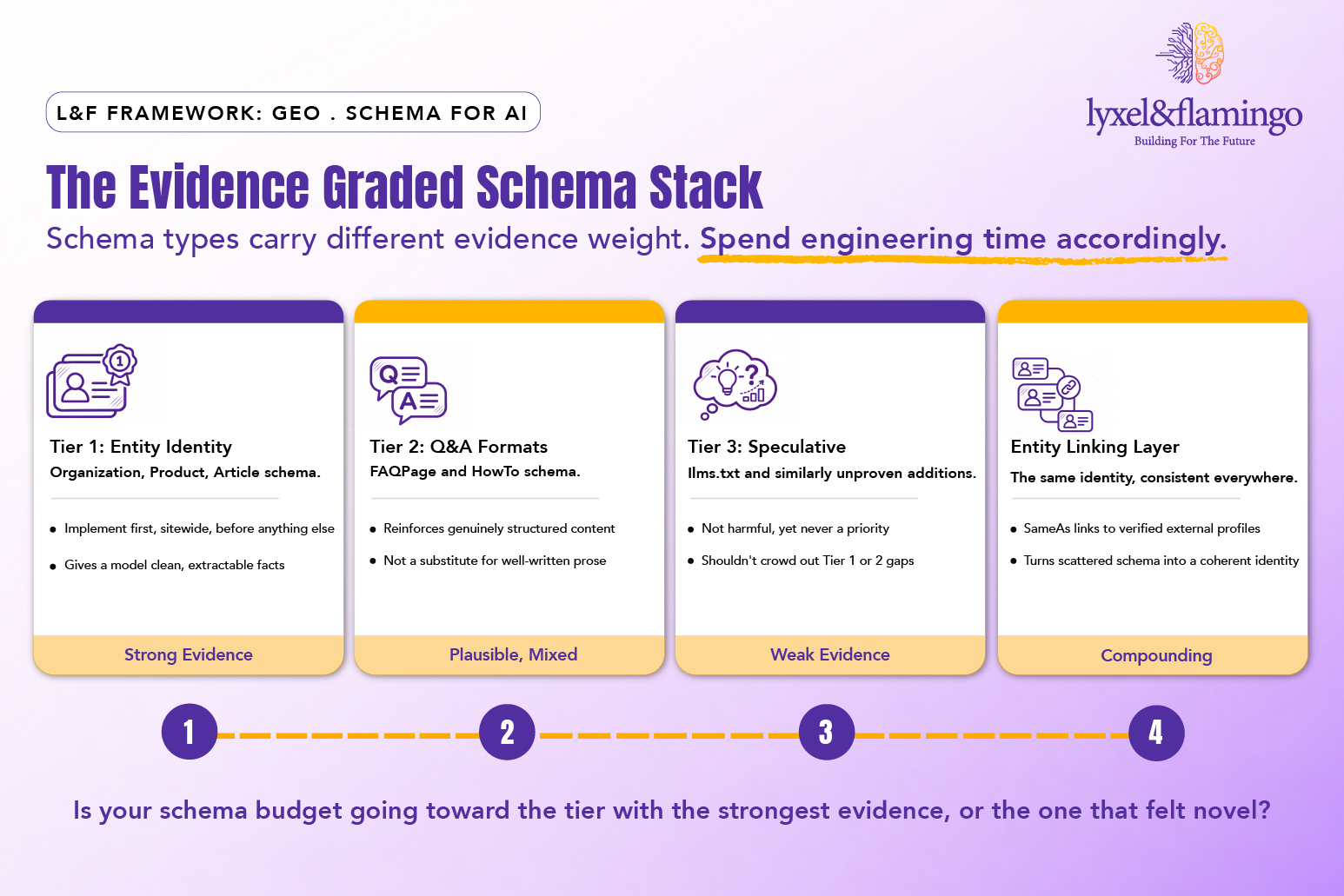
Tier 1: Organization, Product, and Article Schema
Organization schema, part of the broader Schema.org vocabulary, establishes the foundational entity identity: who you are, what you do, your official name, logo, and social profiles, all in a machine-readable format. This is the schema layer with the strongest evidence behind it, since it directly addresses the entity-consistency problem that causes models to hesitate before citing an unclear or ambiguous brand.
Google’s own Organization structured data guidelines describe this markup as a way to help search systems disambiguate the brand behind a site, which is the same entity-clarity signal AI models rely on.
Product schema (price, availability, specifications, reviews) and Article schema (author, publish date, headline, structured body content) round out the tier. Both give a model clean, extractable facts instead of forcing it to parse and infer from unstructured page text, which is exactly the kind of ambiguity a cautious model resolves by simply not citing the source.
Tier 2: FAQPage and HowTo Schema
FAQPage and HowTo schema show plausible, mixed evidence. The underlying logic makes sense: question-and-answer or step-by-step formatted content maps naturally onto the kind of direct-answer citation an AI model is trying to construct, and structuring it explicitly should, in theory, make that mapping easier.
The evidence is mixed rather than strong because well-written FAQ and how-to content in plain prose, without the schema markup at all, can perform comparably if the content itself is clearly structured with genuine question-format headings. Schema here is best treated as a reinforcement of good content structure, not a substitute for it. Google itself restricted FAQ and HowTo rich results in August 2023, another sign this markup works best as reinforcement of clear content, rather than as a standalone visibility lever.
Tier 3: Speculative and Unsupported Markup
Some markup additions, llms.txt being the clearest current example, have been widely recommended without evidence to back the recommendation. Independent research has found no meaningful correlation between adopting these speculative additions and any measurable citation lift, a gap covered in more depth in a dedicated look at llms.txt server-log evidence.
Tier 3 additions are not harmful to implement if time allows. They should never be prioritized ahead of Tier 1 or Tier 2 work, however, and a team reporting on its GEO progress should be honest internally about which tier its current schema investment actually sits in.
The Entity-Linking Layer That Ties It Together
Schema markup on a single page is useful in isolation; however, its real power compounds when it links the brand as a consistent entity across every page and, ideally, out to external authoritative sources like Wikidata or a Knowledge Graph entry. This entity-linking layer is what turns scattered, page-level schema into a coherent identity a model can build confidence in over time.
Practically, this means the same Organization schema, the same official name, the same logo URL, and the same sameAs links to verified social and reference profiles should appear consistently sitewide, not vary page by page or get implemented once and then drift out of sync as the brand updates its details elsewhere.
A Practical Implementation Order
For a team starting from scratch, the sequence that reflects the evidence tiers above is: Organization schema sitewide first, since it is the foundation everything else builds on; Product and Article schema next, on the highest-value pages; FAQPage and HowTo schema after that, where the underlying content genuinely fits the format; and speculative Tier 3 markup last, treated as low-priority experimentation rather than a core deliverable. Before you start, run a baseline AI visibility audit to see which tier your current structured data actually covers.
This order also happens to match implementation difficulty in most CMS environments, since Organization schema is typically a one-time sitewide template change, while Product and Article schema often require per-page or per-template work that benefits from being prioritized by page value. Google’s own introduction to structured data lays out the same implementation logic from the search-engine side.
Framework Explained
Entity identity comes first: Organization schema is the foundation every other citation signal builds on, so it should never be an afterthought.
Match schema to genuine content structure: FAQPage and HowTo schema work best reinforcing content that already reads as direct Q&A or step-by-step, not retrofitted onto prose that isn’t actually structured that way.
Don’t let speculative markup crowd out foundational work: Tier 3 additions are cheap, yet unproven; they should never take priority over Tier 1 implementation gaps.
Consistency compounds: The same entity details repeated correctly across every page and external profile matter more than any single page’s schema completeness.
GEO READINESS NOTE: This tiering reflects the current evidence landscape and Lyxel&Flamingo’s own implementation experience across client SEO engagements, rather than a single named case-study result, since schema’s effect on citation is genuinely evidence-graded rather than a simple before/after metric for any one client. For an applied example of entity clarity driving AI search visibility, see the Timex India SEO and AI search case study.
Key Takeaways
- Schema types carry different evidence weight for AI citation; treating them as one undifferentiated checklist misallocates engineering time.
- Organization, Product, and Article schema (Tier 1) have the strongest evidence and should be implemented first.
- FAQPage and HowTo schema (Tier 2) show plausible, mixed evidence and work best reinforcing genuinely structured content.
- Speculative markup like llms.txt (Tier 3) currently shows weak evidence and should never be prioritized ahead of Tier 1 or 2 work.
- Consistent entity-linking across every page and external profile compounds the value of page-level schema over time.
CXO Takeaway
Is your schema implementation budget going toward the tier with the strongest evidence, or the tier that felt most novel when it was proposed? Getting this sequencing right is often the difference between a schema project that moves citations and one that just checks a box. Lyxel&Flamingo’s SEO team can audit your current schema stack against this tiering and rebuild the priority order.
Frequently Asked Questions
They serve different purposes. Organization schema should come first even for e-commerce, since it establishes the entity identity that makes a model confident in the brand behind the products, before the product data itself is evaluated.
No need to remove it; it is not harmful. Just don’t let it consume further engineering time ahead of Tier 1 or Tier 2 gaps.
Quarterly is a reasonable baseline, with an additional check whenever brand details (name, logo, social profiles) change, since drift between schema and reality undermines the entity-consistency benefit.
Not reliably. Schema reinforces genuine content structure; it does not substitute for content that was not actually written in a clear question-and-answer format.