What this blog covers
Shoppers now ask AI assistants conversational questions, and the assistants answer from listing data, reviews and structured attributes before a results page ever loads. This article shows what changes when an assistant sits between the shopper and the shelf, why Amazon India and Flipkart are tuning their own listings for AI search, and which signals decide whether a product gets recommended. Practitioners and strategists get the Answerable Listing Model, a field-by-field fix table and a monthly share-of-answer check that sits beside rankings.
Table of Contents
- What changes when an AI assistant sits between the shopper and the shelf
- The listing signals AI assistants read before they recommend
- Why marketplaces are tuning listings for AI search themselves
- The gaps that make a good product invisible to a conversational query
- AI search product discovery on a marketplace: the Answerable Listing Model
- The framework explained
- Measure presence in AI answers alongside rankings
- Key takeaways
- The CXO takeaway
A shopper who asks an AI assistant for the best product skips the results page entirely. The assistant reads your listing, decides whether it answers the question, and either names you or moves on.
Quick answer: In AI search product discovery on a marketplace, shopping assistants recommend products by reading listing attributes, descriptions, reviews and customer questions, then answering a shopper’s conversational query. To get recommended, a marketplace listing needs four things: complete attributes, clear answers to real shopper questions, credible reviews and claims that match across every channel. Audit your top listings against those four signals, and track whether your products appear in AI answers alongside your search rankings.
What changes when an AI assistant sits between the shopper and the shelf
Search used to return a list and leave the choice to the shopper. An AI shopping assistant interprets a question like “a moisturiser for oily skin under ₹800”, compares the options and names a few. The shopper may skip the full results page entirely. Your listing now has to win the comparison before it wins the click.
India is already there. Amazon brought its conversational assistant Rufus to Indian shoppers, and Amazon India and Flipkart were reported to be tuning product listings so they surface more prominently in answers from ChatGPT, Perplexity and Gemini. When the marketplaces optimise for the assistants, brands have every reason to follow.
The same logic powers how brands get cited in AI search: systems quote sources that state clear, verifiable answers. A marketplace listing is a source too, and its fields are the raw material. Keyword-stuffed listings give the assistant little to work with. Listings written as answers give it quotes.
Treat this as a discovery channel. Ask the same questions your customers ask, in their words, in the assistants you can access, and note which products get named. Ten questions. One afternoon. Zero cost.
The listing signals AI assistants read before they recommend
Industry guides describe a consistent pattern: assistants draw on structured attributes, titles and bullets, long-form content, reviews and customer questions to build an answer. Marketplace assistants use the marketplace’s own data, while web-based assistants rely on crawled pages and structured markup. Ranking formulas stay private, so treat this as a working model. It still tells you exactly where to invest.
Attributes come first. Size, material, ingredients, compatibility, use case and suitability are the facts an assistant uses to match a product to a question. A missing field is a missing answer. The layering approach in PDP copy for humans and algorithms applies here: lead with plain answers, then add depth. Complete every field the platform offers.
What an AI shopping assistant needs from a listing
Reviews and ratings work as trust signals for the assistant exactly as they do for the shopper. Build a review plan within platform rules and respond to feedback fast. Trust is data.
Consistency counts too. When a claim, size or ingredient list differs between your marketplace listing, your website and your packaging, the assistant meets contradictions, and contradictions lower confidence. Keep one master record and publish from it. One source of truth.
Why marketplaces are tuning listings for AI search themselves
Platforms treat listing quality as the raw material of discovery. The elements shoppers decide on in three seconds already reward a clear title, strong images and credible ratings, and AI assistants raise the value of each. A listing that persuades a human in three seconds also hands an assistant its answer.
Platform behaviour can shift your position overnight. When a marketplace changes how it surfaces products, relative rank moves overnight. Watch platform announcements, seller updates and category tests, and adjust quickly. Passive brands lose position silently.
Paid placement enters the picture as well. Sponsored products are appearing inside AI shopping experiences, so paid and organic compete in the assistant just as they do on the results page. Keep the organic foundation strong, because a paid slot on a weak listing buys very little.
Expect different outcomes across assistants. Why ChatGPT, Gemini and AI Overviews rarely cite the same source shows that each system picks its own sources. Build the common foundation of complete data, clear answers and credible proof, and let each assistant reward it in its own way. Foundation first, tuning second.
The gaps that make a good product invisible to a conversational query
A great product stays visible when its listing answers the question asked. A shopper asks for “a serum for sensitive skin that works under sunscreen”, and a listing that says only “premium formula, visible results” gives the assistant little to quote. Ideal product. Silent listing. Lost recommendation.
Four gaps show up most often: thin attributes, generic descriptions, missing use-case and suitability answers, and unsubstantiated claims. Each is a content decision, and each is fixable within weeks. Start with your ten highest-revenue products.
On your own website, structured data supports the same goal. Read the evidence on whether schema markup affects AI citations before investing, and treat markup as support for clear content. Google’s product structured data guidelines show how accurate price, availability and review markup gives crawler-based assistants cleaner facts. Accuracy beats volume.
Keep availability and delivery data honest. An assistant that recommends a product that is out of stock damages trust in the recommendation, and out-of-stock is your costliest advertisement for exactly that reason.
AI search product discovery on a marketplace: the Answerable Listing Model
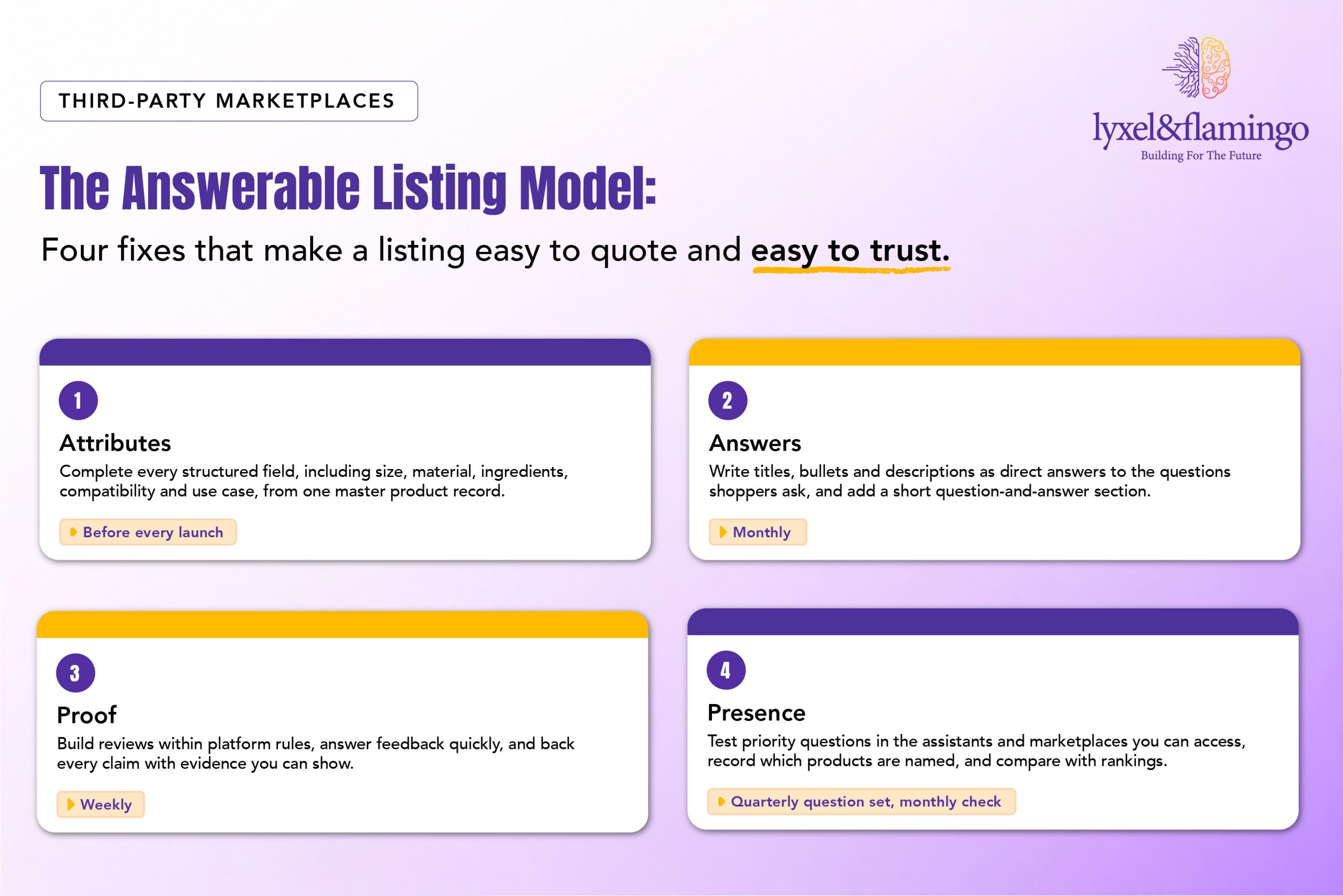
Four fixes make a listing easy for an assistant to quote and easy for a shopper to trust.
The framework explained
Attributes: Complete every structured field the platform offers, sourced from one master product record. Include size, material, ingredients, compatibility, certifications, use case and suitability. Audit the ten highest-revenue products first, then roll the template across the range, identical on every marketplace and your own site.
Answers: Write titles, bullets and descriptions as direct answers to the questions shoppers actually ask. Mine search terms, customer-service queries, reviews and marketplace Q&A to find them. Lead with the plain answer, then add depth. Swap “premium quality” for specific facts a shopper can compare.
Proof: Build credibility that survives scrutiny. Plan review generation within platform rules, resolve repeated complaints at product level and back every claim with test results, certifications or ingredient data. Proof lifts recommendations and conversion together.
Presence: Measure whether assistants name you. Run a fixed set of shopper questions each month and record whether your products appear, in what position and with what description. Track the competitors who show up instead, compare with rankings, and let the gaps set next month’s fixes.
Measure presence in AI answers alongside rankings
Rankings show where you appear in a list. Presence shows whether an assistant names you. Add a monthly presence check to reporting, using the approach in our enterprise GEO checklist: a fixed question set, run on schedule, answers recorded. The output is a simple share-of-answer figure, and it becomes your baseline.
Build the question set from real data: search terms, service queries, review language and marketplace Q&A. Mix broad discovery, comparison and use-case questions, and hold the set steady for at least a quarter so trends stay comparable.
For each question, record three things: whether your product is named, its position and its description. The descriptions reveal which attributes and claims travel and which get lost. Read them like customer reviews.
Seasonal queries deserve their own set. Why “best Diwali gifts under ₹2000” is a ranking problem shows how specific, intent-rich queries reward preparation. Build gifting and festive question sets well before the peak.
This is the listing discipline the Lyxel&Flamingo marketplace team brings to brands like Bosch Power Tools, where visibility and performance scaled together.
Key takeaways
- AI shopping assistants recommend products by reading attributes, answers, reviews and consistent claims.
- Amazon India and Flipkart are tuning their own listings for AI search, so brands should move now.
- Complete attributes and direct answers are the cheapest fixes, and the first ones an assistant uses.
- Each assistant rewards differently. Build a common foundation of data, answers and proof.
- Track share of answer on a fixed question set every month, beside rankings.
The CXO takeaway
Ask your marketplace lead to run your ten most important shopper questions through the assistants you can access, and show you which products get named. Review the ten highest-revenue listings for complete attributes, direct answers, credible reviews and consistent claims. Make one person accountable for the master product record across every channel. Add a monthly share-of-answer figure to the marketplace scorecard, and revisit the work each quarter as the assistants evolve.
A question worth asking today: if a shopper asked an assistant for the best product in your category, would your listing give it anything to say?
Talk to Lyxel&Flamingo and we will run that test with you.
Frequently Asked Questions
The foundations overlap: complete attributes, clear copy and credible reviews serve both. AI search adds conversational queries and answer-style recommendations, so direct answers to shopper questions matter more than keyword placement. Keep your keyword work and extend it with question-led content, run as one programme.
Run a fixed set of real shopper questions through the assistants you can access, and record whether your product is named, in what position and with what description. Repeat monthly and compare the trend. Results vary between assistants, so track each one separately.
Industry guides treat reviews and ratings as trust signals, while assistants keep their formulas private. A product with few reviews or unresolved complaints gives the assistant less reason to name it. Build reviews within platform rules, respond promptly and keep every review request within policy.
Start with the products that earn the most revenue and the questions shoppers ask most often. Fix attributes and answers on those listings first, then roll the same template across categories from one master product record. Review monthly and widen the work as evidence builds.