What this blog covers
Category leadership on Amazon is a compounding position built from search term ownership, sub-category dominance, and content and review signals working together, not a single keyword ranking. This piece breaks down what genuinely owning a shelf requires versus what merely looks like it, and lays out a framework for building that position deliberately rather than hoping visibility holds.
Quick Answer: Category leadership on Amazon means ranking for the generic, high-intent search terms shoppers use before they know your brand exists, not just for branded searches. It requires owning a cluster of related keywords across a sub-category, sustaining strong content and review signals, and defending that position continuously against competitors bidding for the same shelf space. A brand chasing rank #1 for one keyword without this foundation usually loses that position within a season.
Table of Contents
- Category Leadership Is Not the Same as Ranking #1 for One Keyword
- Owning the Search Term Map, Not Just Your Brand Name
- Winning a Sub-Category Before Chasing the Whole Category
- The Content and Review Signals That Sustain Rank
- The Category Leadership Framework
- Framework Explained
- Client Proof Point
- Key Takeaways
- CXO Takeaway
Category Leadership Is Not the Same as Ranking #1 for One Keyword
A brand can rank first for its own name and still be invisible to the vast majority of category shoppers, since most people searching Amazon for a product type have no brand preference yet. That generic search, “running shoes” or “stability trainers” rather than a specific brand name, is where category leadership is actually won or lost.
Ranking for one high-volume generic keyword is also fragile on its own. Competitors can outbid it within days, and Amazon’s own ranking algorithm rewards sustained relevance signals across a cluster of related terms, not a single optimized listing. Genuine leadership means owning enough of that cluster that losing any single keyword doesn’t meaningfully move overall category share.
Our guide to Amazon SEO in 2026 covers the ranking mechanics behind this in more depth, particularly how organic and paid signals now reinforce each other. Amazon’s own Seller Central remains the primary source for how its ranking and relevance signals are officially described, even though the practical weighting of any one signal is rarely published in full.
Owning the Search Term Map, Not Just Your Brand Name
Building category leadership starts with mapping every search term a shopper might use for the product type, including sub-brand names, use-case phrases, and comparison searches against category leaders. A brand entering a category as a challenger often finds more opportunity in these adjacent terms than in the single highest-volume generic keyword, which established leaders have usually already locked down.
Bidding on a competitor’s brand name is a common shortcut, though it rarely builds lasting leadership on its own. The more durable move is capturing the searches tied to specific product attributes and use cases within the category, since those searches convert at higher intent and are harder for a competitor to displace once a brand has proven relevance there.
Winning a Sub-Category Before Chasing the Whole Category
Trying to lead an entire category at once usually spreads budget too thin to win anywhere convincingly. A more reliable path starts with a specific sub-category or use case where a brand already has a genuine product advantage, builds visible leadership there, and expands outward once that foothold is defensible.
This mirrors how genuine market leaders actually built their Amazon presence. Rather than fighting for the broadest possible term on day one, they identified where they could credibly claim leadership first, whether that meant a specific sport, a price tier, or a use case, and let strong performance in that pocket fund expansion into the wider category.
The Content and Review Signals That Sustain Rank
Ranking is only half the equation. Sustaining it requires content, A+ pages, and review volume strong enough to keep conversion rate high once a shopper actually clicks through, since Amazon’s algorithm weights conversion performance heavily in ongoing ranking decisions. A listing that ranks well, yet converts poorly, tends to lose that ranking within weeks.
Review velocity and recency matter more than most brands assume. Our breakdown of why Amazon reviews are a hidden goldmine covers how review signals feed directly into both ranking and shopper trust, and why a brand focused only on ad spend is leaving a major lever on the table. Sponsored Brands and Sponsored Display placements, documented in Amazon’s own advertising console, can reinforce an organic keyword cluster once it exists, though ad spend alone never substitutes for the content and review foundation underneath it.
The Category Leadership Framework
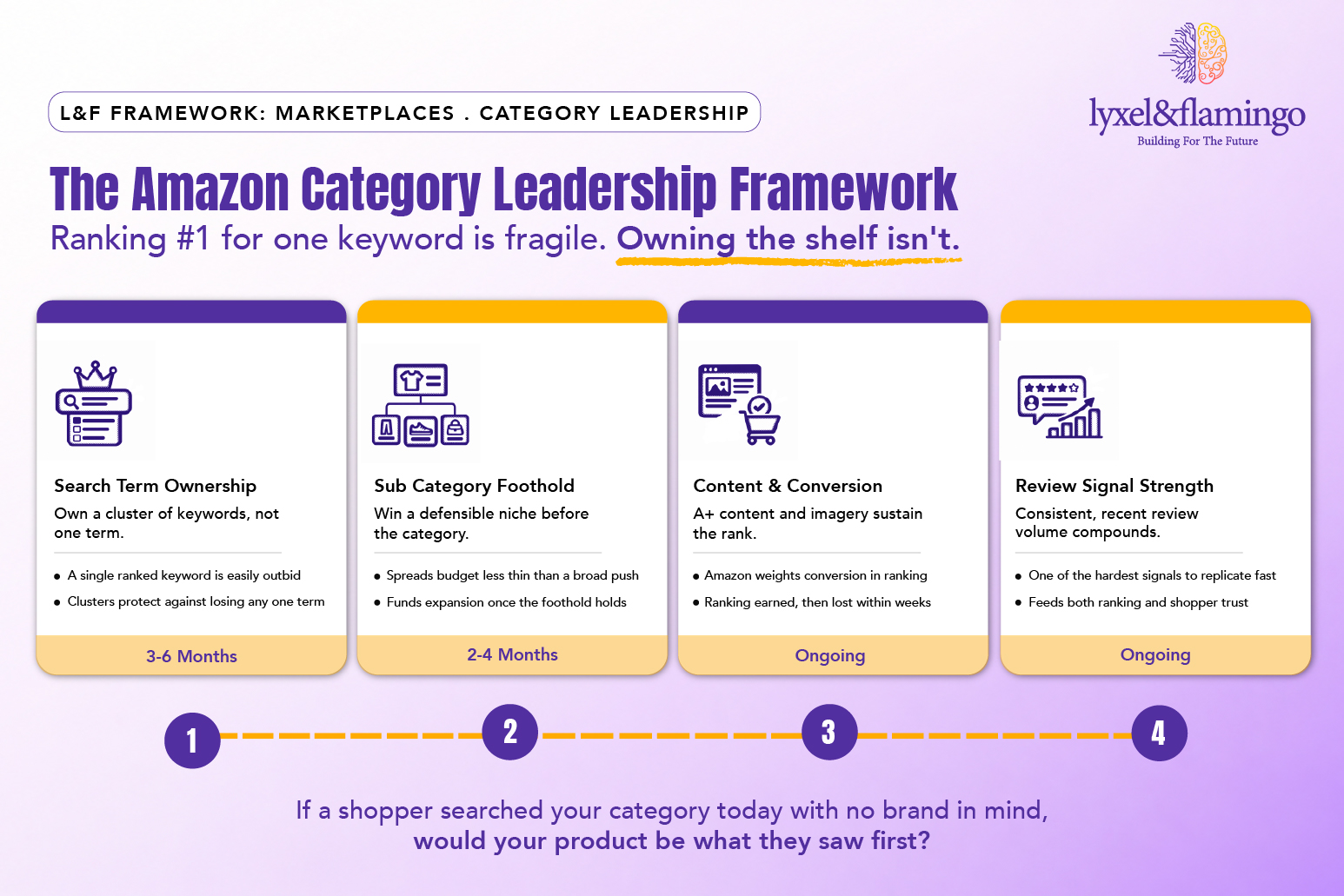
The table below breaks category leadership into the layers that need to be built and defended together, since strength in one layer rarely compensates for weakness in another.
Search Term Ownership: Requires ranking across a keyword cluster, not one term. Time to build: 3–6 months. Risk if ignored: Fragile rank, easily displaced.
Sub-Category Foothold: Requires a defensible use case or niche won first. Time to build: 2–4 months. Risk if ignored: Budget spread too thin to win anywhere.
Content and Conversion: Requires strong A+ content, imagery, and conversion rate. Time to build: Ongoing. Risk if ignored: Ranking earned, then lost within weeks.
Review Signal Strength: Requires consistent, recent review volume. Time to build: Ongoing. Risk if ignored: Trust and ranking both quietly erode.
Framework Explained
Search Term Ownership across a cluster protects a brand from losing overall category visibility when a single competitor outbids one keyword.
Sub-Category Foothold gives a challenger brand a defensible starting point rather than competing head-on for the broadest, most expensive terms first.
Content and Conversion determine whether hard-won ranking actually converts, since Amazon’s algorithm rewards conversion performance in ongoing rank decisions.
Review Signal Strength compounds over time and is one of the hardest advantages for a new entrant to replicate quickly.
Client Proof Point
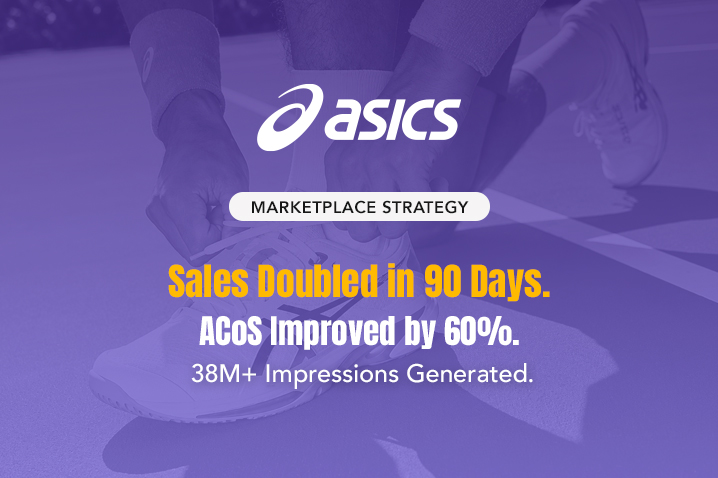
ASICS entered the Indian market as a late competitor against far larger sportswear brands. By focusing on capturing brand and category keywords and building high visibility in the specific sports where ASICS already held credibility, including sub-brands like Kayano and Nimbus, the brand grew AMS-attributed sales by 100% over a year, cut ACoS by 60% within three months, and reached 38 million-plus impressions, while organic traffic to its brand store climbed 40% month over month. Read the full ASICS case study.
Key Takeaways
Category leadership means owning generic, high-intent search terms, not just ranking for your own brand name.
A cluster of related keywords is more defensible than a single high-volume term a competitor can outbid.
Winning a specific sub-category or use case first builds a foothold that funds broader category expansion.
Content quality and conversion rate determine whether earned ranking actually holds over time.
Review signal strength compounds and is genuinely difficult for new entrants to replicate quickly.
CXO Takeaway
If a shopper searched your category today with no brand in mind, would your product be what they saw first? Category leadership on Amazon is built layer by layer, not won with a single well-optimized listing. Search term ownership, sub-category strategy, content, and review strength all need to move together for a position to actually hold. Lyxel&Flamingo’s third-party marketplace team helps brands build that shelf presence deliberately, rather than hoping it holds.
Frequently Asked Questions
Meaningful search term ownership across a keyword cluster typically takes three to six months of sustained investment, though a defensible sub-category foothold can be established faster, often within two to four months.
It can drive short-term visibility, though it rarely builds lasting leadership on its own. Owning attribute and use-case searches within the category tends to be more durable and converts at higher intent.
No. Challenger brands often win faster by claiming a specific sub-category or use case first, rather than competing broadly against category leaders from day one.
Content and conversion rate decline is the most common cause. Amazon’s ranking algorithm weights conversion performance heavily, so a listing that stops converting well tends to lose rank within weeks, even if the keyword strategy stays the same.