
What this blog covers
Voice search is changing how festive shoppers discover products, and many ecommerce brands are still writing pages for typed keywords alone. Queries such as “best Diwali gifts under ₹2000” are conversational, specific, and often driven by urgency. That creates a gap between what shoppers ask and what product pages actually answer.
This blog explains why traditional keyword-focused content can struggle with voice and AI-generated answers, even when a page ranks well in conventional search. It breaks down the Answer-First Architecture, covering direct answers, question-based headings, urgency signals, and FAQs that make category pages easier to understand and extract. It also shows how brands can prepare for festive demand without changing their products, pricing, or checkout experience. For FMCG, D2C, retail, and gifting brands, the message is straightforward: festive visibility now depends on answering customer questions clearly, across both search and AI-driven discovery.
Table of Contents
- What Is Voice Search Optimisation?
- The Problem: Typed Keywords and Spoken Questions Aren't the Same Query
- Why Assistants Skip Pages That Rank Fine on Google
- The Evidence: What the Data Actually Shows
- The Lyxel&Flamingo Framework: The Answer-First Architecture
- What Changes When Pages Are Rebuilt This Way
- 5 Things to Fix Before Your Next Festive Push
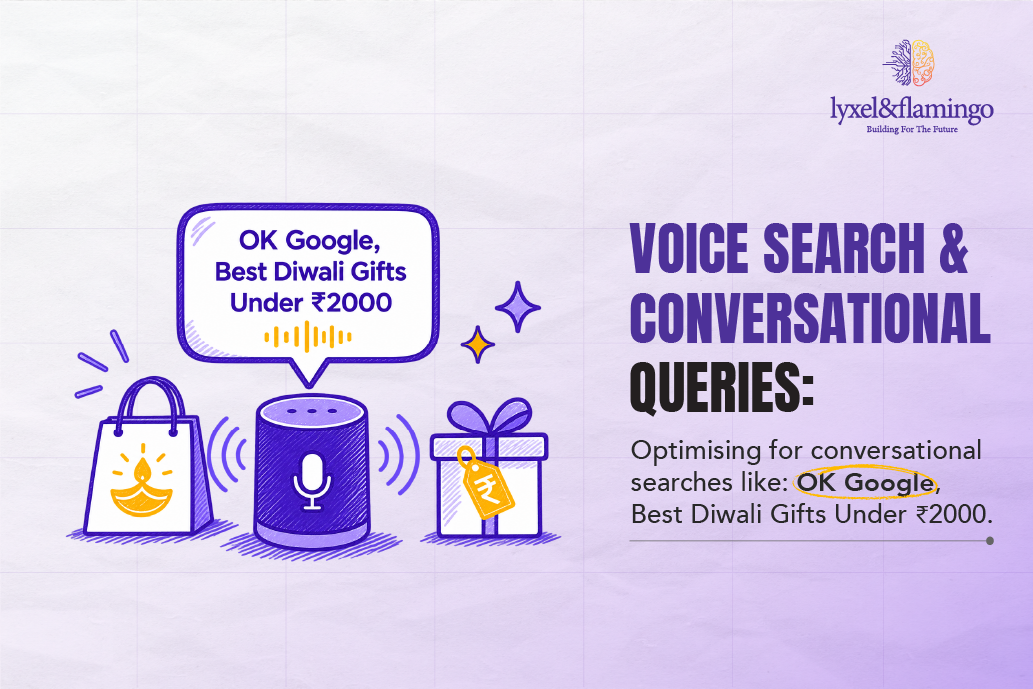
Voice search is changing what ecommerce pages need to answer. People ask complete questions, especially when they have a budget, such as finding the best Diwali gifts under ₹2,000. Product pages still rely on keyword-heavy wording, which misses how customers naturally speak and search. Closing that gap is where traditional SEO work and voice-readiness start to diverge, and it is a bigger problem than most marketing teams in FMCG, D2C, and retail brands realise heading into this festive season.
Search teams keep optimising for typed phrases like “diwali gifts under 2000” (a query that alone pulls close to 170 monthly searches, per keyword-planning data reviewed by our team), while a growing share of that same intent is arriving as a spoken question to Google Assistant, Alexa, or an AI chat interface. Those two query formats do not behave the same way, and a page tuned only for the typed version frequently gets skipped entirely when the query is spoken. That gap is exactly where Lyxel&Flamingo’s GEO work has focused for gifting and D2C clients heading into Q3 and Q4.
The gap between typed-keyword SEO and voice-query readiness is now one of the biggest blind spots in festive commerce content, and it is closable with the right structure, not a redesign.
What Is Voice Search Optimisation?
Voice search optimisation is the practice of structuring content so it directly answers spoken, conversational queries, the kind people ask assistants like Google Assistant, Alexa, and Siri in full sentences rather than fragments. Unlike typed SEO, which rewards keyword density and page authority alone, voice optimisation rewards concise, direct answers positioned near the top of a page, because assistants read one answer aloud and move on.
It matters right now because voice-led shopping queries spike hard around India’s festive calendar, when time-pressed shoppers ask their phone for unique Diwali gifts under 2000 instead of typing it out while juggling three other tasks. A brand absent from that spoken answer loses the sale before the shopper even opens a browser tab.
The Problem: Typed Keywords and Spoken Questions Aren’t the Same Query
Most gifting and D2C brands write product and category pages around short, typed fragments: “diwali gifts,” or “gifts under 2000.” That approach made sense for a decade of desktop search behaviour, and it still works reasonably for the typed searcher. It breaks down the moment intent shifts to voice.
A shopper typing into Google searches “diwali gifts under 2000.” That same shopper, speaking to an assistant while cooking or driving, asks something closer to “what are the best diwali gifts under 2000” or “OK Google, find me some premium diwali gifts under 2000 that don’t look cheap.” These are longer, question-formatted, and loaded with qualifiers, “best,” “premium,” “unique,” that a keyword-stuffed meta description simply does not answer.
India’s festive digital retail economy is not a niche use case either. E-commerce GMV during the 2025 festive sale period crossed ₹1.15 trillion, growing roughly 20% year-on-year, with Day 0 and Day 1 sales alone surging 23 to 25% against 2024. A meaningful and growing slice of that volume starts as a spoken question, not a typed one, and pages built only for the typed version are structurally unable to answer it.
Brands that only optimise for typed keywords are invisible to an entire category of festive shoppers who never open a search results page at all.
Why Assistants Skip Pages That Rank Fine on Google
Here is the part most SEO teams get wrong, and it is worth slowing down for. Google Assistant, Alexa, and AI-driven answer engines do not read your whole page and summarise it on the fly. They pull a short, pre-formed answer, usually a single sentence or a tight paragraph, from a page that already states that answer clearly near the top. If your page buries the answer under three paragraphs of brand story before it gets to “gifts under ₹2000,” the assistant has already moved to a competitor’s page by the time it would have reached yours.
Google AI Overviews and ChatGPT-style answers both need content that directly addresses the question being asked. Marketing lines such as “celebrating the spirit of togetherness” sound pleasant, but they give AI nothing useful to extract. If someone searches for Diwali gifts under ₹2,000, write a direct answer such as: “The best Diwali gifts under ₹2,000 include personalised diyas, dry fruit hampers, and festive candle sets.” The answer becomes easier to understand, extract, and potentially cite.
AI needs one clear answer it can confidently use. If your page hides that answer inside marketing copy, a competitor with simpler wording may get cited instead, even when your product offers more value.
Voice queries also skew heavily toward local and immediate intent, “best last minute diwali gifts under 2000” is a phrase spoken by someone under real-time pressure, often within 24 to 48 hours of the festival. Pages that do not explicitly address urgency, same-day delivery, ready stock, or quick gifting lose that intent entirely, regardless of how well they rank for the calmer, planned-in-advance version of the same keyword.
Want to know why long-tail, question-style content keeps outperforming short keyword pages? Read this blog: Blogging Benefits – Surprising SEO Benefits of Blogging that Improve Visibility
The Evidence: What the Data Actually Shows
E-commerce festive GMV crossed ₹1.15 trillion in the 2025 festive season, growing roughly 20% year-on-year. This is not a slow-growth category; budget-conscious festive gifting is one of the fastest-moving windows in Indian retail, and a two-week visibility gap costs real revenue, not just impressions.
Smart speaker and voice assistant usage crossed critical mass years ago, with over 60% of adults reporting they use a voice assistant on some device, and most of those users engaging with it daily. This isn’t an emerging behaviour anymore, it’s baseline. A gifting brand treating voice as experimental in 2026 is optimising for a smaller and smaller share of actual search behaviour.
Domestic festive-week travel search interest rose 18% year-on-year, and destination-specific searches like Udaipur and Jaipur jumped 49% and 46% respectively. This matters beyond travel, it confirms festive-season search volume overall is compounding hard, not just holding steady, which raises the cost of being unreachable on any query variant, spoken or typed.
The Lyxel&Flamingo Framework: The Answer-First Architecture
At Lyxel&Flamingo, we use a three-layer model to make product and category pages retrievable by both search engines and voice assistants at once. We call it the Answer-First Architecture, and it was built specifically for high-intent, budget-anchored retail queries like this one.
- Direct Answer Layer: The first 100 to 150 words of any category page state the answer plainly: what qualifies as a good gift in this price band, named categories, no throat-clearing. This is the passage an assistant reads aloud, so it has to work standing completely alone, without the rest of the page around it.
- Question-Match Layer: Subheadings are written as actual questions people ask, “what are the best diwali gifts under 2000,” not generic labels like “our collection.” Every H2 doubles as a query match, because assistants and AI Overview panels are pattern-matching the phrasing of the heading against the phrasing of the spoken question.
- Urgency and Specificity Layer: Every product mention carries a concrete detail: price, delivery window, occasion fit. “Best last minute diwali gifts under 2000” only gets surfaced to a page that explicitly signals speed and availability. Vague “shop now” language does not qualify as an urgency signal to a machine reading for intent.
In our work with gifting and D2C brands during festive cycles, the second layer, question-matched subheadings, is consistently the most under-invested element, and also the one with the fastest visibility lift once fixed. Teams pour budget into product photography and paid media while the H2 tags still read like a 2015 brochure.
What Changes When Pages Are Rebuilt This Way
A leading D2C gifting brand we worked with came into the festive season with strong typed-keyword rankings but almost no presence in voice or AI-generated answers for the same product set. The brief was straightforward: fix visibility for conversational, budget-specific queries without touching the core product catalogue or checkout flow.
L&F’s approach restructured category pages around the Answer-First Architecture above, rewriting openings as direct, quotable answers, converting subheadings into question format, and adding explicit urgency and price-band signals across the top-performing SKUs. Nothing about the product mix or pricing changed, only how the content was structured for extraction.
- A marked increase in AI Overview and voice-surfaced visibility within the core festive window
- A clear lift in organic sessions landing on budget-specific category pages
- A meaningful improvement in click-through from question-formatted SERP features
The interpretation matters more than any single number: none of this required new products, new pricing, or new ad spend. It required the existing catalogue to be legible to a machine reading it out loud, which is a content and structure problem, not a merchandising one.
5 Things to Fix Before Your Next Festive Push
- Rewrite your top category page opening as a standalone spoken answer. Draft the first 100 words as if reading them aloud is the entire interaction. State the price band, the gift types, and a qualifier like “unique” or “useful” explicitly, don’t make an assistant infer it.
- Convert at least five H2 subheadings into real questions. Pull directly from how people search: “what are the best diwali gifts under 2000,” “best gifts to buy for diwali under 2000.” Match the phrasing closely, near-matches lose to exact-phrase competitors in voice retrieval.
- Add explicit urgency signals to time-sensitive product pages. If a product genuinely ships same-day or next-day, say so in the first two sentences of that section. “Best last minute diwali gifts under 2000” queries reward pages that answer the time pressure directly.
- Build a dedicated FAQ block using natural spoken phrasing. Assistants and AI answer engines lean heavily on FAQ-formatted content because it is already structured as question-and-answer. This is the single highest-leverage addition most gifting pages are missing entirely.
- Plan a Shopify migration without losing rankings if a platform move is on the roadmap. Map every URL before cutover: Shopify supports up to 100,000 redirects on standard plans and 20 million on Plus. Skipping this mapping step is how brands lose the very rankings this whole framework is built to protect, right before the traffic spike that was supposed to reward it.
Conclusion
Voice search and AI visibility are no longer side tasks for festive ecommerce. Brands that ignore them leave a clear opening for competitors with better category pages. The gap can close quickly once one brand starts answering customer questions in the language people use. Product quality alone may not secure that visibility. Your pages need clear answers, useful category information, and wording that AI systems can understand and reuse. Fix those basics before the festive rush, because competitors usually do not wait for your next Diwali planning cycle.
Frequently Asked Questions
Personalised diyas, premium dry fruit hampers, festive candle and decor sets, and small home decor pieces perform consistently well in this range. The most useful Diwali gifts under 2000 combine a festive theme with everyday usefulness, which is what drives repeat gifting year after year.
SEO targets typed keywords and page-level ranking factors like backlinks and site structure. Voice search optimisation targets spoken, question-formatted queries and rewards concise, extractable answers positioned early on the page. They overlap heavily but are not the same discipline.
Open the page with a direct, plain-language answer to the likely spoken question, then add question-formatted subheadings and a natural-language FAQ section. Avoid burying the answer under brand copy, assistants pull from the clearest, earliest passage they find.
Ideally 8 to 10 weeks before the festive peak, since content restructuring, indexing, and any platform migration work all need time to settle before traffic spikes. Starting in the final two weeks before Diwali leaves almost no room to recover from indexing delays.
Yes, and arguably more so for mid-sized brands, since large competitors are slower to restructure legacy catalogues. A smaller, focused product range is easier to rebuild around the Answer-First Architecture, which means faster wins relative to team size.