
Blog Summary
Brands treat availability as an operations problem and advertising as a marketing one, and that split quietly costs them a fortune. An out-of-stock hero product is not a warehouse hiccup that marketing can work around; it is a live advertisement that keeps spending while returning nothing, and it hands the shopper sometimes for good to whoever is still on the shelf. This is the case for treating availability as one of the most important marketing decisions a brand makes.
Table of Contents
The Ad that runs to a dead end
Picture a brand running a strong campaign on a hero product. The creative is sharp, the bids are competitive, the clicks are coming, and the product is out of stock. Every rupee of that spend is now buying a click that lands on a page where nothing can be bought. The campaign has not stopped; the dashboard still shows activity. But the advertisement has quietly become the most expensive kind there is: one that spends in full and returns nothing, because the thing it is selling is not there to sell.
That is the heart of why availability belongs to marketing, not just operations. A stockout does not politely pause the demand a brand has worked to create. It lets that demand arrive, find nothing, and go elsewhere, and it keeps the marketing running the whole time, paying to send shoppers to a door that is shut.
Related Blog: Festive Season Inventory & Buy Box Strategy
What availability really is
Availability is the share of the time a product is actually there to be bought when a shopper looks for it, at the specific place they look. That last part matters: on quick commerce, being in stock nationally means little if the dark store serving a particular neighbourhood has run dry. Availability is not a single number in a central warehouse; it is a live condition that varies by product, by place and by hour, and it is the foundation every other marketing investment quietly depends on. A campaign, a ranking, a price none of them can do their job on a product that is not there.
Related Blog: Quick Commerce Funnels: Blinkit, Zepto & Instamart Guide
The sale you see, and the costs you do not
When a brand thinks about the cost of a stockout, it usually pictures the immediate sale it missed. That is the small, visible tip. The higher cost sits underneath, mostly unseen: the advertising spend still driving to a dead end, the search ranking the listing quietly loses because a product that cannot sell reads as weak demand, the shopper who switches to a rival, and the competitor who just won that shopper and may keep them. The missed sale is the part a brand notices. The rest is what actually makes a stockout expensive.
The shopper who does not wait
The most underrated cost is the shopper themselves, because they rarely wait. Faced with an empty listing, most simply buy the nearest alternative, and a meaningful share do not come back. Industry research has found that nearly half of shoppers switch brands when their chosen product is out of stock. On a channel built for immediacy, that number is, if anything, higher, because the whole promise is getting the thing now, and a brand that cannot deliver on that promise has handed a rival a trial it did not have to earn. Some of those borrowed shoppers become the rival’s for good.
The ranking that quietly falls
The subtlest cost is the ranking. Marketplace and quick commerce algorithms read availability and sales velocity as signals of demand, so a product that goes out of stock stops selling, and a product that stops selling slides down the results, which means that even after the stock returns, the listing comes back lower than it left. A stockout is therefore not a pause a brand simply resumes from; it is a step backward that has to be climbed again, with the ground given up during the outage often taken by a competitor who stayed on the shelf.
The true cost of a stockout
Add the layers together, and the true cost of a stockout dwarfs the sale it misses: the wasted ad spend, the lost ranking, the switched shopper, and the competitor who gained. Seen whole, availability stops looking like a downstream operations metric and starts looking like what it is: a marketing lever, and one of the most powerful a brand controls, because keeping a product on the shelf protects every other investment stacked on top of it.
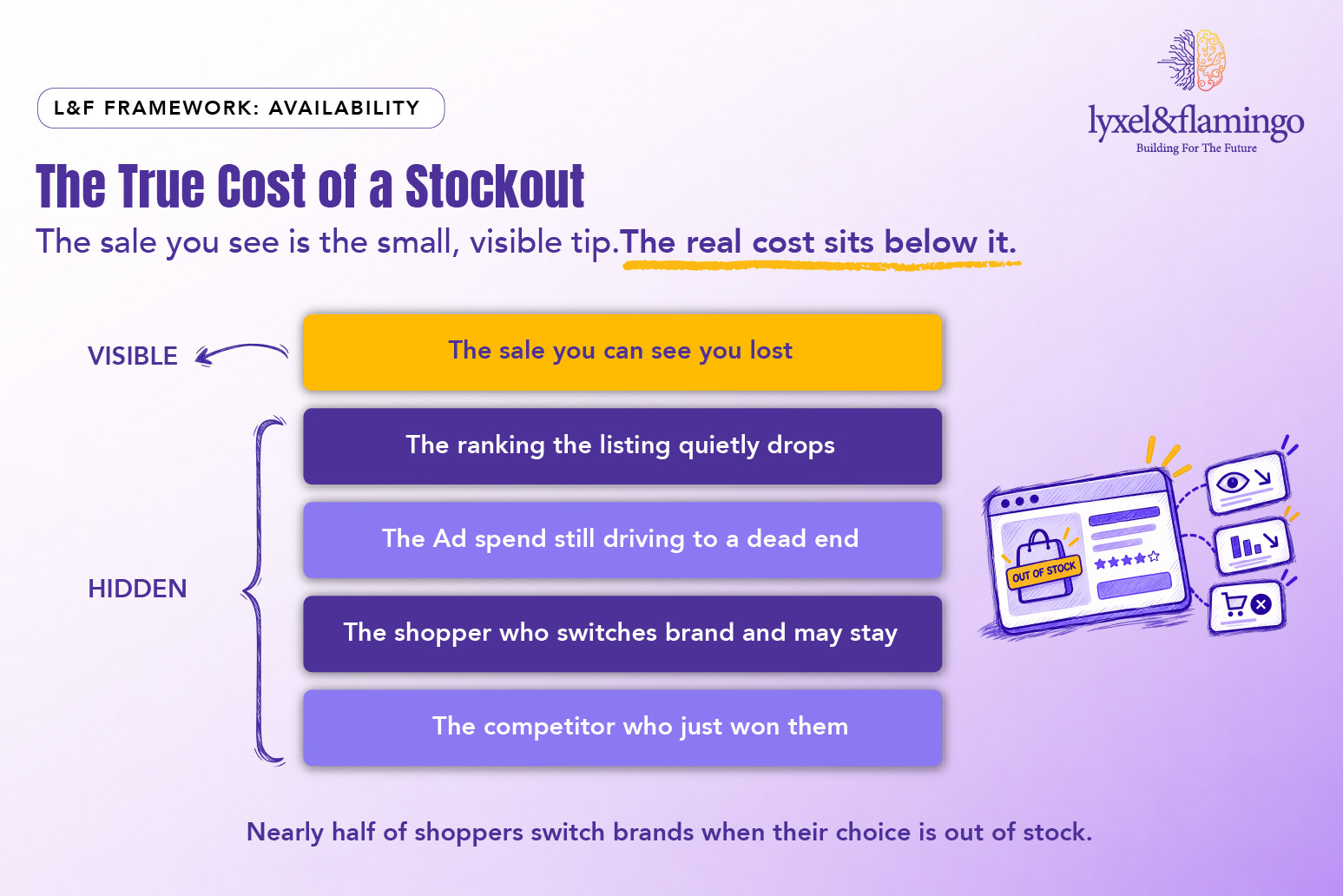
The True Cost of a Stockout: the missed sale is the visible tip; the real cost sits below it.
Availability as a marketing decision
Treating availability as marketing changes who owns it and how it is planned. It means marketing and supply teams reading the same demand signals, buffers sized around the products a brand is actively promoting, and no campaign switched on behind a hero that cannot stay in stock. It is the discipline that makes the difference through a high-demand period on quick commerce, where a single day out of stock on a bestseller can cost more than the buffer would all year. The brands that get this right do not ask marketing to work around stockouts. They make availability part of the marketing plan.
Related Blog: Quick Commerce Goes Festive: Winning the Season on Blinkit, Zepto and Instamart
The question to sit with
So the question worth sitting with is not whether your campaigns are strong. It is whether the products behind your strongest campaigns will still be on the shelf when the demand you created arrives – or whether your best advertisement this season will turn out to be an empty listing, spending in full and returning nothing.
Closing
Treating availability as marketing is a discipline, and it is one Lyxel&Flamingo builds with brand teams across marketplaces and quick commerce. If you would like a clear read on where a stockout is most likely to turn your best campaign into your costliest one, our marketplace team can audit your availability against your marketing plan and show you where the risk sits. Start that conversation with us whenever you are ready.
Frequently Asked Questions
Because it wastes ad spend, loses ranking and hands the shopper to a competitor, all at once. An out-of-stock hero product keeps advertising spending while returning nothing, and nearly half of shoppers switch brands when their choice is unavailable.
A product that cannot sell reads as weak demand, so its listing slides and returns lower. Marketplace and quick commerce algorithms treat availability and velocity as demand signals, so a stockout costs ranking that must be re-earned.
Both - which is the point; it cannot sit only with operations. Availability is a marketing lever because every campaign, ranking and price depends on the product being on the shelf.
Far more than the missed sale the wasted spend, lost ranking and switched shopper together. The true cost of a stockout is dominated by the hidden costs beneath the visible missed sale.