
What this blog covers
Most Amazon display campaigns default to generic banners and hope volume compensates for weak creative. Godrej Appliances took a different approach for a short-window sale event, building culturally resonant creative that highlighted genuine product differentiators, then deploying it across the specific placements that match each stage of the Amazon shopper journey. The result was a 2X CTR lift, 32X increase in purchase rate, and 30X increase in add-to-cart actions. This blog breaks down the creative and placement decisions that made that possible.
Quick Answer: High-converting Amazon display creative for a short sale window combines cultural relevance with genuine product differentiation, deployed across placements matched to shopper intent. Godrej Appliances used design elements tied to Republic Day (without literal flag imagery), led with real differentiators like energy efficiency and warranty length, and spread creative across native ads, above and below-the-fold slots, remarketing, and quad card formats. That combination produced a 2X CTR improvement and a 32X increase in purchase rate during the sale window.
Table of Contents
- Why Generic Banners Fail in a Short Sale Window
- Cultural Relevance Without the Literal Symbol
- Lead With Real Differentiators, Not Just Discounts
- Matching Creative Format to Shopper Journey Stage
- The Numbers Behind Each Placement
- Building This Into a Repeatable Playbook
- Framework Explained
- Key Takeaways
- CXO Takeaway
Why Generic Banners Fail in a Short Sale Window
A short sale window, tied to a specific event rather than a weeks-long festive stretch, does not have time for a shopper to warm up to a brand across multiple touchpoints. The creative has to do the convincing on the first or second impression, which is precisely where generic, discount-only banners fall short.
Godrej Appliances faced this problem directly: a home appliances brand with 60-plus years of history needed to win attention, click-through, and conversion inside a compressed window aligned to Republic Day, competing in category segments like air conditioners and high-capacity refrigerators where category CTR averages are already a known benchmark to beat.
Cultural Relevance Without the Literal Symbol
Rather than using literal flag imagery, the campaign integrated Indian tricolour symbolism through design choices: saffron skies, white architectural details, green foliage. This is a subtler form of cultural resonance than a banner slapped with a flag graphic, and it reads as intentional design rather than an obvious seasonal template.
This distinction matters for CTR specifically. A shopper scrolling through a crowded display environment registers generic seasonal creative as noise. Creative that feels considered, even at a glance, earns a longer look, and a longer look is what a click requires.
Lead With Real Differentiators, Not Just Discounts
The creative highlighted genuine product differentiators: energy efficiency, AI cooling, five-year warranties, alongside the discount itself. Discount-only messaging competes purely on price, a race Godrej does not need to win against category competitors on every SKU.
Leading with real product attributes gives a shopper a reason to click that survives past the sale window. A warranty length or an efficiency rating is a permanent feature of the product; a discount is not. This is the same principle behind winning new-to-brand customers when every competitor discounts at once: differentiation, not discount depth, is what a brand controls when every competitor is cutting price simultaneously.
Matching Creative Format to Shopper Journey Stage
The campaign deployed creative across native ads, above-the-fold and below-the-fold slots, third-party remarketing, and quad card formats, with messaging aligned to distinct stages of the Amazon shopper journey rather than a single creative pushed everywhere uniformly.
This format-to-stage matching is what separates a display campaign that merely reaches shoppers from one that moves them through a funnel. A shopper encountering the brand for the first time via a native ad needs a different message than one being remarketed to after already viewing a product page. That same journey-stage thinking carries through to the Amazon Brand Store that converts, past a digital catalogue: the destination a display ad sends a shopper to matters as much as the creative that got them there.
The Numbers Behind Each Placement
The results validate the format-matching approach at a granular level. Overall CTR improved 2X, and purchase rate increased 32X, alongside a 30X increase in add-to-cart actions. Category-specific numbers back this up further: air conditioner CTR reached 2.26% against a 1.04% category average, and refrigerator CTR reached 1.38% against a 0.88% category average.
The quad card format performed exceptionally well for air conditioners specifically, reaching a 3.31% CTR, more than triple the category benchmark. That kind of format-specific outperformance is only visible when creative and placement decisions are tracked separately rather than as one blended campaign number.
Building This Into a Repeatable Playbook
The specific creative choices, tricolour-inspired design, Republic Day timing, will not repeat exactly for every sale event. The underlying playbook does: find a genuine cultural or seasonal hook that goes beyond the obvious symbol, lead creative with real product differentiators, and match format to shopper journey stage rather than running one creative everywhere.
That structure is what a brand can carry into the next major marketplace sale event, regardless of which specific holiday or occasion anchors it, and it pairs directly with defending ROAS through the festive bidding war, since creative that converts at a higher rate is also the cheapest defense against rising festive CPCs.
Framework Explained
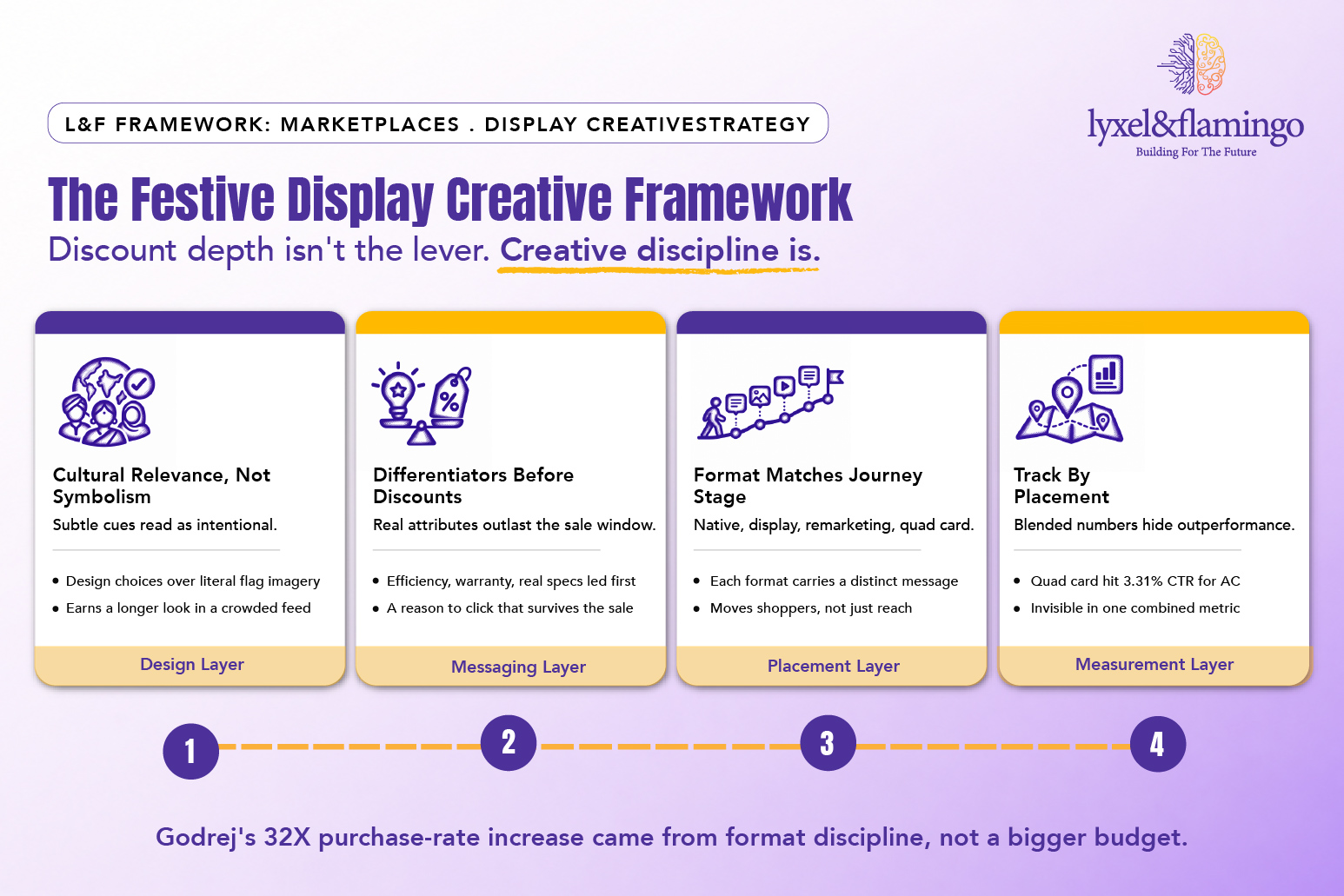
Cultural relevance over literal symbolism: subtle, design-led seasonal cues earn attention that an obvious template does not.
Differentiators before discounts: genuine product attributes give a shopper a reason to click that a discount alone cannot.
Format matches journey stage: native, display, remarketing, and quad card formats should each carry a message suited to that shopper’s position in the funnel.
Track by placement, not blended: format-specific outperformance, like the quad card’s 3.31% CTR, is invisible in a single blended campaign number.
✓ CLIENT PROOF POINT: Godrej Appliances achieved a 2X improvement in CTR and a 32X increase in purchase rate on Amazon during a Republic Day sale window, with air conditioner CTR reaching 2.26% against a 1.04% category average. The campaign used culturally resonant, differentiator-led creative matched to shopper journey stage across native, display, remarketing, and quad card formats. Read the full Godrej Appliances case study.
The same format-and-differentiator discipline carries across categories: Asics’ AMS launch performance and Bosch Power Tools’ work scaling visibility and performance both show journey-matched creative and placement strategy outperforming a single generic banner run everywhere.
Key Takeaways
- A short sale window does not give shoppers time to warm up across touchpoints, which means creative has to convince on the first or second impression.
- Subtle, design-led cultural relevance outperforms literal seasonal symbolism because it reads as intentional rather than generic.
- Leading creative with real product differentiators, not just the discount, gives shoppers a reason to click that outlasts the sale window.
- Matching creative format to shopper journey stage, and tracking results by placement, reveals outperformance that a blended campaign number hides.
CXO Takeaway
The question worth asking about the next display campaign is not “how many impressions can we buy.” It is: does every placement carry a message suited to where that shopper actually is in the funnel?
Godrej’s 32X purchase-rate increase came from format discipline, not from a bigger media budget.
If your display creative still runs as one banner across every placement, Lyxel&Flamingo can build the journey-matched creative framework that delivered a 2X CTR lift for Godrej Appliances.
Frequently Asked Questions
No. The underlying principle, subtle design cues tied to a genuine occasion rather than an obvious template, applies to any seasonal or cultural moment relevant to the brand’s audience, from regional festivals to category-specific shopping moments.
Start with attributes that are both genuinely differentiating and easy to communicate visually or in a short headline, such as warranty length, efficiency ratings, or a specific technology feature, rather than trying to fit every product benefit into one creative.
The format allows multiple product angles or benefits in one unit, giving a category like air conditioners, where shoppers often compare several features at once, more information density within a single ad unit than a standard banner.
The format-to-journey-stage matching and differentiator-led creative principles apply at any brand size. A smaller brand may run fewer placements simultaneously. The same logic, real differentiators over discount-only messaging, holds regardless of scale.