What This Blog Covers
Composable commerce solves real problems around speed and flexibility, yet it trades platform lock-in for a different risk: vendor sprawl and integration debt that grows quietly with every new best-of-breed tool added to the stack. This playbook is for the CTO managing that second-stage problem, with a framework for deciding what to add, what to consolidate, and how to govern a composable stack before it governs you.
Quick Answer: Vendor sprawl in composable commerce happens when teams add best-of-breed tools independently, without a shared ownership model for integrations, auth, and data contracts between them. The fix is not to stop composing; it is to govern composition deliberately, with a small number of well-owned integration points instead of dozens of point-to-point connections. Enterprises that succeed with composable architecture treat vendor governance as a first-class discipline, reviewed on the same cadence as security or uptime.
Table of Contents
The Promise Versus the Reality of Composable Commerce
The pitch for composable commerce is straightforward: swap out a single component (search, checkout, CMS, personalization) without touching the rest of the stack, and move faster than a monolith ever allowed. The MACH Alliance, the industry body formalizing this microservices, API-first, cloud-native, headless approach, has made the architecture pattern itself a well-understood, vendor-neutral standard. For a specific, well-scoped problem, that promise holds up well.
The reality shows up eighteen months later. Each best-of-breed tool arrived to solve one team’s problem in isolation, so the enterprise ends up with excellent point solutions and no coherent system connecting them. What was sold as modularity starts to feel like fragmentation, because nobody owns the seams between the pieces.
This is not an argument against composability. It is an argument for treating the architecture decision and the governance decision as two separate commitments, made deliberately rather than one following automatically from the other.
How Vendor Sprawl Actually Happens
Sprawl rarely happens through one bad decision. It happens through twenty reasonable ones, each made by a different team with a legitimate need and no visibility into what the last three teams already bought.
Marketing adds a personalization engine. Merchandising adds a PIM. Growth adds an experimentation platform. Each vendor integrates directly with the commerce core, because that is the fastest path to shipping, and each integration is a new dependency nobody centrally tracks. Eighteen months later, the org has forty integration points and no one who can draw the full picture from memory.
The pattern accelerates under pressure. A tight deadline pushes a team to bolt on a quick integration “for now,” and “for now” tends to outlive the person who wrote it. Composable stacks do not sprawl because the architecture is wrong; they sprawl because nobody was assigned to prevent it.
The Hidden Cost: Integration Debt
Integration debt behaves like technical debt with a longer fuse. Each individual connection is easy to justify and cheap to add. The cost shows up later, in the form of a checkout outage nobody can diagnose quickly because the failure could be in any one of six vendor integrations, each owned by a different team on a different on-call rotation.
Vendor consolidation conversations at renewal time often reveal the real number: three tools doing overlapping jobs, none of them fully retired because some workflow, somewhere, still depends on the old one. That overlap is rarely visible until someone goes looking for it, which is usually during an incident rather than a planning cycle.
The teams that catch this early tend to be the ones already thinking hard about architecture on purpose rather than by accumulation. Lyxel&Flamingo’s work on enterprise headless commerce covers the speed and scale side of that decision; governance is the discipline that keeps the speed from becoming its own liability six months later.
The Composable Governance Framework
Governing a composable stack does not mean recentralizing decisions. It means putting four disciplines in place before the next vendor gets added, so growth stays deliberate instead of accidental.
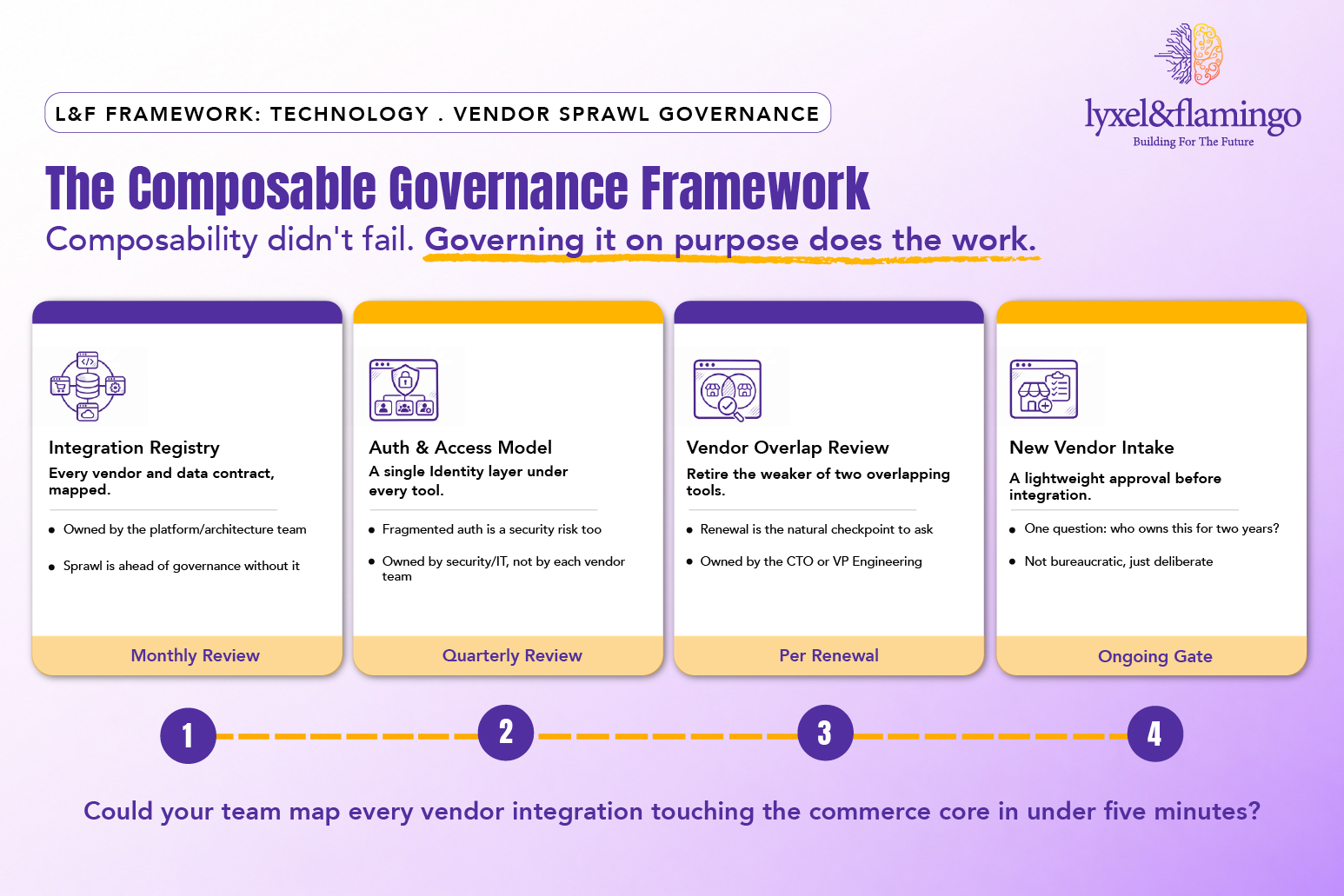
Framework Explained
Integration Registry: If nobody can produce a current map of every integration point in under five minutes, sprawl is already ahead of governance.
Auth & Access Model: Fragmented authentication across vendors is both a security risk and a sign that no one owns the system boundary; a single identity layer, built on an open standard like OpenID Connect, should sit underneath every composed tool.
Vendor Overlap Review: Renewal time is the natural checkpoint to ask whether two tools are quietly doing the same job, and to retire the weaker one deliberately rather than letting both limp along.
New-Vendor Intake: A lightweight gate, not a bureaucratic one, that asks one question before any new integration ships: who owns this connection for the next two years?
Consolidate Without Recentralizing
Consolidation and recentralization sound similar and are not the same move. Recentralizing means going back to a monolith, giving up the flexibility that justified composability in the first place. Consolidating means reducing the number of vendors doing overlapping jobs while keeping the modular architecture intact underneath.
The practical version looks like this: standardize on one identity provider across every composed tool, pick one canonical data contract for product and order data that every vendor integrates against rather than negotiating a custom shape per tool, and retire the weaker of any two overlapping vendors at the next renewal instead of running both indefinitely “just in case.”
None of this requires slowing down feature delivery. It requires a standing decision about where new complexity is allowed to enter the stack, made once, rather than re-litigated every time a team wants to move fast on a new integration.
What Good Composable Governance Looks Like Day to Day
In practice, good governance is mostly invisible. Teams still pick the best tool for their problem. New vendors still get evaluated and onboarded. The difference is that every addition passes through the same lightweight intake, lands in the same integration registry, and sits behind the same identity layer, so the stack grows by design instead of by accident.
The CTOs who get this right tend to review the vendor list the same way they review the security posture: on a fixed cadence, with a clear owner, and with the explicit goal of keeping the map smaller than the ambition. Composability stays a genuine advantage only as long as someone is actively maintaining the coherence underneath it.
CAPABILITY NOTE: Lyxel&Flamingo does not yet have a published case study specifically on vendor governance in a composable commerce stack. Our Technology services practice does work directly on API integrations, application architecture, and custom development for enterprise clients, including the kind of information-architecture and system-restructuring work reflected in our Pierag Consulting engagement, which is an adjacent architecture project, not a composable-commerce governance case study specifically.
Key Takeaways
- Vendor sprawl is not a failure of composable commerce; it is a failure to govern composition on purpose.
- Sprawl accumulates through many individually reasonable decisions, not one bad architecture call.
- Integration debt hides until an incident forces someone to map the dependencies under pressure.
- A four-part governance framework (registry, auth model, overlap review, new-vendor intake) keeps growth deliberate.
- Consolidating overlapping vendors is not the same as recentralizing the architecture; the modular stack can stay intact.
CXO Takeaway
Could your team produce a full map of every vendor integration touching your commerce core in under five minutes? If not, governance is already behind the architecture. Put an integration registry and a lightweight intake gate in place before the next renewal cycle forces the question. Talk to Lyxel&Flamingo’s technology team about an architecture and integration review through our Technology services page.
Frequently Asked Questions
No. Composable commerce solves real speed and flexibility problems that a monolith cannot. Vendor sprawl is a governance failure that can happen alongside any architecture choice; it happens more visibly in composable stacks because there are simply more seams to manage.
If no single team can produce an up-to-date list of every vendor integration touching the commerce core within a few minutes, sprawl has already outpaced governance. A checkout or catalog incident that takes longer than expected to diagnose because the failure could be in several different vendor integrations is another clear signal.
No, and that would trade one set of problems for another. The goal is consolidating overlapping vendors and standardizing shared layers like identity and data contracts, while keeping the modular, best-of-breed architecture intact.
Ideally a platform or architecture team owns the integration registry day to day, with the CTO or VP Engineering owning the periodic overlap review at renewal cycles. A lightweight architecture review board can own new-vendor intake without becoming a bottleneck.