
What This Blog Covers
Marketplace product copy does two jobs at once, and most brands write it for only one. Bullets and descriptions have to persuade a human who’s scanning quickly and skeptically. Titles and backend search terms have to feed an algorithm that decides which searches the listing even surfaces for in the first place. Copy optimised purely for persuasion often under-serves discoverability. Copy stuffed purely for keywords reads as unnatural and converts poorly once a shopper actually arrives. Here is how to write both jobs into the same page without either one undermining the other, and a real Flipkart campaign that proves disciplined, content-led copy moves both metrics together.
Quick answer: Effective PDP copy separates its two audiences by layer rather than trying to serve both at once in every sentence: the title carries the primary keyword and the specific product noun for algorithmic matching, bullets lead with scannable, benefit-led language for human persuasion, the description adds narrative depth and secondary keywords naturally, and backend search terms carry the algorithmic-only keyword variations that would read awkwardly if forced into visible copy. Each layer does its job cleanly instead of every sentence trying to do both.
Table of Contents
- The Two Audiences Every PDP Copy Has to Serve
- Why Writing for Both at Once Usually Fails Both
- The Four-Layer Copy Model
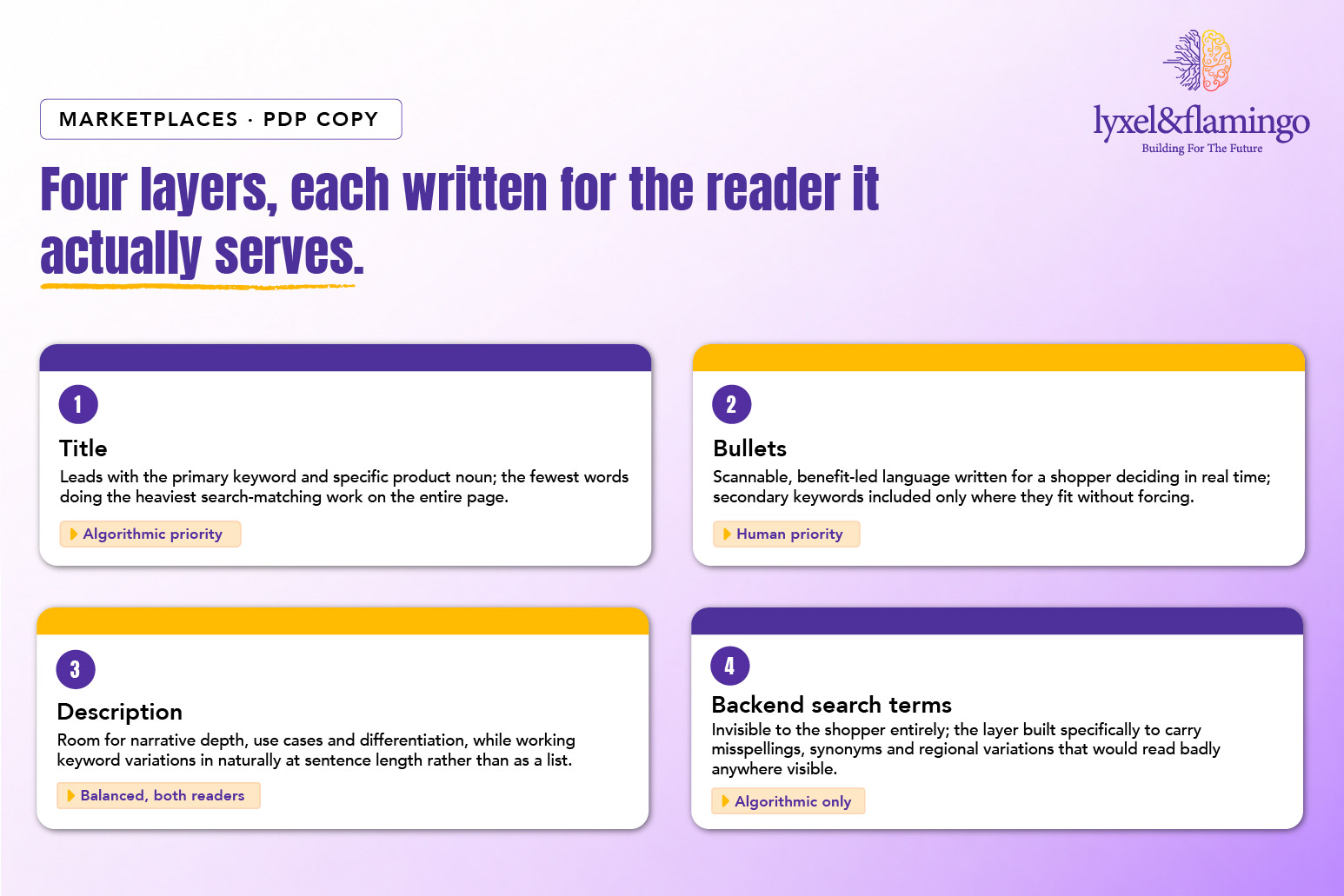
- The PDP Copy Layer Model: Four layers, each written for the reader it actually serves
- The Framework Explained
- A Real Campaign Where Content-Led Copy Moved Both Metrics
- Key Takeaways
- The CXO Takeaway
- The Question to Sit With
- Closing

The Two Audiences Every PDP Copy Has to Serve
A marketplace product page has exactly one set of words and two very different readers. A shopper scans it in seconds, judging tone, clarity and whether it answers their specific question. A search algorithm parses the same words for keyword relevance, deciding which queries the listing surfaces for at all, invisible to the shopper and decisive for whether that shopper ever sees the page in the first place.
Most copy briefs pick one reader and write for it. Content-first copy reads beautifully and ranks poorly. Keyword-first copy ranks well and reads like it was written by a spreadsheet. Neither version does the whole job.
It’s the same tension that decides whether a shopper who lands on the page actually stays for three seconds, the words only get read if the page has already earned that window.
Why Writing for Both at Once Usually Fails Both
The instinct to solve this by blending the two, weaving keywords naturally into persuasive sentences, sounds right and works up to a point. It breaks down once the keyword list gets long enough to matter for competitive categories. Forcing a dozen keyword variations into three bullet points either bloats the copy past what a scanning shopper will actually read, or forces awkward, repetitive phrasing that undermines the very persuasion the bullets exist to deliver.
The better approach doesn’t try to make every sentence do both jobs. It assigns each job to the layer of the page best suited to carry it.
The Four-Layer Copy Model
The title carries the primary keyword and the specific product noun a shopper searched for, doing the heaviest algorithmic lifting in the fewest words. Bullets lead with scannable, benefit-led language, written for the human decision happening in real time, with secondary keywords included only where they fit naturally. The description has room for narrative depth, use cases, differentiation, story, the persuasion a bullet point can’t carry, while still working in keyword variations that read naturally at sentence length. And backend search terms, invisible to the shopper entirely, carry the algorithmic-only keyword variations, misspellings, synonyms, regional terms, that would read awkwardly anywhere a human could actually see them.
Split this way, no single layer is asked to do a job it’s poorly suited for, and the page as a whole ends up serving both readers properly instead of compromising for either.
Getting this right matters most in a listing’s first weeks, when Amazon’s algorithm is still forming its baseline read on the page.
The PDP Copy Layer Model: Four layers, each written for the reader it actually serves
The Framework Explained
- Title:
A title has the least room and the most algorithmic weight of any layer on the page, which is exactly why it should carry almost no persuasive language at all. Every character spent on a marketing phrase in a title is a character not spent confirming to both a shopper and a search algorithm that this listing matches precisely what was searched for. The discipline here is counter-intuitive to anyone trained in traditional copywriting: the title’s job is not to sell, it’s to match, specifically and unambiguously, and the persuasion gets delegated entirely to the layers that follow once the algorithm has already decided to show the listing and the shopper has already clicked. - Bullets:
Bullets are read by a shopper who has already clicked through and is now actively deciding, which makes them the layer where forcing keyword density does the most active harm. A bullet point stuffed with three keyword variations to satisfy a content brief, rather than written to answer the specific question a shopper is asking at that exact moment in their decision, reads as robotic exactly when human trust matters most. Secondary keywords absolutely belong in bullets too, limited strictly to the ones that would appear naturally in a genuinely helpful answer to a shopper’s question, never as a checklist to be worked in regardless of how the sentence reads once they’re forced there. - Description:
The description is the one layer with enough room to genuinely serve both readers without compromise, and it’s consequently the layer most worth investing real writing time in rather than treating as a copy-paste of the bullets in paragraph form. Narrative depth, a specific use case, a differentiator explained in a sentence rather than a fragment, does real persuasive work a bullet point’s brevity can’t carry, and at that length, keyword variations can be worked in as natural word choices rather than forced insertions. A well-written description does double duty precisely because it has the space to let both jobs happen without either one crowding out the other. - Backend search terms:
This is the layer most brands under-use, treating it as an afterthought once the visible copy is finished, when it’s actually the cleanest solution to the entire tension this framework addresses. Every keyword variation, misspelling, regional term or synonym that would read badly if forced into a title or bullet has a home here instead, fully serving the algorithm’s need for keyword coverage without costing the visible copy a single word of readability. A brand that populates backend search terms thoroughly and specifically, rather than as a rushed afterthought, is quietly capturing search volume its visible copy never has to compromise its own persuasiveness to chase.
A Real Campaign Where Content-Led Copy Moved Both Metrics
Wipro Lights‘s Flipkart campaigns show what disciplined, layered content delivers when copy is built for both readers instead of compromising for either. CTR improved 12.37%, conversion rate improved 14.39%, and ROI improved 53.86%, engagement and conversion moving together on the strength of listing content built to perform in a scrolling feed and to surface for the right searches in the first place, not just to look good in an isolated review.
Our Third-Party Marketplace management services team writes catalogue-wide copy structured in exactly this layered model, for algorithm and shopper together.
Key Takeaways
- PDP copy serves two very different readers at once, a scanning human shopper and a keyword-parsing search algorithm, and most briefs write for only one.
- Blending both goals into every sentence tends to fail both once the keyword list gets long enough to matter for a competitive category.
- The four-layer model assigns each job to the layer best suited for it: title for algorithmic matching, bullets for human persuasion, description for both, backend terms for algorithm-only coverage.
- Backend search terms are the most under-used layer on most listings, and the cleanest place to carry keyword variations that would read badly anywhere visible.
- The Wipro Lights campaign shows this discipline moving both metrics together: 12.37% CTR growth and 14.39% conversion growth from the same layered content strategy.
The CXO Takeaway
For a brand leader overseeing a large catalogue, this layered model is less about any single listing and more about what it makes possible at scale: a copywriting standard that a team can apply consistently across hundreds of SKUs without every writer relitigating the persuasion-versus-keywords tension sentence by sentence. The Wipro Lights result shows that this discipline isn’t a trade-off between discoverability and conversion. Built correctly, layer by layer, it improves both at once.
The Question to Sit With
The question worth sitting with isn’t whether your product copy reads well or whether it’s optimised for search. It’s whether each layer of the page is doing the one job it’s actually suited for.
Closing
Lyxel&Flamingo writes catalogue-wide PDP copy structured in this exact layered model, for algorithm and shopper together. Want a review of where your current copy is compromising one job for the other? Start that conversation with L&F →
Frequently Asked Questions
One primary keyword and the specific product noun, stated clearly, is usually enough. Forcing additional keyword variations into a title tends to hurt readability without meaningfully improving search matching beyond what the primary term already achieves.
Yes, disproportionately so relative to the effort. They're invisible to shoppers, meaning there's no persuasion cost to populating them fully with every reasonable keyword variation, misspelling and regional term the product could be searched under.
No. A forced keyword in a bullet costs more in shopper trust than it gains in algorithmic matching, since bullets are read by an actively deciding human far more than they're weighted by most marketplace algorithms.
The core principle holds on both platforms. The specific backend fields and character limits differ slightly. Assigning algorithmic and persuasive work to different layers applies the same way.
At least twice a year, or around major sale events, since search behaviour and competitor copy both shift, and copy that was well-optimised a year ago can quietly lose ground without an obvious signal that it needs a refresh.