What This Blog Covers
Most brands run email, WhatsApp and the website on separate tools, so the same customer receives a cart reminder on chat after buying on web and a welcome email after they have already complained. This article explains why one journey needs one customer record, how the October 2026 move to per-message WhatsApp pricing changes the economics of automation, and how to design flows that respect channel roles instead of repeating the same message three times. It gives CRM leads and ecommerce marketers a four-link journey chain and a 60-day plan, so automation raises repeat revenue and lowers cost per message at the same time.
Quick Answer: Run one customer record across email, WhatsApp and web, give each channel a role, and design flows around the customer’s next step and not around the channel. From 1 October 2026 Meta charges per business message on the WhatsApp Business Platform, including utility templates sent inside the 24-hour window, so every automated message needs a purpose and a suppression rule. Measure repeat revenue per customer and cost per message together.
Table of Contents
- Why Three Channels Break One Customer Journey
- The One Customer Record That Makes Automation Respectful
- Why Per-Message Pricing Turns Every Automation Into a Budget Line
- Channel Roles in One Customer Journey
- The Channel Roles That Stop Flows Repeating Each Other
- What the Journey Chain Asks You to Connect
- The 60-Day Plan to Connect Email, Chat and Web Into One Journey
- Why Journey Measurement Must Follow the Customer and Not the Channel
- Key Takeaways
- CXO Takeaway
Why Three Channels Break One Customer Journey
Each channel is usually owned by a different tool and often a different team. Email runs in the marketing platform, WhatsApp in a messaging provider and the website in the commerce platform, and each keeps its own version of the customer. The result is familiar: a cart reminder arrives on chat after the order has shipped, and a review request goes to a customer with an open complaint.
The cost shows up in trust and in money. A customer who receives the same message in three places learns to ignore all three, while a customer who receives a useful message at the right moment replies. Conversational channels reward relevance more sharply than email does because a WhatsApp message arrives where personal conversations live.
The shift toward conversation is well documented in commerce. The analysis of social commerce on Instagram and WhatsApp shows how discovery, questions and purchase now happen inside chat, which means the journey no longer starts at your website. Your CRM has to follow the customer to wherever the next step happens.
Start with one audit. List every automated message your customer can receive in a week across email, chat, SMS and push, and count the duplicates and contradictions. Longer than anyone expects. Count first, then cut.
The One Customer Record That Makes Automation Respectful
A single customer record is the foundation of a single journey. It holds identity, consent by channel, orders, support history and the last meaningful event, and every channel reads from it and writes to it. Without it, suppression rules are guesses.
The cleanest design uses first-party events as the source of truth. The playbook in signal-based marketing describes how consented customer signals replace fading third-party data and improve attribution at the same time, and the same events drive messages: viewed, carted, bought, delivered, returned, contacted. One event, one decision, one message.
Consent must be recorded by channel and purpose. A customer who agrees to order updates on WhatsApp has not agreed to promotions, and the platform’s rules treat marketing and utility templates differently. Store the consent, the date and the wording, and let the record enforce it. Consent is data.
Choose the system of record before you choose the flows. It can be your CRM, a customer data platform or the commerce platform, as long as one of them is authoritative and the others sync from it. Write down which one, and who owns it.
Why Per-Message Pricing Turns Every Automation Into a Budget Line
WhatsApp pricing changed on 1 October 2026. Reports in Business Standard and elsewhere describe a move to per-message charging in which service replies and utility templates sent inside the 24-hour customer service window are no longer free, with each business phone number in India receiving 1,000 free service messages a month. Utility and authentication messages are reported at ₹0.115 per delivered message in India.
The categories matter because the prices differ. Marketing templates cost several times more than utility ones, with published figures around ₹0.78 to ₹0.86 per message depending on the source, so correctly categorising a transactional message as utility lowers cost. Use the category the message genuinely belongs to, and check the current rate card from Meta or your provider before you plan volumes. Rates change.
Channel Roles in One Customer Journey
Cost now follows design. A flow that sends five messages where two would do costs more, annoys more and converts no better. The discipline in building a single source of truth for marketing data helps here, because a trusted record lets you suppress a reminder when the order has already been placed. Every message needs a reason.
Calculate cost per journey and not only cost per message. Add up the messages in each flow, apply the category rates and divide by the revenue the flow influences. If a flow’s cost rises faster than its repeat revenue, simplify it. Spend where the customer answers.
The Channel Roles That Stop Flows Repeating Each Other
Give each channel one job. Email suits longer content, receipts and re-engagement over days. WhatsApp suits time-sensitive, personal and conversational moments such as order updates, delivery slots and answers to questions, and the web suits browsing, comparison and self-service. Roles prevent duplication.
Design around the next step and the customer’s intent. The method in persona-led CRO starts from who the customer is and what they are trying to do, and a journey should do the same: a first-time buyer needs reassurance and delivery clarity, a repeat buyer needs a fast reorder. Different customers, different next steps.
Let conversations drive the content. Search queries and chat questions show how customers phrase their needs, and conversational journeys mirror that behaviour when they answer in the customer’s words. Use the questions your support team hears most as the starting prompts for your flows. Ask less, answer more.
Always give a human fallback. Automation should hand over to a person when the customer is upset, confused or valuable enough to deserve attention, and the handover should carry the history. A good handover saves a customer and a bad one loses one.
What the Journey Chain Asks You to Connect
Four links, built in order, turn separate channels into one journey. The cadences are a recommended working pattern.
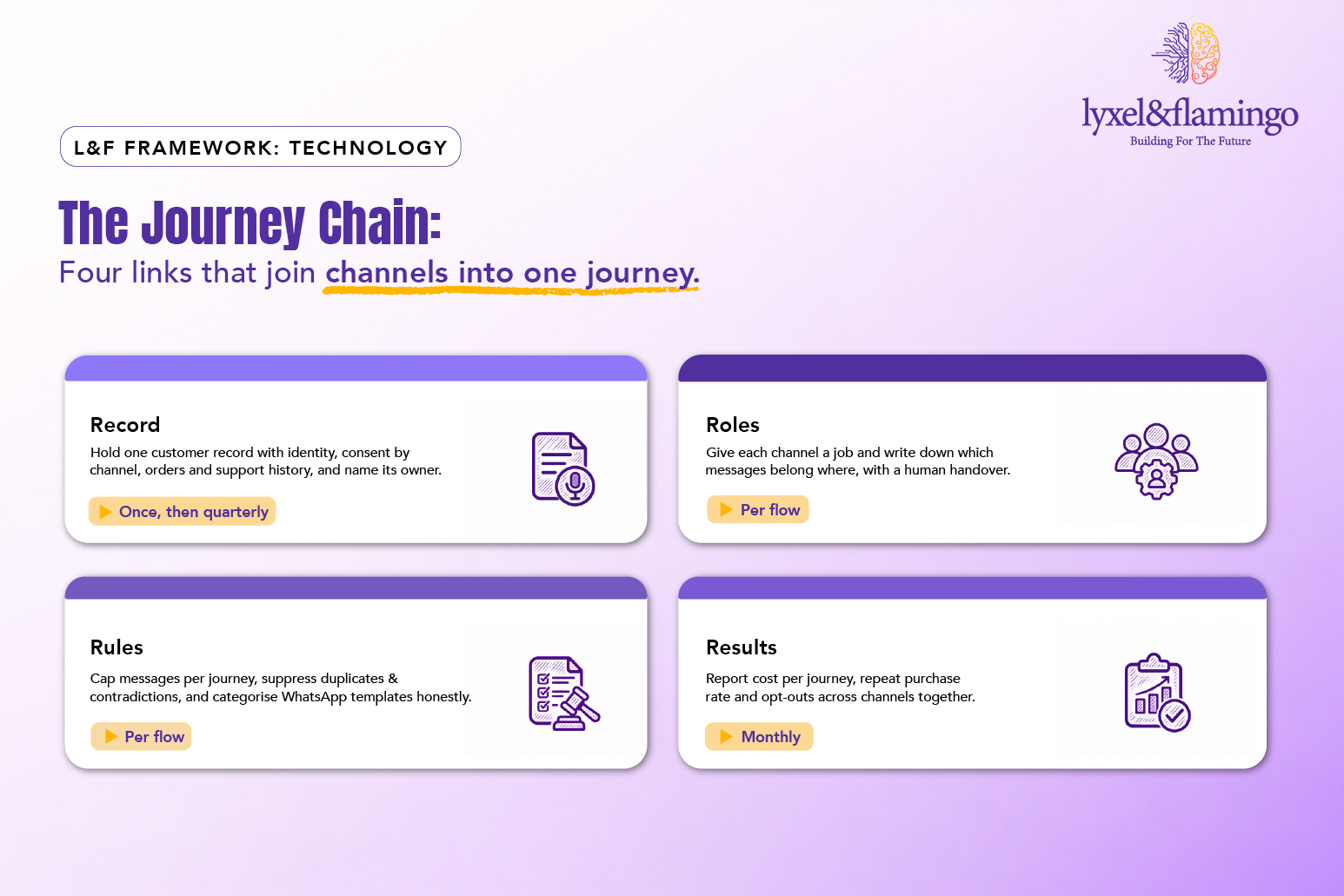
Framework Explained
Record: Begin with a single record of the customer. It should hold identity, consent by channel and purpose, orders, support history and the last meaningful event, and every channel should read from it and write to it. Name one system as authoritative and one person as its owner. Everything else in the chain depends on this record being trusted.
Roles: Decide what each channel is for. Use email for longer content, receipts and re-engagement, WhatsApp for time-sensitive and conversational moments, and the website for browsing and self-service. Write down which messages belong in which channel and add a human handover that carries history. Roles stop the same message being sent three times.
Rules: Write the rules that keep automation respectful and affordable. Cap the number of messages in a journey, suppress promotions after a complaint or a purchase, and categorise each WhatsApp template honestly as marketing, utility or authentication. Check the current rate card before planning volumes. Rules turn a pile of automations into a designed experience.
Results: Measure the journey and not the channel. Report cost per journey, repeat purchase rate, time between orders and opt-out rate, with conversions deduplicated in one place. Compare each flow with its baseline and remove messages that do not earn their cost. Review the numbers monthly with CRM, ecommerce and finance in the same room.
The 60-Day Plan to Connect Email, Chat and Web Into One Journey
Days 1 to 15: Audit and decide. List every automated message across channels, mark duplicates and contradictions, and choose the system of record for identity and consent. Agree the three flows that matter most, such as order updates, cart recovery and repeat purchase. Audit first.
Days 16 to 30: Unify the record. Sync identity, orders and consent by channel into the system of record, define the events that trigger messages, and set suppression rules, for example no promotion within 48 hours of a complaint. One record, clear rules.
Days 31 to 50: Rebuild the three flows. Assign each channel a role, categorise each WhatsApp template honestly, cap the number of messages per journey and add a human handover. Test with a small group and read the replies. Small group, real replies.
Days 51 to 60: Measure and adjust. Report cost per journey, repeat purchase rate and opt-out rate by flow, compare with the baseline, and remove any message that does not earn its cost. Review monthly. Fewer, better messages.
Why Journey Measurement Must Follow the Customer and Not the Channel
Channel dashboards flatter their own channel. Email reports opens, chat reports replies and the website reports sessions, and none shows whether the customer bought again. Measure the journey: repeat purchase rate, time between orders, opt-out rate and revenue per customer, across channels together.
Beware double counting. As your best customer can get counted three times explains, the same sale can be claimed by several systems at once. Deduplicate conversions in one place and agree which touchpoints receive credit. A simple rule applied consistently is better than a clever one applied unevenly.
Keep tracking sound when messages carry links. Server-side collection and consistent identifiers help preserve attribution, and tagged links let you tie a chat message to an order. Test the path from message to purchase end to end before launch.
Review the programme with the same rigour as media. Personalised, adaptive experiences are raising expectations, as adaptive interfaces and AI personalised UX describes, and customers will compare your journey with the best they have used. Set a quarterly review of flows, costs and outcomes, and retire what does not earn its place.
Key Takeaways
- Customers experience one conversation; separate tools and teams make it look like three channels.
- One customer record, with consent by channel, is the foundation of a respectful journey.
- From 1 October 2026 WhatsApp charges per business message, so every automated message needs a purpose and a suppression rule.
- Give each channel one role and design flows around the customer’s next step.
- Measure repeat revenue, cost per journey and opt-outs across channels together.
CXO Takeaway
Ask your CRM and ecommerce leads to list every automated message a customer can receive in a week across email, chat, SMS and push, and to mark duplicates and contradictions. Name one system of record for identity and consent, and one owner. Check that every WhatsApp template is categorised honestly and that current Meta rates are in the budget. Fund a 60-day rebuild of the three flows that matter most. Add cost per journey, repeat purchase rate and opt-out rate to the monthly scorecard. Review the programme each quarter.
Frequently Asked Questions
From 1 October 2026, Meta charges per business message, including service replies and utility templates sent inside the 24-hour customer service window. Business Standard reports that businesses in India receive 1,000 free service messages per phone number each month, with utility and authentication messages at ₹0.115 per delivered message. Marketing templates cost considerably more. Check the current rate card from Meta or your provider before you plan.
Not always, You need one system that is authoritative for identity and consent, and it can be your CRM, a customer data platform or your commerce platform. What matters is that the other tools sync from it and that someone owns it. Choose the system first and add tooling only where the sync fails.
There is no universal number, because tolerance depends on the category and the customer’s intent. Set a cap per journey, suppress promotions after a purchase or complaint, and watch opt-out rate and replies as the warning signs. Test a lower cap on a small group and compare repeat purchase. Reduce until opt-outs fall without repeat purchase falling.
Rarely, the channels do different jobs: email suits longer content and receipts, while WhatsApp suits time-sensitive and conversational moments, and consent rules differ. Use both with defined roles and suppress duplicates across them. Measure repeat purchase for the whole journey and not for each channel alone.
Collect consent by channel and purpose, record the date and wording, and send templates only in the category they genuinely belong to. Provide an easy opt-out and a human fallback. Follow Meta’s current policies and India’s data protection duties, and review both with your legal adviser. Treat consent records as audit evidence.