
What This Blog Covers
Phygital media treats online and offline touchpoints as one measurable journey rather than two separately reported channels, closing the gap where a store visit influenced by a digital ad, or an app purchase completed after an in-store browse, gets lost entirely in reporting built for one world or the other. Here’s what treating stores, screens and search as one journey actually requires.
Table of Contents
- One Journey, Counted as Three People
- Online-to-Offline Attribution: Connecting What Reporting Keeps Apart
- Hyperlocal and Geo-Targeted Media for Multi-Store Brands
- Retail Media Networks: The Fastest-Growing Phygital Channel
- Building One Journey View From Separately Reported Data
- The Phygital Signal Loop: what connects online and offline into one measurable journey
- The Framework Explained
- What a Connected View Protects
- Key Takeaways
- The CXO Takeaway
- The Question to Sit With
- Closing
One Journey, Counted as Three People
Digital analytics reports the research phase. Point-of-sale data reports the in-store visit. App analytics reports the eventual purchase. Each system captures its own slice accurately and completely. None of them, alone, can see that all three slices belong to the same person on the same journey.
This is not a data quality problem so much as a reporting-architecture problem. The systems were built separately, for separate teams, and nobody owns the job of stitching them back into one view.
Online-to-Offline Attribution: Connecting What Reporting Keeps Apart
Store-visit attribution, tying a digital ad exposure to a later physical store visit, closes one of the biggest gaps in phygital measurement. It depends on location data and privacy-compliant matching that many brands already have the raw ingredients for, and have never actually connected end to end.
This connective measurement work is the retail-facing counterpart to the tracking discipline covered from the website side in The Redesign Worked. The Dashboard Still Says It Didn’t, the same principle applied where a screen hands off to a physical store instead of another page.
Hyperlocal and Geo-Targeted Media for Multi-Store Brands
A multi-store brand running one national campaign misses the chance to weight spend toward stores that actually need footfall that week. Hyperlocal, geo-targeted campaigns can route budget store by store, based on real local demand signals rather than a single blended national plan.
This is where phygital thinking pays for itself fastest. The same media budget, redirected by store-level signal instead of spread evenly, drives measurably more footfall to the locations that need it most.
Retail Media Networks: The Fastest-Growing Phygital Channel
Retail media networks, ads placed within a retailer’s own app, site or in-store screens, sit at the exact intersection phygital media is trying to measure. They combine a retailer’s first-party purchase data with placements that influence both online and in-store behaviour simultaneously.
Brands treating retail media purely as another ad placement, rather than the phygital-native channel it actually is, are missing the specific advantage that makes it different from a standard display buy.
Building One Journey View From Separately Reported Data
Building a single journey view does not require replacing every existing system. It requires a deliberate layer that stitches location data, POS data and digital analytics together, owned by someone specifically responsible for the connection, since no individual system is going to build that bridge on its own.
Brands that assign clear ownership of this connective layer, rather than assuming it will emerge naturally from existing reports, are the ones that actually end up seeing the one journey their customers are already living.
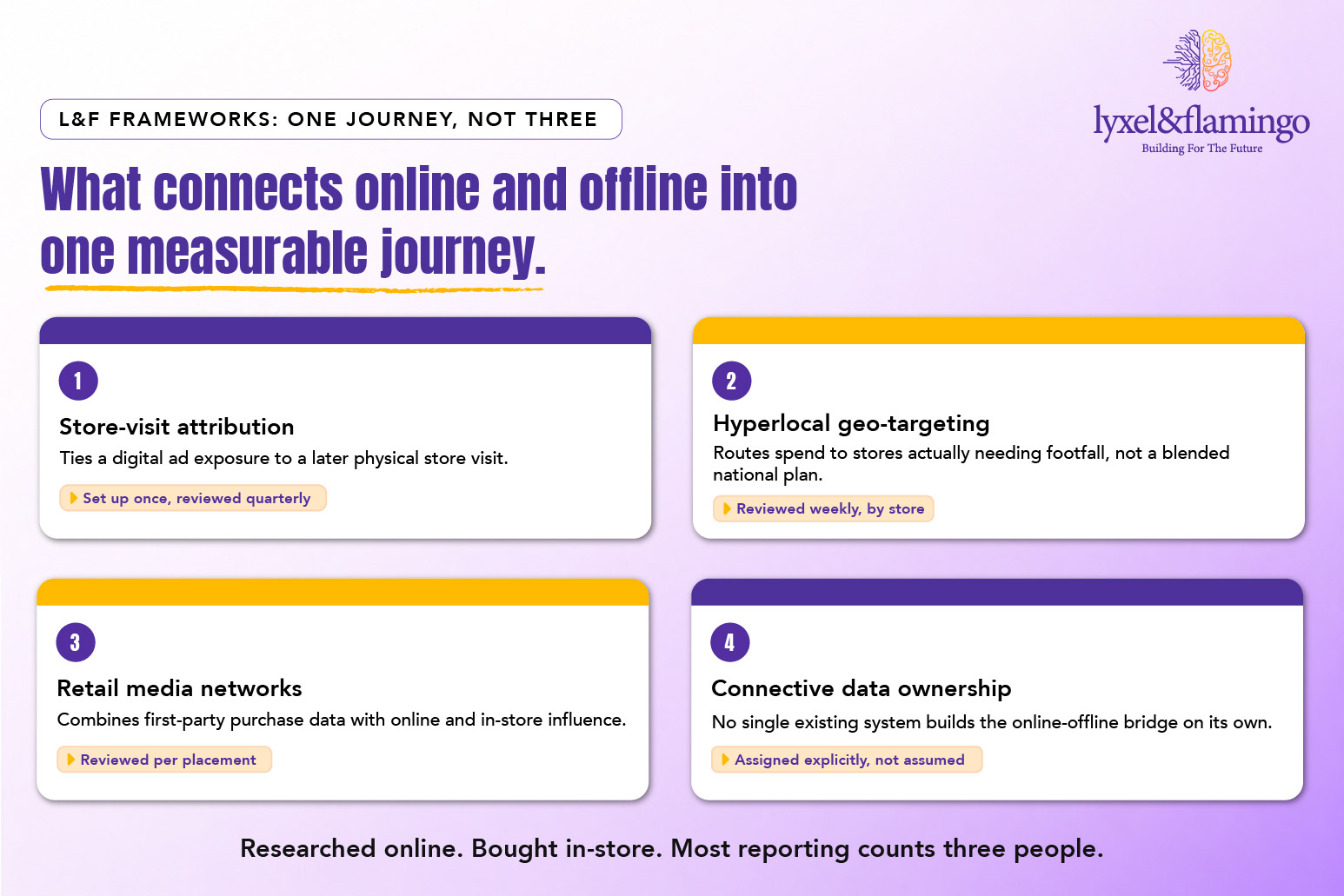
The Phygital Signal Loop: what connects online and offline into one measurable journey
The Framework Explained
- Store-visit attribution: A digital ad exposure that leads to a physical store visit days later is invisible to almost every reporting stack running today, not because the data does not exist, but because nobody connected the two systems that each hold half of it.
- Hyperlocal geo-targeting: One national campaign, spread evenly, ignores that some stores desperately need footfall this week and others do not. Route the same budget by real store-level demand instead, and it drives measurably more traffic to exactly the locations that need it, at no extra media cost.
- Retail media networks: Retail media networks sit at the exact intersection this whole discipline is trying to measure, combining a retailer’s own first-party purchase data with placements that move both online and in-store behaviour at once. Treat one like a standard display buy, and you have missed the entire reason it is different.
- Connective data ownership: No single existing system, not POS, not digital analytics, not the app, is ever going to build the bridge between them on its own. Someone has to own that connective layer explicitly, or the one-journey view everyone claims to want simply never gets built.
What a Connected View Protects
✓ CLIENT PROOF POINT: confirm sign-off before publish. Taco Bell India‘s digital ecosystem shows what phygital infrastructure looks like built properly: loyalty, payment, location services and POS connectivity integrated into one system, supporting 8.5 lakh-plus users, 2X order growth, a store footprint that grew 5X. An app and a store network functioning as one measurable journey rather than two separately reported systems. (L&F client work, mobile app and digital infrastructure, phygital-native by design.)
Our Media services team builds phygital measurement layers that connect online and offline into one customer journey.
Key Takeaways
- Digital analytics, POS data and app analytics each capture their own slice of a journey accurately, but none alone can see it’s the same customer.
- Store-visit attribution ties a digital ad exposure to a later physical visit, closing one of phygital measurement’s biggest gaps.
- Hyperlocal, geo-targeted campaigns route budget to the specific stores that need footfall, instead of one blended national plan.
- Retail media networks combine first-party purchase data with placements that influence both online and in-store behaviour at once.
- Taco Bell India’s connected loyalty, payment and POS infrastructure supported 8.5 lakh-plus users, 2X order growth and a 5X store footprint.
The CXO Takeaway
For a CXO, the question isn’t whether digital performance and store performance each look healthy in their own report. It’s whether anyone can see the one journey connecting them. Without a connective measurement layer, and someone explicitly responsible for it, a brand’s best customers keep getting counted as several different, unrewarded people.
The Question to Sit With
Stop asking whether digital and store performance each look healthy on their own. Ask whether anyone can see the one journey connecting them.
Closing
Lyxel&Flamingo builds phygital measurement layers that connect online and offline into one journey, not two separately reported systems. Want a clear read on where your current reporting is losing the connection between screen and store? Start that conversation with L&F →
Frequently Asked Questions
An approach that treats online and offline touchpoints, digital ads, store visits, app purchases, as one connected customer journey rather than separately reported channels that never get stitched back together.
It ties a digital ad exposure to a later physical store visit using location data and privacy-compliant matching, closing one of the biggest gaps in measuring a phygital customer journey.
It routes media spend to specific stores based on real local demand signals, rather than spreading one national campaign evenly, which drives measurably more footfall to the locations that actually need it.
Not quite. Retail media networks combine a retailer's first-party purchase data with placements that influence both online and in-store behaviour, making them a genuinely phygital-native channel rather than a standard display buy.