
What this blog covers
This blog explains how to build a single source of truth for marketing data. It covers why platform dashboards disagree, what a single source of truth actually is, the four-layer stack that produces it, why defining each metric once is the crucial step, and how to keep the whole thing trustworthy over time. It closes with a self-check and the questions practitioners ask most.
Table of Contents
- Why the pixel sees less than it used to
- What server-side tracking and CAPI do
- The Server-Side / CAPI Event Blueprint
- Getting de-duplication right
- Consent and first-party data
- The mistakes that waste the effort
- Why this feeds everything downstream
- Self-check: is your tracking privacy-ready?
- Key takeaways
- Closing
- Want measurement that holds as cookies fade?
Why the pixel sees less than it used to
For a decade, a browser pixel was enough. It sat on the page, watched what visitors did, and reported it back to the ad platforms using third-party cookies. That world has been closing for a while: iOS privacy prompts, browser tracking prevention, ad blockers, and the retirement of third-party cookies have all cut into what a client-side pixel can observe. The result is missing conversions, weaker optimisation and a fuzzier picture of what media is doing the measurement gap that a post-cookie measurement framework has to close.
Server-side tracking is the answer the industry has settled on. Rather than relying only on the browser to report events, the business sends them from its own server, where cookie limits and ad blockers do not apply. The signal that the pixel now misses is recovered, and the platforms get a fuller, more reliable view to optimise against.
What server-side tracking and CAPI do
Server-side tracking means collecting the record of a customer action on your own server and sending it to the ad platform directly, rather than depending on the browser to do it. The Conversions API (CAPI on Meta, with equivalents on Google and other platforms) is the channel that carries those server-sent events. In practice, most brands run the pixel and CAPI together: the pixel still fires client-side where it can, and the server sends the same events as a reliable backstop for everything the browser misses.
The benefit is accuracy and resilience. Conversions that a blocked or cookie-less browser would have dropped still arrive, so optimisation improves and reported results line up more closely with reality. It also lets a brand send events the browser never saw at all an offline purchase, a call-centre sale, a CRM status change by firing them from the server when they happen. The measurement stops being limited to what a page can observe.
The Server-Side / CAPI Event Blueprint
Server-side tracking helps only if the events are built correctly. The blueprint has three moving parts working together.
Framework: The Server-Side / CAPI Event Blueprint: browser and server events, matched and de-duplicated.
The flow runs from the browser to the server to the platform. Client-side, the pixel fires as it always has, but now stamped with a shared event ID and the visitor’s consent state. Server-side, your server collects the first-party data, hashes any personal identifiers such as email or phone, and fires the same event with the same event ID. The platform then receives both the browser and the server version, recognises them as one event by matching the shared ID, and counts it once. Get those three parts right – a shared ID, hashed identifiers, and events fired on the action that matters – and the platform receives a complete, accurate, privacy-respecting record without inflating the numbers.
Getting de-duplication right
The single most important detail in a server-side setup is de-duplication, because running the pixel and CAPI together means the same conversion is sent twice: once by the browser, once by the server. Without a way to recognise them as the same event, the platform counts both, and a brand ends up optimising toward doubled, fictional conversions. The fix is a shared event ID: the pixel and the server fire the identical event with the same unique identifier, and the platform uses it to collapse the pair into one. It is a small piece of engineering with an outsized effect, and skipping it turns a measurement upgrade into a measurement error.
Consent and first-party data
A privacy-first setup is not only about recovering signal; it is about doing so within the rules and with the customer’s consent. Two practices carry most of the weight. The first is consent mode: the events should carry the visitor’s consent state, so that data is collected and used in line with what they agreed to, and modelling fills the gaps where consent is withheld. The second is first-party data handled responsibly: identifiers such as email and phone are hashed before they leave your server, so the platform can match a customer without ever receiving readable personal data. Done this way, server-side tracking strengthens measurement and respects privacy at the same time, which is the standard a modern setup has to meet.
The mistakes that waste the effort
Server-side tracking rewards precision and punishes shortcuts. The most common mistake is skipping de-duplication, which inflates conversions and corrupts optimisation. Another is firing events on the wrong trigger a page load rather than the real action, such as a completed purchase or a qualified lead which teaches the algorithm to chase the wrong outcome. Sending thin or poorly matched customer data weakens the platform’s ability to attribute the event, wasting much of the accuracy the setup was meant to deliver. And ignoring consent state creates compliance risk that no measurement gain justifies. Each of these turns a worthwhile upgrade into wasted engineering, and each is avoidable with a disciplined event taxonomy mapped to real business actions.
Why this feeds everything downstream
Clean server-side events are the foundation every other measurement effort stands on. The attribution models, the blended efficiency metrics, the incrementality read-outs, and the optimisation the platforms perform all run on the events you send them, so if those events are thin, duplicated, or fired on the wrong trigger, everything above them inherits the error. This is the unglamorous base layer of a single source of truth. Get the events right, and the rest of the stack has honest inputs to work with; get them wrong, and it reports fiction with confidence. It is also the first-party-data groundwork that pairs naturally with a clean GA4 and tag-manager setup.
Self-check: is your tracking privacy-ready?
Score your own setup one point per yes:
- You run server-side tracking (CAPI or equivalent) alongside the pixel
- Browser and server events share an event ID and are de-duplicated
- Events fire on the action that matters, not a page-load
- Personal identifiers are hashed before they leave your server
- Consent state is passed with every event
- Offline and backend conversions are sent server-side where relevant
- You have a documented event taxonomy mapped to business actions
Five or more and your tracking is privacy-ready. Three or fewer and you are likely losing signal or double-counting it.
Key takeaways
- Cookie loss, browser prevention, and ad blockers mean a client-side pixel now misses a growing share of conversions.
- Server-side tracking sends events from your own server; CAPI is the channel that carries them to the platforms.
- Run the pixel and CAPI together, with a shared event ID so the platform de-duplicates them into one.
- Hash identifiers and pass consent state – stronger measurement and privacy compliance at once.
- Clean server-side events are the base layer every attribution, efficiency, and incrementality number depends on.
Closing
The tracking that carried marketing through the last decade is quietly running out of road, and the brands that notice late will spend the next few years optimising on a shrinking, distorted signal. Server-side tracking and CAPI restore what the browser can no longer see, but only when the events are built with care: shared IDs, hashed data, the right triggers, consent throughout. Done properly, it is the foundation that makes every number above it trustworthy. Done carelessly, it is expensive engineering that measures the wrong thing with new confidence.
Want measurement that holds as cookies fade?
L&F builds server-side tracking and CAPI de-duplicated, consent-aware, mapped to real business actions – for consumer brands across India and worldwide. We will set up the events the rest of your stack depends on. Talk to L&F about measurement infrastructure and stop losing signal to the browser.
Frequently Asked Questions
A single source of truth is one place where marketing data from every system is collected, joined and defined consistently, so that any metric means the same thing wherever it appears. It is not necessarily one tool or one dashboard - it is one agreed definition and one reconciled store behind whatever dashboards a team uses, so that revenue, conversions or efficiency figures always trace back to the same underlying, consistently calculated numbers.
Because each system answers a slightly different question and was never told to agree. Ad platforms attribute conversions with their own logic and each claims the same sale; analytics tools count sessions and users differently from clicks; time zones, currencies and attribution windows differ; and the same word - conversion, lead, active user - is defined differently in each tool. None is broken, but comparing them directly will always produce conflicting numbers.
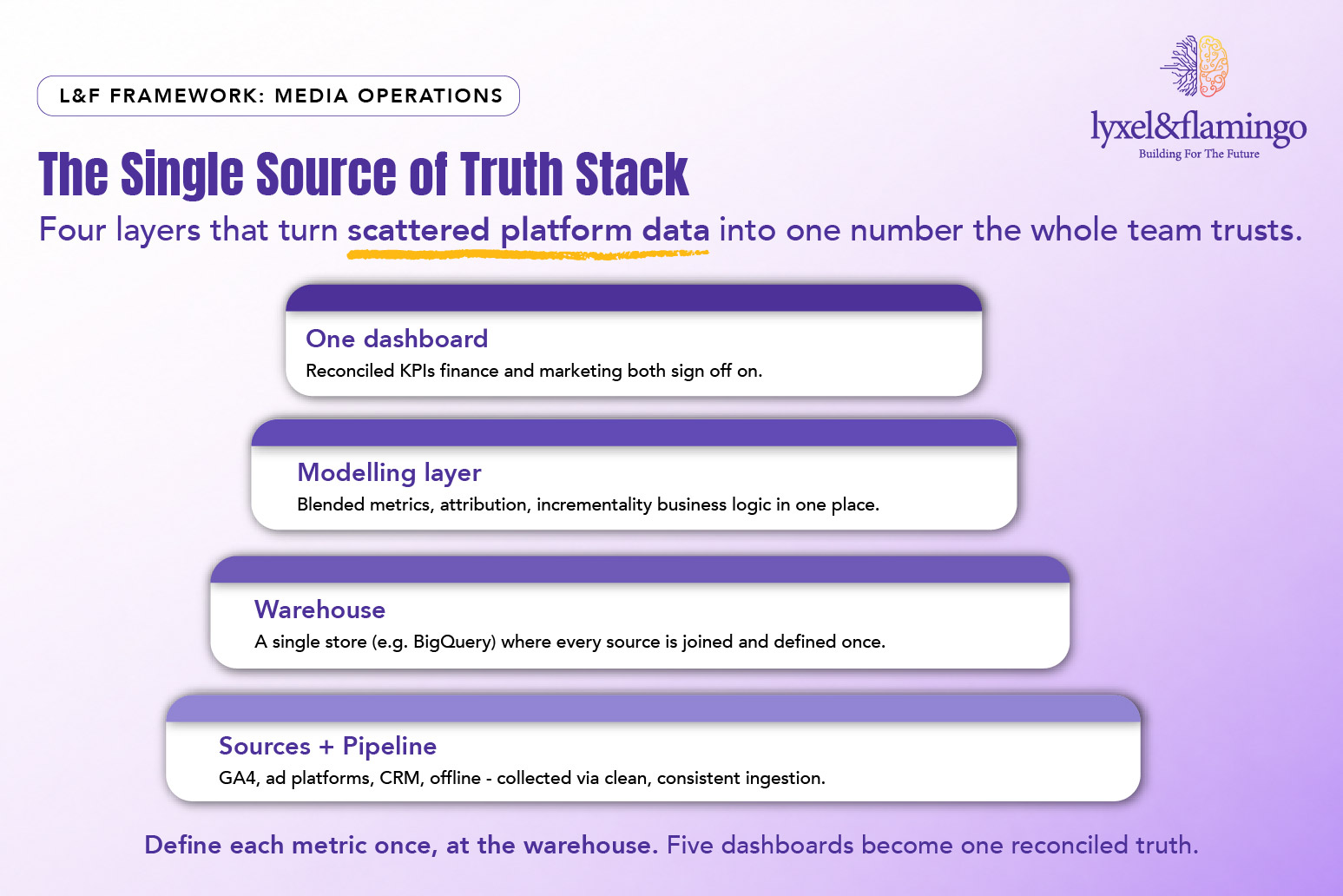
Build it in four layers. Collect data from your sources - GA4, ad platforms, CRM, offline - through clean, consistent pipelines. Join it in a single warehouse such as BigQuery, defining each field once. Apply your business logic - blended metrics, attribution, incrementality - in a modelling layer on top. Then surface reconciled KPIs in dashboards. The decisive step is organisational: agree a single written definition for each metric and hold every dashboard to it.
For most brands beyond a small scale, yes - a warehouse is what lets you join data from many systems and define each metric once in a single place. It does not have to be complex to start; a warehouse like Big Query with clean ingestion and a clear modelling layer is enough. What matters more than the specific tool is that all sources land in one reconciled store with agreed definitions, rather than being compared across separate platform dashboards.
Defining each metric once and holding everyone to that definition. The technical stack matters, but most efforts fail on the organisational step: a team builds a warehouse and still has chaos because three dashboards define a conversion three ways. Agree the written definitions first, encode them in the modelling layer, give them an owner, and the downstream tools stop disagreeing because they all read the same logic. Definitions, not dashboards, end the argument.
Through light governance. Name an owner for the metric definitions, add new campaigns, platforms and metrics through the warehouse rather than around it, and point every report back to the agreed source instead of tolerating private shadow spreadsheets. Without this, the source drifts the moment someone introduces an untracked campaign or their own version of a number. The aim is consistency, so new data strengthens the single source rather than fragmenting it.
It is the foundation they sit on. Attribution models, blended efficiency metrics and incrementality reads all need consistent, reconciled inputs to be meaningful - if the underlying data is defined differently across tools, the analysis on top inherits the inconsistency. A single source of truth provides one agreed set of numbers for those methods to work from, which is why building it tends to come before, or alongside, investing in more advanced measurement.