What this blog covers
Creative fatigue shows up as falling click-through rate, rising frequency and climbing cost per result while targeting and budget stay steady. The cure is a steady supply of fresh, purposeful variation: new hooks, formats, proof points and offers, tested against a control and retired on clear rules. The Blackberrys case study reports 2.9X D2C revenue, 1.8X ROAS and 1.6X transactions, with the period unstated, and lists A/B testing of creatives for click-through rate among the actions. Creative themes also influence brand recall and the language people use when they search for or ask about a brand.
Quick Answer: Watch three signals together: click-through rate, frequency and cost per result, each against its own early baseline. When two of the three move the wrong way for several days, rotate in new creative. Keep a pipeline of tested variations so replacements are ready, change one element at a time to learn what works, retire ads on written rules and record every test. Aim for variety in hook, format and message, and keep the brand voice consistent so refreshes feel like one story.
Table of Contents
- What Fatigue Looks Like
- Step One: Set Baselines and Triggers
- Step Two: Build a Creative Pipeline
- Step Three: Test One Thing at a Time
- Step Four: Retire With Rules
- What the Blackberrys Case Shows
- Creative Themes and Brand Associations
- The Creative Refresh Framework
- Client Proof From Our Work
- Key Takeaways
- CXO Takeaway
What Fatigue Looks Like
Fatigue appears when people see an ad often enough that it stops working. The pattern has a signature: click-through rate drifts down, frequency (the average number of times each person sees the ad) drifts up and cost per click or per purchase rises, even though your targeting and bids have stayed put.
Some dips have other causes. Seasonality, stock-outs, price changes and tracking faults can mimic it. Rule those out first: check inventory, compare against the same period last year and confirm that your conversion tracking still fires. Our guide on why ROAS on Facebook campaigns stops improving walks through the wider diagnosis, and the note on high CPC on Facebook covers the cost side.
Step One: Set Baselines and Triggers
Record each ad’s early performance: click-through rate, cost per result and frequency in its first week or so, once delivery has stabilised. That baseline is the yardstick.
Then write trigger rules. For example: “when click-through rate falls by a fifth from baseline and frequency has risen past a threshold, flag the ad for refresh.” Pick thresholds from your own account history, since a brand with a small audience will hit high frequency faster than one with a broad audience. Review the thresholds each quarter.
Use blended views as well. Fatigue often hides inside averages: one tired ad can drag down a whole ad set while two others carry it. Look at performance by ad, by placement and by audience segment.
Step Two: Build a Creative Pipeline
The best defence against fatigue is supply. Plan creative in batches, with a calendar that always has the next set in production before the current one ages.
Build variation across four dimensions. Hook is the first seconds or the first line. Format covers static, carousel, short video and long video. Message is the benefit, proof or offer you lead with. Look is the setting, models, colour and styling. A strong batch changes at least one dimension meaningfully, so shoppers see something new, and keeps the brand recognisable.
Source variety cheaply. Reuse customer reviews and user content with permission, cut one shoot into many short clips, rewrite hooks for the same footage and test seasonal angles. Our guide on nine rules of managing creatives to maximise Facebook revenues gives a practical rulebook, and our piece on running 100 ad variations and finding winners in 48 hours explains how teams use AI tools to widen the pipeline.
Step Three: Test One Thing at a Time
A test teaches you something only when you know what changed. If a new ad changes the hook, the format and the offer at once, a win or loss reveals little.
Pick a clear question, such as “does a customer testimonial hook beat a product benefit hook for this audience?” Hold the rest steady, split the budget evenly, define the success metric in advance and run the test long enough to gather meaningful data. Declare a winner on the metric that matters to the business, such as cost per purchase, as well as click-through rate, since a clickable ad can attract the wrong people.
The Blackberrys case lists A/B testing of creatives for click-through rate among its actions. Click-through rate answers one part of the question, and pairing it with conversion and cost per purchase gives the full answer.
Keep a test log with the question, the variants, the result and the decision. Over months, the log becomes your brand’s own rulebook. Our guide on designing high-converting ecommerce ad creatives shares design principles to feed the first round of tests.
Step Four: Retire With Rules
Teams often keep a tired ad running because pausing feels risky. Write retirement rules instead: pause when the trigger fires and a replacement is live, and archive the ad with a note on what it taught. Rotate winners back in after a rest, since an ad that tired in March may work again in September with a fresh audience.
Watch for the learning-phase effect on platforms. Swapping every ad at once can reset learning and spike costs. Introduce new creative alongside existing ads, shift budget gradually and retire the weakest first.
Our guide on creative as the biggest media multiplier explains why creative quality changes the return on every rupee of spend.
What the Blackberrys Case Shows
The Blackberrys case study describes a menswear brand in India with lower conversion rates and a need for higher ROAS to grow overall revenue. The programme combined lower-funnel campaigns on Google, Bing and social platforms with reach campaigns on YouTube, Meta and publishers, a seasonal focus on suits and blazers, categorised brand-keyword campaigns, a separate high-intent campaign with negatives because the brand name is also a generic telecom term and A/B testing of creatives for click-through rate.
The case reports overall D2C revenue up 2.9X, ROAS up 1.8X and transactions up 1.6X, and leaves the period unstated. Its headline rounds these to “triple the revenue” and “doubling the ROAS.” Read the figures as the outcome of the whole programme, which used many levers beside creative, and avoid reading them as the effect of creative refreshes alone.
The creative lesson is a modest one: test creative against a clear metric, inside a structure where the rest of the funnel also works. Fresh creative cannot rescue a weak offer or a leaky site, and good creative gets more from a healthy funnel. Our guide on Facebook dynamic product ads best practices shows how catalogue-led creative fits into the mix.
Creative Themes and Brand Associations
Repeated creative themes shape what people remember about a brand, and memory feeds search. When a campaign leans on a theme, such as tailoring, occasion wear or boardroom confidence, shoppers begin to pair the brand with that theme in their own searches and conversations. That pairing, in turn, shows up in the language across reviews, social posts and articles that search engines and AI assistants read.
Use that deliberately. Choose two or three themes you want to own, rotate formats and hooks within them and publish matching pages on your site, such as a style guide or occasion edit, in the same language. Google’s guidance on creating helpful, reliable content stresses original information and clear expertise, and our GEO playbook explains how consistent brand signals earn citations. Our piece on how to improve brand search volumes shows how creative and brand search reinforce each other.
The Creative Refresh Framework
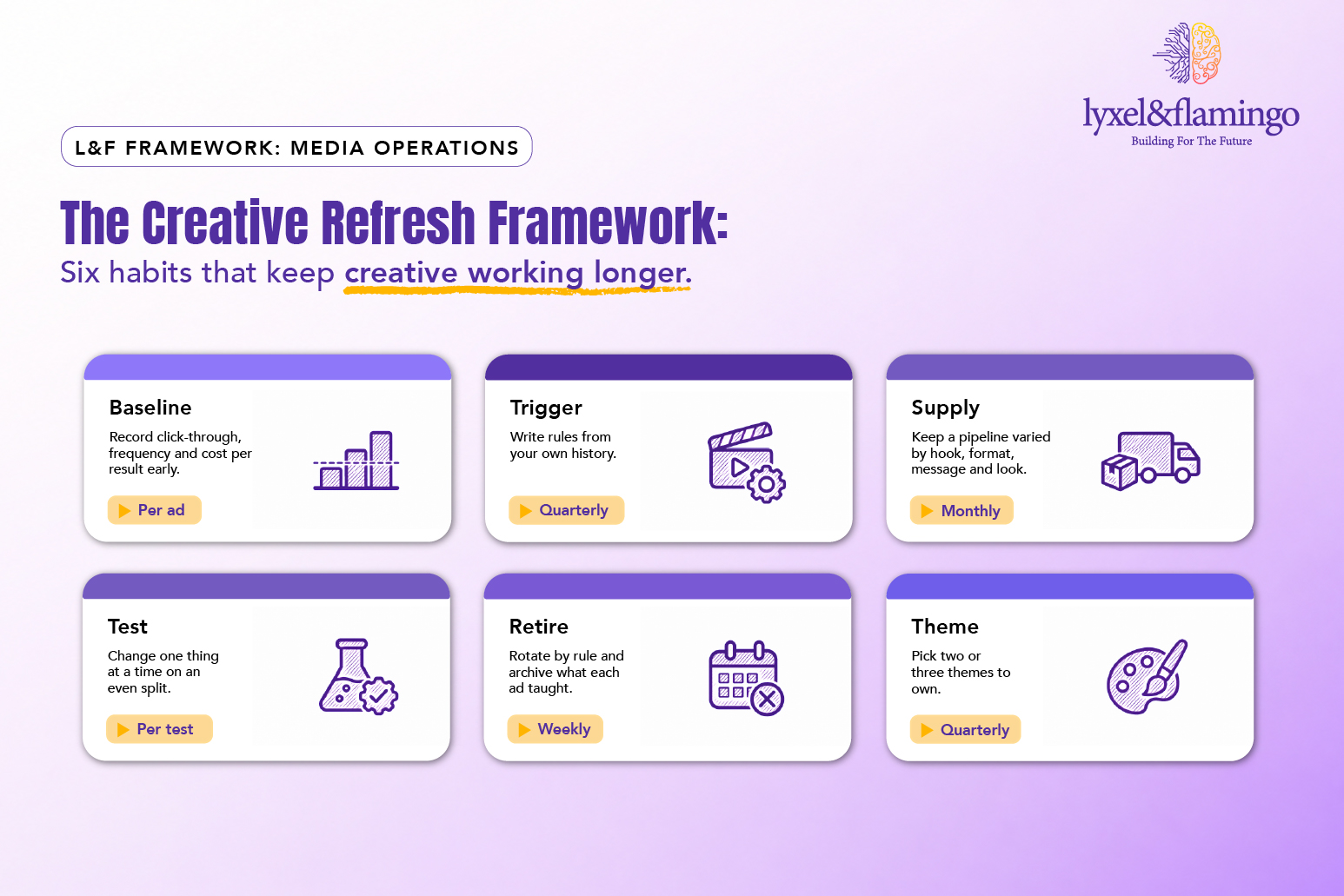
Framework Explained
Use the framework as a standing routine, so that refreshes arrive on your schedule rather than after a drop.
Step 1: Baseline. Record click-through rate, frequency and cost per result for each ad once delivery settles. Check: every live ad has a baseline row.
Step 2: Trigger. Write trigger rules from your own history, such as a drop of a fifth in click-through rate with rising frequency. Check: the rule names who acts and when.
Step 3: Supply. Keep a pipeline of variations across hook, format, message and look. Check: the next batch is in production before the current one tires.
Step 4: Test. Test one change at a time on an even split and judge winners on business metrics. Check: each test has a question, variants, result and decision in a log.
Step 5: Retire. Retire ads by rule once a replacement is live, and rotate winners back after a rest. Check: replacements enter alongside existing ads to avoid a learning reset.
Step 6: Theme. Choose two or three themes you want to own and publish matching pages on your site. Check: creative and site content use the same language.
⚠ CLIENT PROOF POINT: Lyxel&Flamingo ran performance marketing for Blackberrys across search, social and reach channels. The case study reports overall D2C revenue up 2.9X, ROAS up 1.8X and transactions up 1.6X, and leaves the period unstated. A/B testing of creatives for click-through rate was one of several actions. Read the full Blackberrys case study.
Client Proof From Our Work
Creative testing works inside a funnel that also performs. Blackberrys tested creatives for click-through, Kimirica added films, influencers and UGC and Godrej built a campaign around one strong theme.
Blackberrys credits many levers beside creative. Compare each page’s stated period before drawing conclusions.
Key Takeaways
- Fatigue shows as falling click-through rate, rising frequency and rising cost per result at steady targeting and budget.
- Set baselines and written triggers, and rule out seasonality, stock and tracking faults first.
- Keep a pipeline of variations across hook, format, message and look.
- Test one change at a time and judge winners on business metrics.
- Pick a few brand themes so creative builds lasting associations for shoppers, search engines and assistants.
CXO Takeaway
How many tested creative replacements do you hold in reserve today, and what rule says when the current ad retires? If the answer is none, performance depends on luck. Lyxel&Flamingo’s media team pairs creative testing with funnel structure so that fresh ads land in a healthy system.
Frequently Asked Questions
A decline in ad performance that comes from audiences seeing the same creative too often, usually visible as falling click-through rate and rising frequency and cost.
Fatigue follows the audience, so skip fixed schedules. Use triggers based on your own baselines, and keep replacements ready ahead of time.
Overall D2C revenue up 2.9X, ROAS up 1.8X and transactions up 1.6X, with the period unstated, from a programme that included creative A/B testing among many actions.
Consistent creative themes shape brand associations and the language people use about a brand, which search engines and assistants read across the web.