What This Blog Covers
Fintech apps are good at buying installs and poor at keeping the users they buy, and published retention benchmarks for finance apps show how steep the drop is by Day 30. This article explains what separates an install from a habit, why the activation moment predicts long-term retention, how lifecycle messaging does work that campaigns cannot, and how engagement content answers the how-to and comparison questions people ask before they install. It gives growth marketers and fintech CMOs a four-rung ladder from acquisition to habit and a 90-day plan, so engagement is reported beside acquisition cost and not discovered after the budget is spent.
Quick Answer: Move fintech users from install to habit by defining the first valuable action, shortening the path to it, and sustaining it with lifecycle messages tied to what the user did. Benchmarks for finance apps vary widely by source, with Day 30 retention reported between about 2% and 8%, so measure your own. Track install, KYC completion, first transaction, Day 7 and Day 30 retention together, and report them beside cost per install.
Table of Contents
- What Separates an Install From a Habit in a Fintech App
- The Activation Moment That Predicts Day-30 Retention
- Why Lifecycle Messaging Does the Work That Campaigns Cannot
- The Content That Answers How-To Questions Before the Install
- From Install to Habit: Metrics by Stage
- What the Install-to-Habit Ladder Asks You to Build
- The 90-Day Plan to Lift Activation and Day-30 Retention
- Why Engagement Must Be Reported Beside Acquisition Cost
- Key Takeaways
- CXO Takeaway
What Separates an Install From a Habit in a Fintech App
An install proves interest, while a habit proves value. In a fintech app, the events that matter come later: registration, KYC, a first deposit or transaction, and repeat use. A campaign that optimises only for installs buys the cheapest part of the journey and leaves the valuable part to chance.
The gap between early and sustained engagement is visible in regional data. AppsFlyer’s State of Marketing in APAC 2026, as reported by trade media, found India’s finance app installs rising 55%, while across South-East Asia Day 7 retention for finance apps on Android grew 45% year on year and Day 30 retention for the same vertical fell 32%. People arrive and try, and fewer stay.
Published benchmarks for finance apps differ widely, because each source measures different apps and calculates retention in its own way. Day 30 figures quoted in 2026 guides range from about 2% to about 8%. The lesson from mobile app patterns that actually convert is to stop comparing yourself with a single number and to track your own cohorts against your own targets.
Define the habit in numbers before you plan the campaign. For a lending app it can be a completed KYC and a first disbursal within seven days, and for an investing app a first purchase and a second session within two weeks. One definition, written down.
The Activation Moment That Predicts Day-30 Retention
Retention guides repeat one finding: the most predictive early signal is whether a new user completes a meaningful first action in the first session. One benchmark guide states that apps that get users to that action retain them at two to three times the rate of those that do not. For a fintech app, the meaningful action is rarely the install. It is KYC completion or a first transaction.
Mixpanel’s 2026 finance benchmarks make the same point for the sector, advising teams to track KYC funnel completion, activation-to-funding rates and first deposit or first transaction conversion beyond acquisition counts. Those are the points where intent turns into commitment. Watch them weekly.
The right first action differs by user. A borrower, a saver and an investor arrive with different anxieties, which is why designing around personas matters in a regulated product. Map each persona to the first action that gives them confidence, and design the opening journey around it. Different users, different first wins.
Reduce the friction between install and that action. Ask for permissions at the moment they are needed, explain why documents are required, and let users save progress and return. A user who stops at KYC has not rejected your product. They have been interrupted.
Why Lifecycle Messaging Does the Work That Campaigns Cannot
Campaigns find users, while lifecycle messages guide them. The structure of AIDA applied to the screen describes a path from attention to action, and in a fintech app the path continues after the install: welcome, verify, fund, use, return. Each step needs its own message at the right moment.
Trigger messages from behaviour and not from the calendar. A user who stalled at the KYC photo needs a reassurance and a tip, a user who funded and did not transact needs a prompt to try the core feature, and a user who stopped opening the app needs a reason to come back. Segment by the last event.
Use the channels in their roles. Push and in-app messages suit immediate prompts, email suits explanation and WhatsApp suits time-sensitive updates and questions where the user has opted in. Cap the frequency and measure opt-outs. Silence also has a cost when users forget you exist.
Refresh the content as you would refresh creative. Lifecycle messages wear out, and the signals described in detecting and beating ad fatigue apply to them as well: falling response, rising opt-outs and flattening conversion. Test new copy and timing every month. Fresh, not frequent.
The Content That Answers How-To Questions Before the Install
Many users decide before they ever see your app store page. They search for how a loan works, what documents are needed, how fees are charged or how two products compare, and engines answer those questions from whatever pages they can read. Engagement content is therefore also acquisition content.
Write it answer-first and keep it accurate. Put eligibility, steps, timelines, fees and security in plain language on indexable pages, with each page answering one question in its first lines. Pages like these give search and AI engines usable answers about your product and give your lifecycle messages somewhere to link. Plain answers, linked.
From Install to Habit: Metrics by Stage
The handoff from web to app is a known drop-off point. AppsFlyer’s analysis of European finance apps highlights where users leave between web and app, and the trade-offs in app versus PWA apply when you decide how much of the journey to keep on the web. Keep the user’s progress and context across the handoff.
Treat financial claims with care. Lending and investing products carry regulatory duties on claims, disclosures and fees, so have compliance review the content and the lifecycle messages. Accuracy protects users and the licence. A wrong claim travels fast.
What the Install-to-Habit Ladder Asks You to Build
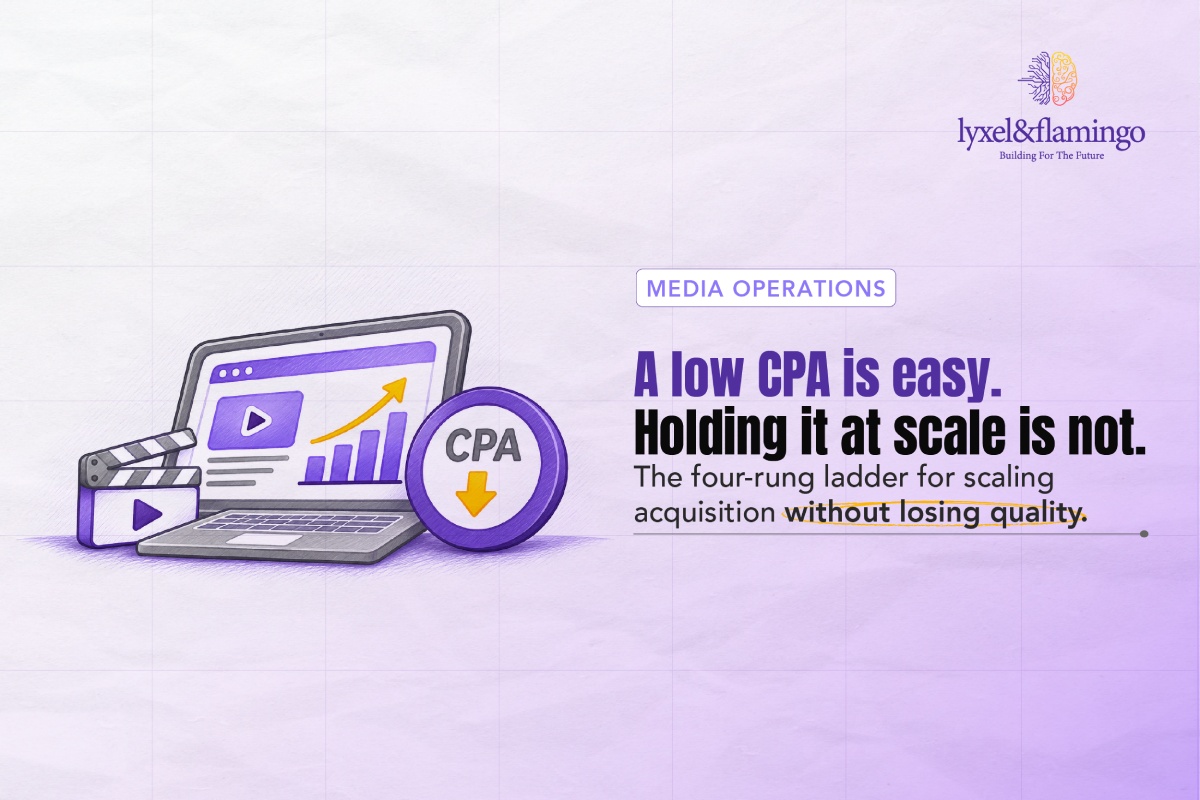
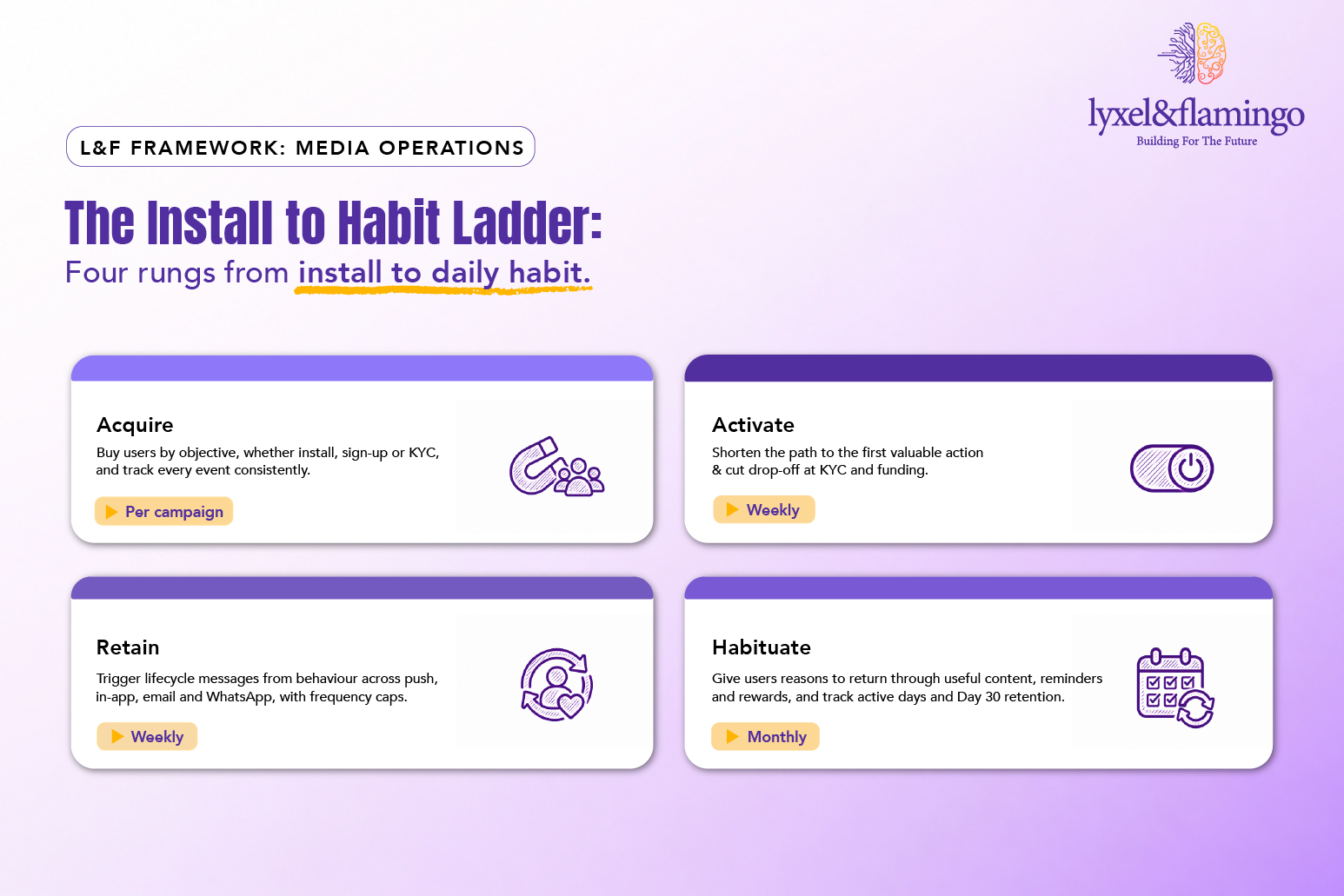
Four rungs, built in order, carry a user from install to routine. The cadences are a recommended working pattern.
Framework Explained
Acquire: Buy the users you can keep. Run separate campaigns for installs, sign-ups and KYC where volume allows, create creatives by theme and audience, and separate campaigns by the locations that perform best. Track each event consistently across platforms and the app, so you can see where each source loses people. Acquisition quality is visible long before retention data arrives.
Activate: Treat the first valuable action as the real conversion. Map every step between install and that action, remove or defer anything not required, explain why documents are needed, and let users save progress. Watch KYC completion and first transaction rate each week. Activation is where most fintech funnels leak, so it deserves the first fix.
Retain: Guide users with messages triggered by what they did. Stalled at KYC, funded and idle and lapsing users each need a different prompt, and each channel has a role. Cap frequency, test against a holdout and watch opt-outs. Retention is built in the days after activation, when users decide whether the app earns a place on their phone.
Habituate: Give users reasons to come back that are not promotions. Useful content, reminders tied to their goals, progress views and rewards for sustained use all help. Track active days per month and the share of users transacting weekly, alongside Day 30 retention. A habit shows up as a rhythm, not a spike.
The 90-Day Plan to Lift Activation and Day-30 Retention
Days 1 to 15: Define and baseline. Agree the first valuable action and the habit definition with product and compliance, then baseline install-to-registration, KYC completion, first transaction rate and Day 7 and Day 30 retention by cohort and source. Baseline first.
Days 16 to 40: Shorten the path. Map the steps between install and the first action, remove or defer anything that is not required, add progress saving and reassurance, and rewrite the first three messages. One path, shorter.
Days 41 to 70: Build the lifecycle. Create trigger-based flows for stalled KYC, funded-and-idle and lapsing users, assign channel roles and cap frequency, and test each against a holdout. Test, then scale.
Days 71 to 90: Report and decide. Compare activation and retention with the baseline, report cost per activated user and per retained user beside cost per install, and decide where budget moves. Retention is the result.
Why Engagement Must Be Reported Beside Acquisition Cost
An acquisition dashboard that ends at the install rewards the wrong behaviour. Report cost per install, cost per registration, cost per KYC, cost per first transaction and cost per retained user in one view, so teams can see which sources bring users who stay. One view, one truth.
Judge sources on quality and not only on price. The measures in performance marketing that scales profitably beyond last-click ROAS include payback and cohort quality, and they translate directly: a source with a higher cost per install and a much higher Day 30 retention may be the cheapest source per retained user. Rank sources by cost per retained user and not by cost per install.
Optimise campaigns to the deeper event where volume allows. Install, sign-up and KYC objectives can be run as separate campaigns, with budgets moved toward the event that predicts retention. Keep tracking consistent across platforms and the app, and reconcile with your own records. Clean events, clear decisions.
Prove the programme to the board with the approach in marketing ROI proof points: link campaign metrics to business outcomes, validate with periodic experiments, and report the decision each result supported. Show lifetime value, not installs. Habit is the asset.
CLIENT PROOF POINT: RupeeRedee (digital lending app): RupeeRedee set out to increase app downloads and registrations while maintaining CPA. The team started app download campaigns on Google and Facebook, set up tracking for installs, registrations and KYC events, created campaigns with separate install, sign-up and KYC objectives to improve CPA, built theme-wise creatives, and segregated campaigns by top-performing locations. This case covers the first half of the journey, from install to registration and KYC; it does not report daily engagement.
5.62L registrations through campaigns · 5.18L installs through campaigns · 3.18% CTR on 20.2L clicks · 92.1% install-to-registration rate
Source: L&F case study, RupeeRedee app. The page states no date range and does not reconcile registrations through campaigns with installs through campaigns, or with its 5M+ total installs, so the figures are shown as published.
Key Takeaways
- An install proves interest and a habit proves value; define the habit in numbers before planning the campaign.
- Finance app retention benchmarks vary widely by source, so measure your own cohorts.
- The first valuable action, usually KYC completion or a first transaction, predicts later retention.
- Lifecycle messages triggered by behaviour guide users where campaigns cannot.
- Report cost per activated and retained user beside cost per install.
CXO Takeaway
Ask your growth and product leads to define the first valuable action and the habit in numbers, such as KYC completion and a first transaction within seven days. Request cohort retention at Day 7 and Day 30 by acquisition source, alongside cost per install. Have compliance review lifecycle messages and content for claims and fees. Fund a 90-day programme on activation and lifecycle with a holdout for every flow. Add cost per activated user and per retained user to the board scorecard. Review the ladder each month.
Frequently Asked Questions
Published figures vary widely, from about 2% to about 8% in 2026 guides, because sources measure different apps and calculate retention differently. Use them as context only, and compare your cohorts with your own targets by acquisition source. Track Day 1, Day 7 and Day 30 together. Improve activation first, since it drives the later numbers.
Count the first action that proves value and commitment, which is usually completed KYC plus a first disbursal, deposit or purchase. Define it with product and compliance, write it down, and track time to that action by cohort. Installs and registrations are earlier steps and not the finish line. Revisit the definition when the product changes.
Explain why each document is needed, ask for permissions at the moment of need, let users save progress and return, and test the camera and upload steps on mid-range phones. Trigger a reassurance message when a user stalls. Measure completion by step to find the exact point of loss. Fix the biggest step first.
Use push and in-app messages for immediate prompts, email for explanation and WhatsApp for time-sensitive updates where the user has opted in, with consent recorded by channel. Cap frequency and watch opt-outs. Test each flow against a holdout so you know what the messages add. Add or drop channels based on measured results.
Many users search for how a product works, what it costs and how it compares before they install. Answer-first pages that state eligibility, steps, fees and security in plain language give search and AI engines usable answers about your product. They also give lifecycle messages somewhere to link. Keep every claim accurate and reviewed by compliance.