What this blog covers
The debate around UGC advertising and AI-generated creatives is shifting. In 2027, ad performance will depend less on who creates an ad and more on how authentic it feels to the audience. Research covering over 500 million impressions found that AI-generated ads achieved an average 0.76% CTR compared to 0.65% for human-made ads. However, consumer trust remains a challenge, particularly when AI-generated content looks artificial. This blog explores why human signals, such as real faces, genuine product demonstrations and creator testimonials, influence ad engagement and conversions. It also introduces Lyxel&Flamingo’s Human Signal Ladder, a four-level framework that combines authentic UGC with AI-powered creative production. Through insights from consumer research and the Blackberrys campaign, it explains how brands can scale creative variations without compromising trust. Finally, discover five practical ways to improve creative testing, optimise ad performance and prepare campaigns for 2027.
Table of Contents
- What Is UGC Advertising?
- The Problem: Brands Are Running a Format War Instead of a Signal Test
- Why "Looks Human" Beats "Made by Humans"
- The Evidence: What the 2026 Data Says About UGC vs AI-Generated Ads
- The Lyxel&Flamingo Framework: The Human Signal Ladder
- What Structured Creative Testing Delivered for Blackberrys
- 5 Things to Change Before Your Next Campaign
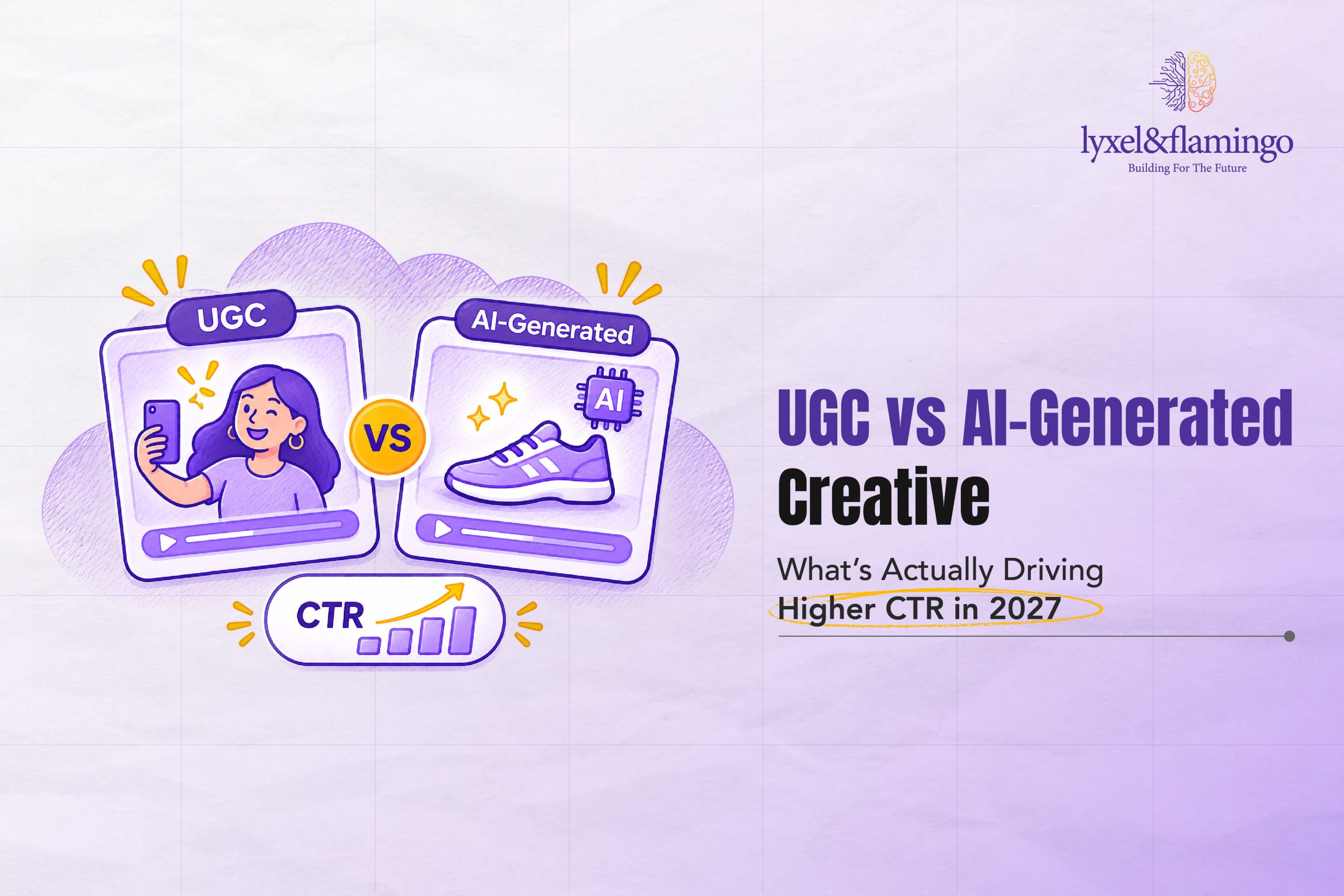
The real split in ad creative performance is not human versus machine. It is creative that reads as human versus creative that reads as manufactured, whoever made it.
In 2027, the highest click-through rates will not belong to UGC advertising or to AI-generated ads as categories. They will belong to ads that look and feel made by a real person, and the brands winning are using AI to produce more of those, not to replace them.
That conclusion comes from the largest live-campaign comparison published so far. In a study of more than 500 million impressions, AI-generated ads averaged a 0.76% click-through rate against 0.65% for human-made ads, and AI ads that did not look like AI achieved the highest engagement of all groups. Meanwhile, only 45% of Gen Z and Millennial consumers feel positive about AI-generated ads, even though 82% of ad executives believe they do.
The question is not whether to use UGC or AI. It is how to scale the human signal without the audience ever noticing the machinery behind it. Most creative teams are still answering the wrong question, and their testing plans show it.
What Is UGC Advertising?
UGC advertising is paid media that uses content made by real customers or creators, such as unboxings, reviews, try-ons and testimonials, in place of or alongside studio-produced creative. AI-generated ad creatives are ads where generative AI produces some or all of the visuals, voice, script or variations. The two are often treated as rivals in the UGC vs AI-generated content debate, but the line between them is blurring fast.
This matters now because both are scaling at once. 83% of ad executives say their companies use AI in creative work, up from 60% in 2024, while 58% of marketers have dedicated and growing budgets for creator partnerships. Brands are funding both sides of the debate, often without a clear rule for when to use which.
The Problem: Brands Are Running a Format War Instead of a Signal Test
Walk into most creative reviews in India today, and you will hear the same argument. The performance team wants more UGC because it “converts”. The finance team wants more AI because it is cheaper and faster. The brand team quietly worries about both of them. Everyone then runs a test that pits a batch of UGC against a batch of AI ads and declares a winner on CTR.
The test is flawed before it starts. It compares two production methods when the audience is reacting to something else entirely: whether the ad feels like a real person talking to them. A polished AI avatar reading a script fails that test. So does a creator video so heavily briefed that it sounds like a commercial. A lightly edited customer clip with an AI-generated background often passes it.
There is a second problem with these tests. Teams read CTR as the verdict, when it is only the first signal. An ad that wins the click but erodes trust in the brand can raise acquisition costs a quarter later, and that cost rarely shows up in the original test report.
The perception gap makes this framing genuinely risky. IAB’s research found that 39% of Gen Z consumers feel negative about AI ads, nearly double the 20% of Millennials, and 30% of Gen Z describe AI-using brands as inauthentic. That is US data, but the pattern matters for India, where Gen Z makes up 40% to 45% of e-retail shoppers.
The CTR debate is framed wrong: audiences are not choosing between UGC and AI, they are choosing between ads that feel human and ads that feel manufactured.
Why “Looks Human” Beats “Made by Humans”
Three forces explain why perceived authenticity, not production method, drives ad creative performance in 2026, and why the AI vs human-generated content framing misleads so many teams.
Force 1: The platforms now read creative as targeting. Meta’s Andromeda ad retrieval system and Google’s AI-driven campaign types use the content of the ad itself to decide who sees it. Creative diversity therefore becomes a media lever. AI makes diversity cheap, which explains why volume has exploded. But volume without a human signal feeds the algorithm many versions of the same unconvincing ad.
Force 2: Human faces and real context carry trust. The Taboola field study, run with researchers from Columbia, Harvard, the Technical University of Munich and Carnegie Mellon, found that a large, clear human face was among the most important factors in making an ad feel human and trustworthy. Genuine UGC carries those cues by default in most formats. AI can carry them too, if it is directed to.
Force 3: Obvious AI triggers a penalty. When viewers detect synthetic imagery, the “uncanny valley” effect kicks in and attention shifts from the product to the oddness. Kantar’s analysis found that GenAI-created ads scored a 54th percentile on overall impact, compared with 65% for non-AI ads. The penalty is not for using AI. It is for letting the audience see it.
| Factor | Pure UGC | Fully AI-generated | Hybrid (real proof, AI scale) |
| Production cost per variant | Medium | Low | Low to medium |
| Speed to 50 variants | Slow | Fast | Fast |
| Built-in trust cues | Strong | Weak unless directed | Strong |
| Risk of “looks fake” penalty | Low | High | Low |
| Brand consistency | Variable | Controllable | Controllable |
| Best use | Proof moments, reviews, demos | Backgrounds, resizing, hook tests | Always-on prospecting and retargeting |
AI does not lose to UGC on CTR; AI that looks like AI loses to anything that looks like a person.
The Evidence: What the 2026 Data Says About UGC vs AI-Generated Ads
AI-generated ads can match or beat human-made ads on CTR, with no drop in downstream conversions. In raw data, AI ads averaged 0.76% CTR against 0.65% for human ads, and they performed comparably under the tightest statistical controls. The study also found AI visuals maintained conversion performance after the click.
The gap between what advertisers believe and what consumers feel about AI ads widened to 37 points. 82% of executives think young consumers feel positive about AI ads, but only 45% do. Encouragingly, 73% say knowing an ad used AI would raise or not change their purchase likelihood, which suggests disclosure is less risky than detection.
Only 48% of consumers like seeing AI-generated images in ads, and 57% worry about misleading AI advertising. Consumer positivity toward GenAI overall rose to 56%, yet distrust of AI-generated ads still ranges from 43% to 51% across generations. Comfort with the technology does not transfer automatically to comfort with AI in ads.
Consumers influenced by trusted creators are 2.5 times more likely to buy. Nearly 75% of Gen Z and Millennials who engage with creators made a purchase based mainly on a creator’s recommendation in the previous six months. This is the trust asset that user-generated content marketing brings, and AI cannot fabricate it.
Want to see how creators are becoming a real sales channel for brands? Read this blog: Creators Are Becoming a Growth Channel on Amazon.ae
55% of marketers trust AI recommendations but still require human review. The same Nielsen research shows creator budgets growing alongside AI adoption. Marketers are not choosing one side, and the data suggests they should not.
The Lyxel&Flamingo Framework: The Human Signal Ladder
At Lyxel&Flamingo’s Creative Intelligence practice, we stopped asking “UGC or AI?” and started asking “how much human signal does this placement need?” The answer sets the production method. We call the model the Human Signal Ladder, and it has four rungs, from highest trust requirement to lowest.
- Proof Rung: real people, real product, no synthetic faces. Reviews, demos, before-and-after content and testimonials should come from genuine customers or creators. This is where ugc marketing earns its premium, and where an AI-generated person would cost you the trust you are trying to borrow. Use AI only for captions, subtitles and aspect-ratio edits here.
- Story Rung: human footage, AI-assisted variation. Take one strong creator video, the core asset of user-generated content marketing, and use AI to produce new hooks, opening lines, backgrounds, music beds and regional language versions. The face and the voice in the ad stay real. This rung is where most brands can multiply output fastest without triggering the “looks fake” penalty.
- Context Rung: AI-generated scenes around real products. Product-in-environment shots, seasonal backdrops and lifestyle settings can be AI-generated, provided the product itself is accurate, and no synthetic person is presented as a real customer. Kantar’s guidance applies here: make the AI seamless, not the subject.
- Test Rung: fully AI-generated concepts for learning, not scaling. Use fully synthetic AI-generated ad creatives to test angles, offers and messages cheaply. When a concept wins, rebuild it on a higher rung with real people before scaling spend behind it.
In our work with D2C brands, the Story Rung is consistently the most under-used and the one with the most immediate impact. Brands commission a creator video, run it once, and move on, when the same footage could feed 30 variants.
What Structured Creative Testing Delivered for Blackberrys
Blackberrys came to L&F with a familiar performance problem: conversion rates were low, and the brand needed a higher ROAS to keep revenue growing. Rather than simply buying more reach, we rebuilt the funnel around product seasonality, separated high-intent search from irrelevant telecom queries, and ran A/B tests on multiple creatives across Google, Meta, YouTube and publisher campaigns to lift click-through rates.
- 2.9X growth in D2C revenue
- 1.8X increase in ROAS
- 1.6X increase in transactions
The same discipline shows up in our full-funnel work for The Body Shop, where testing statics, carousels and videos showed that customers preferred video over the other two formats.
The interpretation matters most for this particular debate. Neither campaign relied on AI-generated creative or a UGC programme, yet both learned what worked by treating creative as something to test, not something to approve once. That is the foundation the Human Signal Ladder builds on: AI raises the number of variants you can test, while real people keep those variants worth testing.
5 Things to Change Before Your Next Campaign
- Replace “UGC vs AI” tests with “looks human vs looks synthetic” tests. Ask five people outside your team to label each ad as real or AI before launch. Track performance by that label, not by production method.
- Build every AI variant on a real human base where trust matters. For reviews, demos and testimonials, start from genuine footage and use AI only for hooks, edits and localisation. Never present a synthetic person as a real customer.
- Put a large, clear human face in the first frame of prospecting ads. The Taboola study points to faces as the strongest trust cue. Check that your top ten prospecting ads open on a person, not a pack shot.
- Judge creative on conversion and brand lift, not CTR alone. Read CTR alongside conversion rate, cost per acquisition and, where budgets allow, brand lift. An ad that wins clicks but loses trust is a delayed cost.
- Write an AI disclosure rule before regulators or audiences write one for you. Decide when your brand labels AI-generated content, and apply it consistently. IAB’s data suggests clear disclosure does less damage than being caught.
Not sure what ROAS your creatives should be delivering? Read this blog: What Is a Good ROAS for D2C Brands in India? 2026 Benchmarks by Category
Conclusion: Scale the Human, Not the Machine
The future of UGC advertising is not a contest with AI. It is a partnership in which AI multiplies the reach of real human proof, and the brands that hide the machinery win the click and keep the trust. Teams that keep running UGC vs AI-generated content format wars will keep getting split verdicts, while teams that manage the human signal will compound creative learning every month.
By 2027, every brand will have access to the same generative tools, which makes the AI vs human-generated content question less about tools and more about material. The advantage will belong to the brands with the most genuine human material to feed them, and the discipline to know where synthetic content does not belong.
If you want to know where your current creative sits on the Human Signal Ladder, speak to our team about a creative signal audit.
Frequently Asked Questions
Neither format wins as a category on its own. Large-scale 2026 data shows AI ads can match or beat human-made ads on CTR, but only when they do not look AI-generated, while genuine UGC keeps an edge in trust-heavy moments.
UGC is made by real customers or creators, while AI-generated content in advertising is produced partly or fully by generative AI. Many high-performing ads now combine both, using real footage with AI-made variations.
Consumer trust in AI-generated ads remains mixed. Kantar found only 48% of consumers like AI-generated images in ads, and IAB found Gen Z nearly twice as likely as Millennials to feel negative about AI ads.
Yes, especially for reviews, demos and testimonials where trust drives the sale. Deloitte's 2026 research found consumers influenced by trusted creators are 2.5 times more likely to buy.
Disclosure is increasingly expected and carries less risk than being caught. IAB found 73% of young consumers say knowing an ad used AI would raise or not change their purchase likelihood.