What this blog covers
Most speed audits measure the wrong page. Checkout-step latency, not homepage load time, is the sharper revenue lever for D2C brands, because shoppers at checkout have already committed to buying and are the most latency-sensitive visitors on the entire site. This piece isolates checkout latency as its own diagnostic category, shows where the milliseconds actually go, and lays out a framework for finding and closing the leak.
Quick Answer: Checkout-step latency, the time between tapping “Place Order” and the payment step confirming, drives outsized cart abandonment because shoppers at that stage carry the highest purchase intent and the lowest patience for friction on the entire site. A one- to two-second delay at the payment, OTP, or order-confirmation step routinely costs more in abandoned revenue than the same delay anywhere else. Brands should treat checkout as its own performance surface, separate from general Core Web Vitals, and fix the payment gateway, OTP, and confirmation steps first.
Table of Contents
Why Checkout Speed Is a Different Problem Than Site Speed
Homepage speed earns a visitor’s attention. Checkout speed earns their money, and the psychology of the two moments is not close to the same. A shopper browsing a category page tolerates a slow filter because they are still deciding. A shopper on the payment step has already decided, pulled out their card, and is now simply waiting for the brand to get out of the way.
That difference is why a site can post excellent Lighthouse scores and still bleed revenue at checkout. Core Web Vitals measure important aspects of real-world user experience, including loading, interactivity, and visual stability, as explained in Google’s Core Web Vitals documentation. They do not, by themselves, isolate every payment, gateway, or order-confirmation delay. A checkout flow riddled with redirects, third-party scripts, and synchronous API calls can therefore hide in plain sight, invisible to the headline metrics everyone is watching.
Brands building AI-first, conversion-focused interfaces already understand that friction at the decision moment costs more than friction earlier in the journey. Checkout latency is that same principle, measured in milliseconds instead of taps.
Where the Milliseconds Actually Go
Payment gateway round-trips are the biggest and most overlooked cost. Every hop to a third-party processor, every redirect to a bank’s OTP page, and every webhook confirmation adds latency the brand does not control directly, yet is fully responsible for in the shopper’s eyes.
Client-side bloat compounds it. Tag managers loading a dozen marketing pixels on the payment page, unoptimized address-autocomplete widgets, and synchronous inventory checks that block rendering until a warehouse API responds all add up, screen by screen, to a checkout that feels sluggish even on a fast connection.
Mobile networks make it worse. A D2C brand selling into tier-2 and tier-3 India, or into markets with inconsistent 4G, sees checkout latency multiply where desktop testing never would have caught it, because lab tests run on office Wi-Fi and real shoppers do not.
The Revenue Math Nobody Runs
Most teams can quote their overall conversion rate. Very few can quote the drop-off between “checkout started” and “order confirmed,” broken down step by step, in milliseconds against abandonment. That single blind spot is usually where the biggest number in the room is hiding. Baymard Institute’s checkout usability research, built from large-scale independent testing and benchmarking, documents how checkout design and usability issues contribute to purchase abandonment across ecommerce sites.
A one-second delay at the payment step does not cost one second of patience. It compounds against a shopper who is already anxious about whether the payment will actually go through, and anxiety plus delay is a reliable abandonment trigger regardless of category or price point.
Run the math on your own funnel: multiply average order value by checkout-stage drop-off by monthly checkout starts, and the number for even a mid-size D2C brand is rarely small. Teams that build this calculation once tend to keep it on a dashboard permanently, because it reframes latency from an engineering nice-to-have into a revenue line item finance already tracks.
The Checkout Latency Diagnostic Framework
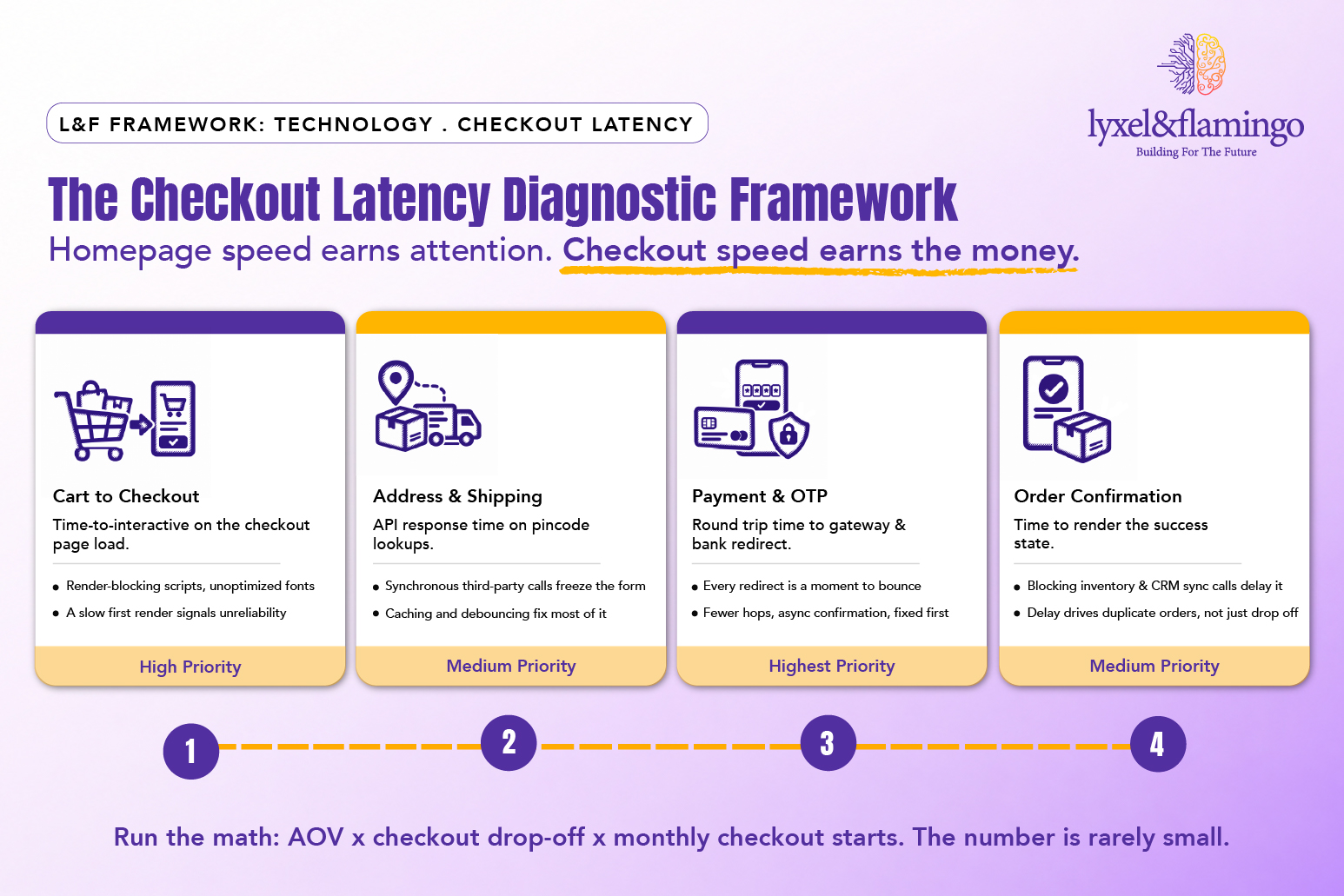
Diagnosing checkout latency needs a narrower lens than a general site audit. The table below breaks the checkout flow into the four stages where teams may find the biggest, fastest wins, tightening the technical and conversion side of the site in tandem rather than treating speed and conversion as separate workstreams.
Framework Explained
Cart to Checkout: The first render of the checkout page sets the tone; a slow load here signals unreliability before the shopper has typed a single field.
Address & Shipping: Pincode and serviceability checks often call a third-party API synchronously, freezing the form until it responds.
Payment & OTP: This is the highest-stakes stage. Every redirect to a bank or gateway is a moment the shopper can bounce, so this gets fixed first.
Order Confirmation: A delayed success screen leaves shoppers unsure their payment worked, which quietly drives duplicate orders and support tickets, not just abandonment.
Fixing the Leak Without a Full Rebuild
A full checkout rebuild is rarely the first move, and it should not be. Most latency at the payment and OTP steps may come from configuration, not architecture: reducing redirect hops, moving to asynchronous payment confirmation, and deferring non-critical scripts until after the order completes can recover meaningful time without touching the platform underneath.
Address and shipping lookups benefit from caching and debouncing rather than a rewrite. A pincode check that fires on every keystroke instead of after the shopper finishes typing is a common, cheap-to-fix source of perceived lag that has nothing to do with the payment gateway at all.
Where a deeper fix is warranted, brands running headless or composable storefronts have more room to isolate the checkout step as its own fast, independently deployable surface, separate from the rest of the site. The tradeoffs of that path are worth understanding on their own terms; Lyxel&Flamingo’s guide to enterprise headless commerce walks through where that investment may earn itself back.
Building Speed Into How You Measure Checkout
Checkout latency is not a one-time audit. Teams that keep the gains they find instrument the checkout flow with real-user monitoring, not just lab tests, and review the step-by-step timing alongside conversion data every sprint, not once a quarter.
The brands that treat checkout speed as a permanent line item, the same way they treat cart abandonment email flows or shipping cost transparency, are the ones who stop rediscovering the same leak every year. Small, steady tightening of the payment and confirmation steps compounds the same way the latency itself does, just in the brand’s favor this time.
Lyxel&Flamingo does not yet have a published case study isolating checkout-step latency as its own revenue metric. What we can speak to directly is our technology practice’s work on conversion rate optimization and checkout experience as outlined on our Technology services page, including A/B testing and behavioral analysis applied to checkout flows for D2C and enterprise clients. Medicair’s UI/UX design and development work is the closest adjacent proof point, a conversion-focused rebuild where every screen between browsing and order confirmation was treated as its own design decision. Brands looking for a dedicated latency audit should treat this as a capability conversation, not a proven-results claim, until that case study exists.
Key Takeaways
- Checkout-step latency is a distinct problem from general site speed and deserves its own measurement, not a line item inside Core Web Vitals.
- The payment, OTP, and order-confirmation steps carry high abandonment risk per second of delay because purchase intent is already at its peak there.
- Much of the latency at checkout may come from configuration (redirects, synchronous calls, unoptimized scripts), not from needing a full platform rebuild.
- A simple revenue-math exercise (AOV × checkout drop-off × monthly checkout starts) turns latency from an engineering concern into a number finance will act on.
- Real-user monitoring on the checkout flow, reviewed every sprint, helps keep the gains from disappearing back into the codebase over time.
CXO Takeaway
If your team can quote homepage load time yet not checkout-step latency, you are optimizing the wrong page. Put checkout on its own dashboard this quarter, run the revenue math against your actual funnel, and prioritize the payment and confirmation steps first. Talk to Lyxel&Flamingo’s technology team about a checkout-specific performance and conversion audit through our Technology services page.
Frequently Asked Questions
Checkout-step latency is the time between specific actions inside the checkout flow (loading the payment page, confirming a payment, rendering the order-success screen), measured separately from homepage or category-page load time, because shopper tolerance and revenue impact differ sharply at each stage.
Even one to two seconds of added delay at the payment or OTP step can measurably increase abandonment, since shoppers at that stage are the most anxious and least patient visitors on the site. The exact threshold varies by category and audience, which is why measuring your own funnel matters more than benchmarking against a generic industry number.
Usually not. Most gains come from reducing redirect hops, moving to asynchronous confirmation, caching shipping lookups, and deferring non-critical scripts. A platform-level change, such as isolating checkout on a composable or headless architecture, is worth considering only after configuration fixes are exhausted.
Break the checkout flow into stages (cart to checkout, address and shipping, payment and OTP, order confirmation) and instrument real-user timing for each one. Pair that with step-by-step drop-off data so latency and abandonment can be read side by side, not as two separate reports.