What this blog covers
A payment mix should follow customers instead of fashion. Cards, wallets, bank transfers and instant payment apps, buy-now-pay-later and cash on delivery each carry different conversion effects, fees, fraud exposure and settlement timing. Segment customers by order value, trust level, device and geography, then show each segment the options it prefers, in the order it prefers, while managing cost and risk. Measure payment success rate, abandonment at the payment step and net contribution by method. Publish accepted payment methods and terms on clear pages so shoppers and assistants find accurate answers.
Quick Answer: Start from data: list the methods your customers use today, their success rates, fees, fraud rates and settlement times. Map methods to segments, for example instant bank payments and wallets for mobile-first repeat buyers, cards for higher-value orders, instalment options for expensive items and cash on delivery for first-time buyers in markets where trust is still forming. Order the options on the page by segment preference, test changes as experiments and review net contribution by method each quarter. State accepted methods and any limits or fees on a clear policy page.
Table of Contents
- Why Payment Choice Shapes Conversion
- Step One: Know What Each Method Does
- Step Two: Map Methods to Segments
- Step Three: Design the Payment Step
- Step Four: Manage Cost and Risk
- Step Five: Measure by Method
- Payment Facts for Search and AI
- The Payment Mix Framework
- Client Proof From Our Work
- Key Takeaways
- CXO Takeaway
Why Payment Choice Shapes Conversion
Checkout friction decides many sales, and payment sits at the sharpest edge of it. Baymard Institute’s checkout usability research publishes extensive checkout usability findings and tracks the average cart abandonment rate over many years. Few leaks are cheaper to fix than a missing method or a clumsy flow.
Payment also carries trust. Familiar logos reassure first-time buyers, and secure, predictable flows calm doubts about unfamiliar brands. Our guide on failure points on a typical ecommerce website lists payment problems beside other conversion leaks, and our piece on how to avoid design mistakes that ruin your conversion rate covers the design side.
Step One: Know What Each Method Does
Each method has a profile. Check the current fees, limits and settlement terms with your payment provider, since they change.
Cards suit higher-value orders and international shoppers. They carry fees and chargeback exposure, and add security obligations. Our guide on insights into information technology security covers security basics.
Instant bank payments and payment apps suit mobile-first shoppers who value speed. In India, UPI plays this role, and our piece on UPI apps as media channels explains how deeply it shapes shopper habits.
Wallets offer stored credentials and one-tap payment, which helps repeat buyers.
Buy now, pay later and instalments soften the price of expensive items and can raise order value, with a cost to the merchant and a risk of regret if the terms confuse people.
Cash on delivery builds trust for new buyers and reaches shoppers without digital payment access, with a cost in returns to origin and cash handling.
Step Two: Map Methods to Segments
Segment by facts you can see: order value, new or repeat status, device, location, category and traffic source.
A mobile-first repeat buyer in a metro area probably prefers instant payment apps or a saved wallet. A first-time buyer ordering a mid-priced item in a smaller city may want cash on delivery for reassurance. A buyer of a premium item, such as home products or electronics, may welcome instalments. A business buyer may need invoicing or bank transfer.
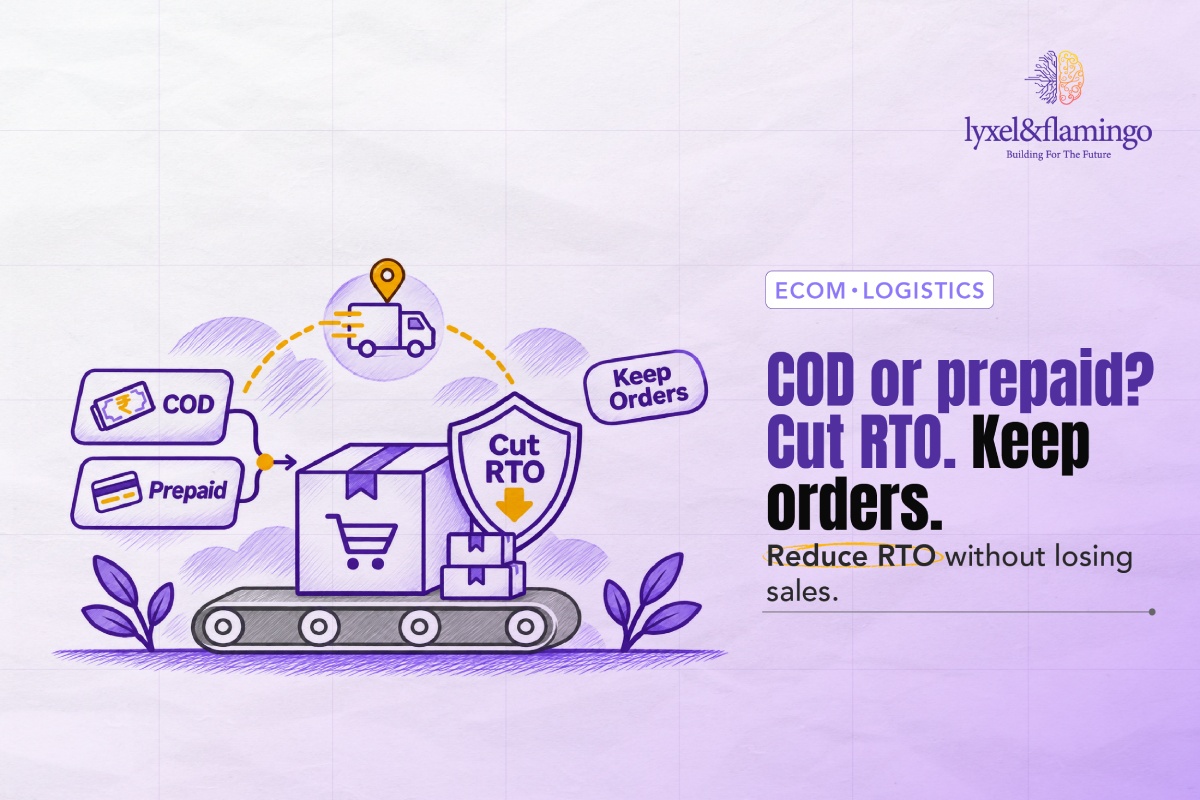
Write this as a simple table with segments in rows and methods in columns, and mark each cell as default, available or hidden. Review it with finance and operations, because each method changes working capital and workload. Our companion guide on cutting RTO with cash on delivery and prepaid options covers the cash-on-delivery decision in depth, and our piece on how to increase AOV helps you judge when instalments lift order value.
Step Three: Design the Payment Step
Design the page so the preferred method is easy to find and quick to finish.
Show the most likely method first for each segment, with recognisable logos and short labels. Preselect the best default where the platform allows. Keep fields minimal, support autofill, show security cues and display the total, including fees and taxes, before the final tap. Remember mobile: large tap targets, numeric keyboards for card and phone fields and a flow that survives a switch to another app and back, as happens during a payment app approval.
Handle failure gracefully. When a payment fails, explain why in plain words, keep the cart and offer another method with one tap. A failed payment without a way forward ends the sale.
Our guide on full-funnel CRO strategy shows how to test checkout changes as part of a wider programme.
Step Four: Manage Cost and Risk
Every method has a cost beyond the fee. Cards bring chargebacks, cash on delivery brings returns and cash handling, instalments bring approval delays and partner terms. Add the true cost of each method to your contribution calculation per order.
Manage risk with proportionate controls: address and device checks, velocity limits, step-up verification on unusual orders and clear communication with legitimate buyers. Avoid controls so heavy that they reject good customers. Keep a review loop with your payment provider and fraud tools, and look at decline reasons, because many declines come from bank-side rules rather than fraud.
Document your policy for each method: limits, fees and refund routes. Written rules help your team decide quickly and give customers the same answer every time.
Step Five: Measure by Method
Track results by method and segment: payment success rate, share of orders, abandonment at the payment step, average order value, refund rate, chargeback or return rate and net contribution after fees and costs.
Run experiments. Add a method for a test segment, reorder options or change the default, and compare delivered, net contribution per visitor rather than only conversion rate. A method that lifts orders while raising costs sharply may lose money, and the reverse can also hold.
Review quarterly with fresh data, and watch for shifts as new methods spread. Our guide on GA4 setup explains how to capture the payment funnel steps you need for this analysis, and our piece on the three kinds of revenue on your website helps you separate the effects.
Payment Facts for Search and AI
Shoppers ask direct questions before they buy: “Do you accept UPI?” “Is there cash on delivery?” “Can I pay in instalments?” Search engines and AI assistants answer from the pages that state the facts clearly.
Create a payments page that lists accepted methods, any limits, fees, instalment terms, refund timelines and security notes, in plain language with headings that match those questions. Mention the methods on product pages and in checkout summaries where they help. Keep the information identical across your site, marketplace listings and customer service replies, and update it when you add or remove a method. Google’s page on AI features and your website says standard SEO fundamentals apply, and our GEO playbook explains how assistants choose sources.
The Payment Mix Framework
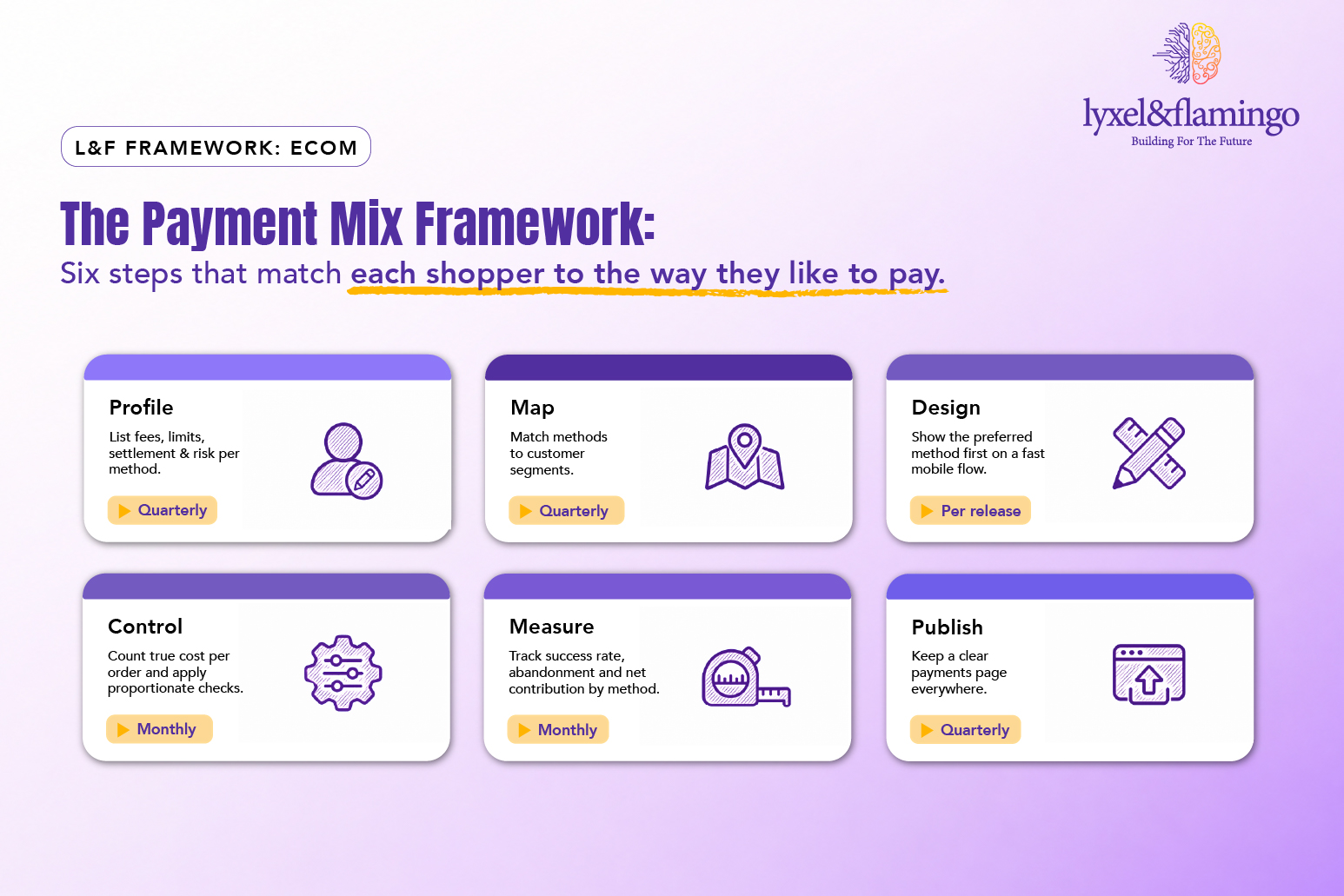
Framework Explained
Work through the framework by segment. The first two steps give you facts, and the rest turn them into a menu that earns more than it costs.
Step 1: Profile. List each method with its fees, limits, settlement time and risk profile, and confirm current terms with your provider. Check: the profile sheet carries a review date.
Step 2: Map. Build a table with segments in rows and methods in columns, and mark each cell default, available or hidden. Check: finance and operations have signed off.
Step 3: Design. Show the preferred method first for each segment, keep the mobile flow fast and offer another method after a failure. Check: a failed payment keeps the cart and offers a way forward.
Step 4: Control. Add the true cost of each method to contribution per order, and apply checks in proportion to risk. Check: decline reasons are reviewed monthly.
Step 5: Measure. Track success rate, abandonment at the payment step, order value and net contribution by method. Check: tests compare net contribution per visitor.
Step 6: Publish. Publish a payments page that lists methods, limits, fees, instalment terms and refund timelines. Check: the page matches checkout and your marketplace listings.
⚠ CAPABILITY NOTE: Lyxel&Flamingo’s ecommerce team designs checkout and payment journeys for D2C and retail brands and connects them to media and SEO performance. This guide shares the working approach and points to related client engagements in the proof section.
Client Proof From Our Work
Payment design appears in storefronts, kiosks and ordering sites. Each engagement below made payment choices for its own setting.
Stanley India describes UPI, cash on delivery and Razorpay Magic Checkout. Subway India describes card payments with a backup gateway and quick retry, and Pizza Pizza describes a three-step checkout. None of them publishes a conversion figure for payments.
Key Takeaways
- Each payment method carries different conversion effects, costs, risks and settlement terms.
- Map methods to segments by order value, trust, device and geography.
- Put the preferred method first, keep the flow fast on mobile and offer a way forward after a failure.
- Judge methods on net contribution, with fees, returns and chargebacks included.
- Publish a clear payments page so search engines and assistants answer shopper questions accurately.
CXO Takeaway
Which payment method earns the most net contribution per visitor, and does your checkout show it first? Many teams only know which method gets used most. Lyxel&Flamingo’s ecommerce team tests payment mix as part of full-funnel conversion work.
Frequently Asked Questions
The set of payment options a store offers, in a chosen order and with chosen defaults, tuned to its customer segments.
It helps first-time buyers and shoppers without digital payment access, and it adds return and handling costs. Offer it where the net numbers support it.
Use data on which method each segment completes most often and which earns the best net contribution, then test the default as an experiment.
Shoppers ask assistants which payment options a store accepts, and clear, consistent pages give assistants accurate answers to quote.