What this blog covers
High-ticket products sell through long, research-heavy journeys. Buyers move between inspiration, comparison, validation and purchase across many sessions and devices, and influencers such as architects and designers shape choices. A site that serves them presents the full range clearly, supports comparison and specification, builds trust through detail and proof, and keeps conversion paths such as showroom visits, enquiries and sample requests open at every stage. Long informational queries make this content a natural fit for search and AI assistants, which favour clear, citable answers.
Quick Answer: Map the journey in four stages: inspire, compare, validate and decide. For each, publish content that answers the questions buyers ask: inspiration galleries, specification sheets, comparison guides, finish and care details, installation notes, warranty terms and showroom information. Serve homeowners and specifiers separately with clear paths for each. Replace a single “buy now” goal with several conversion actions, such as enquiry, showroom booking, brochure download and quote request. Measure assisted journeys and return visits, and structure each page so a search engine or assistant can lift a precise answer.
Table of Contents
- Why Considered Purchases Need a Different Funnel
- Stage One: Inspire
- Stage Two: Compare
- Stage Three: Validate
- Stage Four: Decide
- Serving Specifiers and Homeowners
- What the Artize Project Shows
- Writing for Search and AI Assistants
- The Considered-Purchase Framework
- Client Proof From Our Work
- Key Takeaways
- CXO Takeaway
Why Considered Purchases Need a Different Funnel
Fast-moving consumer goods convert in a single session. High-ticket products stretch across weeks or months. The buyer carries more risk, spends more money and lives with the result for years, so the research load rises to match.
That changes what you measure. Last-click conversion rate undersells a site where most buyers return several times. Better signals include return visits, time spent on specification pages, brochure downloads, showroom bookings and enquiry quality. It also changes how you spend: a media plan that chases the cart alone starves the stages where the decision forms. Our guide on full-funnel CRO strategy explains how to optimise across the whole journey instead of the last click.
Stage One: Inspire
At the start, buyers want ideas, and few of them know the product name they will end up buying. They search for styles (“matte black bathroom ideas”), save images and browse social platforms.
Give them rich, visual, well-organised inspiration: room-led galleries, finishes shown in context and short guides to styles. Make every image shoppable or at least linkable to the products in it. Keep pages fast, because heavy imagery slows them, and Google’s Core Web Vitals guidance offers clear targets such as a Largest Contentful Paint within 2.5 seconds at the 75th percentile.
Treat this stage as brand building as well as traffic. Our piece on what brands can learn from Piyush Pandey’s campaigns shows how emotion carries a premium brand.
Stage Two: Compare
Once a buyer has a direction, comparison begins. They compare brands, ranges, finishes and prices, and they open many tabs.
Help them compare on your terms. Offer range pages that explain how collections differ, side-by-side specification tables, finish swatches and guides such as “how to choose between a wall-mounted and a deck-mounted mixer.” Keep language specific: dimensions, materials, certifications and compatibility matter more than adjectives.
Be open about price positioning. Premium buyers respect clarity, and hidden prices create doubt. Where pricing varies by project, explain what drives it and offer a clear route to a quote.
Stage Three: Validate
Validation answers the question “will I regret this?” It needs proof and reassurance.
Show installation photos from real homes, designer and architect endorsements where you have permission, warranty terms in plain language, care instructions, delivery and installation process and service support. Add clear reviews and ratings where they exist. Publish the people behind the brand and the story of how products are made.
This is also where the showroom matters. Many premium categories close in person, so connect the site to the physical experience with showroom locators, appointment booking and clear opening hours. Our guide on O2O strategies explains how to bridge online research and offline visits.
Stage Four: Decide
Decision-stage pages should lower friction and keep the door open for several routes to a close: add to cart for items that ship directly, request a quote for project orders, book a consultation or call a dedicated number.
Remove surprises. Show delivery timelines, installation scope, return rules and payment options before checkout. Provide a human contact point, because buyers of expensive items like to ask a person. Our guide on how to build a conversion funnel audit shows how to find the points where decisions stall.
Then follow up. A buyer who downloaded a brochure or requested a quote deserves a sequence of helpful emails or messages, such as care tips, project checklists and showroom invitations. Our guide on the WhatsApp layer in omnichannel customer experience covers conversational follow-up.
Serving Specifiers and Homeowners
In many home categories, a second audience shapes the sale: architects, interior designers and contractors. They need different things from a homeowner. They want specification sheets, CAD and technical files, finish codes, project references and a quick route to a trade contact.
Give them a dedicated path from the main navigation, so they can find technical detail without wading through lifestyle content. Organise the site around how specifiers search: by product type, by finish, by project need. Meanwhile, keep the homeowner path visual and reassuring. Both paths can share one catalogue while presenting it differently.
What the Artize Project Shows
Artize is a luxury bathware brand from the Jaquar Group. The Artize case study, published in May 2026, describes a brief to position the brand correctly in luxury, serve architects and designers, present the full range clearly and work well on mobile.
The approach began with discovery and an audit, with user journeys mapped, and an information architecture built around specifier intent. The team created a visual design system covering typography, palette and image treatment, built low-fidelity prototypes before visual design, produced a fully responsive build tested on desktop, tablet and mobile, and wrote copy for the brand. The case study says website visits surged within the first month and gives zero figures, so this article treats it as a reference for the method and quotes zero results.
The lessons carry across categories. Start from the buyer’s intent, design for the specifier as well as the homeowner, prototype before polishing and test on every device.
Writing for Search and AI Assistants
Considered purchases generate long, specific questions: “what finish lasts longest in hard water,” “how to plan a wet room for a small bathroom.” Those queries suit informational content, and they increasingly reach assistants as well as search engines. Google’s guidance on creating helpful, reliable content stresses original information and clear expertise, and its page on AI features and your website says standard SEO fundamentals apply.
Write each guide to answer one question in the first lines, then add the detail. Use clear headings, short tables for specifications and plain statements of facts such as dimensions, materials and warranty terms. Add structured data for products and organisation details. Our guides on entity-based SEO and E-E-A-T trust signals explain how to build the signals that make a brand recognisable, and our GEO playbook covers citations.
The Considered-Purchase Framework
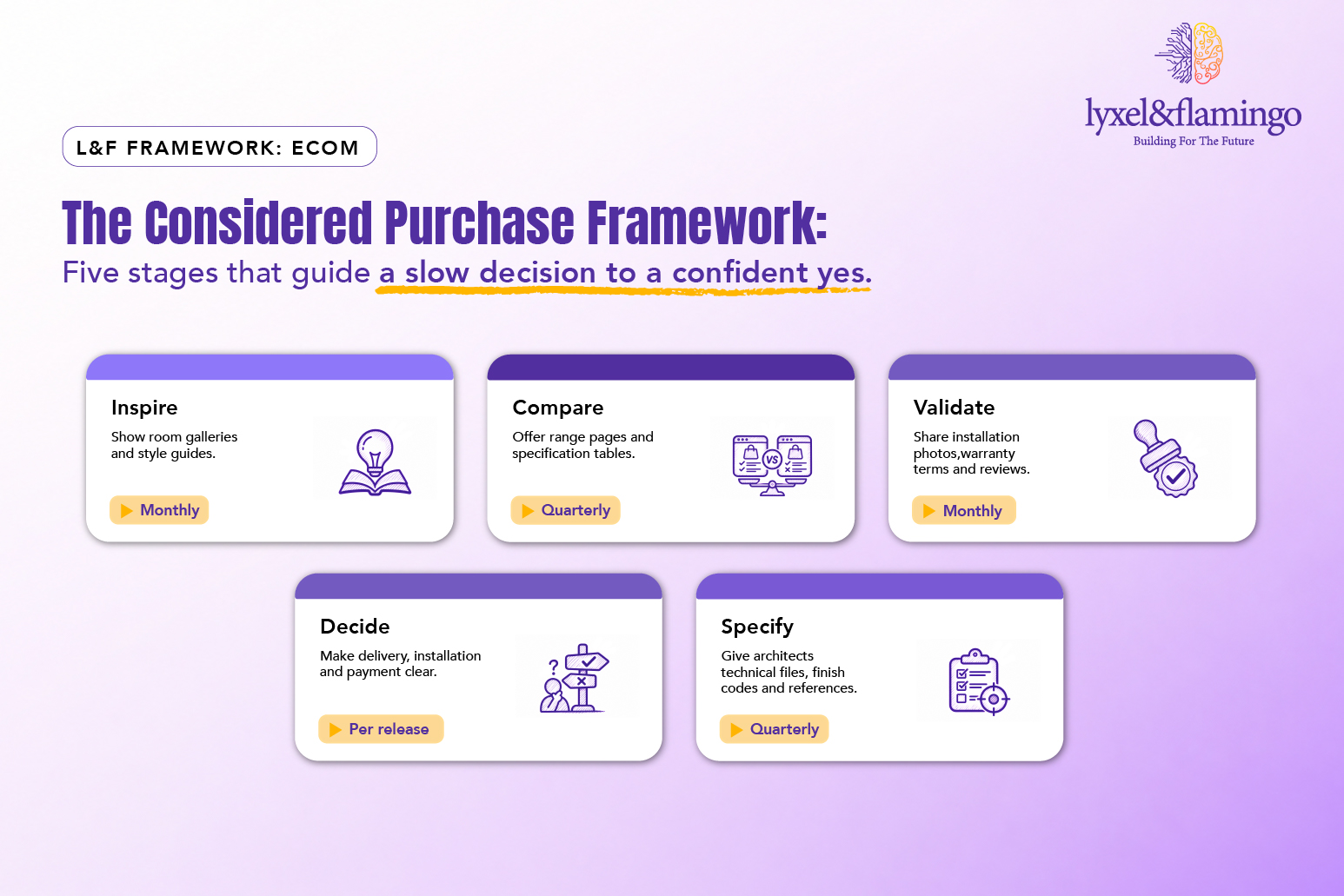
Framework Explained
Walk a real buyer through the five stages and ask what they need at each. The framework works best when each stage has its own content and its own conversion action.
Step 1: Inspire. Publish room galleries and style guides that help buyers picture the result. Check: every gallery image links to the products in it.
Step 2: Compare. Offer range pages that explain how collections differ and tables that compare specifications. Check: a visitor can compare two ranges without leaving your site.
Step 3: Validate. Show installation photos, warranty terms in plain words, care guidance and reviews. Check: the warranty page answers the three questions your showroom hears most.
Step 4: Decide. Make delivery times, installation scope, payment options and a human contact point easy to find. Check: a buyer can request a quote or book a visit from any product page.
Step 5: Specify. Give architects and designers technical files, finish codes and project references on a dedicated path. Check: a specifier can download a specification sheet in two clicks.
CLIENT PROOF POINT: Lyxel&Flamingo built Artize’s luxury bathware website with discovery and audit, an information architecture around specifier intent, a visual design system, prototypes and a fully responsive build. The case study notes that website visits surged within the first month and publishes zero figures. Read the full Artize case study.
Client Proof From Our Work
Considered purchases need strong first impressions and clear evidence. Artize covers the website side and Godrej Appliances covers advertising for air conditioners and large refrigerators.
Artize publishes zero figures. Godrej’s CTR comparisons run against category averages, and the page states zero period.
Key Takeaways
- High-ticket buyers research over weeks, so measure return visits and assisted journeys beside last-click sales.
- Serve four stages: inspire, compare, validate and decide, each with its own content and conversion action.
- Give architects and designers a dedicated path with technical files and references.
- Offer several ways to convert, including quotes, showroom bookings and consultations.
- Write answer-first guides with clear specifications so search engines and AI assistants can quote them.
CXO Takeaway
If your best buyer visited your site five times before purchasing, which of those five visits would they remember as helpful? Map the journey before you redesign anything. Lyxel&Flamingo’s ecommerce team starts projects of this kind with discovery and an audit.
Frequently Asked Questions
A high-value buying decision that involves extended research, comparison and often advice from others before purchase.
Track return visits, specification page engagement, brochure downloads, showroom bookings, enquiry quality and assisted conversions beside last-click sales.
If they influence your sales, yes. They need technical files, finish details and references that homeowners rarely look for.
Long, specific research questions suit assistants, and pages with clear, factual answers are easier for them to quote.