
What this blog covers
Creative is now the single biggest lever in paid media, and the one most brands still under-brief. This blog explains why the shift to Advantage+ and Performance Max quietly turned creative into the new targeting, introduces L&F’s framework: The Creative Multiplier Loop (Relevance, Volume, Velocity, Signal, Feedback), and shows how it drove a 4.5X ROAS for boAt and a 73% CTR lift for Lotto. It closes with a scorecard any CXO can run on their own creative operation.
Table of Contents
- What Creative Effectiveness Really Means Once the Algorithm Takes Over
- Why the Edge Quietly Moved from the Media Buyer to the Creative
- The Five Creative Blind Spots Costing CMOs Return
- Framework: The Creative Multiplier Loop
- Inside the Loop: What Each Stage Fixes
- How the Loop Played Out: boAt, Lotto and R&B
- Score Your Own Creative Operation: The Multiplier Scorecard
- Key Takeaways
- The Question Worth Sitting With
What Creative Effectiveness Really Means Once the Algorithm Takes Over
Creative effectiveness is the degree to which the advertisement itself, the idea, the message, and the execution drive the business outcome, independent of budget, bid, or targeting. For most of the last decade, marketers focused their craft on targeting: audiences, lookalikes, exclusions, and bid strategies. That craft has now largely been absorbed by the platforms. On Meta’s Advantage+ and Google’s Performance Max, the algorithm decides who sees the ad. What the marketer still controls, almost the only thing left to control, is the creative and the signals it sends.
Creative is no longer the finishing layer on a media plan. It is the plan’s largest remaining variable, and the core of modern media creative optimisation.
- Targeting is now automated (Advantage+, Performance Max); creative is the main variable you still control.
- Creative effectiveness is measured by outcomes, not opinions: engagement signals, CTR by funnel stage, and cost-per-result at scale.
- Creative works as a system built on relevance, volume, velocity, signal, and feedback, not as a collection of one-off assets.
Why the Edge Quietly Moved from the Media Buyer to the Creative
Two things happened at once. First, the evidence hardened. Analysis of hundreds of campaigns has found that creative quality drives roughly 47-49% of a campaign’s sales impact, and as much as 65% of sales lift in digital, more than reach, brand or targeting combined (Nielsen). Creative is not the tie-breaker; it is the main event.
Second, the platforms automated the parts marketers used to optimise by hand. When every advertiser in a category rents the same AI to do the targeting, the targeting stops being a source of advantage. And AI is not only doing the targeting; it is reshaping the economics of making creative: McKinsey estimates generative AI could lift marketing productivity by 5-15% of total marketing spend, worth about $463 billion a year (McKinsey). The lever moved from the media buyer to the creative system. Most budgets have not.
Two brands with identical budgets, audiences, and bidding strategies can now produce dramatically different business outcomes for one reason alone: the quality of their creative. Brands that still treat creative as the final 5% of the campaign brief are focusing on the part they influence least while neglecting the factor that drives nearly half of campaign performance.
The practical consequence is significant. Two advertisers can run identical budgets, target the same audiences, and use the same bidding strategy, yet one achieves a 2X ROAS while another reaches 5X ROAS. The difference is creative, not media buying.
The Five Creative Blind Spots Costing CMOs Return
- Creative is briefed as decoration, not as the performance driver. It gets the last 5% of the timeline and the first cut of the budget, then everyone is surprised when results plateau.
- Production cannot keep up with the algorithm’s appetite. Modern AI-driven media needs a constant stream of fresh variants to test; traditional shoots are too slow and too expensive to feed it.
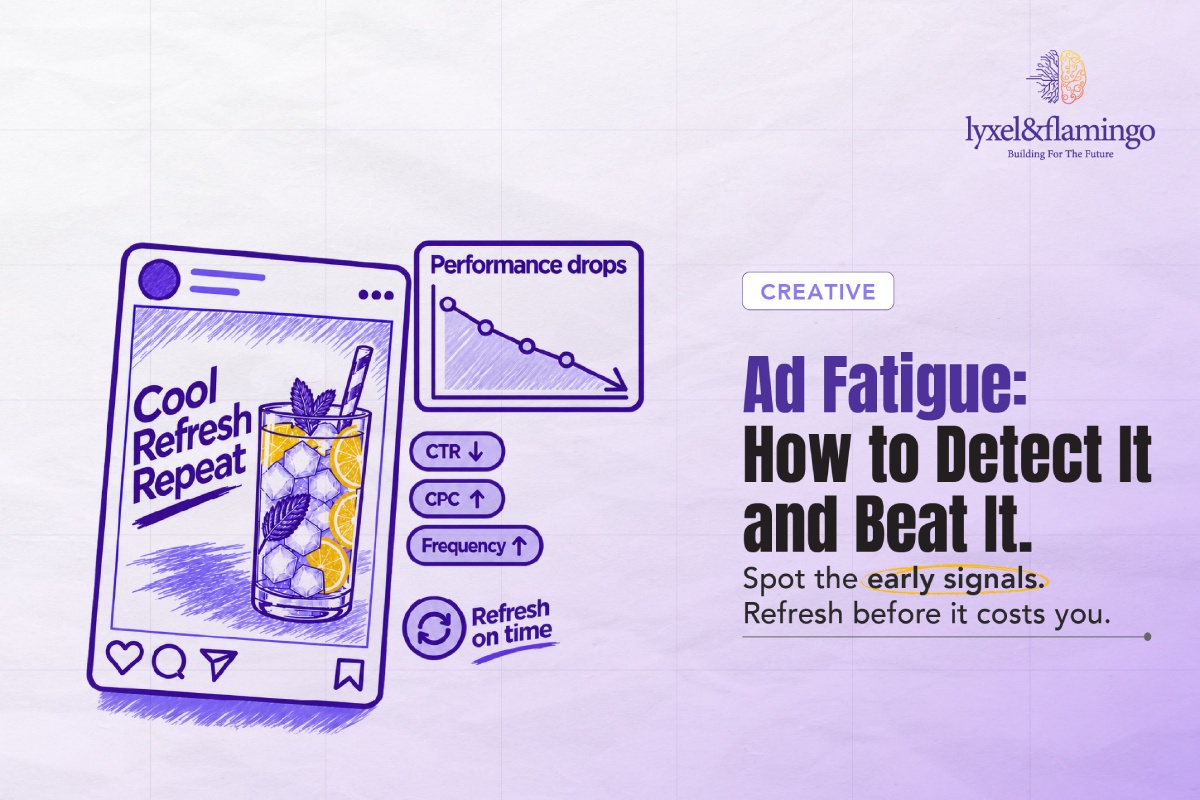
- Ad fatigue is misread as audience saturation. Performance decays, the team blames the audience or the platform, and pours budget into a tiring creative instead of refreshing it.
- Everyone now targets the same way. With Advantage+ and Pmax, undifferentiated creative produces undifferentiated results, and rising costs, because there is no other lever left to pull.
- There is no feedback loop. Media data that should be writing the next creative brief dies in a reporting dashboard, so the same mistakes get re-shot next quarter.
Framework: The Creative Multiplier Loop
Running Creative as a System, Not a Hand-off
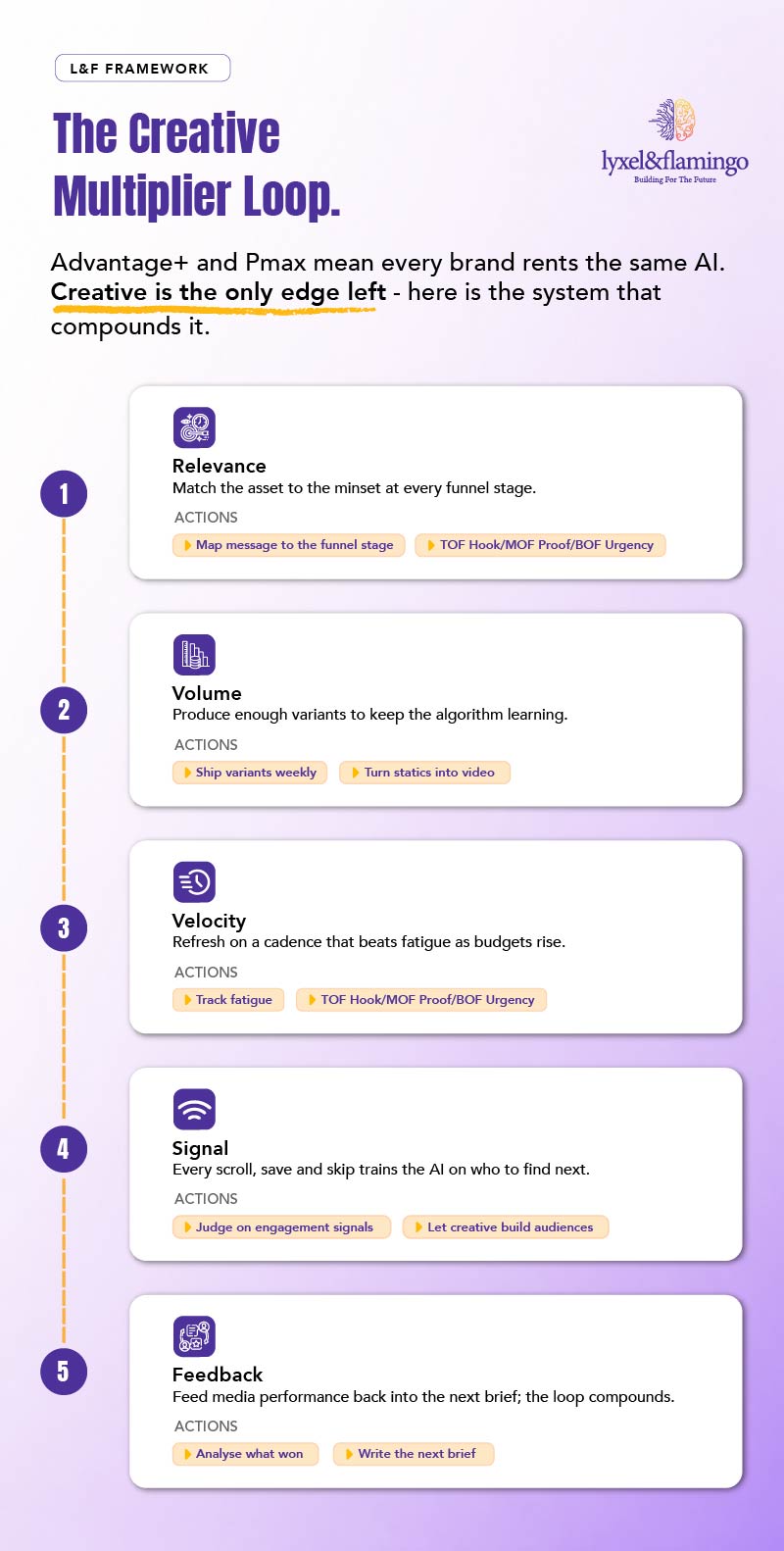
A creative operation that actually multiplies media performance runs as a loop, not a hand-off. Five stages, each feeding the next, sitting inside a full-funnel media system, with one idea at the centre: creative is the new targeting.
Inside the Loop: What Each Stage Fixes
01. Relevance:
The loop starts with matching the message to the mindset at each funnel stage: a curiosity-led hook at the top, feature and social proof in the middle, urgency and a clear action at the bottom. The failure mode is one flat message pushed across the whole funnel. The AI unlock is generative concepting: mapping a single insight into stage-specific messages in minutes rather than weeks.
02. Volume:
The algorithm is hungry. It needs enough distinct variants to find the combinations that work, and it needs them continuously. The failure mode is shipping three creatives a month and wondering why learning stalls. The AI unlock is production at scale: turning static assets into motion, spinning up format and message variants without a new shoot for each one
03. Velocity:
Winning creative decays. Velocity is the discipline of refreshing on a cadence that beats fatigue, so performance holds even as spend rises. The failure mode is riding a winner until it collapses. The AI unlock is automated fatigue detection and on-trigger iteration, so the next version is ready before the current one tires.
04. Signal:
This is the stage most teams miss. Every scroll, save, share and skip on your creative is a signal that trains the algorithm on who to find next. Good creative does not just convert the people who see it; it teaches the AI to find more people like them. That is why creative is the new targeting: the creative is the audience-building instrument.
05. Feedback:
Finally, media performance feeds the next brief. Winning-pattern analysis: which hooks, formats, claims and lengths worked, becomes the input to the next batch, so every cycle starts smarter than the last. Close this loop and creative compounds; leave it open and you restart from zero each quarter.
How the Loop Played Out: boAt, Lotto and R&B
The loop is not theory. It is how we run creative for some of India’s most competitive consumer brands.
For boAt, we built a funnel-matched creative system: lifestyle, use-case hooks at the top of funnel (“perfect for your commute”), feature and proof in the middle (“60 hours of playtime”, “loved by over 500,000 users”), and urgency at the bottom (“few units left”). Aligning creative depth to user mindset, Relevance and Signal working together, delivered a 4.5X ROAS and a 1.74X lift in CTR.
For Lotto’s India relaunch, the challenge was relevance, not awareness. We built distinct creative routes for Gen Z and millennials and ran a Meta-first, test-and-learn system designed for continuous iteration. The result was a 73% increase in CTR while budgets scaled 59% and CPC fell 6% : Velocity in practice.
For R&B Fashion, the constraint was production. Video outperforms on Meta, but traditional shoots could not keep pace with a fast-moving catalogue. We used AI to turn static product images into motion-led, funnel-wise videos and built a repeatable workflow that unlocked video at scale with no shoots. That is Volume, solved with AI.
The lesson for brand leaders: none of these wins came from better targeting. They came from a creative system that was relevant, produced at volume, refreshed at velocity, engineered to signal, and closed with feedback.
Creative is one layer of a bigger system. It is the biggest lever inside profitable performance marketing, and its true effect only becomes visible once you fix how you measure media so that leading signals, not last-click, decide which creative actually wins.
Score Your Own Creative Operation: The Multiplier Scorecard
Score your creative operation against the following criteria. Give yourself one point for every “Yes”.
- Relevance
Every live creative is mapped to a specific funnel stage and customer mindset, rather than being used across the entire funnel.
- Volume
You produce enough distinct creative variants every month to keep the algorithm in active learning mode. - You can create video assets without commissioning a new production shoot for every campaign.
- Velocity
You monitor creative fatigue and refresh assets on a defined schedule before performance begins to decline.
- Signal
Creative is evaluated using engagement signals that influence the algorithm, not just final conversions.
- Feedback
Media performance is analysed into a clear “what worked and why” report that directly informs the next creative brief.
- Performance
Creative has its own owner, testing budget, and dedicated line item within the media P&L. - You can identify your top three performing creative hooks this quarter using data rather than memory.
Score Guide
- 7-9: A compounding creative engine.
- 4-6: Producing, but leaking performance.
- Below 4: Creative is a cost centre, not a multiplier.
Key Takeaways
- With Advantage+ and Pmax, the algorithm does the targeting; creative is the largest remaining lever, responsible for roughly half of sales impact (Nielsen).
- Run creative as a loop, not a hand-off: Relevance, Volume, Velocity, Signal, Feedback.
- Creative is the new targeting: engagement signals train the AI on who to find next.
- AI changes the maths at every stage: concepting, production, fatigue detection and brief-writing, making volume and velocity affordable (McKinsey: up to $463bn in marketing productivity).
- Proof: 4.5X ROAS (boAt), +73% CTR at +59% budget (Lotto), video at scale with zero shoots (R&B).
The Question Worth Sitting With
For a decade, the marketer’s edge was in the targeting. That edge has been automated away. What remains, and what now decides whether two identical media plans succeed or stall, is the creative and the system that produces it. The brands that win the next few years will not be the ones with the cleverest audiences; everyone rents the same AI for that. They will be the ones who treat creative as a compounding, measurable engine: relevant, produced at volume, refreshed at velocity, engineered to signal, and improved by feedback. Creative was always the biggest multiplier. AI just changed the maths on how much of it you can afford to make, and how fast it compounds.
Frequently Asked Questions
In practice, yes, because targeting has been largely automated. On Advantage+ and Performance Max the platform decides who sees your ad, so the creative becomes the main variable you still control. Nielsen's analysis attributes around half of an ad's sales impact to creative, more than any other single factor.
Enough to keep the algorithm in active learning for most performance accounts that means a steady weekly stream, not a monthly drop of three. The exact number depends on spend and audience size, but the failure mode is almost always too few, too slowly. This is why AI-assisted production matters: it makes the required volume affordable.
Fatigue is falling engagement as the same people see the same creative too often: rising frequency, falling CTR, rising CPMs. Beat it with velocity: track the signals, set a refresh cadence, and have the next iteration ready before the current one collapses.
Yes, when it is built funnel-wise and tested like any other creative. For R&B Fashion we turned static product images into motion-led videos across the funnel and unlocked video at scale with no shoots. AI is a production and iteration accelerator; the strategy and the testing discipline still decide the outcome.
Read the leading signals: CTR and engagement rate by funnel stage, hold rate and view-through on video, save and share rates, and crucially cost-per-result stability as you scale. These move before ROAS does and tell you which creative is teaching the algorithm well.
It should be a named line in the media P&L with its own owner and a protected testing budget, not an afterthought funded from what is left. Brands that resource creative as a performance function consistently get more out of the same media spend.
Brief for the funnel stage and the signal, not just the look: specify the mindset (cold, considering, ready), one message per stage, and the engagement you want the asset to earn. Set a testing budget and a refresh cadence up front, and judge output on leading signals: hook rate, hold rate, saves, not only final ROAS.
Both. The platforms automate targeting for B2B too, so creative relevance and volume increasingly decide cost per lead. The difference is that B2B creative leans harder on proof, authority and specificity, and the feedback loop runs on lead quality rather than an immediate sale.