What this blog covers
Demand Gen campaigns serve image, video and carousel ads across Google surfaces such as YouTube, Discover and Gmail, and Google’s help page says Demand Gen lets advertisers reach more than 3 billion active monthly users. For ecommerce, results depend on strong creative, layered audiences that combine in-market and custom segments with remarketing, a conversion goal matched to the funnel stage and patient measurement. The Kenstar case study reports a 260% rise in conversions for hero products with a Demand Gen upper-funnel layer plus a remarketing layer.
Quick Answer: Prepare several video and image assets in the formats Demand Gen uses, build audiences from your customer lists, website visitors, in-market segments and custom segments, and keep prospecting and remarketing structures separate. Optimise toward purchases once the account has enough conversion data, and use a lower-funnel goal such as add to cart or page view to seed learning if volume is thin. Judge the campaign over a full learning window, using assisted conversions and branded search lift alongside last-click sales, and refresh creative before fatigue sets in.
Table of Contents
- Where Demand Gen Fits in an Ecommerce Account
- Creative: Formats and What to Show
- Audiences: Prospecting and Remarketing Layers
- Bidding and Conversion Goals
- Measuring What Demand Gen Really Does
- What the Kenstar Programme Reports
- Brand Reach, Search and AI Mentions
- The Demand Gen Framework
- Client Proof From Our Work
- Key Takeaways
- CXO Takeaway
Where Demand Gen Fits in an Ecommerce Account
Search captures people who already know what they want, and Performance Max sweeps across inventory with a conversion goal. Demand Gen fills a different role: it creates and nurtures demand among people who browse, watch and scroll before they search.
Google’s Demand Gen overview says the campaign type lets advertisers reach more than 3 billion active monthly users and describes a migration of Display campaigns toward Demand Gen. Check the page for the current status, since the programme and its timelines have changed over time.
For a store, the role is clear. Demand Gen introduces products to likely buyers, keeps the brand visible and feeds remarketing pools. Our guides on upper-funnel and lower-funnel advertising and the full-funnel media engine explain how the layers work together, and our summary of Google Ads trends places Demand Gen among the wider changes.
Creative: Formats and What to Show
Creative drives Demand Gen more than any other lever. Prepare a mix of vertical and square video, horizontal video, single images and, where your catalogue allows, product-led formats that pull from your feed.
Show the product in use in the first seconds, state the benefit plainly and keep the brand visible without taking over. Our guide on how holistic video drives full-funnel performance and the piece on YouTube’s AI tools for video ads cover the video side.
Plan variety. Test different hooks, offers and formats, and keep three to five distinct concepts live. Our guide on why creative is the biggest media multiplier explains why this matters more than small targeting tweaks.
Audiences: Prospecting and Remarketing Layers
Build audiences in layers. For prospecting, start with in-market segments for your category, custom segments built from searches and websites relevant to your buyers, and lookalike-style expansion from your customer lists where available. For remarketing, use website visitors, product viewers, cart abandoners and past buyers, with windows matched to intent.
Keep the layers in separate campaigns or clearly separate ad groups, so that budget and results stay readable. Exclude recent purchasers from prospecting and remarketing alike, and exclude low-intent visitors from the hottest remarketing pools. Our guide on dynamic product ads best practices shows a catalogue-driven approach to the remarketing layer.
Use first-party data wherever you can. Customer lists, consented website events and clean conversion tracking improve targeting and bidding. Our article on signal-based marketing in a cookieless world covers the data foundation.
Bidding and Conversion Goals
Match the bid strategy to the account’s maturity. With enough purchase data, optimise for conversions or conversion value, so the system looks for people likely to buy. With thin data, begin with a goal higher in the funnel, such as add to cart or a qualified page view, then move to purchases as volume grows.
Give the campaign time and stable budgets. Frequent edits restart learning, and a budget too small to generate conversions leaves the system guessing. Set a realistic daily budget for the number of conversions you want per week, and avoid judging after two days.
Align the conversion goal with business value. If product margins differ, use conversion value tracking so that the system prefers high-value orders.
Measuring What Demand Gen Really Does
Demand Gen influences people who buy later through other channels, so last-click reports undercount it. Read several signals together: direct conversions, view-through and assisted conversions, new customer share, branded search volume and the performance of remarketing audiences fed by the campaign.
Run clean tests where possible. A geo split or a holdout can show lift beyond attribution models. Compare periods with and without the campaign, while allowing for seasonality and other changes.
Our guide on moving beyond ROAS explains how to judge upper-funnel work with wider metrics.
What the Kenstar Programme Reports
The Kenstar Demand Gen case study, published in June 2026, covers an Indian home appliances brand that needed to reach buyers at seasonal intent peaks and re-engage those who had yet to convert. The approach layered a Demand Gen upper-funnel campaign using in-market and custom segments for water geysers and small appliances with a remarketing layer for high-intent visitors who had yet to convert.
The page reports a 260% increase in conversions for hero products, a 100% increase in click-through rate, a 40% reduction in cost per click and a 73% increase in quarter-on-quarter investment. Most of these figures come without a stated period, so read them as the programme’s reported outcomes, and expect your own results to vary with category, budget and creative.
Brand Reach, Search and AI Mentions
Demand Gen widens the number of people who see your brand, and some of them search for you afterwards. Branded search is one of the clearest signals of that effect, and our guide on improving brand search volumes shows how to track it.
Wider presence also adds to the mentions across the web that AI engines learn from. Our GEO playbook explains how brand mentions and consistent facts feed AI answers, and Google’s page on AI features in Search confirms that standard SEO fundamentals still apply. Send Demand Gen traffic to fast, clear landing pages, since the same pages serve organic search.
The Demand Gen Framework
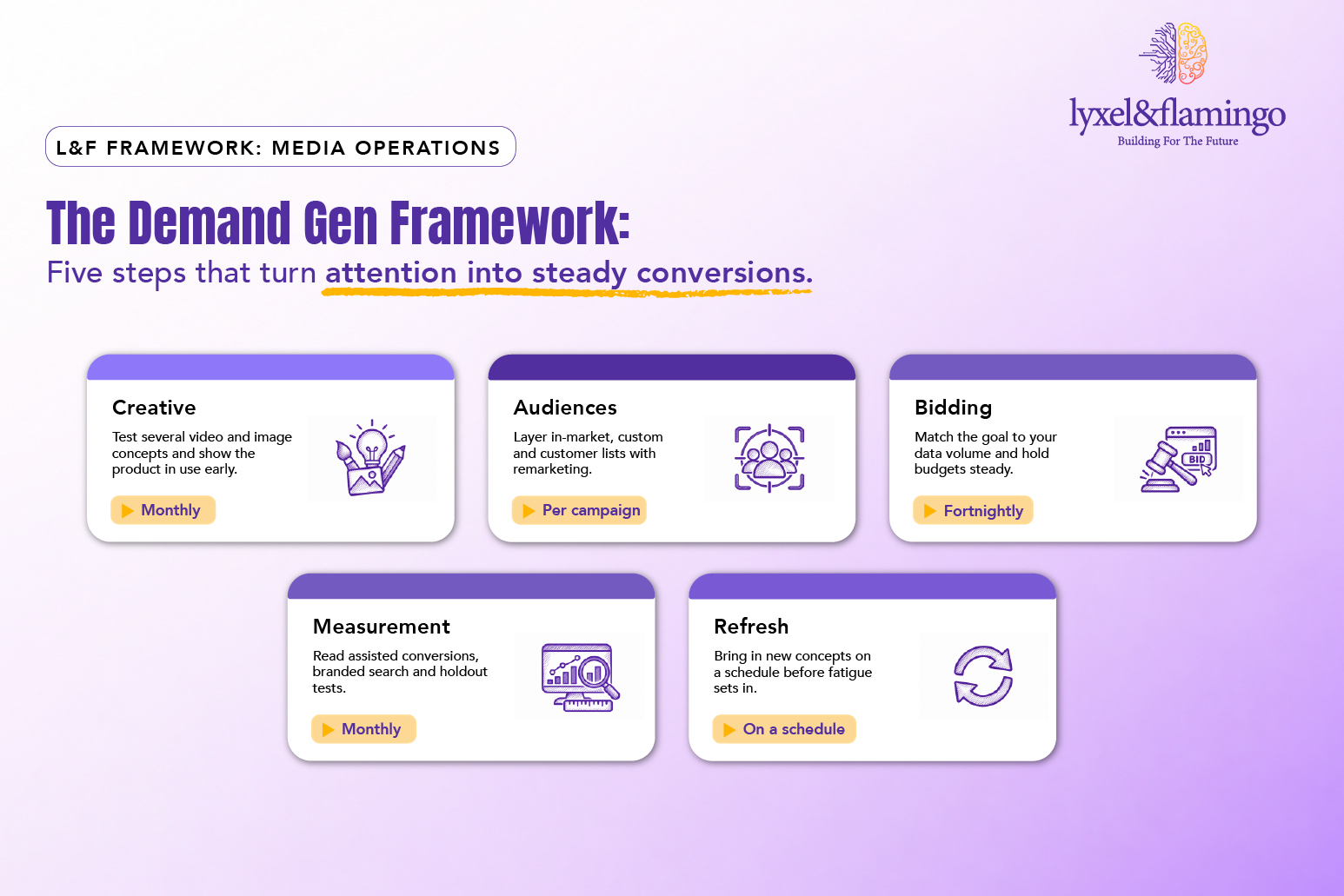
Framework Explained
Work through the five steps in a loop. Creative and audience choices feed bidding and measurement, and measurement tells you when to refresh.
Step 1: Creative. Prepare several video and image concepts and show the product in use within the first seconds. Vary the hook as well as the colours. Check: each campaign runs at least three distinct concepts.
Step 2: Audiences. Layer in-market audiences, custom segments built from relevant searches and your customer lists, and add a remarketing layer for people who visited and left. Check: every audience has a clear reason and a size that allows learning.
Step 3: Bidding. Pick a bidding goal that matches your conversion volume and hold budgets steady while the system learns. Frequent edits restart learning. Check: changes happen on a set rhythm, such as fortnightly.
Step 4: Measurement. Read assisted conversions, branded search lift and holdout tests beside last-click sales, since Demand Gen often influences purchases that close elsewhere. Check: your report shows at least one measure beyond last click.
Step 5: Refresh. Schedule new concepts before performance falls. Retire the weakest creative and archive what it taught. Check: a refresh calendar exists and is followed.
CASE STUDY NOTE: The Kenstar case study reports a 260% rise in conversions for hero products, a 100% rise in click-through rate, a 40% drop in cost per click and a 73% rise in quarter-on-quarter investment from a Demand Gen upper-funnel layer plus a remarketing layer. Read the full Kenstar Demand Gen case study. Most figures come without a stated period, and results vary by brand.
Client Proof From Our Work
Demand Gen rewards strong creative and well-layered audiences. Kenstar shows the audience side and Hindware shows the creative side.
Most Kenstar figures carry zero period labels, and Hindware’s engagement figures describe a social-first Diwali campaign, so read them as examples of creative and audience discipline instead of a promise for your account.
Key Takeaways
- Demand Gen creates and nurtures demand among people who browse before they search.
- Creative drives results, so prepare several concepts in several formats.
- Layer prospecting and remarketing audiences, and keep them separate.
- Match the bidding goal to conversion volume, and give the campaign time to learn.
- Judge it with assisted conversions, branded search and holdout tests, and send traffic to fast landing pages.
CXO Takeaway
If Demand Gen stopped tomorrow, which of your other channels would feel it first? The answer shows the campaign’s true role in the funnel. Lyxel&Flamingo’s media team plans and measures Demand Gen as part of full-funnel programmes.
Frequently Asked Questions
A Google Ads campaign type that serves image, video and carousel ads across Google surfaces to reach people who are browsing and watching, according to Google's help documentation.
Yes, particularly with strong creative, layered audiences and purchase-based bidding, though it often also supports sales that finish through other channels.
A layered mix of in-market segments, custom segments, customer lists and website remarketing, kept in separate structures.
Through a full learning window and enough conversions for the system to optimise, rather than a day or two