What this blog covers
Most brand budgets are still built around auctions, while creators, retailers, affiliates, delivery networks and platforms now sell access to audiences, credibility and moments beyond any bid. This guide shows what the collaboration economy means for a paid-heavy budget, how to spot when paid alone has peaked, why different partners lend different things, and where the evidence is strong and where it is thin. CXOs get the Four-Partner Portfolio, Reach, Trust, Convert, Distribute, a 90-day pilot plan and the control-group discipline that proves a partnership earns its place.
Table of Contents
- What the collaboration economy means for a paid-heavy budget
- The saturation signal that tells you paid alone has peaked
- What partners lend beyond your media budget
- The four partner types that carry different jobs
- Brand partnership marketing: the Four-Partner Portfolio
- The Framework explained
- The 90-day plan to pilot your first partnership
- Why every partnership needs a control group and a stop rule
- Client proof point: IndiGo x Zepto
- Key takeaways
- The CXO takeaway
Paid media buys attention one auction at a time. Partners lend attention, trust and access beyond any auction, and the brands adding them to the mix are rewriting what paid is asked to do.
Quick answer: Brand partnership marketing out-performs paid alone when partners add reach, trust or access beyond the auction, and when results are measured as incremental sales instead of attributed ones. Sort partners into four jobs, reach, trust, conversion and distribution, give each one metric and test each against a holdout. Meta reports lower cost per incremental purchase for advertisers using partnership ads, while some affiliate conversions would happen anyway, so test before you scale.
What the collaboration economy means for a paid-heavy budget
The collaboration economy is every way a brand reaches customers through other parties’ audiences, channels and credibility, instead of buying every impression at auction. Creators, retailers, affiliates, delivery networks and platforms each own something beyond a media budget’s reach: trust, context or distribution. Partnerships sit alongside paid media and change its job.
The money is already moving. Trade coverage of Meta’s results puts partnership ads at a $10 billion annual revenue run-rate in early 2026. In India, Flipkart Group launched Meta affiliate partnerships in June 2026, letting creators tag Flipkart and Myntra products in Facebook posts and Reels. When platforms and retailers build rails for partnerships, the channel has left the experiment stage.
Retailers belong in the same picture. Our retail media networks guide shows how many retailers now sell access to their shoppers, each one a partnership with commercial terms. Treat your partner portfolio as seriously as your channel portfolio. Partners are an asset class.
Start by counting. List every partner touching a customer for you today, what each brings, what it costs and how it is measured. Partners listed. Strategy next.
The saturation signal that tells you paid alone has peaked
Paid media works until each extra rupee buys a worse customer. The signs are familiar: cost per acquisition rising with spend, audiences overlapping across platforms, creative wearing out faster and new-customer share sliding. When several show up together, the issue is the structure of the plan.
Demand creation versus demand capture explains why. Paid search and retargeting capture demand that already exists, and that pool is finite. Partnerships create demand beyond your budget’s reach: a creator’s audience, a retailer’s shelf, a delivery bag. A plan built only on capture hits a ceiling.
Check your own data. Track new-customer share in paid media across four quarters and the cost of the marginal customer. Falling share and rising cost mean you are paying more for repeat touches. Marginal cost is the honest number.
Keep paid in the mix. Partnerships need paid support to scale: creator content becomes a partnership ad, a retailer’s catalogue becomes a campaign. The mix changes. Paid stays.
What partners lend beyond your media budget
Creators lend credibility. Influencer and performance marketing convergence shows how creator content travels from awareness to conversion once paired with paid distribution. Meta’s own research claims advertisers running at least 30% partnership ads saw a 45% lower median cost per incremental purchase across 20 EMEA lift studies. A platform claim, and a strong reason to test.
Retailers lend shelf and data. A retail partner owns the moment of purchase, the catalogue and the conversion data, and collaborative formats use all three to close the loop between media and sale. The trade-off is control: the retailer sets terms and owns the catalogue. Know what you give before you count what you gain.
Delivery and platform partners lend context and doorstep access. A consumer waiting for a ride or unpacking a delivery pays attention in a way a scrolling feed rarely earns. These placements are often negotiated outside the auction, which can lower cost and raises the stakes on measurement. Context is the asset.
Smaller creators lend scale through volume. Micro-influencer economies carry authenticity across markets, and management load rises with every partner added. Authenticity at scale is an operations problem, so plan operations before the roster.
The four partner types that carry different jobs
Partners fall into four types, each with a different job. Reach partners lend audiences. Trust partners lend credibility. Conversion partners close sales. Distribution partners lend physical or contextual access.
Mixing up the jobs wastes money. A coupon site is a conversion partner, so judging it on awareness misreads it. A creator is a trust and reach partner, so judging them only on last-click sales undervalues them. One primary job and one metric per partner.
Partnership types, the job each does and how to measure it
Social channels often connect the types. Social commerce on Instagram and WhatsApp shows a creator’s content, a brand’s catalogue and a chat conversation sitting in one journey. Design the handoffs between partners. The journey is the unit.
Watch attribution that flatters conversion partners. Structured incrementality tests regularly find that a meaningful share of attributed affiliate conversions, roughly one in five in one 2026 analysis, would have happened anyway. Test before you pay.
Brand partnership marketing: the Four-Partner Portfolio
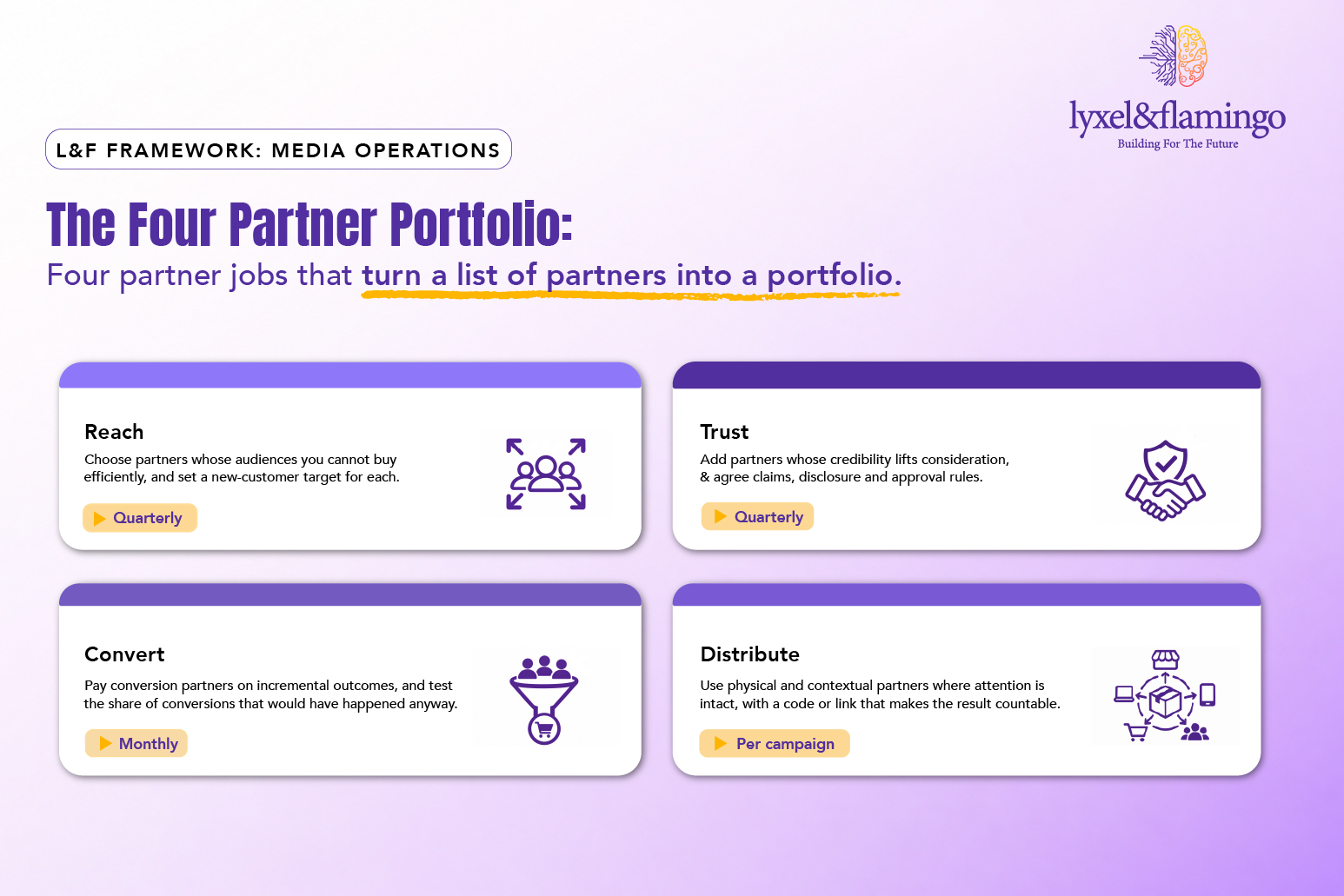
Four partner jobs, each with one metric, turn a list of partners into a portfolio.
The Framework explained
Reach: Find partners who bring audiences auctions price badly. Creators, media owners and platform placements put your brand in front of people your targeting rarely finds. Set a new-customer target per partner, measure branded search and first-time buyers, and drop partners whose audiences overlap with what you already buy.
Trust: Add partners whose voice carries weight with your buyers: experts, reviewers, respected retailers. Their credibility shows up in consideration and conversion lift. Agree claims, disclosure and approval upfront, in line with ASCI’s advertising and influencer guidelines, and keep records.
Convert: Pay conversion partners for outcomes you can verify. Affiliates, retail media and collaborative formats close sales, and their reports tend to flatter themselves. Use holdouts and unique codes, pay on incremental results where possible and prune partners that mostly capture demand you already own.
Distribute: Use partners offering physical or contextual access while attention is intact: delivery networks, commute platforms, store partners. Give each placement a code or link, compare redemptions and conversion with a paid benchmark, and choose placements for the moment ahead of the price.
The 90-day plan to pilot your first partnership
- Days 1 to 20: choose the job and the partner. Pick the job you need, reach, trust, conversion or distribution, shortlist two partners and write commercial terms: fees or commission, approval rights, data sharing and reporting.
- Days 21 to 45: build the test. Design a holdout, agree the success metric and stop rule, create a unique code or link per partner and brief both teams together.
- Days 46 to 75: run and watch. Launch to a defined audience or region, review weekly, keep paid support ready to amplify winners and record creative, offers and timing.
- Days 76 to 90: read and decide. Compare incremental sales, new-customer share and cost per incremental sale with your paid benchmark, then scale, change or stop, reported on one page.
Why every partnership needs a control group and a stop rule
Partnerships are easy to start and hard to judge, so measurement must be designed in. Geo experiments for enterprise marketing sets the method: compare comparable regions or audiences with the partnership and in a control group, hold the design fixed and read total sales. Believe the experiment over the partner’s report.
Write the stop rule before launch: minimum incremental sales, maximum cost per incremental sale, review date, all agreed with the partner. A clear rule protects the relationship as well as the budget.
Protect the brand. Partnerships put your name in other people’s hands, so agree disclosure, claims and approval with every creator and retailer, and spell out in the contract what happens when something goes wrong.
Report the portfolio on profit. Performance marketing that scales profitably puts margin and payback at the centre, so a partnership sale and a paid sale compare on equal terms. Partnerships earn their place on margin.
Client proof point: IndiGo x Zepto
IndiGo’s 19th Anniversary Sale needed to reach premium urban consumers beyond a saturated digital feed. Lyxel&Flamingo turned the sale into boarding-pass-styled flyers with a scannable booking QR code, delivered inside Zepto bags across Delhi NCR and Mumbai during the sale window. A grocery bag became a gateway to travel.
- 12.5% conversion rate recorded
- 99.9K boarding-pass flyers delivered through Zepto
- 2 cities, Delhi NCR and Mumbai, with a QR-led offline-to-online booking path
Read the full story in the IndiGo x Zepto case study, and see creator-led cultural partnerships in action with boAt x MTV Hustle.
Key takeaways
- Partnerships change what paid media is asked to do, adding reach, trust and access beyond the auction.
- Sort partners into four jobs, reach, trust, conversion and distribution, each with one metric.
- Partnership evidence is promising and partly vendor-reported, and some attributed affiliate conversions would happen anyway.
- Pilot one partnership for 90 days with a holdout, a stop rule and a unique code or link.
- Report partners on incremental sales and margin.
The CXO takeaway
Ask your marketing and media leads for one page listing every partner touching a customer today, with its job, cost and measurement. Decide which of the four jobs you most need to add. Fund one 90-day pilot with a holdout, a stop rule and a unique code or link per partner, and require cost per incremental sale and margin beside the paid benchmark. Put disclosure, claims and approval rules in every contract, and review the portfolio quarterly.
The question for your next planning meeting: if last-click attribution vanished tomorrow, which partners could you still prove were worth paying?
The Lyxel&Flamingo media team builds partnership portfolios with the measurement baked in. Start the conversation and we will help you design your first pilot.
Frequently Asked Questions
Often, with the right measurement. Meta reports that advertisers running at least 30% partnership ads saw a 45% lower median cost per incremental purchase across 20 EMEA lift studies, a platform claim worth testing. Some attributed affiliate conversions would happen anyway, so test your own partnerships against a paid benchmark with a holdout.
Start with the job you most need done: reach when new-customer share is falling, trust when consideration is weak, conversion when demand exists and needs capturing, distribution when attention in your category is scarce. Pilot one partner for that job with one metric and a holdout.
Compare comparable regions or audiences with the partnership and in a control group, hold the design fixed and read total sales and new-customer share. Use unique codes or links so outcomes can be counted, and report cost per incremental sale beside your paid benchmark.
Match payment to the job: fixed fees for reach and trust partners, commission for conversion partners, ideally on incremental outcomes. Start small, agree approval rights and reporting, write the stop rule into the contract and review terms after the pilot.
Flattering attribution, brand safety and misleading claims, over-dependence on one partner and data-sharing duties. Manage them with holdouts, clear disclosure and approval rules, a spread of partners, written data terms and a stop rule for each partnership.