What this blog covers
Phygital media joins physical and digital touchpoints into one shopper journey, while most brands still plan stores, screens and search as separate budgets with separate reports. This explainer shows what phygital media means in practice, why search is the hinge between street and screen, and how to measure offline sales that digital media influenced. CXOs get the Phygital Journey Loop, Spot, Connect, Measure, Merge, plus a 90-day pilot and the boAt x Rapido story of a real commute moment that earned a sustained 7.5% CTR.
Table of Contents
- What phygital media actually means for a brand with stores
- The overlooked moments between screens and shelves
- Why search is the hinge between store and screen
- The measurement bridge from offline sales to digital spend
- Phygital marketing in practice: the Phygital Journey Loop
- The framework explained
- The 90-day pilot that proves one phygital journey
- Why one journey needs one owner and one budget
- Client proof point: boAt on Rapido
- Key takeaways
- The CXO takeaway
Your shopper sees the store, the screen and the search box as one journey. Your budget probably sees three.
Quick answer: Phygital marketing treats stores, screens and search as one journey with one owner, one budget and one measurement plan. A Meta and Retailers Association of India whitepaper reports that more than half of Indian shoppers research online before buying in-store, and more than half research in-store before buying online. Spot the real-world moments where intent forms, connect each touchpoint to the next with search, codes and local listings, and test the combined effect with geo experiments.
What phygital media actually means for a brand with stores
Phygital media plans physical and digital touchpoints as parts of one shopper journey. A shopper sees a screen in a taxi, searches the brand on a phone, checks stock at a nearby store and buys in person. Every step belongs to the same decision. Plan the steps together and you win the sale. Plan them apart and you pay for each one twice.
India already shops this way. The Meta and Retailers Association of India whitepaper from February 2026 reports that over 50% of retail consumers research online before buying in-store, and over 50% research in-store before buying online. Meta also puts 77% of retail discovery on social media, a vendor figure to read as such. The direction is the story: discovery and purchase now happen in different places.
Stores still carry most sales in many categories. Industry estimates put offline retail at the large majority of Indian apparel sales. A plan built only around online transactions overlooks the dominant channel. Demand creation versus demand capture explains the dynamic: screens create demand that stores often capture.
Start with the journey, then the channel. Map how your best customers discover, check and buy, using sales data, store staff and search queries. List the touchpoints in order and name each owner. One journey, many owners.
The overlooked moments between screens and shelves
Most media plans cover places where people scroll and miss the moments where they wait. A commute, a queue, a ride-tracking screen, a shop entrance: attention with zero competing feed. Brands that claim these moments early own space rivals have yet to price.
The shop and the search box connect through a small, rarely designed action. A shopper in-store checks a price on a phone, or a shopper at home searches for the nearest outlet with stock. Local SEO for multi-city retail brands shows how near-me searches turn attention into visits. A complete local listing is the cheapest media in the plan, and it stays open around the clock.
Touchpoints and the job each does in one journey
Screens inside and around stores add a third layer. In-store screens, digital signage and QR codes push shoppers into digital journeys: scan for details, join loyalty, buy later online. Each needs a clear next step and a way to count it. Every screen needs an action.
List the ten moments where your category’s intent forms and score each on reach, relevance and cost, including moments that are still unpriced. Pick three to test.
Why search is the hinge between store and screen
Search is where a street impression becomes a decision. A shopper who sees a billboard, store or screen ad types the brand or product into a search box. Brand search volume, local queries and store-locator use are the first signals a phygital plan is working.
Plan search as the connector. Paid search, paid social and shopping each play distinct roles, and phygital adds street and in-store moments upstream. Get branded search and local listings ready before buying attention elsewhere, so the click lands with you.
Availability closes the loop. A shopper who finds your store on a map and meets an empty shelf becomes a lost customer and a poor review. Show store-level stock where possible and offer click-and-collect or delivery as a fallback. Search promises. Stock delivers.
Social feeds both. As social commerce on Instagram and WhatsApp shows, conversations on these channels now start journeys that end in a store. Give store teams a way to receive and answer those enquiries. A message is a visit in waiting.
The measurement bridge from offline sales to digital spend
Offline sales are the hardest to credit, so brands often leave them uncredited. Start with simple signals: store visits, coupon and QR redemptions, calls and direction requests from local listings, and branded search by region. Each is imperfect. Together they show direction.
Then add an experiment. Raise or cut media in a set of stores or regions, hold others steady and compare sales at the till. Counting beats guessing.
Geo experiments for enterprise marketing lays out the design: comparable regions, fixed duration, promotions held steady and a success metric agreed upfront. A well-run test protects budget when a clever dashboard argues otherwise.
Keep privacy in view. Linking an offline purchase to an online identity needs consent, and India’s data protection obligations keep tightening. Favour aggregated, consented signals and record how each was collected.
Phygital marketing in practice: the Phygital Journey Loop
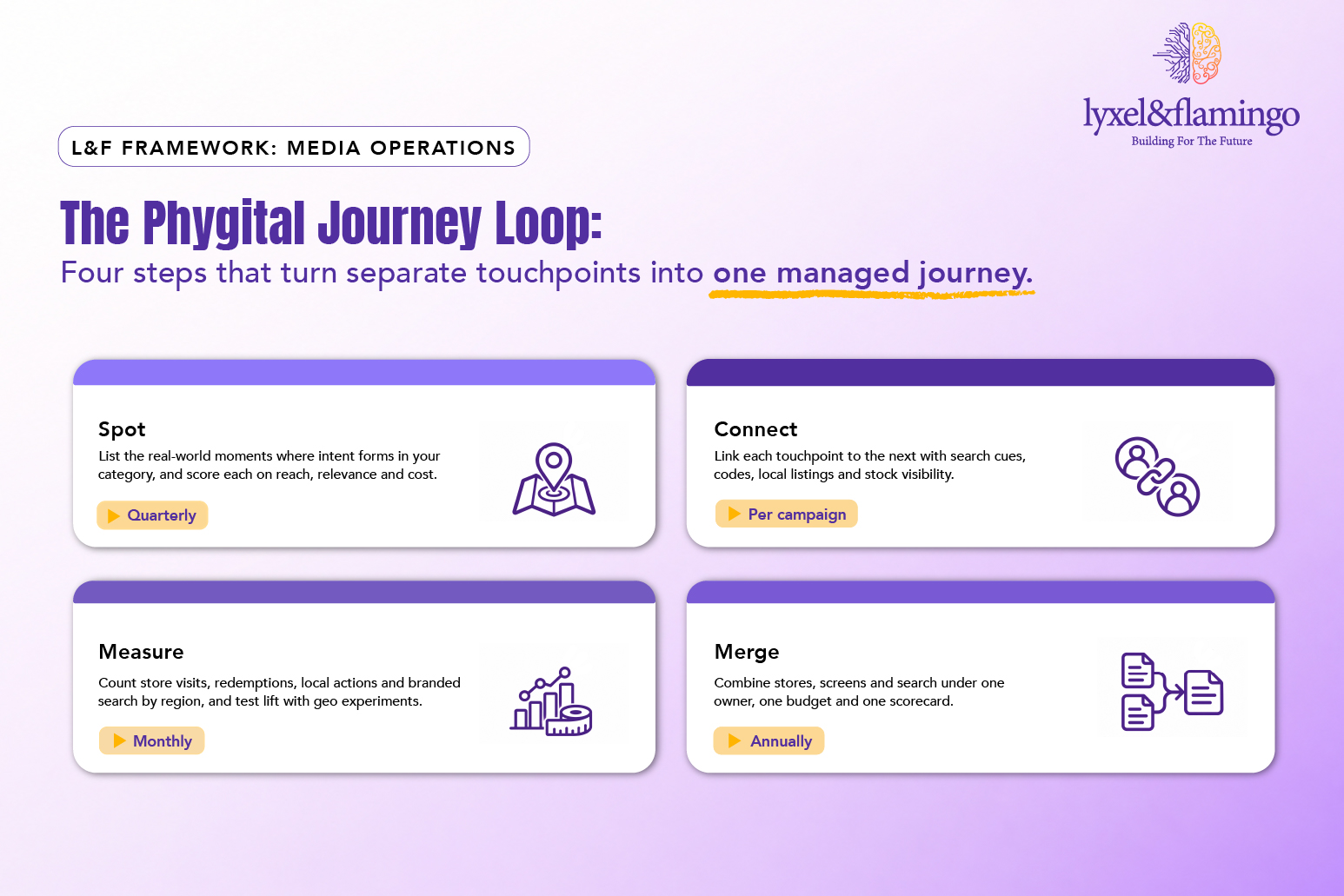
Four steps, repeated each quarter, turn separate touchpoints into one managed journey.
The framework explained
Spot: Find where buying intent forms in the real world: commutes, queues, shop entrances, ride-tracking screens, in-store aisles. Score each on reach, relevance and cost, and include unpriced moments, since unclaimed attention is cheap. Test three moments per quarter and log the learning.
Connect: Give every touchpoint a next step. A screen prompts a search or scan, a store invites online follow-up, a search result shows the nearest store and its stock. Local listings, a store locator and simple codes carry the shopper across the gap.
Measure: Count what you can and test the rest. Track visits, redemptions, calls, direction requests and branded search by region, and run geo experiments compared at the till. Record consent for any data linking offline purchases to online identities.
Merge: One owner, one scorecard. Report total sales by region and journey stage, fund by stage, and review the split yearly with finance. The merged plan ends the credit arguments and leaves one question: what does the shopper need next?
The 90-day pilot that proves one phygital journey
- Days 1 to 20: pick the city and the moments. Choose one city with your stores, map intent moments, select one contextual activation and one in-store link, and complete every local listing.
- Days 21 to 45: connect the touchpoints. Add a search cue or code to the activation, show store-level stock, set up counts for visits, redemptions, calls and directions, and brief store teams.
- Days 46 to 75: run against a control. Compare the pilot city with a similar city over the same weeks, track branded search by region and count sales at the till, with other promotions held steady.
- Days 76 to 90: decide. Report lift, cost and lessons on one page, decide whether to widen the pilot and name the owner of the combined journey.
Why one journey needs one owner and one budget
Phygital plans fail when stores, media and ecommerce report to different leaders. Each optimises its own number, and the shopper meets three versions of the brand. Name one accountable owner with authority over the combined plan.
Give that owner one scorecard. A single source of truth for marketing data joins store sales, online orders, local actions and media spend in one view. Bring finance into the design.
Fund by journey stage: attention, connection, conversion. Let stage targets decide where money moves, and review the split quarterly. A channel budget rewards the channel. A stage budget rewards the shopper.
Prove the programme with the discipline in marketing ROI proof points: link activity to business metrics, validate with periodic experiments and report the decision each result supported.
Client proof point: boAt on Rapido
boAt launched the Airdopes 701 ANC into India’s most contested audio category with one benefit to land: active noise cancellation. Lyxel&Flamingo embedded the brand into a real commute moment, the screen Rapido users check again and again while waiting for their ride, through a map and top-banner integration. Quiet, at the exact moment the city got loud.
- 7.5% CTR, sustained across six months of live placement
- 7.24M impressions against the core launch audience
- 543K clicks and ₹2.8L in direct sales attributed
Read the full story in the boAt x Rapido case study, and see how IndiGo and Zepto turned a delivery moment into media.
Key takeaways
- Shoppers move between stores, screens and search in one decision. Plan the journey.
- Over half of Indian retail consumers research online before buying in-store, and over half do the reverse.
- Search is the hinge between street impressions and store visits, so ready local listings and branded search first.
- Prove offline impact with store-level signals and geo experiments counted at the till.
- Give the journey one owner, one budget and one scorecard.
The CXO takeaway
Ask your marketing and retail leaders for one map of your best customers’ journey, first impression to purchase, with every touchpoint owner named. Confirm every store has a complete local listing and branded search is covered before buying new attention. Fund one geo experiment this quarter comparing activated regions with control regions, counted at the till. Put total sales by region and journey stage on one scorecard, under one accountable owner.
The question for your next planning meeting: if your biggest store and your biggest ad were measured by the same person, what would you change tomorrow?
The Lyxel&Flamingo media team plans contextual media, search and measurement as one system. Share your journey map and we will help you pick the first three moments to test.
Frequently Asked Questions
Phygital media plans physical touchpoints, stores, signage and real-world placements, and digital touchpoints, screens, search and social, as one shopper journey. The goal is to guide a shopper from attention to purchase keeping them on track across channels, with one owner, one budget and one way of counting results.
Combine simple signals with experiments. Track store visits, redemptions, calls, direction requests and branded search by region, and run geo experiments that change media in some regions while holding others steady. Compare sales counted at the till, and record consent for any data linking an offline purchase to an online identity.
Start lean. A complete local listing, a store locator, simple QR codes and a regional scorecard cover the first steps. Add store-level stock feeds or in-store screens once the pilot shows a return.
Brands with a few stores, dealer networks, pop-ups or presence in retail partners’ stores can use the same approach at smaller scale. Start in regions with physical presence and test one activation at a time.
Pick one city with your stores. Complete the local listings, run one contextual activation that prompts a search or scan, and compare sales with a similar city over the same weeks. Agree the success metric and stop rule upfront, and widen the pilot only when it pays.