What This Blog Covers
Discount codes raise order value by handing back the margin you set out to protect, and the arithmetic is less forgiving than most promotion plans assume. This article compares blanket discounts with four onsite merchandising moves: anchoring, bundling, thresholds and post-add rewards. It shows how to test each against a control, and why margin per order, not AOV alone, is the number a CMO should take to the board. You will leave with an ordered ladder of tactics that grows basket value while protecting profit and giving your finance team a number it can trust.
Quick Answer: To increase AOV without hurting margin, use price anchoring, curated bundles, thresholds set just above your current median basket and post-add rewards. Avoid blanket codes, which give margin away to shoppers who would have paid full price. Judge every tactic on contribution margin per order and test it against a control.
Table of Contents
- Why a Discount Raises AOV by Spending the Margin You Meant to Protect
- What Anchoring and Bundling Do That a Discount Code Cannot
- The Threshold Mechanics That Lift Baskets Without Discounting
- The Hidden Leak Between Your Best Offer and the Shopper Who Never Sees It
- What the Margin-Safe AOV Ladder Tests, in Order
- What to Measure: Margin per Order, Not AOV Alone
- Key Takeaways
- The CXO Takeaway
Why a Discount Raises AOV by Spending the Margin You Meant to Protect
Here is the arithmetic, using an illustrative product. At a price of 100 and a product cost of 60, gross margin is 40. A 10% discount takes the price to 90 and the margin to 30, a 25% cut in gross profit on that order. The shopper must buy a substantially larger basket just to break even.
Blanket codes also reach shoppers who were already buying. You pay the discount to customers with no change in behaviour. Not a growth lever. For a CMO, the point is governance: any promotion that lifts revenue while lowering contribution margin should be flagged in the weekly review, and its owner should explain why it continues.
The alternative is to change the choice architecture on the page, and that starts with knowing who your shoppers are, as covered in persona-led CRO. Different shoppers decide differently by need and moment. A page built for the average shopper is built for nobody. That is a brief for your design and merchandising teams.
Start there. The question for each page is what decision the shopper is making and which product combination serves it. Answer it with data from your own orders. Then design the offer.
What Anchoring and Bundling Do That a Discount Code Cannot
Anchoring places a higher-priced option beside the one you want to sell, so the target looks measured. A bundle packages complementary items at a price that feels fair and carries a healthier margin than the parts sold alone. Both change what the shopper compares against. Neither requires you to cut the price.
Page design carries the idea. The structure in the science behind a landing page that converts applies to product and collection pages, with the offer visible before the decision. If a shopper has to hunt for the bundle, it does not exist.
Build bundles from behaviour. Use order data to find the products bought together and the products viewed together, then curate sets that solve a complete need. Sets, not discounts. Present these tactics to your merchandising team as tests with owners and dates, so each one produces a clear result rather than a permanent change nobody measured.
Name bundles by the job they do, such as “starter routine” or “weekend kit”. Clear purpose gives the shopper a reason that a percentage off does not. A job, not a discount.
The Threshold Mechanics That Lift Baskets Without Discounting
A free-shipping or gift threshold set slightly above your current median basket gives shoppers a reason to add one item. Choose the number from your own data. Too high and nobody reaches it; too low and it gives away shipping on baskets you already had. Re-set it when the median moves.
Show progress in the cart. A line that says how far a shopper is from the threshold turns a rule into a prompt. A nudge, not a rule. Because each threshold is a pricing decision, review it with finance whenever you change shipping costs or supplier terms, so that the offer keeps pace with the economics behind it.
Rewards after add-to-cart work well because intent is already high. A sample, a small gift or loyalty points lands when it changes the basket and costs little. Cap the cost per order so the reward cannot outrun the margin. Attach it to behaviour you want to repeat.
Personalisation will sharpen this. AI personalised UX previews where adaptive interfaces take thresholds and recommendations next. Plan the data and consent foundations now, so you can use them when the tools mature.
The Hidden Leak Between Your Best Offer and the Shopper Who Never Sees It
An offer nobody sees is a cost with no benefit. Check whether shoppers drop before they reach the threshold message, the bundle or the reward. Look at scroll depth and cart-view data, not only conversion. The gap is often upstream of the offer.
A friction audit will show where shoppers stall on product, cart and checkout pages, from slow images to unclear delivery costs. Fix those before you add more offers. Every extra offer on a broken page compounds the confusion. Repair, then promote.
Test mobile first, since a long bundle block can push the add-to-cart button out of view on a small screen. Review the page on a mid-range phone, not only on your own device. Small screens, big losses. Ask your analytics team to show the funnel from product view to offer view to add-to-cart, since that sequence reveals where the best-designed offer is being missed.
Keep the design honest. Present the real price and the real saving, and avoid false urgency that damages trust. Honest offers, lasting trust.
What the Margin-Safe AOV Ladder Tests, in Order
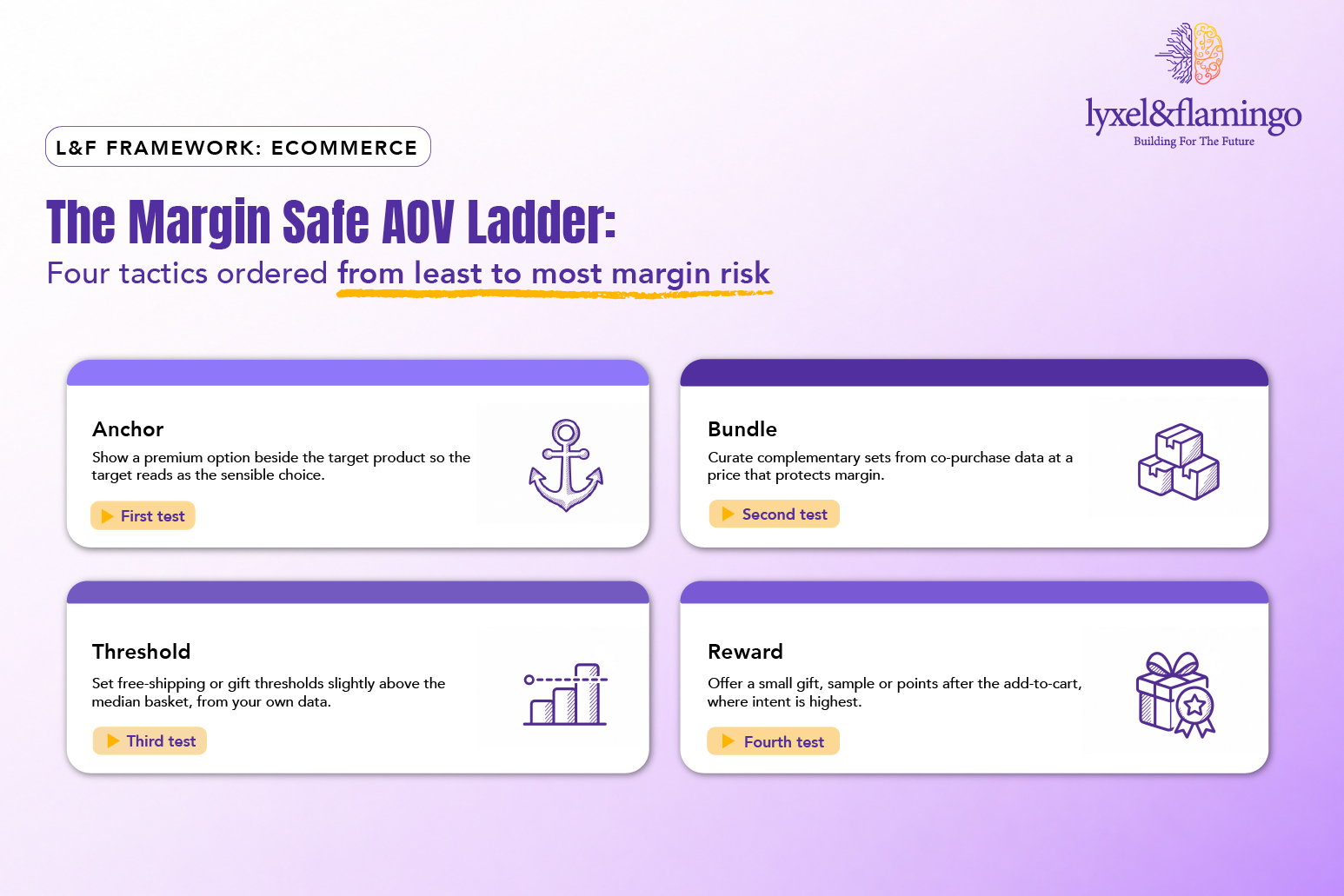
Four tactics ordered from least to most margin risk. Test each one against a control before you move up.
Framework Explained
Anchor: Anchoring changes comparison without giving anything away. Place a premium option beside the product you want to sell so the target reads as a sensible middle choice. Use it on category and product pages where several price points sit together, and measure the share of orders that land on the target product.
Bundle: Bundles lift basket size and often margin. Build them from co-purchase and co-view data, name them by the job they do and price them so the set feels fair while protecting margin. Review them every quarter, because purchase patterns shift with season, stock and new launches.
Threshold: A threshold works when it is reachable. Set it slightly above your current median basket from your own order data, show progress to it in the cart and re-set it when the median moves. Watch the share of baskets that land just above the line and the cost of shipping you now absorb.
Reward: Rewards are the most direct and the most easily abused. Offer a small gift, sample or points once an item is in the cart, cap the cost per order and tie the reward to behaviour you want. Measure repeat purchase as well as basket size, so the reward builds the customer instead of renting them.
What to Measure: Margin per Order, Not AOV Alone
AOV can rise while profit falls. Track contribution margin per order, conversion rate, return rate and repeat purchase for each tactic against a holdout. A tactic that lifts AOV and cuts conversion can lose money overall. Judge on total contribution.
Think about the customer you keep. Existing customers fund the ones you are chasing, so a tactic that lifts first-order AOV while hurting repeat rate is a poor trade. Cohort the results by first-order tactic and watch the second and third orders. The real return shows up late.
Report the result as margin per order and total contribution. Leadership can then compare tactics on one scale. Margin first, AOV second. Put the table in the board pack.
Use the same discipline as Shopify conversion optimisation: one change at a time, a clear hypothesis and a stopping rule. Stop tests that reach the rule early. A tested tactic is an asset; an untested one is an opinion. Insist on margin per order in every promotional post-mortem, so the discussion begins with profit and not with the volume that was easy to report.
Key Takeaways
- A 10% discount on a product with 40% margin cuts that order’s gross profit by 25%.
- Anchors, bundles, thresholds and post-add rewards change behaviour without a blanket code.
- Set thresholds from your own median basket and re-set them as it moves.
- An offer shoppers never reach is a cost with no benefit, so fix page friction first.
- Judge each tactic on margin per order, conversion and repeat rate against a control.
The CXO Takeaway
Ask for a report that shows discount spend as a percentage of revenue next to AOV by month. If AOV is flat while discount spend rises, you are paying for demand you already had. Redirect one test cycle to anchors and thresholds. Name one owner for margin per order, so every promotion answers to profit before it answers to volume. Put each test result in the monthly leadership review beside conversion and repeat rate, so the full trade-off is visible in one place. Repeat the cycle every quarter, and retire any offer that lifts basket value while lowering contribution margin.
Frequently Asked Questions
Start slightly above your current median basket value, using your own order data, so the threshold asks most shoppers to add one item and not several. Test two levels against a control, and watch conversion and margin per order, not only basket size. Re-check the number each quarter, because a change in shipping cost, product mix or festive demand moves the median. Show progress to the threshold in the cart so shoppers can see how close they are.
Some do, which is why you test bundles against a control and track total margin instead of bundle sales alone. Bundles built from real co-purchase data usually add basket size instead of simply shifting it, because they combine products shoppers already buy together. Watch the share of orders that move from single items to bundles, and the margin on each. If the bundle lifts margin per order, the shift is working in your favour.
In effect, yes: they are a deferred reward with a real cost, which lands when points are redeemed. Cap the cost per order, so a reward cannot outrun the margin on the basket. Make points conditional on behaviour you want, such as reaching a basket threshold or buying from a second category. Track repeat purchase as well as basket size, because the return on points comes from the next order, not the first.
Long enough to cover your normal purchase cycle and reach a sample you can defend, often several weeks. Set the duration, the sample and the success metric before you start, so nobody stops the test early on a flattering result. Avoid starting tests during a major sale, when behaviour is unrepresentative and discounts hide the effect of the change. Review the result by new and returning customers, since the two groups often respond differently.