What This Blog Covers
Category-creation brands face a specific problem paid media can’t solve on its own: there’s no existing search demand to bid on. This covers how an organic-first content approach builds category authority from zero, and what that actually requires in year one.
Quick Answer: An organic-first approach for a new category means publishing educational, problem-first content before product content, ranking for the questions a potential customer is already asking in an adjacent category before they know your specific product exists. This takes longer to show results than paid media, typically 6 to 9 months before meaningful organic traffic. It builds a durable asset that paid spend alone can’t buy: category authority that compounds instead of resetting every time the ad budget pauses.
Table of Contents
- Why Paid Media Can’t Solve a Zero-Demand Problem
- Starting From Adjacent Search Intent
- The Sequence: Problem, Then Category, Then Product
- The Category-Entry Content Framework
- Framework Explained
- What Success Looks Like at Month 6 vs Month 12
- Why This Compounds Where Paid Doesn’t
- Key Takeaways
- CXO Takeaway
Why Paid Media Can’t Solve a Zero-Demand Problem
Paid search works by bidding on existing demand, someone is already searching for something close to what you sell. A genuinely new category has no keyword volume to bid on yet, which means paid search spend in that early phase is mostly wasted, aimed at search terms nobody’s typing. Google’s own SEO starter guide makes the same point from the platform side: there is no shortcut around building genuine topical relevance, paid or otherwise.
Paid social can build awareness. Awareness without a next step, somewhere for that curious viewer to go deepen their understanding, converts poorly. This is where organic content plays a role paid media structurally can’t, the same structural advantage behind the owned-channel reset: why D2C brands are rebuilding growth around their website, not the marketplace: content and search equity compound on a channel you own in a way paid placement on someone else’s platform never does.
Starting From Adjacent Search Intent
The fix is starting from the adjacent problem, not the product. Someone doesn’t search for a category that doesn’t exist to them yet. They do search for the problem that category solves, usually framed in terms of whatever solution they currently use or wish existed.
Mapping this adjacent search intent, the problem-language searches happening today, in categories bordering the new one, gives a content strategy something real to target while genuine category-specific search volume is still building. Google’s own guidance on creating helpful, reliable, people-first content reinforces the same principle from the platform side: content built around genuine audience problems outperforms content built around keywords alone.
The Sequence: Problem, Then Category, Then Product
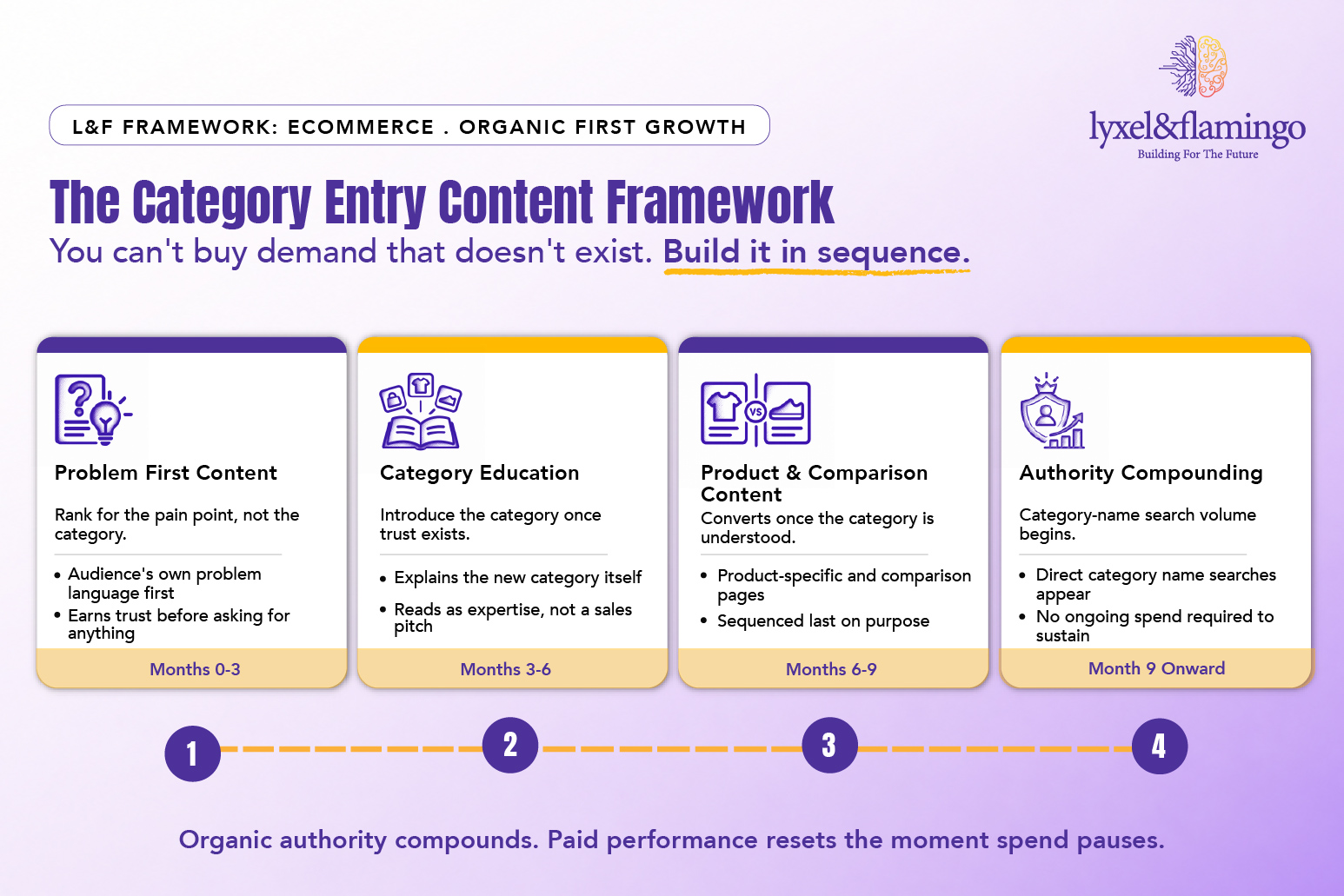
The first content wave addresses the problem directly, ranking for the pain point in language the audience already uses, without assuming they know your category exists yet. This earns traffic and trust before asking for anything, written the way answer-first content demands, the first fifty words doing the work, not three paragraphs of throat-clearing before the actual answer.
The second wave introduces the category itself, explaining what this new type of solution is and why it exists, now that the audience has been earned through problem-first content and trusts the source enough to consider a new framing.
The third wave is product content, comparison and specific-use-case pages, once there’s an audience that understands the category well enough for product-level content to make sense to them.
The Category-Entry Content Framework
Framework Explained
- Problem-First Content: this wave earns an audience that doesn’t yet know your category exists, by being useful about their actual problem first.
- Category Education: introducing the category too early, before trust is established, reads as a sales pitch; introducing it after problem-first content has proven useful reads as genuine expertise.
- Product & Comparison Content: this content only converts well once the audience already understands the category conceptually, which is why sequencing it last matters more than most teams expect.
- Authority Compounding: this is the payoff phase, where the brand’s earlier content investment starts generating category-name search volume directly, rather than only capturing adjacent-problem searches.
What Success Looks Like at Month 6 vs Month 12
At month 6, success looks like meaningful organic traffic to problem-first content and early category-education pages, with direct category-name search volume still low. This is the phase where a team unfamiliar with organic timelines often loses confidence, right before the compounding phase begins.
At month 12, success looks like category-name searches appearing directly, product and comparison content converting at a healthy rate, and organic traffic that doesn’t require continuous new content investment to sustain, the durable asset paid media doesn’t build.
Why This Compounds Where Paid Doesn’t
Paid media performance resets the moment spend pauses. Organic category authority, once established, keeps generating traffic and trust with no ongoing spend required to sustain it, which is exactly why the slower timeline is worth the patience for a brand genuinely creating a new category rather than competing in an existing one. Original research and proprietary data compounds this advantage further, since category-defining brands are also the ones with the richest first-party data to turn into citable content.
Torani’s work with Lyxel&Flamingo established organic authority in an emerging category from a standing start, the kind of result that depends on exactly this problem-first, sequenced approach rather than assuming product content alone would find an audience that didn’t know to look for it yet.
The same sequencing discipline shows up at a larger scale in Converse’s organic revenue growth and Timex’s SEO work with Lyxel&Flamingo, both proof that content built around real audience problems compounds into category authority a paid budget alone can’t buy.
Key Takeaways
- Paid media can’t solve a zero-demand problem; there’s no existing search volume to bid on for a genuinely new category.
- Start with adjacent problem-language search intent, not product or category content.
- Sequence content: problem first, category education second, product and comparison content third.
- Expect 6 to 9 months before meaningful organic traffic, with the real payoff, category-name search volume, forming after that.
CXO Takeaway
A category-creation brand needs patience budgeted into the marketing plan explicitly, 6 to 9 months of organic-first investment before the payoff phase, not a paid media strategy that assumes demand already exists.
If your category doesn’t have search volume yet, is your content strategy targeting the problem your audience already searches for, or waiting for them to search for you?
Talk to Lyxel&Flamingo’s SEO team about building an organic-first content sequence for a category that doesn’t have established search demand yet.
Frequently Asked Questions
Paid search bids on existing demand, and a genuinely new category has little to no keyword volume yet, meaning early paid spend targets search terms nobody’s actually typing.
The adjacent problem the category solves, in the language the audience already uses today, before introducing the category or product itself.
Typically 6 to 9 months before meaningful organic traffic, with category-name search volume forming as a later payoff phase around month 9 to 12.
Paid performance resets the moment spend pauses. Organic category authority, once established, keeps generating traffic without ongoing spend required to sustain it.