What This Blog Covers
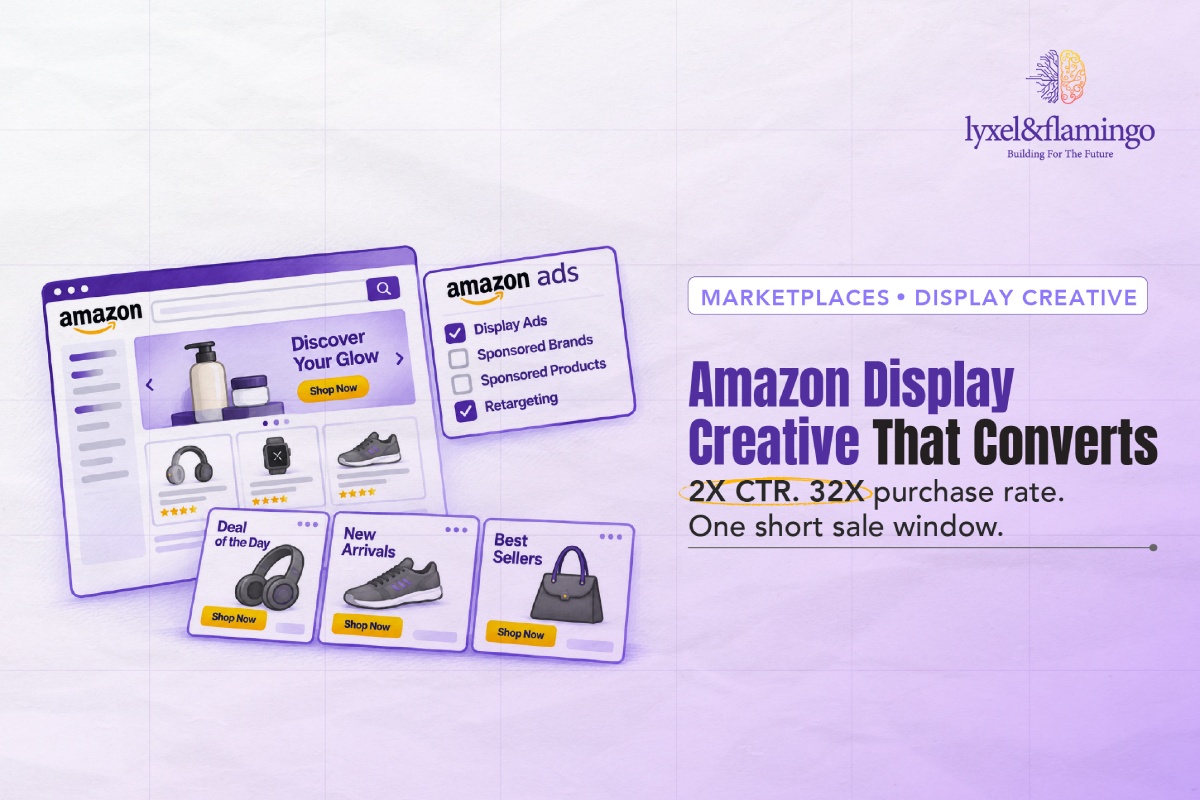
Marketplace advertising and marketplace product content are frequently managed as separate workstreams, owned by different teams, on different timelines, with no shared audit between them. This piece makes the case for a unified creative audit ahead of festive season, covering what “weak product content” actually looks like at the listing level, why it silently caps every ad dollar spent driving traffic to it, and how to run the audit before the sale calendar opens rather than mid-event.
Quick Answer: A marketplace creative audit checks whether product listing content, images, A+ content, titles, and reviews, can actually convert the traffic that advertising is paying to send. The most common gap is a listing optimized for search ranking (keyword-stuffed titles, minimal imagery) rather than for the shopper who already clicked through and is now deciding whether to buy. Running this audit before a festive sale, rather than discovering the gap through a disappointing ACOS mid-event, protects every advertising dollar spent during the highest-competition weeks of the year.
Table of Contents
- Why Ads and Listings Get Managed as Separate Problems
- 2. What “Weak Product Content” Actually Looks Like at the Listing Level
- 3. The Hidden Cost: Paying Twice for the Same Lost Sale
- 4. Running the Audit Before the Festive Sale, Not During It
- 5. The Marketplace Creative Audit Framework
- Framework Explained
- Key Takeaways
- CXO Takeaway
Why Ads and Listings Get Managed as Separate Problems
Marketplace advertising and marketplace content frequently sit with different owners inside a brand, a performance marketing team running Sponsored Products and Sponsored Brands, a separate content or catalog team managing listing copy and imagery, each measured against its own set of metrics with little shared review between them.
This split makes a specific kind of failure invisible until the numbers are already disappointing: the ad team sees a healthy click-through rate and assumes the campaign is working, while the actual conversion rate on the listing itself quietly caps every dollar spent getting the shopper there in the first place. Neither team owns the gap, so it rarely gets diagnosed until a festive-season ACOS review forces the question.
2. What “Weak Product Content” Actually Looks Like at the Listing Level
Weak product content rarely looks dramatic. It usually looks like a title built entirely for keyword coverage rather than readability, a main image that meets the platform’s minimum technical requirements rather than actually differentiating the product, and an A+ content module that was built once at launch and never revisited for festive relevance.
Amazon reviews function as a hidden goldmine that weak listings consistently underuse, showing recent, specific reviews prominently rather than burying strong social proof below a generic image carousel. A shopper arriving from a festive ad, already primed by the ad’s own strong creative, forms an instant quality impression from the listing’s first three images, a pattern Nielsen Norman Group’s research on first-impression usability documents consistently across digital storefronts, and a mismatch between ad quality and listing quality reads as a trust signal failure rather than a simple inconsistency.
3. The Hidden Cost: Paying Twice for the Same Lost Sale
A weak listing doesn’t just lose the sale once. It loses it, then the brand pays again to try to win it back through retargeting, a second ad spend chasing a shopper who already formed a negative impression on the first visit and is now a harder, more skeptical conversion than a fresh prospect would be.
This compounds specifically during festive sale weeks, when every competitor is bidding for the same shopper and CPCs spike in near lockstep across the category. A brand sending that expensive traffic to an underperforming listing is effectively paying a festive-season premium to generate a weaker-than-usual return, the exact opposite of what the ad spend was meant to achieve, and a weak listing caps the return on every Amazon ad format discussed in when to scale Sponsored Products, Sponsored Brands, Video and DSP, not only Sponsored Brands.
4. Running the Audit Before the Festive Sale, Not During It
The audit itself is straightforward and takes a fraction of the time a mid-sale fire drill does: review the primary and secondary images against current festive relevance, check whether the title balances keyword coverage with actual readability, confirm A+ content reflects the current product and any festive packaging or bundle, and spot-check recent reviews for unaddressed quality complaints that a shopper would see before converting.
Running this review four to six weeks before the festive calendar opens leaves enough time to reshoot imagery, rewrite A+ content, or address a recurring review complaint, none of which can be fixed mid-sale without disrupting a listing that’s already live and ranking. Sharper, purpose-built creative earns its value fully only when the listing it points to is equally ready, and the same timeline discipline applies to the operational side covered in the Amazon vs Flipkart festive seller readiness checklist and in festive season inventory and Buy Box strategy: a perfectly audited listing still underperforms if it’s out of stock or has lost the Buy Box by the time the sale opens.
5. The Marketplace Creative Audit Framework
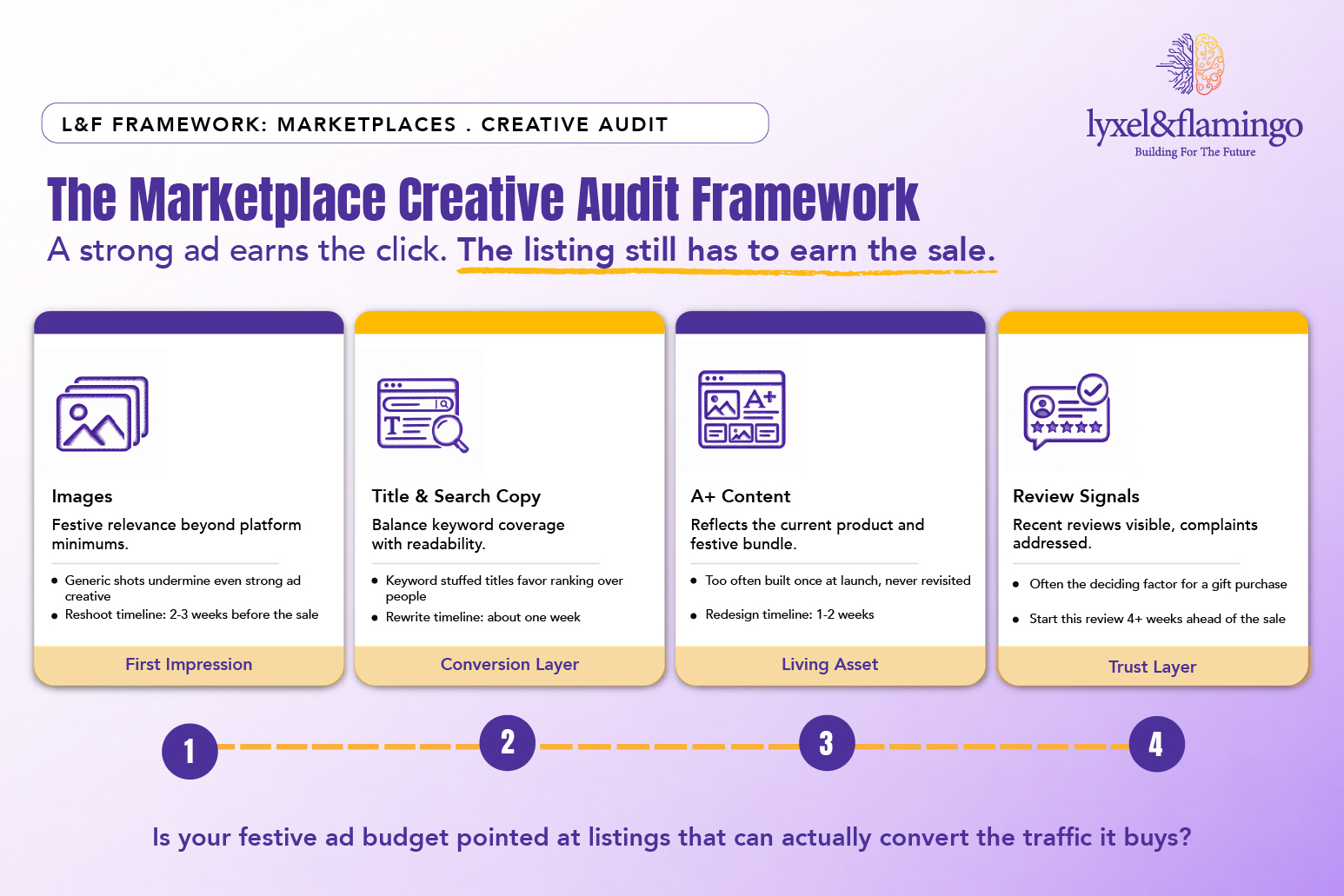
The table below breaks the audit into the four areas that most directly determine whether advertising traffic actually converts.
Framework Explained
Primary and Secondary Images: Form the first impression a festive-ad shopper forms within seconds of landing on the listing, and generic imagery undermines even the strongest ad creative that brought them there.
Title and Search Copy: Need to work for both the platform’s ranking algorithm and the actual person reading it, a balance keyword-stuffed titles consistently get wrong.
A+ Content: Should be treated as a living asset tied to the current festive moment, rather than a one-time launch deliverable left untouched for years.
Review Signal Management: Determines whether social proof, often the deciding factor for a festive gift purchase, actually reaches the shopper at the moment of decision.
✓ CLIENT PROOF POINT: ASICS’s AMS launch work paired sharpened campaign strategy with sustained attention to listing and content quality across its catalog, growing AMS-attributed sales by 100% over a year, cutting ACoS by 60% within three months, and reaching 38 million-plus impressions, while organic traffic to its brand store climbed 40% month over month. Read the full ASICS case study.
Key Takeaways
- Marketplace advertising and product content are often managed by separate teams, which hides the gap between them until performance already suffers.
- Weak product content usually looks ordinary: a keyword-first title, generic imagery, stale A+ content, buried reviews.
- A weak listing effectively charges a brand twice for the same lost sale, once on the original ad, again on retargeting.
- Running a creative audit four to six weeks before festive season leaves time to fix what a mid-sale discovery cannot.
- The audit covers four areas: images, title and search copy, A+ content, and review signal management.
CXO Takeaway
Is your festive-season ad budget pointed at listings that can actually convert the traffic it buys? A strong campaign sending shoppers to a weak listing is quietly capping its own return, and the fix is cheaper and faster before the sale calendar opens than during it. Lyxel&Flamingo’s third-party marketplace team runs this exact audit ahead of festive-season campaigns.
Frequently Asked Questions
Four to six weeks is a reasonable minimum, enough time to reshoot imagery, rewrite A+ content, or address a review pattern without disrupting a listing already live and ranking.
Ideally both, reviewed together. The entire point of the audit is closing the gap that forms when these two functions operate without a shared review process.
Only briefly. A strong ad earns the click; the listing itself still has to convert the visit, and a mismatch between ad quality and listing quality tends to read as a trust signal problem to the shopper.
Imagery refresh is usually the fastest, highest-impact fix, since it’s the first thing a shopper evaluates and the most common area left generic or outdated.