What This Blog Covers
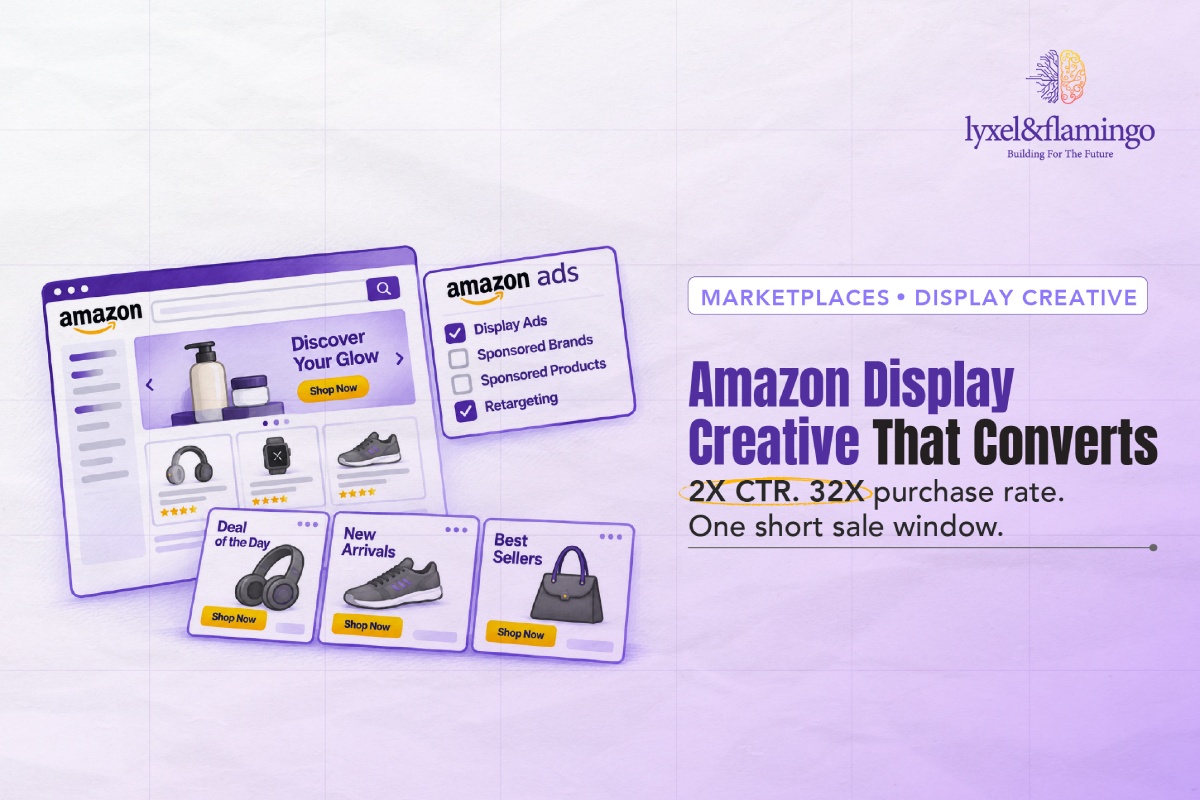
Amazon’s ad stack in 2026 spans four genuinely different formats, Sponsored Products, Sponsored Brands, Sponsored Brands Video, and DSP, each suited to a different stage of brand maturity and a different moment in the festive sale calendar. This piece breaks down what each format actually does, the sequence brands typically scale through, and how to decide when a format is worth adding rather than simply available.
Quick Answer: Sponsored Products should anchor almost every Amazon ad account, since it captures existing high-intent demand at the lowest funnel point. Sponsored Brands adds category and competitive-term visibility once Sponsored Products is converting efficiently. Sponsored Brands Video earns its budget when a brand has differentiated creative worth showing, typically once the catalog and reviews are already strong. DSP becomes worthwhile once a brand needs to reach shoppers off Amazon or retarget at scale, which usually means an established Amazon presence and a budget large enough to justify its higher management overhead. Scaling in this order, rather than all four at once, protects efficiency while the account is still being proven.
Table of Contents
- Why Format Sequencing Matters More Than Format Selection
- Sponsored Products: The Foundation, Not the Whole Strategy
- Sponsored Brands: Owning the Category Search, Not Just the Branded One
- Sponsored Brands Video: When Creative Quality Earns Its Budget
- DSP: The Format Most Brands Add Too Early
- The Amazon Ads Scaling Framework
- Framework Explained
- Key Takeaways
- CXO Takeaway
Why Format Sequencing Matters More Than Format Selection
Amazon makes every ad format available from day one, which creates a common and expensive mistake: a brand new to Amazon advertising spreads a modest budget thin across all four formats simultaneously, rather than building efficiency in one before adding the next. Each format has a different learning curve and a different minimum viable budget to produce a usable signal.
Sequencing by maturity, not by what’s technically available, is what separates accounts that scale efficiently from accounts that accumulate spend across formats without ever making any single one work well. This matters even more heading into a festive sale window, where CPCs spike in near lockstep across every format once the sale calendar opens, and an account without a proven foundation has far less room to defend efficiency under that pressure. The same readiness logic runs through Amazon’s Great Indian Festival vs Flipkart’s Big Billion Days seller checklist, where ad sequencing is one piece of a wider pre-sale readiness plan.
Sponsored Products: The Foundation, Not the Whole Strategy
Sponsored Products targets high-intent, bottom-of-funnel search, a shopper actively searching for a product like the brand’s own, and converts more reliably than any other Amazon format because it’s meeting demand that already exists rather than creating it. This makes it the right starting point for essentially every account, regardless of category or budget size.
The mistake isn’t running Sponsored Products first, it’s stopping there once the account matures. A brand that has optimized Sponsored Products to a stable, efficient ACOS and still hasn’t added Sponsored Brands is leaving category-level visibility entirely to competitors, even while its own product-level targeting performs well.
Sponsored Brands: Owning the Category Search, Not Just the Branded One
Sponsored Brands places a brand’s logo, a custom headline, and a curated product collection at the top of generic category search results, the exact moment a shopper who doesn’t yet know the brand is forming a consideration set. Amazon SEO and ranking mechanics and Sponsored Brands placement reinforce each other here, since a brand appearing in both the organic and sponsored slot for a category term builds a credibility signal a single placement doesn’t.
This format earns its budget once Sponsored Products is already converting efficiently, since Sponsored Brands is building awareness for shoppers earlier in their decision, a slower, more category-level return than Sponsored Products’ immediate conversion signal. Running it too early, before the product listing and reviews have passed their own creative audit, wastes the format’s real strength, a pattern Think with Google’s research on upper-funnel media has documented well beyond Amazon specifically: awareness spend underperforms whenever the destination it points to isn’t ready to convert.
Sponsored Brands Video: When Creative Quality Earns Its Budget
Video placements inside Sponsored Brands carry real production and testing overhead, and they only pay off when the brand has something genuinely differentiated to show, a product demonstration, an unboxing moment, a use case that a static image can’t communicate as clearly. A brand running video with generic, repurposed creative typically sees click-through rates barely above static Sponsored Brands, at a meaningfully higher cost to produce.
Festive season is where this format earns its keep most clearly: gifting-moment creative, festive packaging reveals, and seasonal use-case videos consistently outperform evergreen creative during the exact weeks when sharper, purpose-built ad creative offsets CPC pressure more effectively than raising bids alone.
DSP: The Format Most Brands Add Too Early
Amazon DSP (Demand-Side Platform) extends advertising beyond Amazon’s own search results, onto Amazon-owned properties and the open web, with retargeting capability that draws on Amazon’s first-party shopping data. It’s genuinely powerful, and it’s also the format brands most often add before they’re ready for it.
DSP rewards an account that already has volume: enough existing Amazon shoppers to retarget meaningfully, and a budget large enough to absorb its steeper learning curve and management overhead without crowding out the formats still doing the foundational work, the same programmatic discipline the IAB advocates for display and video spend generally. A brand adding DSP before Sponsored Products and Sponsored Brands are both efficient is usually diluting management attention across five priorities instead of building real strength in two.
The Amazon Ads Scaling Framework
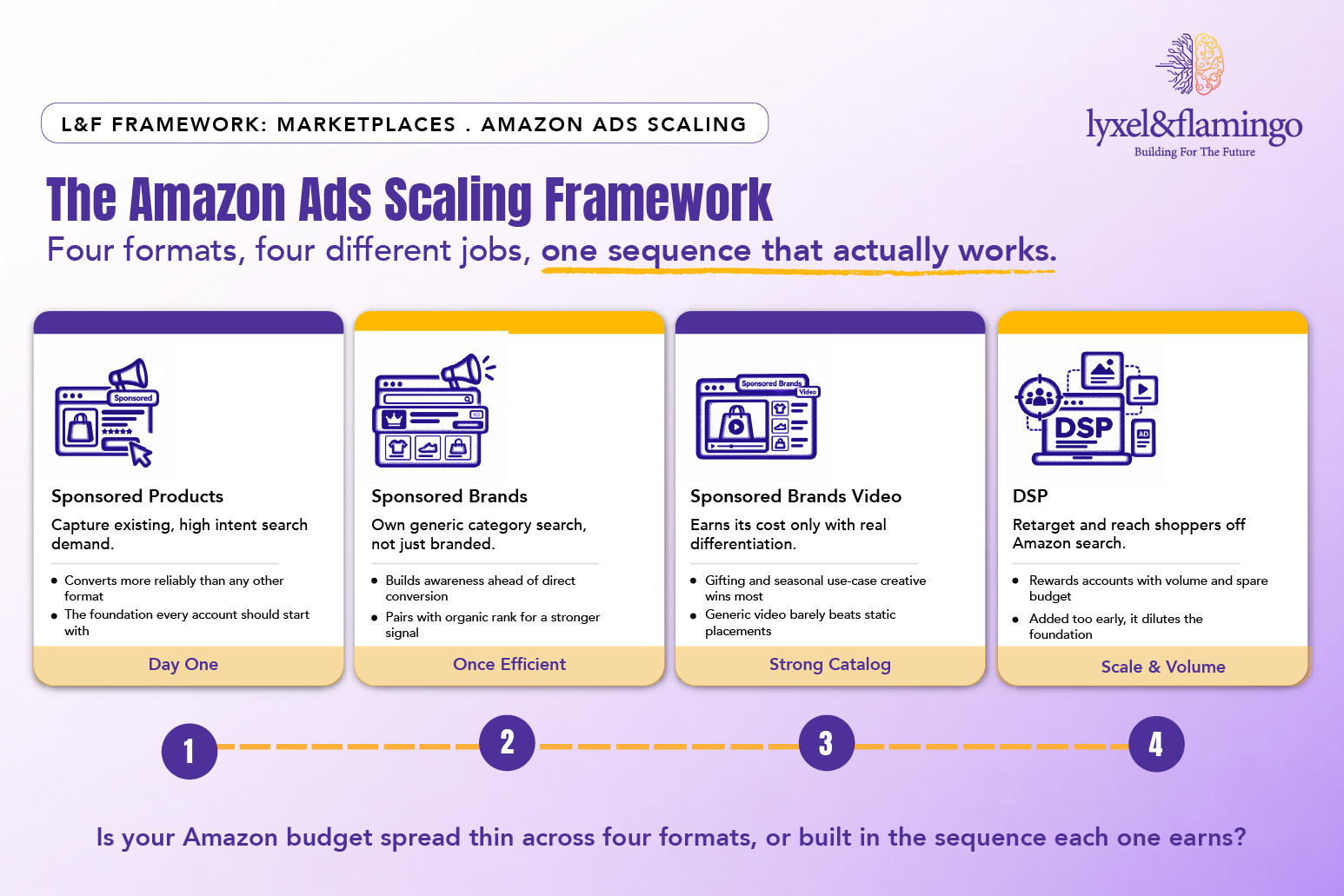
The table below sequences the four formats by the stage of account maturity where each typically earns its budget.
Framework Explained
Sponsored Products: Earns its place in every account from day one, since it converts existing demand more reliably than any format building new demand.
Sponsored Brands: Adds category-level visibility once the foundation is efficient, turning a single-listing presence into a category-wide one.
Sponsored Brands Video: Only earns its higher production cost when the creative itself is genuinely differentiated, which festive gifting moments usually provide.
DSP: Rewards an account with existing volume and spare budget to manage its complexity, rather than an account still proving its foundational formats work.
Lyxel&Flamingo’s third-party marketplace team manages the full Amazon Ads stack, Sponsored Products through DSP, as part of ongoing marketplace engagements. In ASICS’s AMS launch work, a sequenced approach across Sponsored Products and Sponsored Brands grew AMS-attributed sales by 100% over a year while cutting ACOS by 60% within three months. Read the full ASICS case study.
Key Takeaways
- Amazon ad formats should be scaled in sequence by account maturity, not launched simultaneously from day one.
- Sponsored Products anchors nearly every account, since it converts existing high-intent demand most reliably.
- Sponsored Brands earns its budget once Sponsored Products is already efficient, adding category-level visibility.
- Sponsored Brands Video only pays off with genuinely differentiated creative, which festive gifting moments provide.
- DSP rewards accounts that already have volume and budget to manage its added complexity, rather than new accounts.
CXO Takeaway
Is your Amazon ad budget spread thin across four formats, or built efficiently in the sequence each one actually earns? Heading into a competitive festive sale calendar, an account with a proven Sponsored Products and Sponsored Brands foundation defends efficiency far better than one still spreading budget across every format at once. Lyxel&Flamingo’s third-party marketplace team builds and sequences Amazon ad strategy around exactly this maturity curve.
Frequently Asked Questions
Rarely a good idea. Starting with Sponsored Products, then adding Sponsored Brands once it’s efficient, typically builds a stronger foundation than spreading a modest budget across every format simultaneously.
When the creative is genuinely differentiated, a product demonstration or a use case a static image can’t show. Generic, repurposed video rarely outperforms static placements meaningfully.
This varies by category, though DSP generally rewards accounts with existing Amazon shopper volume to retarget and a budget large enough to absorb its steeper management overhead without pulling resources from Sponsored Products or Sponsored Brands.
It matters more. An account with an already-efficient Sponsored Products and Sponsored Brands foundation has far more room to defend ROAS when festive CPCs spike than an account still establishing basic efficiency.