What this blog covers
Legacy brands often assume stalled growth means the brand itself needs reinventing. Frequently the real gap is organic search discipline that was never built in the first place, decades of brand trust with none of the technical and content foundation to convert that trust into search visibility. This covers how a heritage brand grows organic revenue without touching its core identity.
Quick Answer: Legacy brands typically have strong branded search volume, people searching the brand name directly, yet weak non-branded search visibility, meaning they’re invisible to potential customers who don’t already know the brand. Fixing this requires technical SEO foundations many legacy sites never built, content that targets non-branded, problem- and category-level searches, and trust-signal content that converts decades of offline reputation into on-page credibility. None of this requires new branding or a redesign.
Table of Contents
Why Legacy Brands Assume the Problem Is the Brand
When growth stalls for a brand that’s been around for decades, the instinct is often to assume the brand itself has gotten stale and needs reinventing, a new look, a new tone, sometimes a full rebrand. That instinct is usually wrong, and it’s an expensive, risky way to be wrong, since a rebrand also puts decades of accumulated brand equity at risk.
Most of the time, the actual gap is a lot less dramatic: the brand simply never built the organic search foundation that a newer, digital-native competitor built from day one, technical SEO health, non-branded content, structured trust signals. This is a different, narrower fix than a full legacy brand website redesign, which addresses platform and experience debt rather than search visibility specifically, and the two are worth distinguishing before committing budget to either.
Branded vs Non-Branded Search: The Real Gap
A legacy brand almost always ranks well for its own name. That’s branded search, and it reflects real brand equity. It only captures people who already know the brand exists, however.
Non-branded search, someone searching for the category or the problem the brand solves without knowing the brand name, is where the real growth opportunity usually sits unclaimed. A legacy brand with weak non-branded visibility is invisible to exactly the audience a growth strategy needs to reach: people who don’t yet know to search for it by name.
Converting Offline Trust Into On-Page Signals
Decades of brand trust built offline, through retail presence, word of mouth, reputation, doesn’t automatically translate into the on-page trust signals search engines and customers look for. A legacy brand’s site often lacks the structured content, genuine reviews, detailed provenance, clear expertise signals, that would convert that offline trust into ranking authority.
This is usually a content and structure gap, not a trust gap. The trust already exists; it just isn’t represented on the site in a form that earns credit for it. Google’s own guidance on creating helpful, reliable, people-first content describes almost exactly the structured trust signals a legacy brand’s site is usually missing.
The Legacy Brand Organic Growth Framework
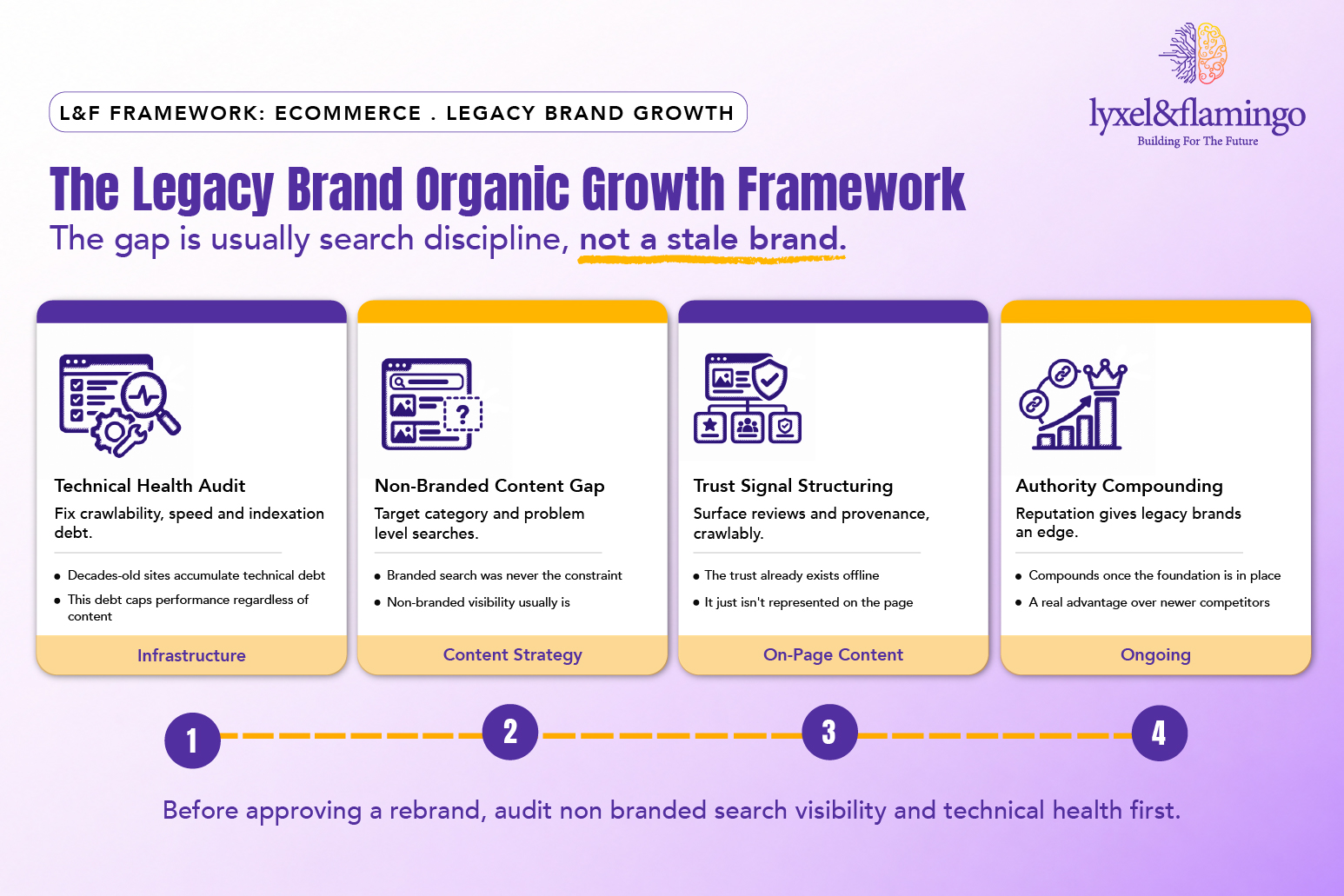
Technical Health Audit (Site infrastructure): Fix crawlability, page speed and indexation issues that decades-old sites frequently accumulate, measured against Google Search Essentials.
Non-Branded Content Gap (Content strategy): Build content targeting category and problem-level searches, not just branded queries.
Trust Signal Structuring (On-page content): Surface genuine reviews, provenance and expertise content in a structured, crawlable form.
Authority Compounding (Ongoing): Let accumulated non-branded content and trust signals compound into broader category visibility over time.
Framework Explained
Technical Health Audit: legacy sites accumulate technical debt over years of incremental changes, and this debt quietly caps organic performance regardless of how strong the brand or content is.
Non-Branded Content Gap: this is usually the single largest untapped opportunity for a legacy brand, since branded search was never the constraint, non-branded visibility was.
Trust Signal Structuring: converting decades of offline reputation into on-page signals search engines can actually credit is a content and structure project, not a trust-building project, the trust already exists.
Authority Compounding: once the technical and content foundation is in place, a legacy brand’s existing reputation gives it a real compounding advantage over newer competitors still building trust from zero.
What Changes and What Doesn’t
What changes: technical infrastructure, the depth and breadth of non-branded content, and how trust signals are structured on the page. What doesn’t need to change: the brand’s visual identity, tone, or core positioning, none of which caused the organic growth gap in the first place.
Proof This Works Without a Rebrand
Timex’s organic growth work with Lyxel&Flamingo produced 5X organic revenue growth in seven months, without touching the brand’s core identity, proof that the gap for a legacy brand is usually technical and content-driven, not a positioning problem requiring reinvention.
Key Takeaways
Legacy brands usually have strong branded search and weak non-branded search visibility, the real growth gap.
Decades of offline trust doesn’t automatically convert into on-page trust signals; that’s a content and structure project.
Technical SEO health, non-branded content and trust signal structuring, not a rebrand, are what close the gap.
Brand identity, tone and positioning don’t need to change to unlock organic growth.
CXO Takeaway
Before approving a rebrand to address stalled growth, audit non-branded search visibility and technical SEO health first. The cheaper, lower-risk fix is often sitting in a gap the brand itself never caused.
Does your brand rank well for its own name and poorly for the problem it solves? That gap, not your brand identity, is probably the real constraint.
Talk to Lyxel&Flamingo about auditing your non-branded search visibility before committing budget to a rebrand.
Frequently Asked Questions
Stalled growth feels like a brand relevance problem. For most legacy brands it’s actually a non-branded search visibility gap, a much cheaper and lower-risk fix than a full rebrand.
Branded search is someone searching the brand name directly, reflecting existing brand equity. Non-branded search is someone searching the category or problem without knowing the brand, which is where legacy brands usually have the real visibility gap.
Not automatically. That trust needs to be converted into structured, crawlable on-page signals, reviews, provenance, expertise content, which many legacy sites never built.
No. The fix is technical SEO health, non-branded content and trust signal structuring. Brand identity and positioning aren’t the constraint and don’t need to change.