What This Blog Covers
Quick commerce growth built purely on discount depth peaks and resets every festive cycle, since a shopper who arrived for a deal has little reason to return once the deal disappears. This piece covers what actually earns visibility inside the app between sale events, why dark-store inventory functions as a marketing lever most brands still treat as a pure supply chain problem, and how to design a festive-season plan that leaves the brand stronger in November than it was in September.
Quick Answer: Quick commerce visibility and repeat purchases come from winning the search-to-cart moment consistently, not from the deepest discount during a festive sale window. The levers that compound are keyword and category placement inside the app, dark-store inventory depth and freshness (which directly determines whether a brand even appears as an option), and post-purchase mechanics, such as reorder prompts and subscription nudges, that give a shopper a reason to come back once the festive offer has expired. Brands treating quick commerce as a pure media-spend channel typically see the sharpest post-festive drop-off; brands treating it as a retail and merchandising channel hold more of the spike.
Table of Contents
- Why the Festive Discount Spike Doesn’t Build a Q-Commerce Business
- 2. Winning the Search-to-Cart Moment Inside the App
- 3. Dark-Store Inventory: The Visibility Lever Nobody Treats as Marketing
- 4. Designing for the Second Order, Not Just the First
- 5. The Q-Commerce Visibility and Retention Framework
- 6. What a Festive-Season Plan Looks Like Once the Discount Ends
- Key Takeaways
- CXO Takeaway
Why the Festive Discount Spike Doesn’t Build a Q-Commerce Business
A deep Diwali-week discount pulls in a genuine spike in orders, and it pulls in a specific kind of shopper: one who is there for the price, searching by category or browsing a festive collection page rather than looking for the brand by name. That shopper converts well during the sale window and rarely becomes a repeat customer once the price returns to normal.
The platforms themselves report this pattern consistently across categories: discount-driven acquisition spikes hard and decays fast, while visibility- and experience-driven acquisition builds more slowly and holds. India’s quick commerce market scale, now large enough that a single festive week can distort an entire quarter’s growth narrative, makes this an easy trap to fall into. A brand chasing only the spike is optimizing for a single festive week at the cost of the eleven months around it, the same discount-dependency trap covered from the AOV side in how to increase AOV without relying on discount depth.
2. Winning the Search-to-Cart Moment Inside the App
Quick commerce search behaves closer to a marketplace search bar than a traditional search engine: a shopper types a category term, “chocolates” or “skincare gift set,” and the app surfaces a ranked grid within seconds, driven heavily by past purchase behavior, inventory proximity, and historical conversion rate on that listing. A brand with strong offline recognition still loses this moment if its listing isn’t optimized for exactly how shoppers search inside the app.
Quick commerce marketing patterns show that the brands winning this moment treat listing titles, imagery, and category tagging with the same rigor as an Amazon listing, rather than as an afterthought copied over from the website. A festive-specific product image (gift-wrapped, seasonal framing) measurably outperforms a generic product shot in these grid views, since the shopper is scanning fast and responding to visual cues before reading a single word.
3. Dark-Store Inventory: The Visibility Lever Nobody Treats as Marketing
This is the part most marketing teams miss entirely: a brand’s product can rank perfectly and still be invisible, because it simply isn’t stocked in the dark store nearest that shopper. Quick commerce visibility is gated by physical inventory placement in a way traditional e-commerce never was, which makes supply chain planning a genuine marketing lever rather than a separate workstream.
Festive demand concentrates hard in specific micro-markets and specific days, and a brand that hasn’t mapped dark-store coverage against expected festive demand density loses visibility exactly when demand is highest, the opposite of what any media plan intends. Analysis of what actually drives quick commerce conversion confirms stockout rate during peak windows as one of the single largest drivers of lost quick commerce revenue, larger than most creative or pricing decisions combined. The same discipline applies on the marketplace side of festive planning, where inventory and Buy Box readiness against expected demand protects visibility in exactly the same way dark-store mapping does on quick commerce.
4. Designing for the Second Order, Not Just the First
A first order during a festive sale is relatively easy to win with the right discount. The second order, placed in a normal week with no campaign running behind it, is the actual test of whether the brand built something durable. Few quick commerce strategies are designed around this moment at all.
Reorder prompts, post-delivery notifications, and subscribe-and-save mechanics (where the platform supports them) all shift a one-time festive buyer toward habitual purchase behavior, though they only work if the first-order experience, delivery speed, packaging, product quality, earned enough trust to make a second order feel like an easy decision rather than a fresh evaluation. The post-purchase experience gap costing D2C brands repeat customers covers this same trust-building window on the website side, and the logic carries over directly to quick commerce, where the delivery experience itself is the entire brand interaction. Segmenting festive-acquired shoppers for a dedicated second-purchase push, rather than folding them into a generic retention list, is the same discipline cohort-based retention marketing argues most enterprises still get wrong.
5. The Q-Commerce Visibility and Retention Framework
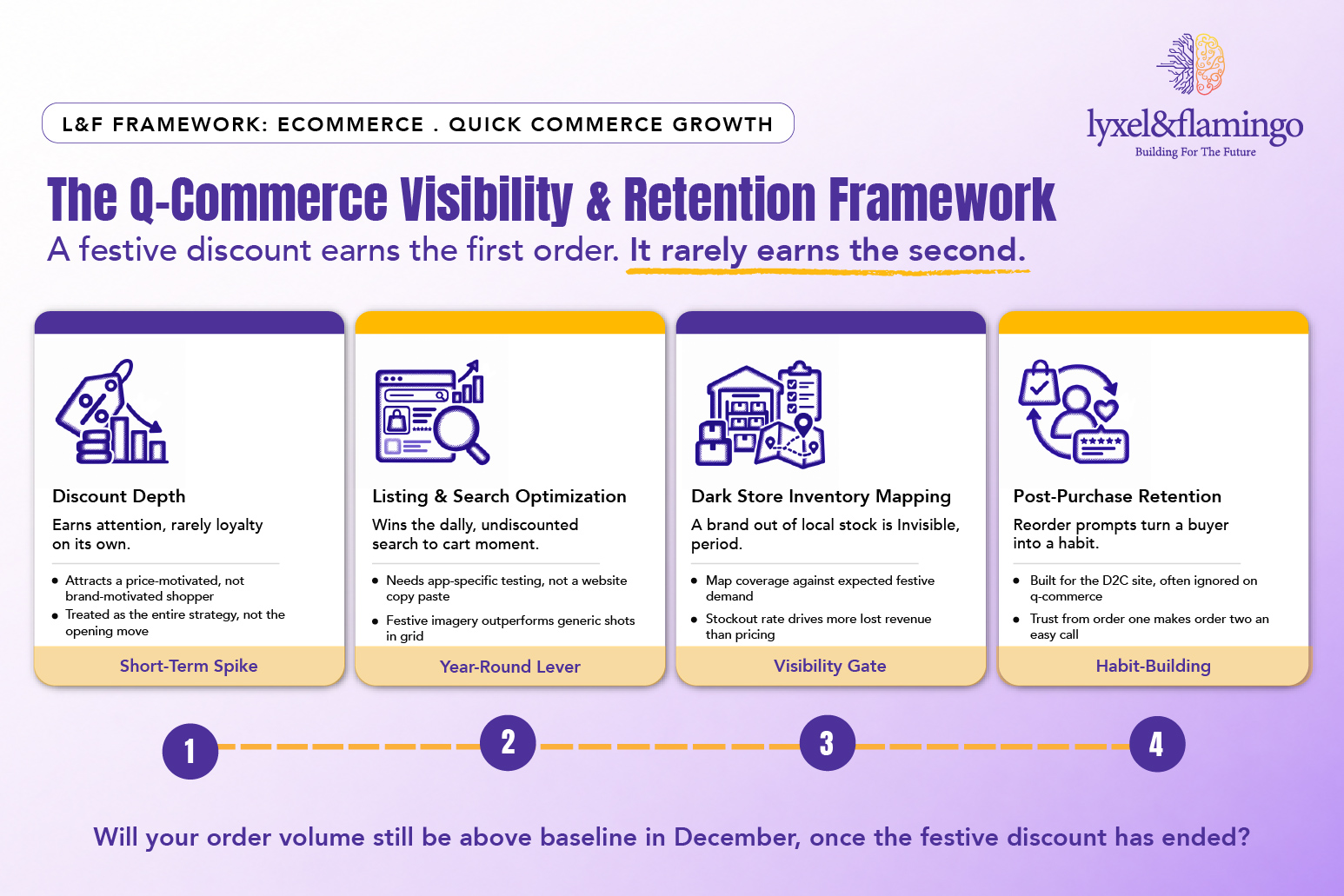
The table below separates the levers that build a durable quick commerce presence from the ones that only move a single festive week.
Framework Explained
Discount Depth earns attention during a festive window, though it rarely earns loyalty on its own, since the shopper it attracts is price-motivated rather than brand-motivated.
Listing and Search Optimization determines whether a brand wins the daily, undiscounted search-to-cart moment that makes up the vast majority of the calendar year.
Dark-Store Inventory Mapping is the single most overlooked lever, since a perfectly optimized listing still converts zero orders if the nearest dark store is out of stock.
Post-Purchase Retention Mechanics turn a festive-week acquisition into an ongoing relationship, closing the gap between a spike and sustained growth.
CAPABILITY NOTE: Lyxel&Flamingo’s third-party marketplace team builds quick commerce visibility and listing strategy as part of broader marketplace engagements, including festive-season planning. A dedicated case study isolating quick commerce repeat-purchase outcomes alone is not yet published, so this reflects an active strategic approach rather than a standalone proof point.
6. What a Festive-Season Plan Looks Like Once the Discount Ends
A festive quick commerce plan built to last past the sale window starts with the inventory map, not the discount calendar: confirming which dark stores actually carry the product in the micro-markets where festive demand is expected to concentrate, well ahead of the sale dates. Listing optimization, festive-specific imagery, and category tagging come next, tested and live before the sale begins rather than patched in mid-event. The Internet and Mobile Association of India tracks the broader digital commerce adoption curve this planning sits inside, useful context for sizing a festive-season quick commerce investment against the category’s overall growth trajectory.
The discount itself still matters, and it should be built as the opening move in a longer relationship rather than the entire strategy: paired with a reorder nudge, a subscription option where available, or a loyalty mechanic that gives the festive shopper an actual reason to open the app again in December with no sale running at all.
Key Takeaways
- Discount-led quick commerce growth spikes hard during festive weeks and decays fast once the offer ends.
- Listing and search optimization inside the app functions as its own discipline, distinct from website SEO.
- Dark-store inventory coverage is a visibility lever, since a brand that isn’t stocked locally isn’t discoverable at all.
- The second order, placed without a discount running, is the real measure of durable quick commerce growth.
- A festive plan built around inventory mapping and retention mechanics, not discount depth alone, holds more of the spike.
CXO Takeaway
Will your quick commerce order volume still be above baseline in December, or does the entire gain disappear the moment the festive discount ends? The brands that hold their festive-season gains usually invested in inventory mapping and search visibility weeks before the sale, and built a reorder mechanic into the very first delivery. Lyxel&Flamingo’s third-party marketplace team builds quick commerce strategy around this exact question.
Frequently Asked Questions
Yes, as an acquisition tool. The mistake is treating it as the entire strategy rather than the opening move in a longer retention plan.
Substantially. Several quick commerce platforms weight ranking partly on local stock availability, so a brand can be perfectly optimized and still rank poorly in a micro-market where it isn’t stocked.
Yes. Quick commerce search weighs recency, local inventory, and past local conversion heavily, alongside the title and imagery factors that matter on a traditional marketplace.
Pairing the first delivery with a clear reorder prompt or subscription option, since trust built in that first transaction is highest immediately after delivery, not weeks later.