
What This Blog Covers
Marketing efficiency gets treated as a euphemism for cuts more often than an actual operating discipline: a MarTech stack that earns its keep, budget pacing that catches waste mid-flight, and a structure, agency, in-house or hybrid, chosen for what it actually delivers rather than habit. Here’s what a genuinely efficient marketing organisation does differently, without simply spending less.
Table of Contents
- Efficiency Isn't a Synonym for Cuts
- The MarTech Stack That Earns Its Keep, and the One That Doesn't
- Budget Pacing: Catching Waste While There's Still Time
- Agency, In-House or Hybrid: A Decision, Not a Default
- Dashboards Leaders Actually Use, Not Just Receive
- The Efficient-Marketing-Org Model: four levers that recover budget without cutting activity
- The Framework Explained
- What Real Efficiency Protects
- Key Takeaways
- The CXO Takeaway
- The Question to Sit With
- Closing
Efficiency Isn’t a Synonym for Cuts
Asked to do more with the same budget, most marketing teams’ first instinct is to reduce activity uniformly across every channel, treating efficiency as austerity rather than a genuine operating discipline aimed at removing waste specifically while protecting what actually works.
The difference matters enormously in outcome. Uniform cuts reduce everything equally, including the channels driving the most return. Genuine efficiency work finds and removes the waste sitting specifically in the channels and tools that aren’t.
The MarTech Stack That Earns Its Keep, and the One That Doesn’t
Most marketing teams accumulate tools faster than they retire them. A MarTech stack audited honestly, tool by tool, against what it’s actually used for and what it costs, routinely surfaces subscriptions nobody remembers approving and platforms doing a job a cheaper tool already does elsewhere in the stack.
This audit, run annually rather than never, is one of the few efficiency exercises that recovers real budget without touching a single working campaign.
Budget Pacing: Catching Waste While There’s Still Time
A quarter’s budget reviewed only at the quarter’s close finds waste after the money is already spent. In-flight pacing, reviewed weekly, catches an underperforming line item with enough runway left to actually redirect that spend somewhere still working, rather than simply noting the loss in a retrospective.
This is the same in-flight discipline argued for in Your ROAS Looks Perfect. That’s the Problem, applied here to the budget-management process itself rather than the measurement model behind it.
Agency, In-House or Hybrid: A Decision, Not a Default
The agency-versus-in-house structure at most brands was decided once, years ago, for reasons nobody currently on the team can fully explain, and it persists mostly through inertia rather than because anyone recently checked whether it still delivers the best output for the current budget and team size.
Revisiting this decision periodically, on evidence of actual output relative to cost rather than habit, is a structural efficiency lever most marketing organisations never touch because the current setup, whatever it is, feels too settled to question.
Dashboards Leaders Actually Use, Not Just Receive
A reporting dashboard nobody opens between the monthly meeting where it gets presented isn’t driving any decisions. It’s generating a report. Building it out further rarely improves efficiency, since the problem was never a lack of data in the first place.
The efficient version of a leadership dashboard has fewer metrics, not more, chosen specifically because a leader actually checks them between meetings and makes decisions based on what has changed.
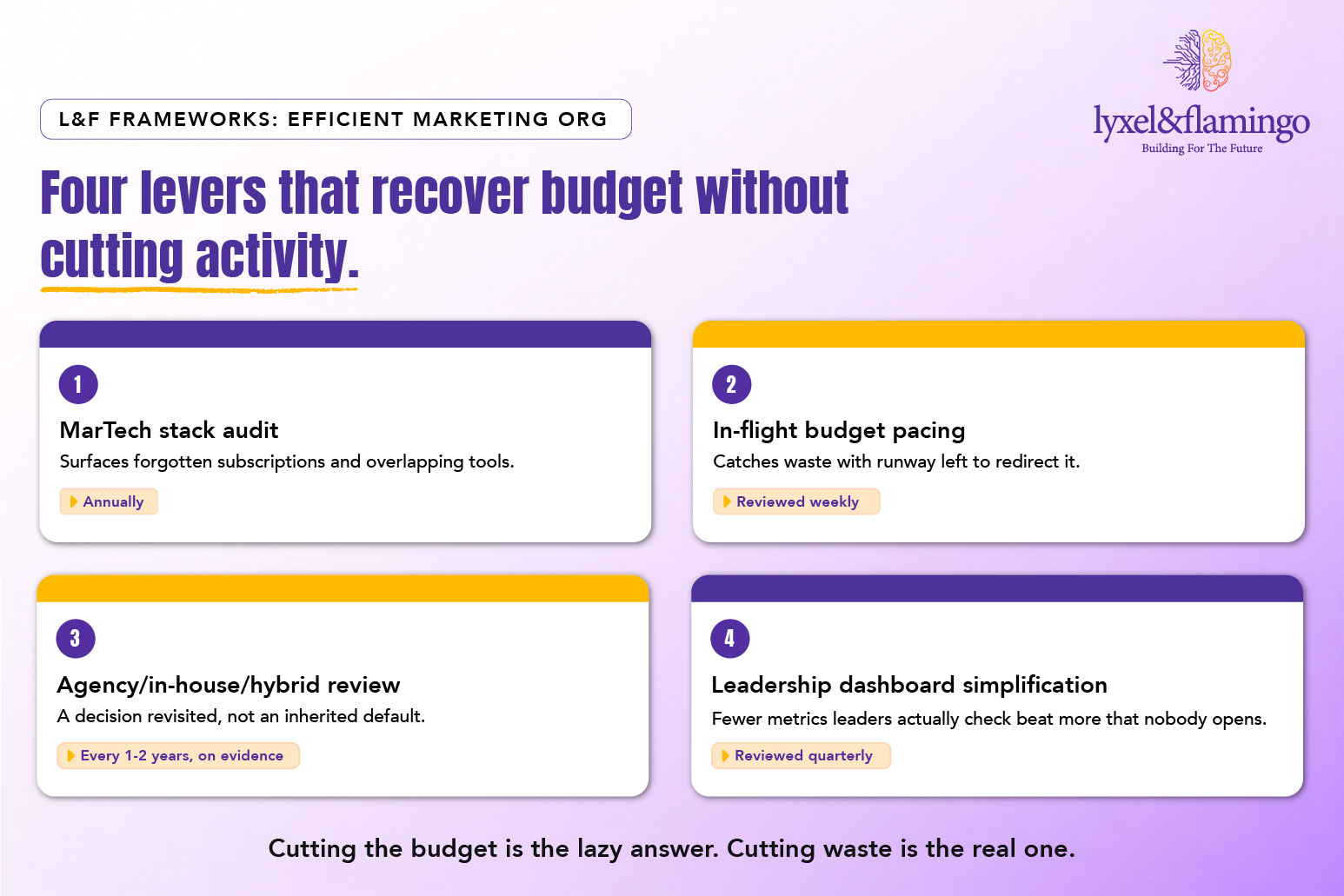
The Efficient-Marketing-Org Model: four levers that recover budget without cutting activity
The Framework Explained
- MarTech stack audit: Tools accumulate faster than anyone retires them. An honest, line-by-line MarTech audit routinely turns up a subscription nobody remembers approving and a platform doing a job a cheaper tool already handles two rows down in the same spreadsheet.
- In-flight budget pacing: A budget reviewed only at quarter’s close finds the waste after the money is already spent and gone. Weekly in-flight pacing catches the same underperforming line item with enough runway left to actually move that spend somewhere it can still do something.
- Agency/in-house/hybrid review: The agency-versus-in-house call at most brands was made once, years ago, by people who may not even be on the team anymore, and it survives purely on inertia. Revisit it on evidence of current output relative to current cost, not because it feels too settled to question.
- Leadership dashboard simplification: A dashboard nobody opens between the meeting where it gets presented is not driving a single decision. It is generating a report nobody reads. Fewer metrics, chosen specifically because a leader actually checks them, beats more metrics that just sit there.
What Real Efficiency Protects
CLIENT PROOF POINT: confirm sign-off before publish. Greenply‘s content and SEO programme shows what efficient, focused investment delivers over sustained effort: blog impressions grew 875% within twelve months, off a content strategy mapped against 6.1 million searches. Growth built on disciplined targeting of where the budget would actually earn its keep, not a broad, unfocused spend increase. (L&F client work, content and SEO programme, 12-month result.)
Our Media services team runs MarTech and budget-pacing audits designed to recover budget without cutting working activity.
Key Takeaways
- Asked to do more with the same budget, most teams cut activity evenly instead of removing waste specifically.
- An honest, annual MarTech stack audit routinely surfaces forgotten subscriptions and overlapping tools nobody remembers approving.
- Weekly in-flight budget pacing catches an underperforming line item with enough runway left to actually redirect the spend.
- The agency, in-house or hybrid structure at most brands was set once and persists through inertia, not recent evidence.
- Greenply’s focused, disciplined content and SEO investment grew blog impressions 875% within twelve months.
The CXO Takeaway
For a CXO, a flat budget doesn’t have to mean less activity. It has to mean someone actually asked what’s currently being paid for that has quietly stopped earning its keep. A MarTech audit, in-flight pacing and a periodically revisited structure recover real budget without cutting a single working campaign.
The Question to Sit With
Stop asking what to cut. Ask what is currently being paid for that has quietly stopped earning its keep.
Closing
Lyxel&Flamingo builds the operating discipline that recovers marketing budget without cutting working activity, MarTech audits, in-flight pacing and structural reviews included. Want a clear read on where your current marketing budget is quietly leaking? Start that conversation with L&F →
Frequently Asked Questions
No. Genuine efficiency work removes waste from tools and channels that aren't earning their keep while protecting what is actually working, rather than reducing activity uniformly across every channel the way a straightforward budget cut does.
Annually is a reasonable minimum. Most teams accumulate tools faster than they retire them, and an honest audit routinely surfaces forgotten subscriptions and overlapping platforms doing a job already covered elsewhere.
Because a quarter-end review finds waste after the money is already spent, while weekly in-flight pacing catches an underperforming line item with enough runway left to actually redirect that spend.
Yes, periodically, on evidence of actual output relative to cost. Most brands set this structure once and never revisit it, even as team size, budget and channel mix change significantly over time.