
What This Blog Covers
Every festive brief this year asked for the same output twice as fast. Nobody adjusted the budget to match. AI-assisted video production is changing what’s possible inside a festive production calendar, for specific parts of the process only. This breaks down what genuinely speeds up, what still needs a human editor, and how to brief a hybrid pipeline without losing creative quality.
Quick Answer: AI video tools cut turnaround most reliably in pre-production and variant generation, not in final creative judgment. Teams that save real time use AI for storyboarding, rough cuts, localization and format resizing, while keeping a human editor on the hero cut and every brand-safety decision. Expect a 30 to 40 percent reduction in production time on a festive campaign. Not a 90 percent one.
Table of Contents
The Festive Production Squeeze
Festive briefs used to ask for one hero film and a handful of cutdowns. Now they ask for a hero film, six aspect ratios, three regional dubs, a Reels-native version, and a static fallback set, all inside a window that hasn’t gotten any longer. The number of deliverables has grown faster than the number of production days.
Most creative teams absorb this by cutting corners on the assets nobody scrutinizes closely, the fifth cutdown, the low-priority market dub, and that’s exactly where a brand’s inconsistency starts to show. The honest fix isn’t a bigger team. It’s a pipeline that knows which parts of production actually need a human and which don’t.
What AI Actually Speeds Up
Storyboarding and pre-visualization move fastest. A concept that used to take two days to storyboard by hand can get a first-pass visual direction in hours, giving the creative director something concrete to react to instead of a blank page.
Format resizing and platform variants are the clearest win. Once a hero cut is locked, generating a 9:16 version for Reels, a 1:1 for feed, and a 6-second bumper used to mean re-editing three separate timelines. AI-assisted reframing handles the mechanical resizing, leaving an editor to check pacing rather than rebuild it.
The same logic applies to the sheer volume of variants a festive calendar now demands for proper testing, which is exactly the problem the performance creative testing framework is built to manage once those variants exist.
Localization and dubbing for regional markets is the third real gain. Generating a first-pass Tamil or Bengali dub track for review is faster than booking a studio slot for every market before anyone has confirmed the creative even works.
Where Human Judgment Still Wins
Cultural nuance in festive messaging is not a technical problem, and AI tools consistently get it wrong in ways that are expensive to catch late. The specific way a diya is lit, which greeting fits which region, how a joint family is shown on screen: these are brand-safety decisions, not style choices, and they need a human who understands the market.
The final hero cut still needs a human editor’s pacing and emotional judgment. AI-assisted rough cuts are a fast starting point, not a finished film, and the gap between the two is exactly where a brand’s creative distinctiveness either survives or disappears into what starts to look like everyone else’s festive ad.
That’s the same generic-look risk covered in ad fatigue: how to detect it and beat it: audiences tune out faster when creative starts to feel interchangeable, and AI-generated output that skips the human polish pass is a fast way to get there.
The Hybrid Production Framework
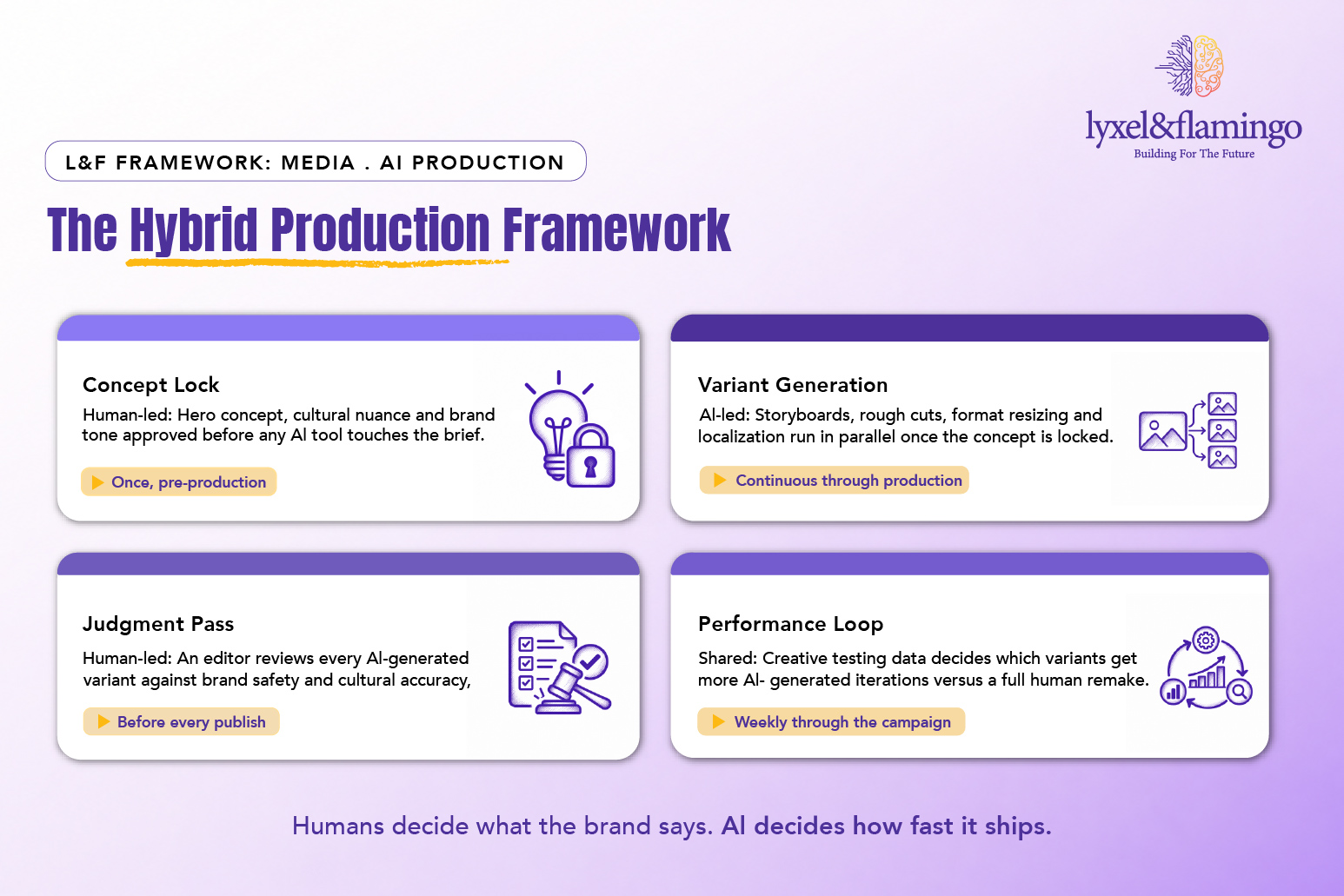
The teams getting real speed gains aren’t choosing between AI and human production. They’re sequencing them deliberately, so each does the part it’s actually good at.
Framework Explained
- Concept Lock: Nothing goes into an AI-assisted pipeline until the hero concept, tone, and cultural references are approved by someone who owns brand judgment, not just production speed.
- Variant Generation: Once locked, format resizing, rough cuts, and localization run as parallel AI-assisted tracks, freeing the human team from the mechanical repetition that used to eat most of the calendar.
- Judgment Pass: Every variant gets a human review before it publishes, specifically for cultural accuracy and brand safety, not just whether the cut looks technically clean.
- Performance Loop: Early performance data decides where to invest more AI-generated iterations and where a variant needs a full human remake instead of another automated pass.
Briefing for Speed Without Losing Quality
The brief itself needs to change, not just the production tool. Lock the hero concept and get cultural sign-off before anyone touches an AI tool, so speed gains apply to derivative work rather than the one decision that actually needs to be slow.
Build the judgment-pass checkpoint into the calendar as a fixed step, not an optional one. Teams that skip this under deadline pressure are the ones that end up publishing the version that technically works, without sounding like the brand.
What This Means for Your October Calendar
A hybrid pipeline doesn’t mean a smaller team. It means a smaller number of people spending their time on the decisions that actually require judgment, while AI absorbs the format resizing, localization drafts, and rough cuts that used to consume most of a festive production window.
Proof that creative pace matters shows up directly in Lyxel&Flamingo’s own client work.
When Blackberrys needed its creative to keep pace with a faster-moving media calendar, the result was 3X revenue growth and a meaningfully higher ROAS, the kind of gain that a faster, better-tested production pipeline makes possible at scale.
Key Takeaways
- AI cuts real time in pre-production and variant generation, not in final creative judgment.
- Expect a 30 to 40 percent faster turnaround on a festive campaign, not a fully automated one.
- Cultural nuance in festive creative still needs a human editor’s final pass, every time.
- Build the judgment-pass checkpoint into the calendar as a fixed step before scaling AI-generated variants.
CXO Takeaway
For CMOs approving festive production budgets, the ROI case for AI video tools is in throughput, not headcount reduction. Budget for a smaller, more senior creative team producing more tested variants, not an unattended pipeline that needs no review.
If your production calendar hasn’t changed shape since last Diwali, is speed actually the constraint, or is it something else?
Talk to Lyxel&Flamingo about building a hybrid production pipeline that gets festive creative to market faster without losing what makes a brand’s tone recognizable.
Frequently Asked Questions
No. AI tools reliably speed up pre-production and variant generation. Final creative judgment, cultural nuance and brand tone still need a human editor’s pass before anything publishes.
Most teams see a 30 to 40 percent reduction in turnaround time on a festive campaign when AI handles storyboarding, format resizing and localization, not the near-instant production some vendors promise.
Generic-looking output that misses cultural specificity. This is especially risky during Diwali and festive messaging, where imagery and tone carry real cultural weight that a model trained on generic data won’t reliably get right.
Start with the lowest-risk task: format resizing and localization drafts for already-approved hero creative, not the hero concept itself.