
What This Blog Covers
This blog explains why AI retrieval systems treat content freshness as a citation signal rather than just a quality indicator, shows how to audit which pages in your existing library are at risk of slipping out of citation range, and provides a four-tier calendar model that keeps your content in active AI consideration without requiring a full team dedicated to constant rewrites. It covers the distinction between freshness and recency, how to score pages on citation potential and decay risk to build a prioritised refresh queue, what a genuine content refresh involves compared to a cosmetic date change that produces no freshness signal at all, and how the Content Refresh Priority Model distributes review effort across monthly, quarterly, bi-annual, and annual cycles matched to the strategic value and decay speed of each content type in your library.
QUICK ANSWER: A content refresh calendar structures when and how existing pages are reviewed, updated, and re-dated to maintain AI citation eligibility. AI systems deprioritise content that appears stale: pages without recent revision signals, facts that have shifted since publication, or examples that no longer hold. A tiered calendar, matching refresh frequency to the strategic value of each page, is the operational system that keeps a content library in active citation consideration rather than gradually decaying out of it.
Table of Contents
- The Problem: Why Does Content Lose AI Citations Over Time?
- What Does Freshness Actually Signal to an AI Retrieval System?
- How Do You Decide Which Pages to Refresh First?
- Content Decay Risk: Quick Assessment by Category
- What Does a Proper Content Refresh Actually Involve?
- The Content Refresh Priority Model: Four Tiers, One Calendar
- Client Proof Point
- Key Takeaways
- The CXO Takeaway
The Problem: Why Does Content Lose AI Citations Over Time?
Content does not become uncitable because something goes wrong. It becomes uncitable because something stops being done. AI retrieval systems, particularly those with web access or recent training data, weight published and revision dates as signals of whether the information is likely to still be accurate. A page that was cited eighteen months ago because it contained a current benchmark, a recent study, or an up-to-date recommendation gradually loses that signal as the date ages and the underlying information is superseded.
This is structurally different from how traditional SEO worked. A well-ranked page could retain its position for years without a single update, carried by backlinks and domain authority. An AI citation, by contrast, requires the page to continue demonstrating relevance at the moment of retrieval, not just at the moment of original indexing.
The practical result is a content decay problem that most brands are not measuring. Pages that were actively earning citations in early 2026 are quietly losing them as the data they contain becomes harder for a retrieval system to trust. The answer is not to publish more. It is to maintain what already exists on a structured calendar, which connects directly to the answer-first writing discipline that ensures refreshed content is immediately extraction-ready once updated.
What Does Freshness Actually Signal to an AI Retrieval System?
Freshness is not the same as recency. A page published yesterday with thin, unverifiable content is less citable than a page published three years ago with rigorous methodology and a genuine revision date. What AI retrieval systems weight is evidence of active maintenance, not just an original publication date.
The signals that indicate freshness to a retrieval system include: a visible last-updated or last-reviewed date in the page markup or visible text; changes to statistics, case study results, or examples since the original publication; schema markup that carries an accurate dateModified field; and the presence of references to events or data that are clearly within a credible recent timeframe.
None of these require a complete rewrite. A page that was originally strong on answer-first structure and authority signals can remain a strong citation candidate if it is reviewed for accuracy, updated where the underlying facts have moved, and re-published with an honest revision date. Maintaining accurate revision signals is part of the broader GEO citation framework where freshness is one of six pillars that compound with each other rather than operating independently.
How Do You Decide Which Pages to Refresh First?
Refreshing everything simultaneously is not possible, and prioritising randomly wastes resource. The starting point is a content audit that scores each page on two axes: citation potential (is this the kind of content AI systems want to cite?) and freshness risk (how long since the last substantive update, and how fast does the underlying information change in this category?).
Pages that score high on citation potential and high on freshness risk get addressed first. These are typically pages covering specific benchmarks, statistics, category comparisons, and how-to guidance in fast-moving verticals. A page explaining AI citation behaviour that was last updated in 2024 is already operating at high freshness risk, even if it was excellent when published.
The audit also catches a category that most brands miss: pages that were never strong citation candidates to begin with, which are being maintained out of habit rather than strategic value. These pages drain resource that would be better spent on Tier 1 and Tier 2 content. One of the calendar functions is to surface them for consolidation or retirement decisions rather than perpetual low-value maintenance.
Content Decay Risk: Quick Assessment by Category
What Does a Proper Content Refresh Actually Involve?
A content refresh is not changing the publication date and republishing the same text. An AI retrieval system that previously indexed the content will detect that no meaningful change occurred, and the freshness signal will not improve. The discipline requires genuine revision: updated statistics with sourced current data, examples replaced or supplemented where older ones have dated, headings reviewed against how the query landscape has shifted, and the opening passage checked for answer-first structure.
The minimum meaningful revision for maintaining AI citation eligibility includes: verifying every statistic and replacing any that have materially changed; checking that any named case studies still reflect current reality; reviewing the FAQ or structured Q&A sections against what users are now actually asking about the topic; and updating the dateModified field in Article schema. A complete rewrite is rarely necessary and often counterproductive, since it loses the accumulated authority and backlink signals the original page built.
The Content Refresh Priority Model: Four Tiers, One Calendar
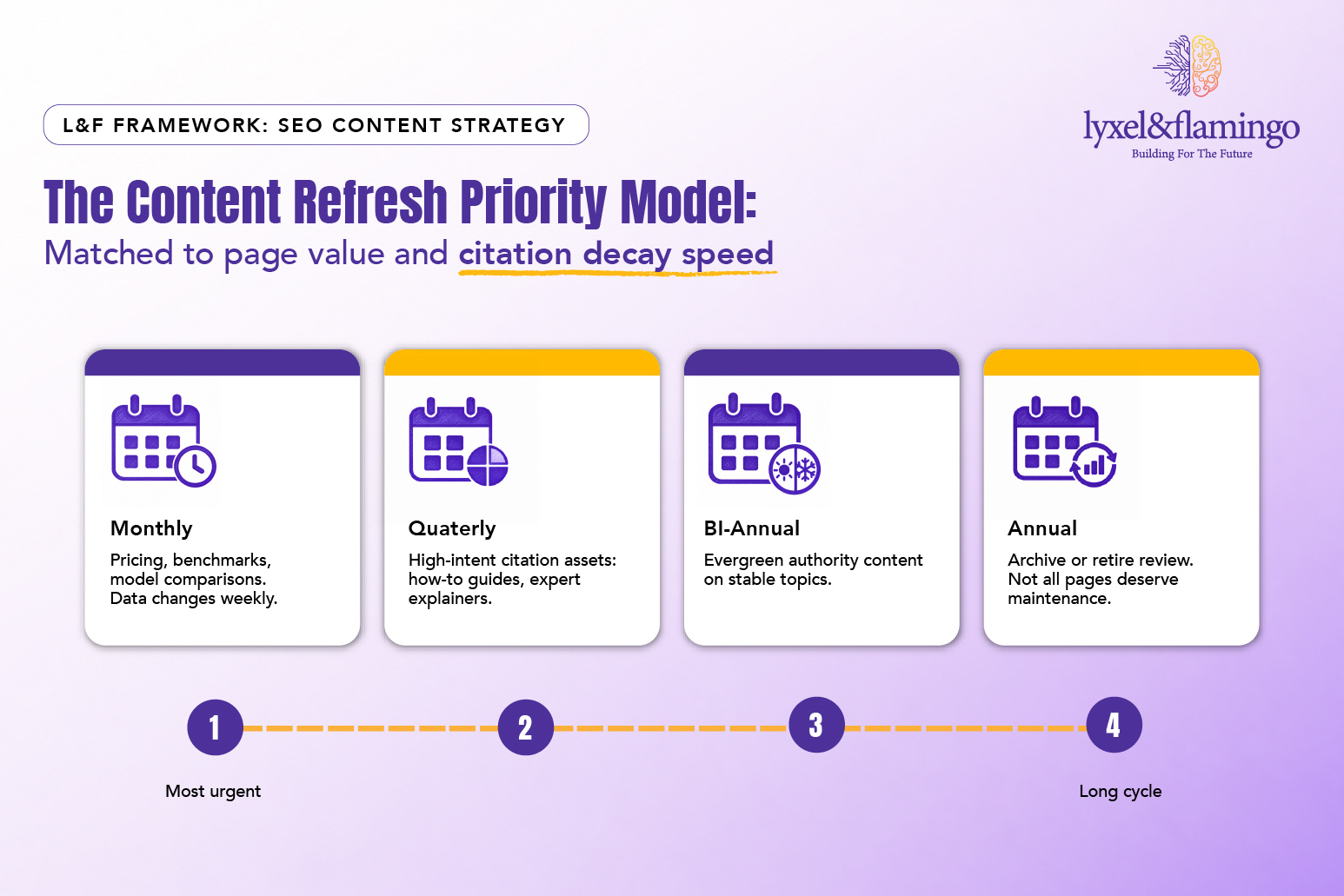
The Framework Explained
Most content programmes treat freshness as a publishing problem rather than a maintenance discipline. In Lyxel&Flamingo’s own work running content programmes across retail, FMCG, and digital-first verticals, we find the same gap consistently: pages earning strong AI citations in Q1 are quietly losing them by Q3, not because the competition has published better content, but because no one scheduled a review. We apply a four-tier refresh model before any page is left to run beyond its natural citation decay window.
01. Tier 1: Monthly Review
Does this page contain data that changes faster than a quarterly review cycle? Pricing pages, model comparisons, regulatory guidance, and AI visibility benchmarks all belong here. A pricing page four months out of date is not just stale: it is actively misleading to an AI system that has previously cited it, and the system will stop citing it the moment a fresher alternative appears. The scope stays limited to verification rather than rewriting: check the numbers, check the examples, update what has moved, re-publish with an honest revision date and updated schema.
02. Tier 2: Quarterly Review
Is this one of the pages already earning citations, organic traffic, and conversion-relevant engagement? A statistic now two quarters out of date, a case study whose subject company has since changed, a FAQ section that no longer answers what the audience is actually asking: these are exactly the gaps a quarterly review catches before they cost a citation. The quarterly pass is the discipline that keeps a brand’s highest-value pages continuously earning without requiring a full rebuild on any of them.
03. Tier 3: Bi-Annual Review
Is this page on a topic stable enough that the underlying facts move slowly, but important enough that quiet drift could still erode trust between reviews? Definitions, methodology guides, and foundational explainers all feel timeless but are not. The bi-annual calibration pass is not a rewrite: it is a check asking whether anything is no longer accurate, whether anything is missing that would make this page more complete, and whether the schema still carries an honest revision date.
04. Tier 4: Archive or Retire
Every content library contains pages maintained out of inertia rather than strategy: campaigns that ended, products discontinued, queries the brand no longer pursues. The annual archive review is the conversation most content programmes never have, because no one wants to retire content they spent budget producing. But maintaining these pages consumes crawl budget, dilutes domain signal quality, and crowds the library with content earning nothing. The retire decision, whether consolidation, 301 redirect, or removal, is the discipline that keeps the rest of the library performing above its surface-area cost.
A brand that runs every page through those four tiers ends up with something most content programmes never build: a library where every page is actively earning, actively maintained, or actively scheduled for a decision. That is what turns a growing archive into a compounding citation asset rather than a growing liability.
Client Proof Point
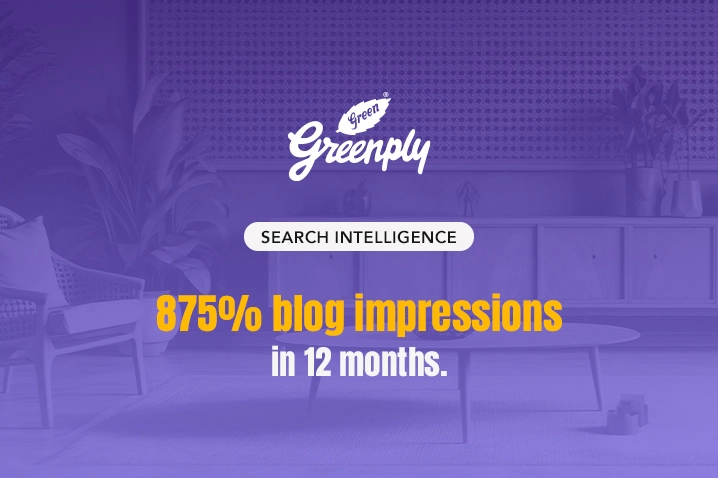
Greenply‘s content programme illustrates what a structured refresh approach delivers at scale across a competitive building materials vertical. Running a systematic review cycle for high-priority citation assets, the programme established answer-first restructuring and freshness signal maintenance as core disciplines rather than one-time activities. The compounding effect of structured freshness maintenance across a large catalogue of pages is the result this calendar model is built to produce.
Key Takeaways
- AI systems treat content freshness as a citation signal. Pages without genuine revision in the past 12 months are at increasing risk of being displaced by more recently maintained alternatives.
- Freshness is not the same as recency. AI systems weight evidence of active maintenance (updated statistics, revised examples, accurate
dateModifiedschema) rather than simply prioritising newly published content. - The four-tier calendar matches refresh frequency to citation risk: monthly for high-velocity content, quarterly for strategic assets, bi-annually for evergreen content, and an annual archive review for declining pages.
- A content refresh is not a cosmetic date change. Genuine revision of statistics, examples, and FAQ sections is what generates the freshness signal that retrieval systems recognise.
- The archive and retire decision (Tier 4) is as strategically important as any individual page refresh. It keeps the content library performing above its maintenance cost.
The CXO Takeaway
For a brand leader, the content refresh calendar converts a growing content library from a depreciating asset into a compounding one. Without a calendar, every page published eventually becomes a page that needs rebuilding. With one, the ongoing maintenance cost of each page is small, the cumulative freshness signal across the domain is continuously improving, and the pages that are no longer worth maintaining are identified and resolved before they dilute the library’s overall citation authority. The question is not whether to maintain content. It is whether to do it reactively or systematically.
Frequently Asked Questions
No, and it may actively harm them. AI retrieval systems can detect when a page has not changed substantively. A date update without corresponding content revision produces no genuine freshness signal. Updating the dateModified field in schema markup is only meaningful when the content it refers to has actually been revised. The discipline is genuine revision first, then honest date update.
Start with any statistic that includes a year (for example, "as of 2024") and any statistic sourced from a report or study that has since been updated by its publisher. These are the most obvious staleness signals to an AI system. Next priority is any benchmark or percentage that the content presents as current evidence for a recommendation: if the evidence has moved, the recommendation may have too.
No, The calendar is for content with active citation potential, not for everything the library contains. Run a two-question filter first: is there still a real query this page serves, and would an AI system retrieving it today find something worth citing? A no on either question means the page belongs in the Tier 4 archive and retire review, not in an ongoing maintenance cycle. The volume of content that genuinely deserves active refreshing is almost always smaller than teams assume.