
What This Blog Covers
This blog makes the strategic case for proprietary data as the highest-leverage content investment available to brand leaders, explains precisely why AI systems favour original research over even the best synthesised content, and gives a framework for identifying and publishing the data most organisations are already generating. It also announces L&F’s forthcoming India AI Visibility Benchmark: the argument in practice.
QUICK ANSWER : Original data earns AI citations because it represents information that exists nowhere else. AI systems are designed to surface unique claims: the uniqueness is what makes attribution necessary. A proprietary statistic, a commissioned benchmark, a prompt study across 200 queries: each is citation-ready the moment it is published in a structured, answer-first format. Generic content summarising widely available information competes in a saturated field. Original data competes almost alone.
Table of Contents
- Why Are AI Systems Built to Cite Original Data Over Everything Else?
- What Data Are Most Brands Already Generating Without Publishing?
- Why Does Well-Written Generic Content Still Lose the Citation?
- Content Format vs AI Citation Performance: A Quick Reference
- The Data Citability Stack: Which Four Formats Actually Earn Citations?
- The Framework Explained
- How Do You Make a Data Asset Citation-Ready for AI Systems?
- Client Proof Point
- Key Takeaways
- The CXO Takeaway
Why Are AI Systems Built to Cite Original Data Over Everything Else?
The citation logic of an AI retrieval system rewards uniqueness above almost everything else. When a language model encounters a claim that appears across multiple sources, it synthesises the claim without attribution, because no single source owns it. When it encounters a claim that exists on one page and nowhere else, it cites that page, because attribution is the only honest option.
This is not a side effect of how AI systems work. It is a design feature. The systems are explicitly built to surface information a user could not find by reading a dozen generic articles. A proprietary statistic, a commissioned benchmark, a dataset derived from actual operational data: each of these is citable by definition, precisely because it cannot be reproduced from any other source.
The practical consequence is a citation landscape far less competitive than it appears. One benchmark from L&F’s India AIO research shows exactly why, as detailed in the India AI Overviews statistics analysis: the triggers, query types, and vertical patterns that produce citations are specific enough that original data covering them competes with almost nothing.
What Data Are Most Brands Already Generating Without Publishing?
Most organisations thinking about AI citations assume the problem is that they lack interesting data. In practice, the problem is usually the opposite: they have never looked at what they already generate as a publishable asset.
A brand managing relationships with 350 or more clients holds performance data, keyword movement, impression behaviour, and category benchmarks that no third-party research firm could access. A platform processing thousands of transactions daily understands demand patterns in its category that no survey can replicate with the same granularity. A logistics business operating across thousands of PIN codes has delivery and availability data that a category analyst would pay to read.
None of this requires a new research budget. It requires a decision: that the data already being generated is worth structuring, dating, and publishing. That decision is what separates organisations that earn AI citations from those that compete for them without a durable advantage.
Why Does Well-Written Generic Content Still Lose the Citation?
Quality is a prerequisite, not a differentiator. A well-structured, clearly written, authoritatively sourced page that summarises what the industry says about attribution modelling is a secondary source. An AI system encountering it will not cite it for the conclusion: it will go to the primary sources the page is itself citing.
This is the trap that catches most content programmes. Investment goes into writing quality: expert tone, clear structure, accurate citations of third-party research. All of this improves the page’s credibility and its chances of ranking well in traditional search. None of it gives the AI system a reason to cite that specific page rather than the primary sources the page summarises.
Generic content is also replaceable. Another brand can publish the same page tomorrow, with more recent sources, better formatting, and a fresher date, and the AI system will cite that page instead. Original data is not replaceable on the same timeline. A proprietary benchmark published in November 2026 remains the only source for those specific findings until the producing organisation updates it. The competitive moat is not quality. It is existence.
Content Format vs AI Citation Performance: A Quick Reference
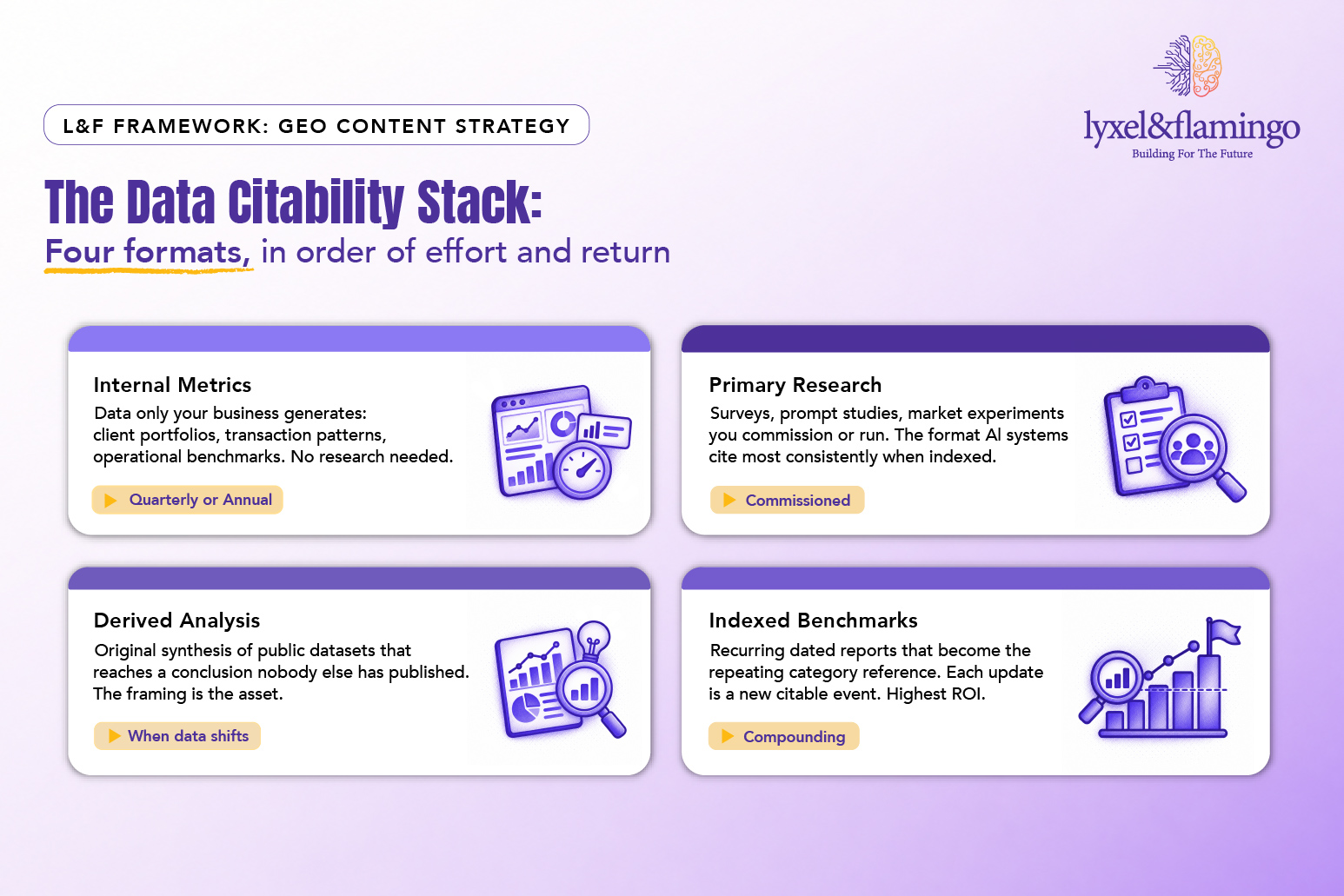
The Data Citability Stack: Which Four Formats Actually Earn Citations?
The Framework Explained
- Internal Metrics: The lowest-friction starting point for most organisations. Every client engagement, transaction record, campaign result, or operational measurement generates data that an external researcher could not access. Structuring it into a publishable format, a clear methodology statement, publication date, key finding stated explicitly in the opening passage, is the primary task. The data already exists; the decision to publish it is the investment.
- Primary Research: Surveys and prompt studies require upfront investment. They produce the format AI systems cite most consistently: a finding that is both unique and methodologically grounded. The methodology statement that accompanies it (what was measured, across how many data points, over what period) converts the finding from an assertion into a citable claim. Without a methodology, even a genuine finding reads as opinion. With one, it reads as evidence.
- Derived Analysis: The most underused format in most content programmes. Available data, government statistics, platform disclosures, published industry research, can be combined and interpreted in ways that produce genuinely new conclusions. The derivation is the proprietary element. The same sources, synthesised through a different analytical lens, reach a different and original finding that has no other home.
- Indexed Benchmarks: The highest-compounding format in the stack. A recurring report, a quarterly AI visibility index, an annual content citability study, trains AI retrieval systems to treat the publishing organisation as the authoritative source for that measurement over time. Each update is a new citable event. The second publication earns citations more easily than the first because the reference already exists in the AI retrieval data.
How Do You Make a Data Asset Citation-Ready for AI Systems?
Having original data is necessary. Having it in a form AI systems can extract and attribute is what makes it a citation rather than an internal report that never leaves the shared drive.
Three structural requirements make a data asset citation-ready. First, the key statistic or finding must appear in the opening passage of the page, in a sentence that can stand alone without the surrounding context. A data point buried in a methodology section or presented only as a chart without a clear prose statement will not be extracted. The finding needs to be said, in plain language, before it is shown.
Second, the methodology must be stated plainly: what was measured, across how many data points, over what period. AI systems weight claims with explicit methodology over unsourced assertions, even when the assertion is accurate. A statistic without a methodology is indistinguishable, to a retrieval system, from a number someone estimated.
Third, the asset needs a publication date and, where possible, a version number or update cycle. Recurring research compounds in citability, and pairing this with the sequencing discipline in Answer-First Writing ensures the data is not just unique, but immediately findable in the opening passage where AI systems look first.
Companion Post
Original data structured in answer-first format outperforms original data buried three paragraphs in. The uniqueness of the claim earns the right to be cited; the sequencing determines whether a retrieval system actually finds it.
Client Proof Point
Lyxel&Flamingo’s position as the source of this post illustrates the argument it makes. The agency manages SEO and GEO programmes for 350+ brands across India, the UAE and the UK, with $250M in media under management. The performance data generated across that portfolio- keyword movement, AI citation rates, impression behaviour, and category benchmarks- is a proprietary data estate that no external research firm could replicate at that scale across the Indian market.
The India AI Visibility Benchmark, L&F’s forthcoming recurring measurement of AI citation share across Indian brands by category and engine, is the application of the Data Citability Stack to L&F’s own content programme. When published, it will be the only recurring, category-level measurement of AI citation behaviour in the Indian market. That specificity is precisely what makes it citation-ready.
Key Takeaways
- AI citation logic rewards uniqueness above almost everything else: a claim that exists on one page and nowhere else must be cited to be attributed. Generic content is not in that position.
- Most organisations are sitting on unpublished data estates, performance portfolios, transaction records, operational benchmarks that are publishable in their current form, with structuring and dating.
- Generic content is replaceable on a three-to-six-month cycle. A proprietary benchmark remains competitive until the producing organisation publishes its next update. That is a categorically different content asset.
- The Data Citability Stack identifies four formats in ascending order of effort and compounding return: internal metrics, primary research, derived analysis, and indexed benchmarks.
- Recurring, indexed benchmarks compound in citability: AI systems learn to treat them as the authoritative reference for a category, and each update is a new citable event.
The CXO Takeaway
For a brand leader deciding where to concentrate content investment in 2027, the original data case comes down to one calculation: how long will a generic article remain competitive before a competitor publishes a more recent version? The answer is typically three to six months. A proprietary benchmark remains competitive until the producing organisation publishes its next update, and each update compounds the advantage rather than restarting the race. Most organisations are already generating this data. The investment is in the decision to treat it as a content asset, not in new research infrastructure.
Frequently Asked Questions
Even a small sample generates citable data when the methodology is clearly stated and the finding is specific. A study of 50 Indian brands' AI citation behaviour across two engines is more citable than a survey of 10,000 people asking whether they use AI search. Specificity and a clear methodology matter more than sample scale.
A managed risk, not an absolute barrier. The data that earns AI citations is category and pattern data, not client or customer specifics. Publishing that average CTR from AI Overview citations in Indian retail fell 12% in Q3 2026 reveals nothing about individual clients and creates citation authority worth considerably more than whatever strategic signal it implies.
Quarterly for high-velocity categories where the underlying data changes meaningfully. Annually for slower-moving categories. The discipline that maintains authority is updating only when the data has materially changed. Updating too frequently without genuine new findings dilutes the asset and signals instability.
Both, with the blog post as the primary indexed document. The blog post is what AI systems index and cite; the download is what converts readers into leads. The key finding must be stated explicitly in the blog post's opening passage, not hidden behind a gated report that retrieval systems cannot access.