
What this blog covers
Why most measurement setups quietly mislead the businesses that rely on them, and a practical model the Single-Goal Tracking Model that ties every funnel to one North-Star outcome, instruments clean events, and attributes honestly, so a CXO can finally answer “is our UI/UX actually working?” with data rather than instinct.
Table of Contents
- Single-goal tracking, defined: One outcome, many paths to it
- Why most analytics setups quietly lie
- Where measurement breaks down
- Framework: The Single-Goal Tracking Model
- The Framework explained
- Real-world scenario: Timex
- Going deeper: The measurement readiness checklist
- Key takeaways
- The CXO takeaway
Single-goal tracking, defined: One outcome, many paths to it
Single-goal tracking is the discipline of defining one primary business outcome the North-Star conversion and then instrumenting every channel and funnel so that its contribution to that single outcome is measurable and comparable. Paid, organic, social, email, and app are different paths; they should all be measured against the same destination. The alternative each channel reporting its own vanity metric in its own dashboard produces a business that is data-rich and insight-poor, unable to say which of its funnels is actually creating value.
Why most analytics setups quietly lie
The problem is rarely a lack of data; it is data that misleads. Analytics that count sessions, likes, and impressions without tying them to a single commercial outcome give every channel a way to look successful while the business cannot tell what is working. And the stakes of getting this wrong are measurable: the same UX improvements that lift conversion only prove their worth if they are tracked. A 0.1-second improvement in mobile load speed raises conversions by 8.4% (Deloitte/Google, 2020), but a business with broken measurement will never see that gain in its numbers and will defund the work that produced it. Meanwhile, the funnel leaks it cannot see keep costing it: cart abandonment averages 70.19% (Baymard Institute, 2024), and without stage-level tracking, a team cannot say where, or why.
Where measurement breaks down
- No single North-Star goal: When every channel optimises its own metric, no one can rank the funnels by the value they actually create. The first discipline is agreeing on the one outcome that matters.
- Inconsistent event design: Events named and fired differently across pages and platforms cannot be compared or aggregated. Inconsistent instrumentation is the most common silent failure in GA4.
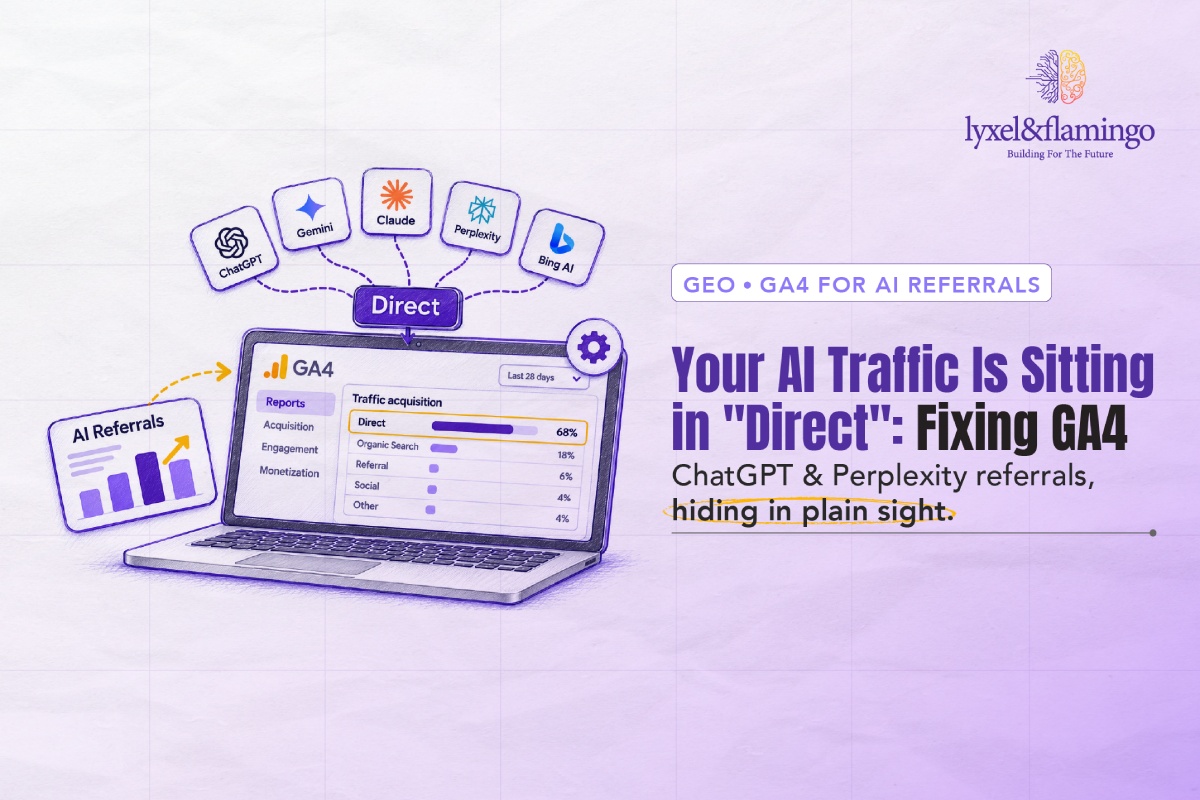
- Attribution collapse: As users arrive via AI answers, chatbots, and zero-click search, traffic that is not tagged gets dumped into “direct,” and the channels that actually drove it are starved of credit and budget.
- Vanity dashboards: Impressions and sessions feel like progress but do not map to revenue. A dashboard that cannot answer “which activity drove which outcome?” is decoration.
- Measurement bolted on at the end: Analytics configured after launch, rather than designed alongside the build, means the highest-value early data is lost permanently.
Framework: The Single-Goal Tracking Model
The model is sequential: a beautiful dashboard built on inconsistent events is worse than no dashboard, because it is confidently wrong.
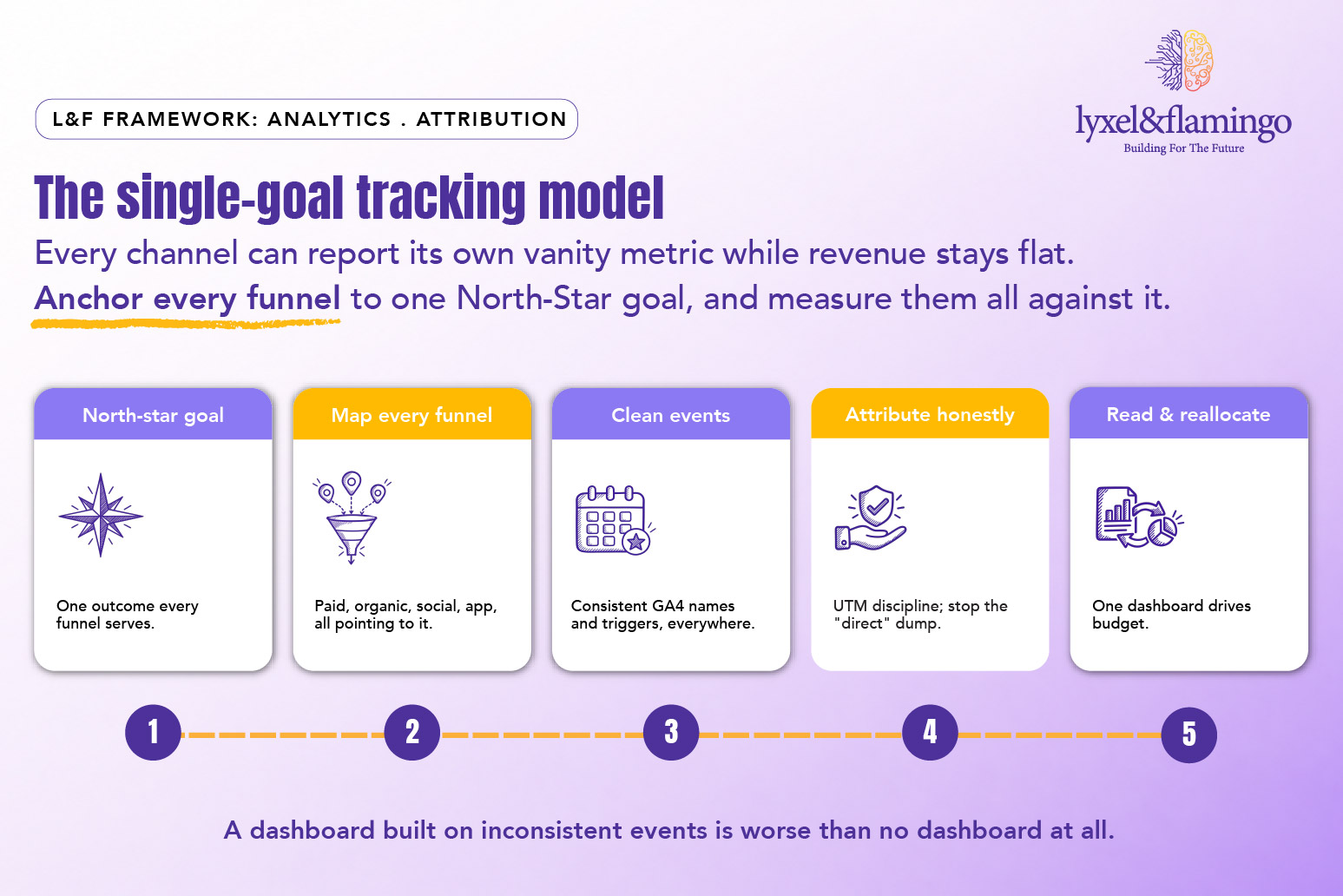
Framework: The Single-Goal Tracking Model
The Framework explained
One North-Star goal: The decision that makes everything downstream possible. Until a business names the single outcome that matters most a purchase, a qualified lead, a booking every channel is free to declare victory on its own terms, and leadership has no basis for ranking them. The North Star does not mean ignoring secondary metrics; it means subordinating them to one outcome so that contribution can be compared across funnels that otherwise share nothing.
Map every funnel to it: Is where the single goal becomes an operating principle rather than a slogan. Each channel has its own shape: a paid funnel and an organic funnel behave nothing alike, but each must be instrumented to show its contribution to the same destination. Done properly, this ends the most common boardroom failure in marketing measurement: five channels each reporting success while overall revenue is flat, because nobody was measuring them against the same thing.
Instrument clean events: Is the technical discipline on which the whole model rests. In GA4, everything is an event, and the value of the data depends entirely on events being named consistently and firing on the right triggers across every page, template, and platform. This is unglamorous work, and it is exactly where most setups quietly fail, which is why understanding how GA4 actually models users and sessions is a prerequisite, not an optional extra, for anyone making decisions from the data.
Attribute honestly: Is the stage that determines whether budget flows to the channels that deserve it. As more traffic arrives through AI tools and dark social, untagged visits are silently bucketed into “direct,” and the channels that genuinely drove them lose their credit. Rigorous UTM discipline and a deliberate approach to capturing this traffic rather than letting analytics guess is the difference between reallocating budget on evidence and reallocating it on a systematic misread. Knowing why your analytics shows more users than sessions, or vice versa, is part of reading these numbers without being misled by them.
Read and reallocate: Closes the loop by turning measurement into decisions. A single consolidated view one that puts every funnel’s contribution to the North-Star goal side by side is what lets a CXO move spend toward what works and design effort toward where the funnel leaks. Measurement that is not read and acted on is just expensive archaeology; the point of the model is a faster, better-evidenced decision, repeated.
Real-world scenario: Timex
When Timex engaged Lyxel&Flamingo, the brand had genuine equity but a search-visibility gap and, underneath it, a measurement problem: no clean way to connect the work being done to the commercial outcomes it was supposed to produce. The programme was run as a measured system rather than a set of disconnected tactics. The technical and on-page SEO work was instrumented end-to-end with GA4, Google Search Console, Screaming Frog, SEMrush and Ahrefs, so that every change could be attributed to a movement in the numbers and every next decision was evidence-led rather than intuitive.
The result across seven months was not a single vanity metric but a consistent picture pointing at one outcome: organic growth that showed up commercially: 26% growth in organic traffic, 102% growth in organic clicks, 124% growth in organic impressions, and 5X organic revenue growth. The revenue figure is the one that matters, and it was only trustworthy because the measurement underneath it was clean. That is the Single-Goal Tracking Model in practice: many funnels of activity, one outcome they were all measured against, and a number leadership could act on with confidence. The same full-funnel discipline applies whether the North-Star is organic revenue, qualified leads, or booked appointments.
Going deeper: The measurement readiness checklist
Before trusting a single number in your dashboard, confirm:
- A single North-Star conversion is defined and agreed across teams
- Every channel has a documented funnel that maps to that goal
- GA4 events use a consistent naming convention across all pages and platforms
- Conversion events fire on the correct triggers and are validated in real time
- UTM parameters are applied consistently across all paid and partnership links
- AI, referral, and dark-social traffic are captured rather than dumped into “direct”
- Search Console is verified and reconciled against GA4
- One consolidated dashboard shows every funnel’s contribution to the North-Star goal
Key takeaways
- You cannot optimise UI/UX if you cannot measure tracking; turns design from opinion into evidence.
- The core discipline is one North-Star goal that every funnel is measured against, ending the “every channel wins in its own report” illusion.
- Clean, consistently named GA4 events are the foundation; a dashboard built on inconsistent events is confidently wrong.
- Attribution honesty capturing AI and referral traffic rather than dumping it into “direct” is what makes budget reallocation trustworthy.
- Timex shows the payoff: a measured programme produced 5X organic revenue growth that leadership could act on because the measurement beneath it was clean.
The CXO takeaway
For a CXO, the value of getting tracking right is not a tidier dashboard; it is better capital allocation. Every budget decision, every call on whether a redesign worked, every argument about which channel to scale, is only as good as the measurement underneath it. A business measuring five funnels against five different vanity metrics is not data-driven; it is data-comforted. The one that defines a single outcome, instruments every funnel against it, and attributes honestly can move money toward what works and design effort toward where it leaks repeatedly, and with confidence. In a landscape where an increasing share of demand arrives through channels the old dashboards cannot see, that discipline is quickly becoming the difference between compounding and guessing.
Frequently Asked Questions
The single conversion that best represents value creation for your business - a purchase, a sales-qualified lead, a booking. Secondary metrics still matter, but they are read in service of the one outcome everything is measured against.
GA4 is the backbone for most businesses, but it is only as good as its event design and its reconciliation with Search Console and ad-platform data. Tooling matters less than the discipline of consistent instrumentation.
Through deliberate UTM tagging of every controllable link, referral-source analysis, and a policy of investigating “direct” spikes rather than accepting them. The goal is to stop misattributing traffic you actually earned.
CRO is the practice of improving conversion; single-goal tracking is the measurement system that tells you whether your CRO worked and where to aim it next. One is the action, the other is the evidence.
Alongside the build, never after it. Analytics configured post-launch loses the highest-value early data permanently, and retrofitting consistent events is far more expensive than designing them in.