What This Blog Covers
Retail media and marketplace organic search are usually planned by different people, funded from different lines and judged by different metrics, yet they compete for the same few slots on the same results page. This article explains why a paid-only view of performance misleads, how paid velocity and organic rank feed each other, and why total sales and TACoS tell a truer story than ACoS alone. It gives CMOs and performance leads a four-part budget model that sets one visibility goal across both, with product roles, shared metrics and a single monthly review that finance can follow and trust.
QUICK ANSWER: Retail media and organic search are one shelf because shoppers see a single results page where paid and organic slots compete, and each influences the other. Budget them together by product role, namely launch, defend, harvest and rescue, and read total sales, TACoS and organic rank next to ACoS. A brand that reports paid and organic separately will overspend on terms it already owns and underinvest in the pages that earn the sale.
Table of Contents
- Why Shoppers See One Shelf, Not Two Budgets
- The Paid-Organic Flywheel That Quietly Rewrites Your Ranking
- What Your Dashboard Hides When ACoS Stands Alone
- The Spend Rules That Separate Launch, Defence and Harvest
- What the One-Shelf Budget Model Asks You to Decide
- Framework Explained
- Why the Finance Conversation Changes When You Report Total Sales
- Client Proof point:
- Key Takeaways
- The CXO Takeaway
Why Shoppers See One Shelf, Not Two Budgets
A shopper types a query and sees one list of products, some labelled sponsored and many not. They do not care which line of your budget bought the slot. They care whether the product fits, the price is fair and the reviews are credible. One page, one decision.
The money is following that behaviour. According to the dentsu-e4m Digital Advertising Report 2026, advertising spend on e-retail platforms in India reached ₹17,601 crore in 2025, up 55.86% year on year and equal to 24.58% of India’s digital media spend. When a quarter of digital spend sits on marketplaces and quick-commerce apps, treating it as a side channel is a planning error. Retail media is now a core part of the media mix.
The split between paid and organic mirrors the split described in demand creation versus demand capture. Paid slots capture demand at the moment of intent, while organic position reflects the demand and trust you have already built. A plan that funds only capture, with nothing for the page that converts it, hits a growth ceiling. A CMO should ask which side of the line each rupee sits on.
Start by drawing the shelf. For your ten highest-revenue queries, list who holds each of the first ten positions, which are sponsored and which are organic, and where your products sit. The picture shows where you pay for what you can earn and where you earn what you should defend. One picture, one conversation.
The Paid-Organic Flywheel That Quietly Rewrites Your Ranking
Practitioners describe a flywheel in which advertising generates early sales, sales and conversion signals lift organic rank, and a higher organic rank lowers the spend needed to stay visible. Marketplaces do not publish their ranking formulas, so treat the mechanism as a working model and not a rule. The model still explains a pattern many teams report: strong paid launches followed by stronger organic positions. Test it on your own catalogue.
The flywheel only turns if the page converts. The elements shoppers decide on in three seconds sets out the title, images, price and ratings that make or break a click, and no bid fixes a weak page. Paid traffic to a poor listing buys clicks and lowers conversion, which can pull organic rank down. Fix the page before you feed it.
The 2026 State of Retail Media Report from Skai, a survey of 166 advertisers, describes the most mature Amazon advertisers as connecting media to organic rank, product page quality and lifetime value, and not treating ads as a standalone demand-capture tool. It describes them building paid-organic flywheels where media builds long-term demand. The finding is directional, from a vendor survey, and it matches what the model predicts. A prompt, not a proof.
Give organic rank a place in the media plan. Track rank for your priority queries weekly, next to spend, and note which campaigns move it. Rank movement is the earliest signal that paid is building something that lasts. Watch it like a share price.
What Your Dashboard Hides When ACoS Stands Alone
ACoS divides ad spend by ad-attributed sales, so it can look excellent while the business gains nothing. A dashboard where every number is green can still hide a problem, which is the argument in every KPI is green and your board should still worry. A low ACoS on a branded term you would win anyway is a comfort and not a result. The metric rewards defence as much as growth.
TACoS divides ad spend by total sales, paid and organic together. If ad spend rises and TACoS falls, organic sales are growing faster than spend, which is the flywheel working. If TACoS rises with flat total sales, you are paying more for the same demand. TACoS is the number that connects the ad account to the P&L.
Attribution has a second gap. Marketplace ads influence sales that the platform does not credit to the ad, and part of what is attributed would have happened organically. Neither error shows in ACoS. Both show in an incrementality test.
Design the test with care. The principles in geo experiments for enterprise marketing apply to marketplaces: change spend in one set of products or regions, hold another steady and compare total sales. Run it at least once a year on your largest campaigns. Believe the test over the dashboard.
The Spend Rules That Separate Launch, Defence and Harvest
Set a role for every product before you set a budget. A launch product needs paid velocity to earn early reviews and rank, and can run a higher ACoS for a defined period. A defend product holds the rank it has and protects branded and category terms from competitors. A harvest product is mature and should depend less on paid each quarter.
A fourth group needs honesty. Rescue products convert poorly because of content, price or stock, and paid spend only exposes the problem. Pause support, repair the listing and restart when conversion recovers. Fix, then fund.
Rules protect the plan under pressure. Defending ROAS through the festive bidding war describes how bidding intensifies in peak weeks and why caps and role-based targets matter. Agree the targets for each role before the season, so nobody raises bids on a harvest product at midnight. A rule written in September saves a decision made in panic.
Review roles every quarter. A launch product becomes a defend product as rank settles, and a defend product becomes a harvest product as reviews accumulate. Move budget with the role, not with habit. Roles change; budgets should follow.
What the One-Shelf Budget Model Asks You to Decide
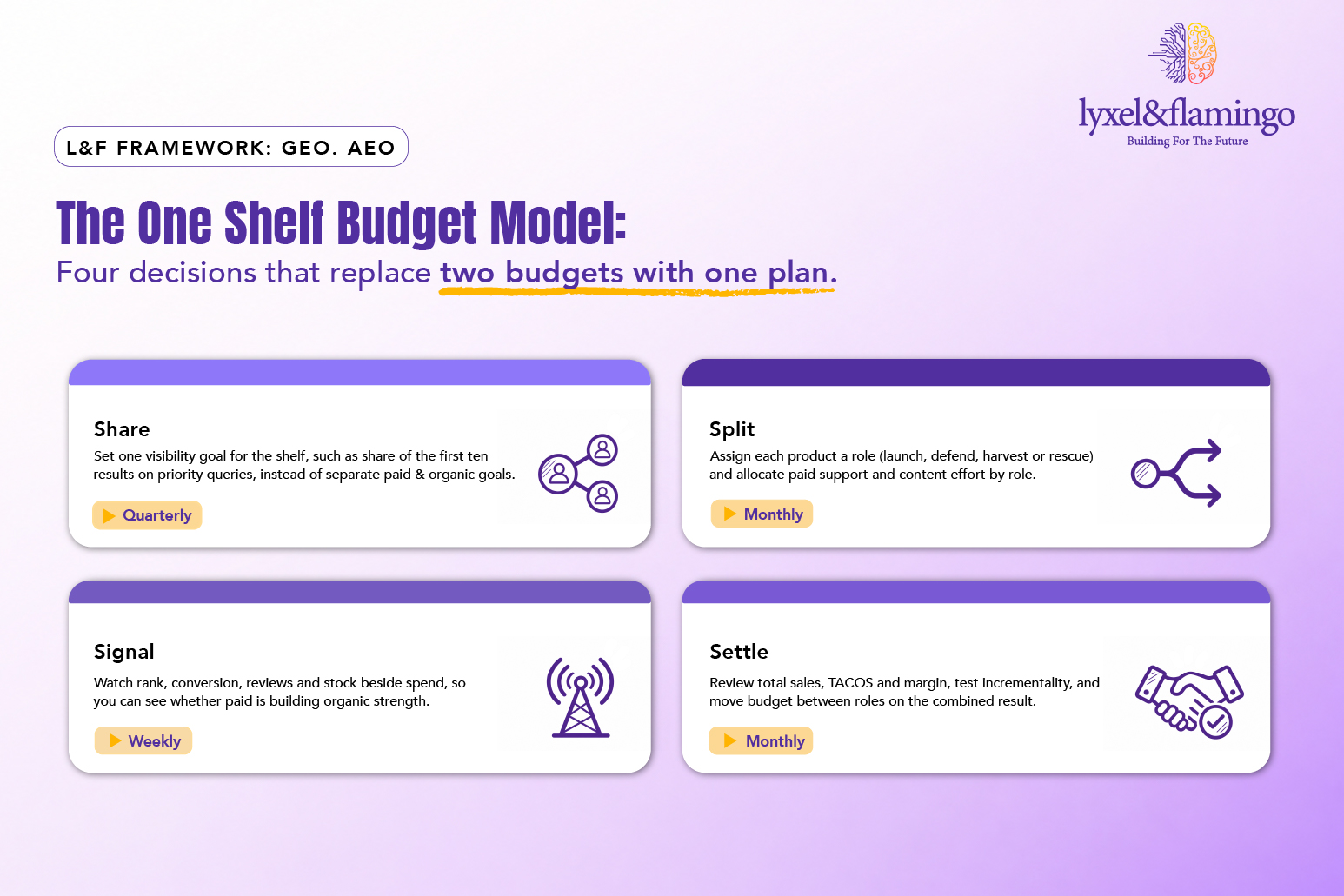
Four decisions, taken together, replace two budgets with one plan for the shelf. The cadences are a recommended working pattern.
Framework Explained
Share: Replace separate paid and organic goals with one visibility goal for the shelf. A useful measure is your share of the first ten results on your priority queries, with paid and organic positions both counted. The goal gives media, content and catalogue teams a shared target. Agree it quarterly with finance, and tie it to total sales instead of channel ratios.
Split: Assign every product a role before you allocate money. Launch products receive paid velocity and fast content work, defend products receive protection on branded and category terms, harvest products receive less paid each quarter, and rescue products receive content and stock fixes before any spend. The role decides the budget and the metric. Review roles every month as products mature.
Signal: Watch the indicators that show whether paid spend is building organic strength: organic rank on priority queries, conversion rate, review volume and rating, and stock depth. Read them next to spend each week. If spend rises while rank and conversion stay flat, the money is renting visibility. If rank rises, it is building it.
Settle: Review the combined result each month. Compare total sales, TACoS and contribution margin with plan, and run an incrementality test on your largest campaigns at least once a year. Move budget between roles on the evidence. Report one page to finance, with the shelf as the unit, so the conversation is about profit and not about ad-account ratios.
Why the Finance Conversation Changes When You Report Total Sales
Finance understands total sales and contribution margin. Channel-level ratios that move independently are harder to trust. Reporting paid and organic on one page, with total sales, TACoS and margin, gives finance a view it can rely on. The conversation shifts from defending an ad account to managing a shelf.
Use the metrics set out in the marketplace KPIs every CXO should track during festive sales as the base: visibility, conversion, efficiency and availability, each with an owner. Add organic rank and TACoS for the priority queries. Keep the page to one side of A4. A dashboard no one reads is not a dashboard.
Prepare for the transparency rules too. India’s upcoming Consumer Protection (E-Commerce) (Amendment) Rules, 2026, as reported by Exchange4media, are expected to require clear identification of sponsored listings and disclosure of ranking parameters. Clearer labelling can change how shoppers treat paid slots. Watch the final text and adjust the plan.
Finally, connect the shelf to profit. Performance marketing that scales profitably beyond last-click ROAS sets out the measures that survive growth, including margin and payback. A shelf that grows revenue while shrinking contribution margin is a leak. Aim at profit per unit of shelf, not at the cheapest click.
Client Proof point:
ASICS entered Amazon advertising in India as a late entrant, competing against well-funded rivals such as Nike, Puma and Adidas. The brand focused on three things: winning its own brand keywords, staying highly visible in the sports it leads, and promoting sub-brands such as Kayano and Nimbus. Paid and organic work ran together, so the brand store grew alongside the ad account.
The results:
- 60% lower ACoS within three months, the best in its category
- 100%+ growth in AMS-attributed sales over one year
- 38M+ impressions in just over three months
- 40%+ month-on-month growth in organic traffic to the brand store
Key Takeaways
- Shoppers see one results page, so plan paid and organic as one shelf with one visibility goal.
- ACoS alone rewards defence; add TACoS, total sales and organic rank to see what paid is building.
- Give every product a role (launch, defend, harvest or rescue) before you set its budget.
- Marketplaces do not publish ranking formulas, so test the paid-organic effect with incrementality experiments.
- Report total sales and margin to finance on one page, with the shelf as the unit.
The CXO Takeaway
Ask your marketplace lead for one page that shows, for your ten highest-revenue queries, who holds the first ten positions and which of your products appear as paid or organic. Put total sales, TACoS and organic rank next to ACoS in the monthly review. Assign a role to every product and cap spend on harvest products. Fund one incrementality test this year on your largest campaign. Make one leader accountable for the shelf across media, content and catalogue. Revisit the roles each quarter.
Frequently Asked Questions
ACoS divides ad spend by sales attributed to ads, while TACoS divides ad spend by total sales, paid and organic combined. ACoS tells you how efficient the ads are on their own terms. TACoS tells you whether advertising is building the whole business. Track both, and read the trend in TACoS as the better signal of long-term health.
Not by instinct. Run an incrementality test, where you reduce spend on a set of products or regions and compare total sales, before you cut. Protect branded and high-intent terms that competitors target, and reduce spend on terms where your organic position is already strong. Review the result monthly and restore spend if total sales fall.
There is no fixed timeline, because marketplaces do not publish their ranking formulas and categories differ. Track organic rank for priority queries weekly next to spend and conversion, and look for movement over several weeks. A product with a weak page will not gain rank however much you spend. Fix content and stock first, then judge the effect of paid.
Assign roles first. Launch products can carry a higher ACoS for a defined period to build reviews and rank, defend products hold position on key terms, and harvest products should depend less on paid over time. Set a target and a review date for each role, and move budget as products change role. Review the split every quarter with finance.