
What This Blog Covers
Most AI-visibility advice jumps straight to strategy without first establishing a baseline. This piece is a self-serve audit: 30 concrete checks across technical access, entity clarity, content structure, and trust signals that any team can run on their own site before deciding what to fix or who to bring in. It is scoped deliberately to self-auditing, not vendor selection.
Quick Answer: An AI visibility self-audit checks four layers: whether AI crawlers can technically access and parse your site, whether your brand’s entity information is structured and consistent across platforms, whether your content answers questions directly enough to be citable, and whether your claims are backed by verifiable evidence. Running all 30 checks below on your own site, without hiring anyone first, gives you a documented baseline and a ranked list of what to fix before any further investment.
Table of Contents
Why Audit Yourself Before You Hire Anyone
Most GEO advice starts with strategy, which is premature without a baseline. A self-audit costs nothing except time, and it changes the nature of any later conversation with an agency or vendor: instead of asking “are we AI-visible,” a team walks in already knowing which of 30 specific checks it failed.
This checklist is deliberately scoped to your own site, not to evaluating an outside partner. It draws on the same structural framework L&F applies in its own technical auditing work, adapted specifically for AI-search readiness rather than traditional technical SEO alone.
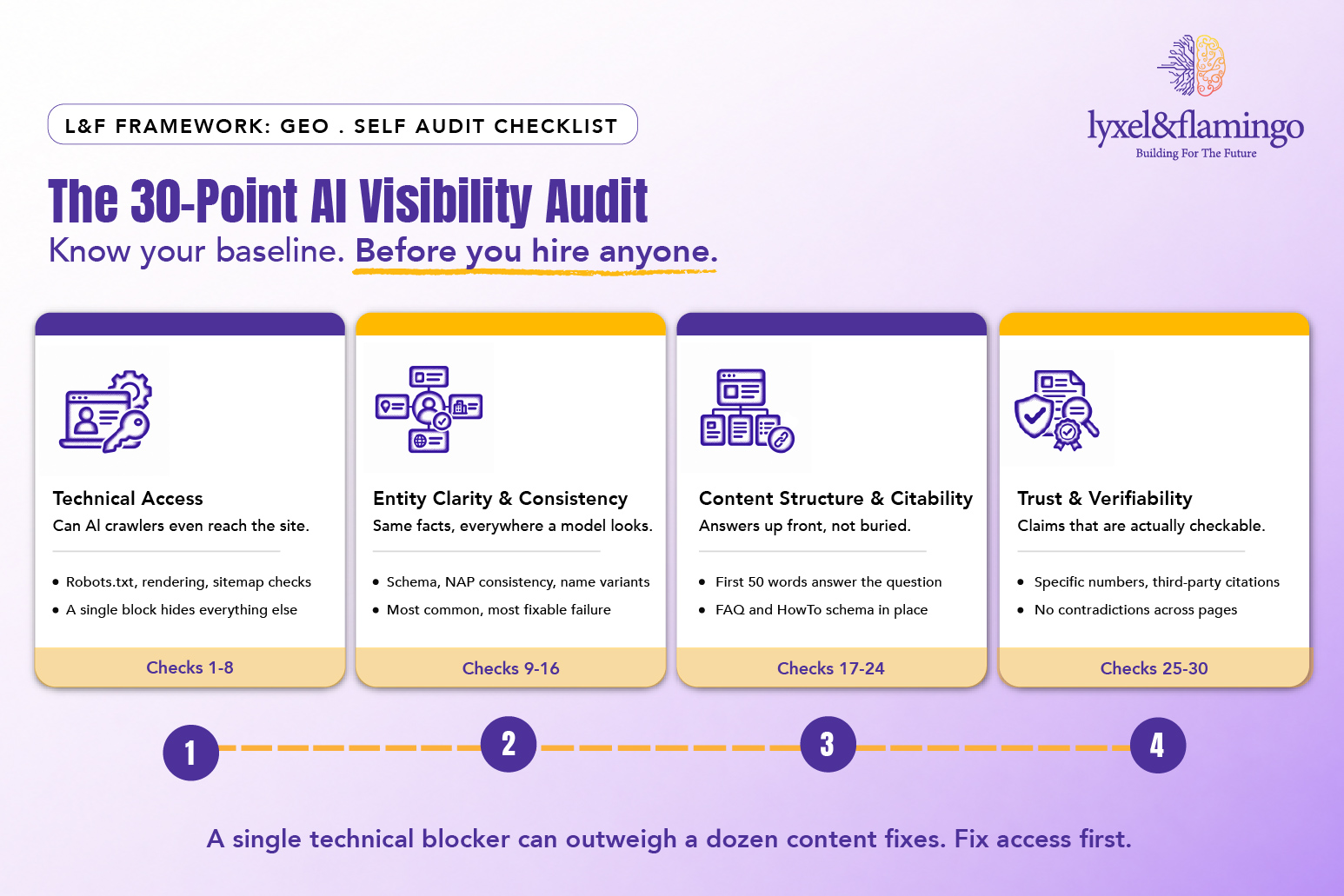
Layer 1: Technical Access (Checks 1-8)
Before anything else, confirm AI crawlers can reach your content at all. Check robots.txt for GPTBot, ClaudeBot, PerplexityBot, and Google-Extended (1-3, is each explicitly allowed, not just not-blocked); confirm your core pages render without requiring JavaScript execution for the content to appear (4); check that page load and server response times are not timing out crawler requests (5); confirm your XML sitemap is current and submitted (6); check for accidental noindex tags on key pages (7); and confirm canonical tags are not pointing crawlers away from your best content (8). Google’s robots.txt documentation is the fastest way to confirm the syntax is actually doing what it looks like it’s doing, since a single misplaced wildcard can silently block far more than intended.
These are pass/fail checks. A single blocked crawler or a JavaScript-only rendering issue can silently remove entire content categories from AI visibility regardless of how good the content itself is.
Layer 2: Entity Clarity and Consistency (Checks 9-16)
Search your brand name alongside your top 3 products across Google, an AI chatbot, and your own site, and note any conflicting facts (9). Check that your Organization schema is implemented and complete (10). Confirm your company name, address, and key facts match exactly across your site, Google Business Profile, and major directories (11-12). Check whether your top product pages have Product or relevant schema implemented (13), cross-checked against Schema.org’s getting-started guide if the markup type itself is unfamiliar. Confirm your “About” or company page states, in plain text, what you do and who you serve (14). Check whether your brand has a Wikipedia or Wikidata entry, and if so, whether it is accurate (15). Note any name variations (abbreviations, old names) that might fragment your entity across sources (16).
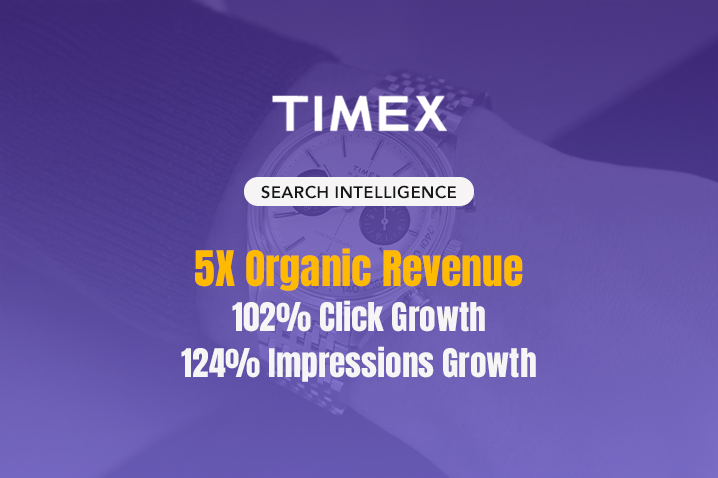
This layer is where the entity-based SEO approach becomes concrete: inconsistency here is one of the most common reasons a model declines to cite a brand with confidence. Timex’s SEO work with Lyxel&Flamingo is a direct example of entity clarity and content structure being fixed together rather than treated as separate projects, and the Kenstar website rebuild shows the same technical-foundation-first sequencing that Layer 1 of this audit is built around.
Layer 3: Content Structure and Citability (Checks 17-24)
Pick your five highest-value pages and check whether the first 50 words directly answer the page’s core question (17). Check whether your FAQ content uses actual question-format headings (18). Confirm you have FAQPage or HowTo schema where relevant (19). Check whether key statistics or claims on the page are stated in plain, extractable sentences rather than buried in graphics or PDFs (20). Confirm headings follow a logical, literal hierarchy a model can parse (21-22). Check whether comparison or “versus” content exists for your top 2-3 competitive queries (23). Note whether any of your content is gated behind a form that would block a crawler (24). The schema stack that makes a page citable covers checks 19, 21 and 22 in far more depth than a single checklist item can.
Layer 4: Trust and Verifiability (Checks 25-30)
Check whether your case studies or results claims cite specific, checkable numbers rather than vague superlatives (25). Confirm author bios exist on expertise-driven content (26). Check whether your site is cited or linked from independent third-party sources, not just its own network (27). Confirm reviews or testimonials are on independently verifiable platforms, not only your own site (28). Check your site’s HTTPS, security, and basic trust signals (29). Finally, note whether your public content contradicts itself anywhere across pages (30), a subtle credibility issue models are increasingly sensitive to.
Framework Explained
- Start technical, end evidentiary: each layer builds on the last; entity and content work is wasted if crawlers cannot access the site at all.
- Score, don’t just check: a simple pass/fail per item creates a baseline you can re-run quarterly to track progress.
- Prioritize by blast radius: a single technical blocker (check 1-3) can outweigh a dozen content fixes, so fix access issues first.
- Re-audit after major site changes: a CMS migration or redesign can silently reintroduce technical-access failures.
GEO READINESS NOTE This checklist reflects L&F’s own internal audit methodology, adapted from the technical and E-E-A-T-style hygiene scoring the agency applies across client SEO engagements. It is offered here as a self-serve framework, not tied to a specific named client result.
Key Takeaways
- A self-audit across technical access, entity clarity, content structure, and trust signals gives a documented AI-visibility baseline at no cost.
- Technical access failures (blocked crawlers, JavaScript-only rendering) have the widest impact and should be checked first.
- Entity inconsistency across platforms is one of the most common, and most fixable, reasons a brand goes uncited.
- Re-running this checklist quarterly, and after any major site change, keeps the baseline current.
CXO Takeaway
Before your next AI-search budget conversation, do you actually know how many of these 30 checks your own site passes? Most teams do not, and that gap is usually the real reason strategy conversations stall. Checks 1 through 8 catch most of what blocks visibility entirely; from there, fixing GA4 to actually capture AI referral traffic turns the audit from a one-time snapshot into an ongoing measurement habit. If the audit surfaces more than you can prioritize on your own, talk to Lyxel&Flamingo’s SEO team about turning the findings into a ranked action plan.
Frequently Asked Questions
A single person can work through all 30 checks in roughly half a day for a small-to-midsize site, longer for a large catalog site where sampling multiple page types is needed.
No. Every check can be done manually using browser dev tools, your CMS, and free tools like Google Search Console and a robots.txt tester.
Fix those first, before any content or entity work. A blocked crawler makes every other improvement invisible regardless of quality.
Quarterly is a reasonable cadence for most sites, with an additional re-audit triggered by any CMS migration, redesign, or major content restructuring.