
What This Blog Covers
India’s internet growth is increasingly vernacular, yet most GEO and AI-search optimization work assumes English is the only language that matters. This blog breaks down why AI models cite sources differently across languages, why a strong English GEO position does not transfer automatically, and what a genuinely multilingual GEO strategy needs to include, from content depth in regional languages to how AI engines source non-English citations differently than English ones.
Quick Answer: A GEO strategy built only in English misses a large and growing share of India’s search behavior, since AI engines cite sources differently depending on query language, and often have thinner, less authoritative source pools to draw from outside English. Brands need dedicated content depth in the regional languages their core audience actually searches in, not machine-translated versions of English content, along with monitoring of how citation patterns differ by language, since strong English-language AI visibility does not automatically transfer to Hindi, Tamil, or other regional-language queries.
Table of Contents
- Why English-Only GEO Misses a Huge Share of Real Search Behavior
- How AI Citation Sourcing Differs by Language
- Why Machine-Translated Content Does Not Solve This
- Building Genuine Content Depth in Regional Languages
- Monitoring Citation Visibility Across Languages
- Where to Start If Resources Are Limited
- Framework Explained
- Key Takeaways
- CXO Takeaway
Why English-Only GEO Misses a Huge Share of Real Search Behavior
India has one of the largest and fastest-growing bases of non-English internet users anywhere in the world, and that growth shows up directly in search behavior, not just casual browsing. A GEO strategy that optimizes exclusively for English-language queries is, by construction, optimizing for a shrinking share of the addressable audience relative to where growth is actually happening.
This gap compounds for brands selling into categories with strong regional or vernacular search behavior, home and lifestyle, personal care, local services, where a meaningful share of purchase-consideration queries may never be phrased in English at all. The same local SEO discipline that wins “near me” searches ahead of festive footfall applies with even more force to AI-mediated regional-language queries.
How AI Citation Sourcing Differs by Language
AI models draw from different pools of source material depending on query language, and those pools are not equally deep or equally authoritative across languages. English-language queries in most categories have a much larger, more competitive, more authoritative set of potential sources for a model to cite from than the same query asked in a regional language.
This means a brand’s strong English-language citation position provides limited insurance for regional-language visibility. The model is not translating its English answer; it is running a largely separate retrieval and citation process against a different, often thinner, source pool, a dynamic closely related to why Gemini’s shortlist of citation sources is already difficult to get onto even in English.
Why Machine-Translated Content Does Not Solve This
The intuitive fix, machine-translate existing English content into regional languages, addresses volume, not quality or trust. Machine-translated content frequently reads as unnatural to native speakers, misses cultural and linguistic nuance in how a category or product is actually discussed, and can contain translation errors that undermine the credibility a model is trying to assess when deciding whether to cite a source.
AI models, like human readers, appear to weight source quality and coherence when forming citation decisions. Thin, awkwardly translated content is unlikely to compete effectively against genuinely native-language content from a competitor who invested properly in the language.
Building Genuine Content Depth in Regional Languages
Real content depth means original, well-researched content created for a regional-language audience, not a translation layered on top of English content built for a different audience with different phrasing habits and different underlying questions. This includes region-specific product considerations, locally relevant use cases, and terminology that matches how the audience actually searches, not a literal translation of English keywords.
This is a meaningfully larger content investment than a translation project, and it is exactly the gap that separates brands with genuine regional AI-search visibility from brands that assume their English content “covers” every language a customer might search in.
Monitoring Citation Visibility Across Languages
A brand cannot manage what it does not measure separately. Citation visibility needs to be tracked language by language, not as a single blended AI-search visibility score, since strong performance in English can mask near-total invisibility in the languages where a large share of the actual audience is searching.
This kind of granular monitoring should sit alongside the same entity-based clarity work that supports AI citation in English, applied consistently across every language a brand’s audience actually uses. The same blind spot shows up in analytics: most teams never separate AI-referred visits by language in the first place, a gap covered in fixing GA4 for AI referrals.
Technically, this also depends on the page itself signalling language correctly to both search engines and AI crawlers, which is what Google’s own guidance on managing multi-regional and multilingual sites covers in detail.
Where to Start If Resources Are Limited
A brand cannot build deep content in every regional language simultaneously with a limited budget. Start by identifying the one or two languages where the largest share of the addressable audience actually searches, based on real user data rather than assumption, and build genuine content depth there first before expanding further.
This mirrors how English-language GEO work should be prioritized: by actual query volume and category exposure, not by which language is easiest to produce content in internally. The same prioritization logic, and the same schema stack that makes a page citable, carries over once a priority language is chosen: structured data needs to exist in that language too, not just in English.
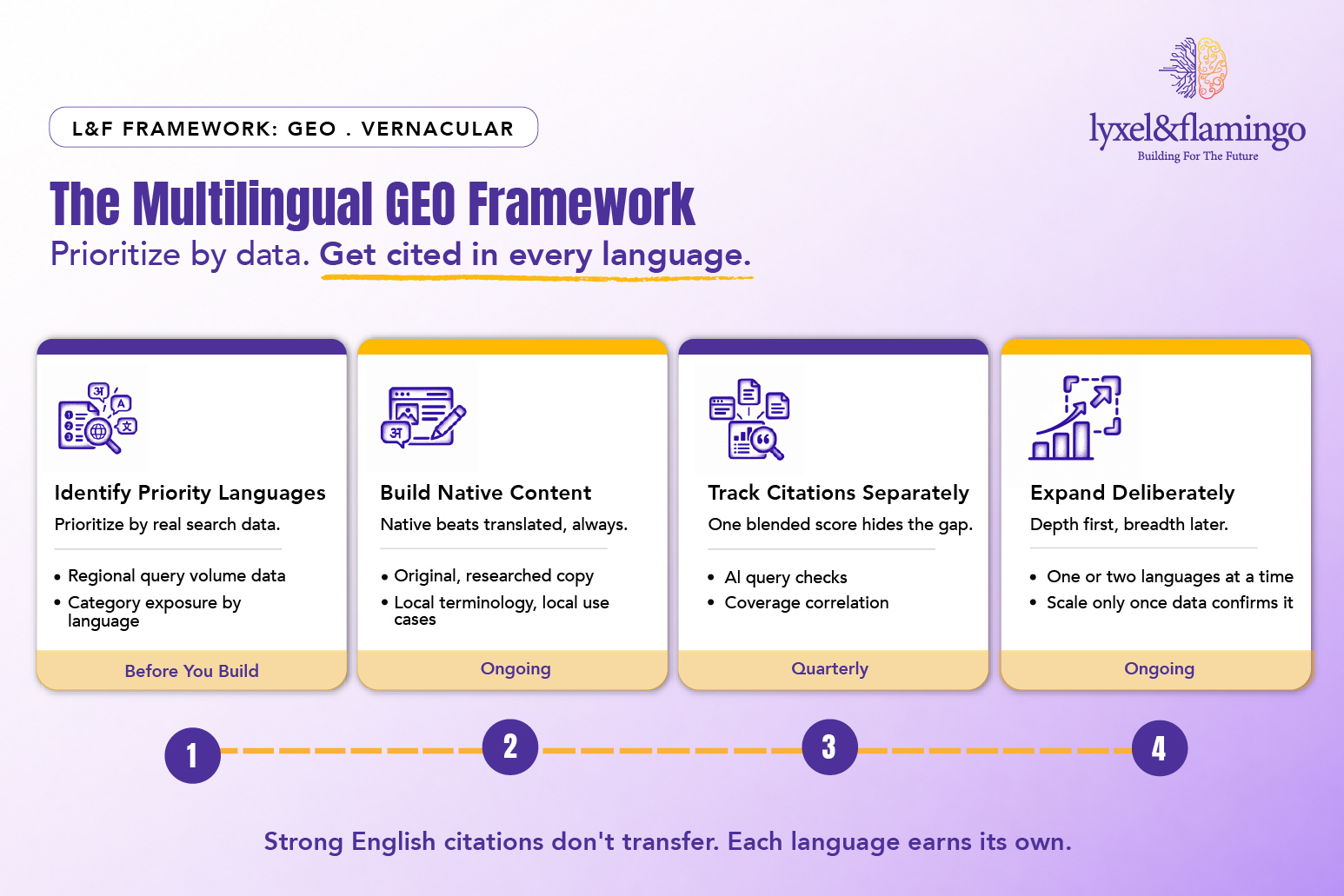
Framework Explained
- Data before language choice: Prioritize regional languages based on real query volume, not internal convenience or assumption.
- Native over translated: Genuinely researched regional-language content outperforms machine-translated English content in both quality and citation trust.
- Measure separately: Citation visibility should be tracked per language, since strong English performance can hide regional invisibility.
- Depth before breadth: Build real content depth in one or two priority languages before spreading resources across many.
Multilingual GEO measurement is a newer discipline than English-language AI-search work, and Lyxel&Flamingo does not yet have a case study isolating regional-language citation results specifically. This framework draws on the agency’s broader local SEO and entity-clarity work across Indian-language markets, and on the same citation-sourcing research referenced throughout this piece.
Key Takeaways
- India’s fastest-growing internet audience searches primarily in regional languages, and an English-only GEO strategy misses that growth by design.
- AI models cite sources differently by query language, often from a thinner, less authoritative pool outside English, so strong English visibility does not transfer automatically.
- Machine-translated content addresses volume, not the quality and trust signals that appear to influence AI citation decisions.
- Citation visibility should be monitored language by language, since a blended score can hide near-total invisibility in the languages that matter most to the actual audience.
CXO Takeaway
The question worth asking is not “are we visible in AI search.” It is: are we visible in AI search in the languages our actual customers search in, or only in the language our content happens to be written in?
For many Indian brands, those are two very different answers.
If your GEO strategy has never been measured outside English, Lyxel&Flamingo can run the language-level citation audit that shows exactly where the gap is, and which regional language deserves investment first.
Frequently Asked Questions
Start with one or two, chosen based on real query volume data for the brand’s core audience, rather than attempting broad coverage immediately. Depth in a priority language beats thin coverage across many.
It can work as a stopgap for informational content while genuine native-language content is developed. It should not be treated as the long-term strategy, since it tends to underperform genuinely native content on both user trust and AI citation.
No, each language has its own source pool, citation patterns, and content maturity online, which means visibility work needs to be planned and measured separately for each language rather than assumed to behave uniformly.
Regional-language voice search is growing quickly in India and often surfaces the same underlying citation and source-quality dynamics as text-based AI search, which means the content depth and native-language investment described here supports both.