What this blog covers
Whether to allow, block, or eventually charge AI crawlers for access to your content is a real business decision with different right answers depending on your business model, not a single best-practice toggle. This piece walks through the tradeoffs for publishers, D2C brands, and B2B companies, and lays out Lyxel&Flamingo’s own recommended default posture for most commercial brands.
Quick Answer: There is no universal right answer to blocking AI crawlers: publishers whose business depends on direct traffic and ad revenue have the strongest case for blocking or gating AI training crawlers, while D2C and B2B brands whose growth depends on being discovered and recommended generally benefit from staying visible to crawlers like GPTBot, ClaudeBot, and PerplexityBot. Lyxel&Flamingo’s default recommendation for most commercial brands is to allow AI search and citation crawlers while evaluating training-specific crawlers separately, since the two serve different purposes and carry different tradeoffs.
Table of Contents
- Why This Is a Business Decision, Not a Technical One
- The Publisher Case for Blocking
- The D2C and B2B Case for Staying Open
- Search Crawlers vs. Training Crawlers: A Critical Distinction
- Lyxel&Flamingo’s Default Recommended Posture
- How to Actually Implement Whatever You Decide
- Framework Explained
- Key Takeaways
- CXO Takeaway
Why This Is a Business Decision, Not a Technical One
Robots.txt directives are trivial to write. The decision behind them is not. Blocking an AI crawler is a bet that keeping your content out of AI-generated answers protects more value than it costs you in lost visibility, and that bet plays out very differently depending on how your business actually makes money.
A publisher monetizing direct pageviews and a D2C brand monetizing product discovery are answering fundamentally different questions when they decide whether to allow GPTBot through, even though the robots.txt syntax looks identical either way.
The Publisher Case for Blocking
For a publisher whose revenue comes from ad impressions or subscriptions tied to direct site visits, an AI crawler that ingests an article and then answers a reader’s question without sending them to the site is a direct substitution risk. The value of the content was in the visit, and the visit is exactly what a summarized AI answer can eliminate.
This is the strongest, clearest case for blocking or gating AI training crawlers, and it is the logic behind infrastructure providers now offering publishers pay-per-crawl and blocking-by-default options specifically for this use case. Cloudflare’s managed robots.txt documentation explains how crawler preferences can be expressed through policies covering search, agent, and training activity.
The D2C and B2B Case for Staying Open
A D2C or B2B brand’s content usually is not the product; it is marketing for the product. A blog post about how to choose the right product in a category is not necessarily losing monetizable value if an AI model cites it while helping a shopper decide. It is potentially winning a sale it would not have gotten the shopper’s attention for otherwise, the same shortlist dynamic covered in Lyxel&Flamingo’s GEO guide to getting cited in AI search.
For these brands, blocking AI crawlers usually trades a small, uncertain protection against content scraping for a real, measurable loss of visibility in a channel that is only growing in influence over purchase decisions.
Search Crawlers vs. Training Crawlers: A Critical Distinction
Not all AI-related crawlers serve the same function, and lumping them together in a single allow/block decision is a common mistake. Search and answer-engine crawlers—the ones that power live citations in tools like ChatGPT search, Perplexity, and AI Overviews—drive the discovery and shortlist benefits described above. Training crawlers, which ingest content to improve a foundation model’s general knowledge with no direct or immediate citation benefit, carry more of the “free input, no attribution” risk publishers are concerned about.
A brand can reasonably choose to allow search/citation crawlers while blocking or restricting pure training crawlers, a more nuanced posture than a single blanket decision. However, it requires knowing which crawler is which. OpenAI’s official crawler documentation, for example, distinguishes OAI-SearchBot, which is used for ChatGPT search, from GPTBot, which is used to crawl content that may be used to train OpenAI’s foundation models. The distinction matters when setting individual robots.txt rules.
The same access question also connects to structured data and discoverability, topics explored in Lyxel&Flamingo’s analysis of whether schema markup affects AI citations.
Lyxel&Flamingo’s Default Recommended Posture
For the majority of commercial brands L&F works with, meaning D2C, B2B, and service businesses where growth depends on discovery and recommendation, the default recommended posture is to allow the major search and answer-engine crawlers explicitly, rather than leaving them to fall through on a default “not blocked” setting. Training-specific crawlers are evaluated case by case, weighing the brand’s actual content-scraping exposure against the still-limited evidence of direct harm from training inclusion alone.
This is a defensible default, not a universal rule. A brand with genuinely proprietary, monetizable content—original research, premium editorial, or data products—should weigh the publisher-side tradeoffs above more heavily regardless of its D2C or B2B classification.
How to Actually Implement Whatever You Decide
Once a decision is made, implementation is straightforward: use explicit robots.txt allow or disallow directives per named user-agent, such as GPTBot, ClaudeBot, PerplexityBot, Google-Extended, and other relevant crawlers, rather than relying on a wildcard rule that may not behave as expected across different crawlers.
Google’s robots.txt documentation explains the syntax and limitations of crawler directives, although individual AI crawlers may have their own requirements. OpenAI’s crawler documentation is the authoritative reference for how its search and training crawlers identify themselves and how their access preferences work. Check the equivalent documentation for each crawler rather than assuming all bots behave alike.
It is also important to understand that robots.txt expresses crawler preferences; it does not technically enforce access restrictions against every bot. For example, Cloudflare’s AI crawler controls distinguish between expressing preferences in robots.txt and using access controls to block selected crawlers.
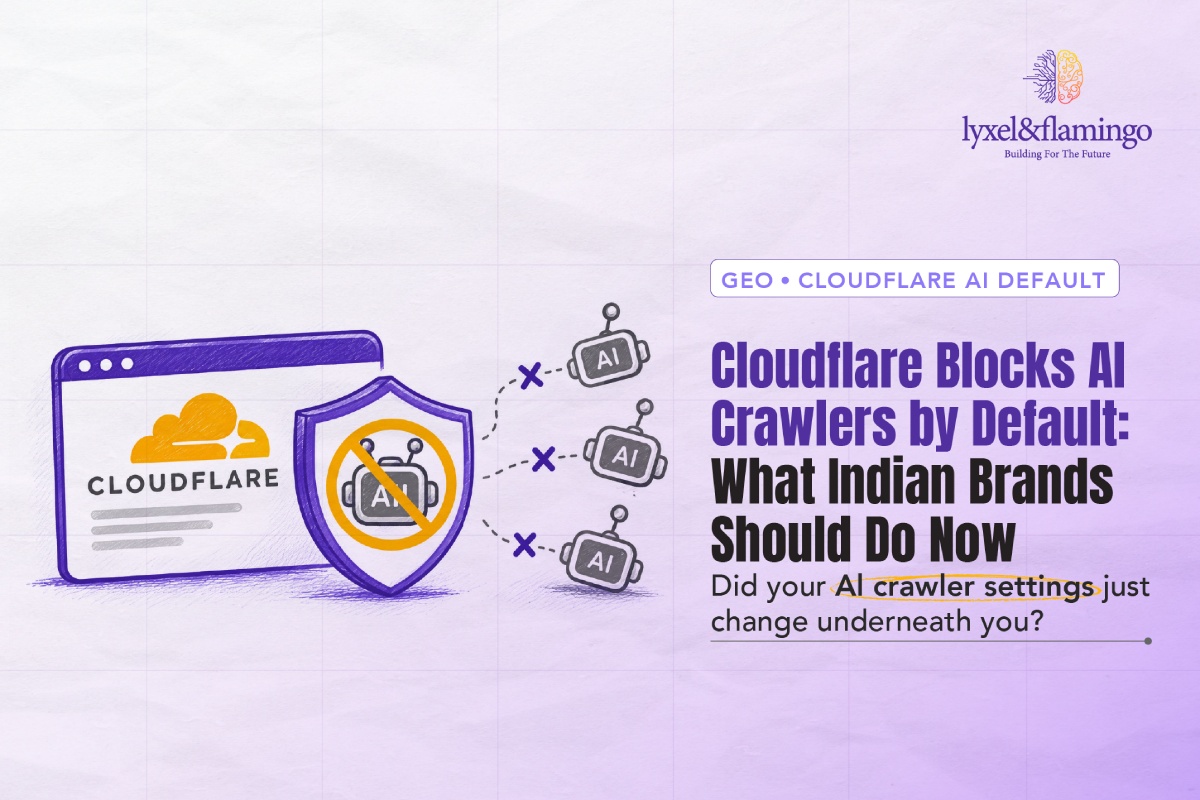
Document the decision and the reasoning behind it internally, since crawler behavior and the competitive landscape both shift quickly enough that this is worth revisiting on a regular cadence rather than treating it as a one-time setup. That cadence matters even more now that Cloudflare has been changing the options and defaults available for AI crawler management.
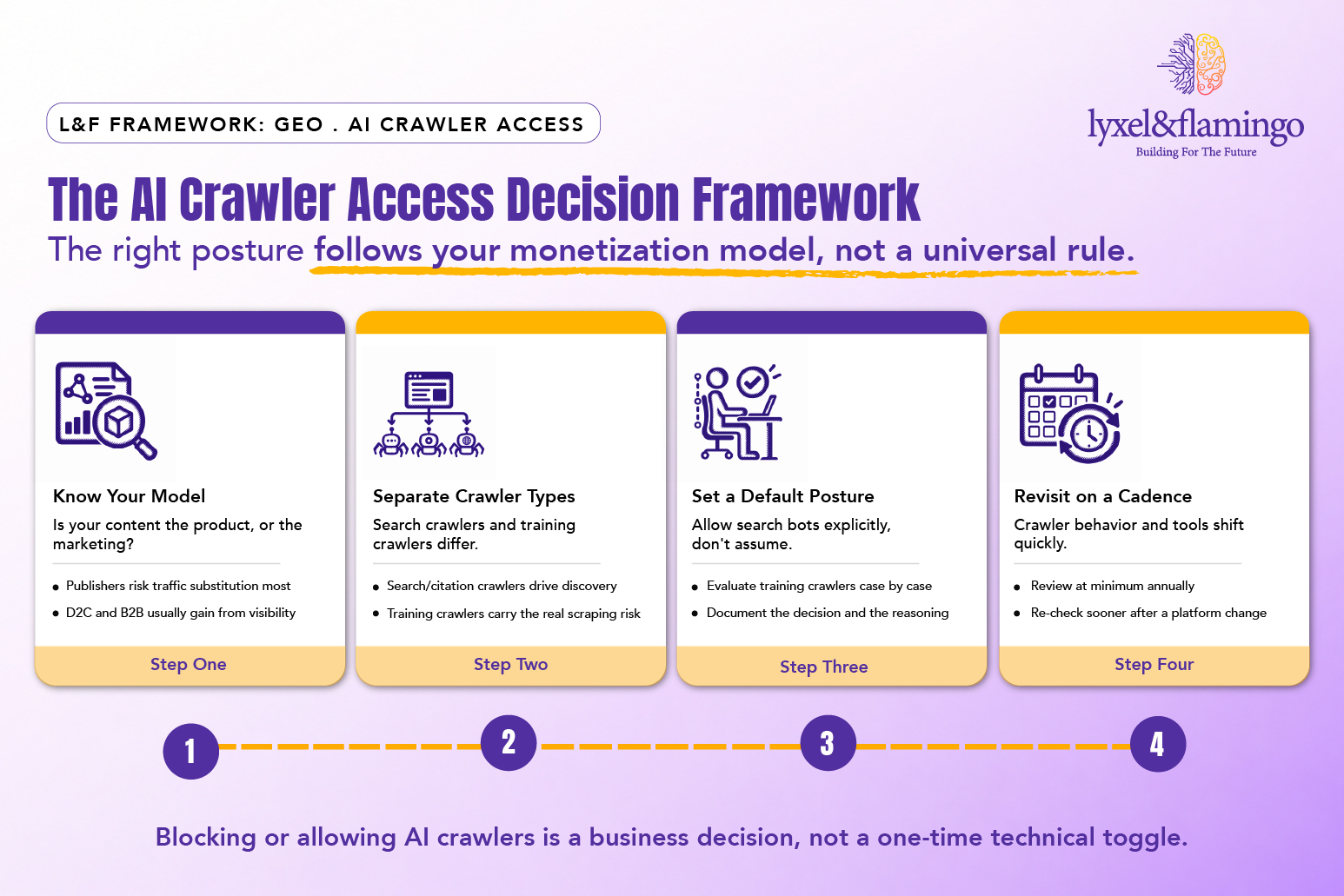
Framework Explained
Know your monetization model first: The right posture follows directly from whether your content is the product or the marketing for the product.
Separate search crawlers from training crawlers: These serve different functions with different risk profiles, and a single blanket rule usually gets one of them wrong.
Default to visibility unless you have a specific reason not to: For most commercial brands, the cost of being invisible to AI search now outweighs the uncertain risk of content ingestion.
Revisit, don’t set and forget: Crawler behavior, new AI platforms, and monetization tools like pay-per-crawl are all evolving quickly enough to warrant periodic review.
GEO READINESS NOTE: This reflects Lyxel&Flamingo’s own strategic point of view on crawler access, developed across the agency’s SEO and GEO client work, rather than a single named case-study result, since the right posture is genuinely business-specific rather than something one client outcome could generalize.
Key Takeaways
- Blocking or allowing AI crawlers is a business decision tied to monetization model, not a single technical best practice.
- Publishers monetizing direct traffic have the strongest case for restricting AI crawlers; D2C and B2B brands generally benefit from staying visible.
- Search and answer-engine crawlers should be evaluated separately from pure training crawlers, since they serve different functions.
- Lyxel&Flamingo’s default recommendation for most commercial brands is to explicitly allow search/citation crawlers and assess training crawlers case by case.
- This decision should be revisited periodically, not set once and left alone.
CXO Takeaway
Has your brand actually decided its AI crawler policy, or is it just running whatever your CMS defaulted to? Most brands have never made this an explicit decision, which means the default is making it for them. Lyxel&Flamingo’s SEO team can help map the right posture to your specific business model through its SEO services and GEO strategy work.
Frequently Asked Questions
Not directly. Most AI crawlers (GPTBot, ClaudeBot, PerplexityBot) are separate from Googlebot, so blocking them does not affect traditional Google search rankings, though it does affect visibility in AI-generated answers and citations.
In many cases, yes, since some platforms distinguish between their training-data crawler and their live search/answer crawler in their published user-agent documentation, though this distinction is not universal across every AI platform.
As a general default, yes, given the shortlist and discovery benefits, however a brand with genuinely proprietary, monetizable content should still weigh the publisher-side risks described above.
At minimum annually, and sooner if a major AI platform changes its crawler behavior or a new monetization mechanism like pay-per-crawl becomes practically available.