What This Blog Covers
On Myntra, a fashion brand earns relevance through signals the platform trusts. Bids follow that signal. This article explains how storefront quality, spend sequence and sale-window readiness decide discovery, and why building visibility first, protecting branded demand next and scaling only on proof is a more reliable route than chasing impressions. For a CMO the lesson is practical: judge every Myntra rupee by the signal it builds, and plan the next sale window while the account is still quiet, so that signal rather than ambition sets the pace.
Quick Answer: On Myntra, search placement follows platform signals over keyword bids, so a fashion brand must earn discovery before it scales spend. Start with product-page placements and a complete storefront, protect branded demand from the first week, and open top-of-search only after click-through and conversion prove out. Plan the sale window while the account is still quiet.
Table of Contents
- Why Myntra Visibility Is Earned Through Signals Over Bids
- The Catalogue Fixes That Turn Earned Traffic Into Orders
- What Sequence Works: Discover, Protect, Then Scale
- The Readiness Checks That Decide Your Sale Window Before It Opens
- What the Earned-Visibility Sequence Looks Like in Four Moves
- Framework Explained
- What to Measure When the Sale Window Closes
- Client Proof Point
- Key Takeaways
- The CXO Takeaways
Why Myntra Visibility Is Earned Through Signals Over Bids
On Myntra, keyword control belongs to the platform, not the advertiser. A brand cannot choose where it appears; it can only give the platform reasons to place it. That changes the planning question from “how much should we bid” to “what signals have we built”. The second question is the one a CMO should be asking.
Established brands carry months or years of click-through, conversion and sales history. A new account, or a brand returning to the platform, carries none. The platform reads that gap as risk and rations exposure accordingly. Spend alone does not close it.
The performance-first playbook for Myntra ads makes the point that rising ad spend does not fix falling ROAS until the catalogue underneath is repaired. Spend follows the foundations. Always in that order. When ROAS falls, look at the catalogue before you raise the budget. That reframing changes how you brief agencies and internal teams, because the goal moves from buying exposure to building a record the platform can reward.
Read every plan through that lens. Ask what signal each rupee builds, and then what it buys. Signals first. Revenue follows signals.
The Catalogue Fixes That Turn Earned Traffic Into Orders
A discovery win is wasted on a weak page. Inconsistent size charts, thin product detail and titles that target brand searches with little category intent all suppress conversion and push return rates up. Each is a catalogue decision, and each shows up in the P&L as marketing waste. Fix them before you add media.
Fashion carries a specific risk: sizing. Baymard’s apparel UX research shows size information is one of the most-checked details on a fashion product page. Clear size guidance, accurate imagery and category-led titles protect conversion and reduce returns. These are listing decisions, and the principles in writing PDP copy for humans and algorithms apply directly. Treat the listing as the first ad a shopper sees.
Complete every attribute the platform asks for. Incomplete listings give the algorithm less to match against a shopper’s search, which narrows where you can appear. Ask your catalogue team for a completeness score by category. A short catalogue review before any festive window is one of the cheapest ways to protect a media budget, since every fix compounds across all the traffic that follows.
Fix the page first. Spend second. The order saves money and improves every later result.
What Sequence Works: Discover, Protect, Then Scale
Most launches chase impressions from day one. A better sequence earns relevance first, protects it once it exists and expands only when the data confirms readiness. Early on, favour product-page placements, where you appear as a contextual recommendation, over top-of-search slots the account has not yet earned. Relevance, then protection, then scale.
Brand protection comes early: switch it on within the first week branded traffic appears, so demand you have created is captured instead of leaking to a competitor. A reference split many teams use as signals stabilise is roughly 60% discovery and 40% branded. Treat the split as a starting point and adjust to your own click-through and branded search volume. The order of work also gives you a clean story for finance: each stage has a purpose, a metric and a reason to move on, so spend increases are justified by evidence.
Open top-of-search and widen the catalogue only after click-through and conversion prove the account is ready. If either slips, hold spend and fix the page. Scale follows signal. Ambition waits for proof. With festive e-commerce GMV forecast to cross ₹1.15 lakh crore in 2025, festive pressure makes teams reverse this order, so write the rule down in advance.
Festive pressure is why a marketplace SEO and listing checklist for the big sale events belongs in the plan before spend does. Run it four weeks before the window, when fixes are still cheap. A prepared account lets the sale amplify it; an unprepared one exposes it.
The Readiness Checks That Decide Your Sale Window Before It Opens
Sale events like Myntra EORS, which brought 4 million+ styles from 10,000+ brands to its June 2025 edition, concentrate demand into days. Myntra also reported a 1.3x rise in first-time shoppers during EORS, exactly the audience a new storefront needs to be ready for. An account arrives at that window either with signal history and stock, or without them. Planning must start while the account is still quiet. Treat the sale as a test of preparation across supply, catalogue and media together, and make one person accountable for the joint plan.
Availability is part of readiness. A strong placement on an out-of-stock size produces clicks and no orders, a pattern covered in why out-of-stock is your costliest advertisement. Ask supply planning to share size-level depth with marketing before the window opens. Visibility without stock burns budget.
Prepare the sale in layers: catalogue complete, size run deep, brand protection live, discovery campaigns already learning. Then raise spend where the data says it will convert. Layers over heroics.
Find the gaps before the event finds them. Run a dry audit three to four weeks ahead and fix what it finds. Rehearse early. React less.
What the Earned-Visibility Sequence Looks Like in Four Moves
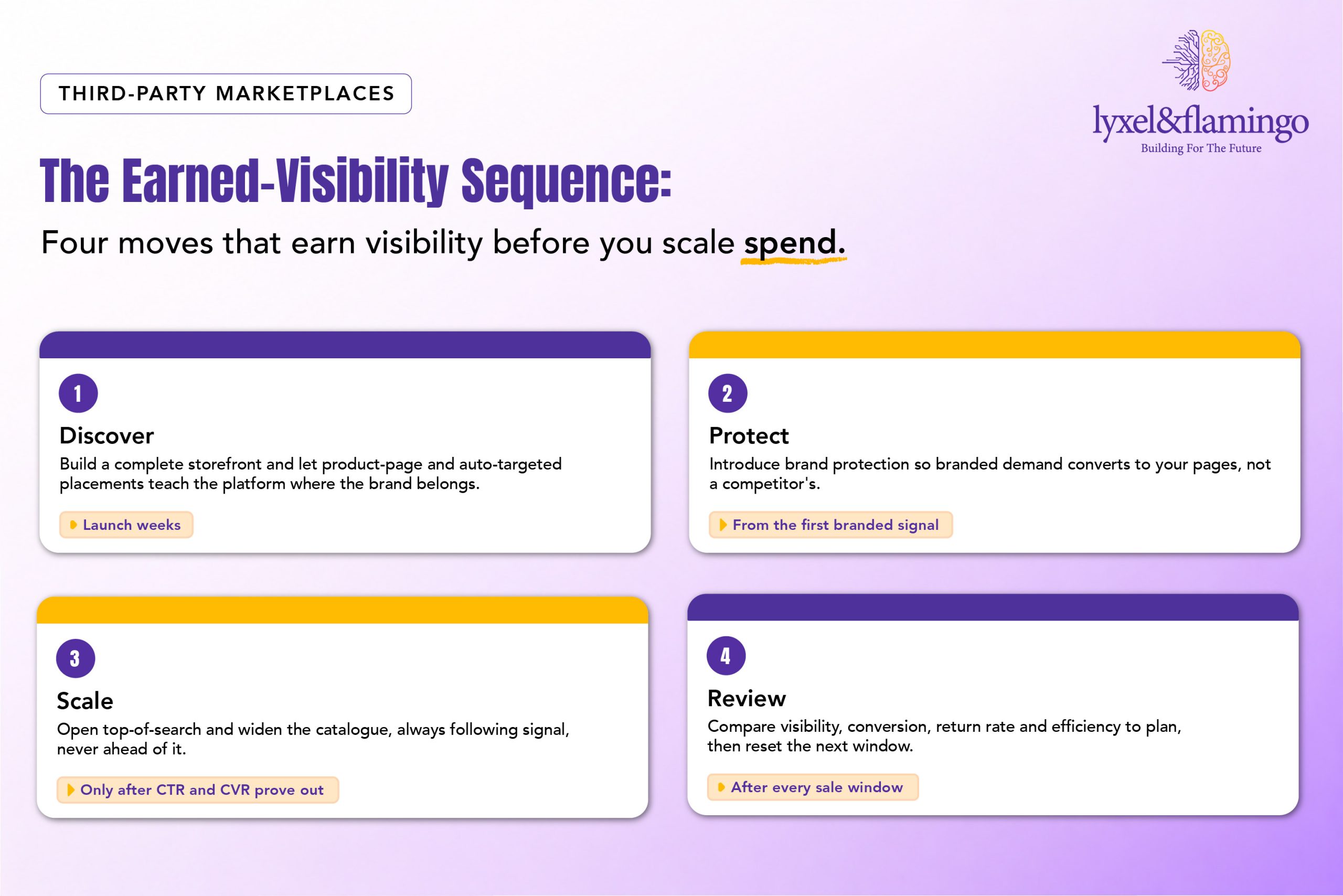
Four moves for a fashion brand entering Myntra or re-entering a sale window. The cadence is a recommended working pattern.
Framework Explained
Discover: With no history, impressions and discovery are the first measure. Launch with a complete storefront and let product-page and auto-targeted placements teach the platform where your products belong in the category. The aim in these weeks is learning; returns come next, so judge success on relevance signals and click-through quality.
Protect: Once shoppers search for your name, you have already paid for that awareness. Brand protection keeps those searches landing on your pages, not a competitor’s. Switch it on as soon as branded traffic appears, because the demand you have created is the cheapest demand you will ever convert.
Scale: Expansion is earned by data. When click-through and conversion hold, open top-of-search and widen the catalogue together; when either slips, hold spend and fix the page. Scaling ahead of signal is how efficiency collapses, and festive pressure is when teams are most tempted to do it.
Review: Each window teaches the next. Compare visibility, conversion, return rate and efficiency with plan, and write down which placements and products earned their budget. Include returns for fashion, since a sale is efficient when the orders stay delivered.
What to Measure When the Sale Window Closes
Sale results are easy to misread because spend and sales both spike. Separate the scorecard into visibility, conversion, efficiency and returns, and read each against the plan. A win counts when sales rise and returns hold. Name the metric that would change your next decision.
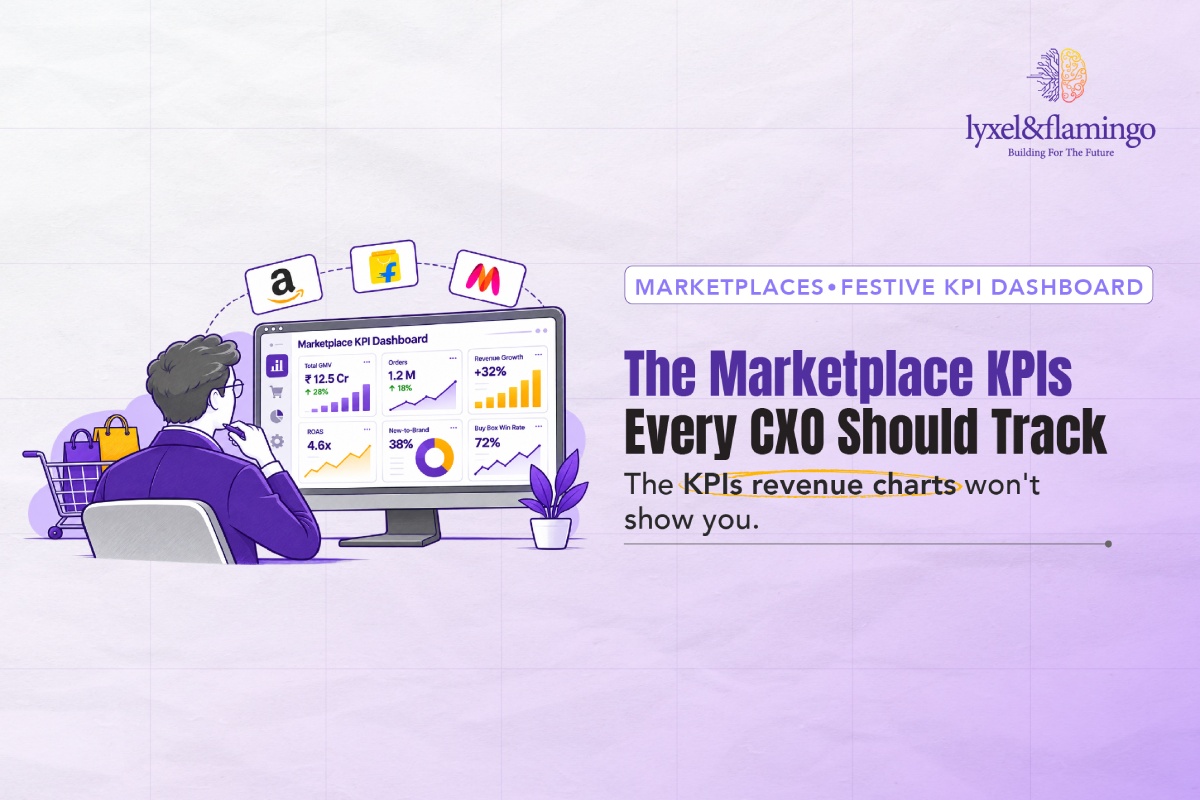
The marketplace KPIs a CXO should track during festive sales sets out the metrics that stop a spend increase being mistaken for a gain. Fashion needs one more line: return rate, since efficiency includes what stays sold. Returns remain one of the biggest margin pressures in apparel, a theme in McKinsey and BoF’s State of Fashion 2026. Put it on the same page as ROAS. Leadership should see both at once.
Cap bids on placements that do not convert, and protect the products with the best conversion. Mid-sale optimisation is about moving budget, not adding it. Agree the rules before the window, so nobody improvises at midnight. A short written review after every window turns each sale into an input for the next one, which is how an account builds a compounding advantage over rivals that treat each event as a fresh start.
Close the window with a review, with returns defended as covered in defending ROAS through the festive bidding war. Record what each phase delivered and which placements earned their budget. Then reset the plan for the next sale. One window, one lesson.
Client Proof Point
Lotto Sport Italia on Myntra: Lotto relaunched in India in 2025 through a 40-year exclusive licence with Agilitas Sports and entered Myntra as a fresh account, ready to build listings, sales history and search signals from day one. Together with Lotto, we built visibility first, protected branded demand early and scaled only as click-through and conversion confirmed readiness. Results compare OND 2025 with the initial months after listing and campaign launch.
Results at a glance:
- ~60x growth in orders run-rate
- ~50x revenue velocity
- +139 bps improvement in conversion rate
- ~4x click-to-order efficiency
- 9x spend scale with efficiency intact
Source: Lyxel&Flamingo case study, Lotto Sport Italia, Myntra OND 2025.
Key Takeaways
- Myntra search placement follows platform signals, so a brand earns discovery before it buys scale.
- Catalogue quality, especially size guidance and category-led titles, decides whether earned traffic converts.
- Protect branded demand from the first signal and open top-of-search only after click-through and conversion prove out.
- Sequence beats spend: earn visibility first, protect it, then scale on proof.
- Score every sale on visibility, conversion, efficiency and returns, not on spend and sales alone.
The CXO Takeaways
Ask your marketplace lead how much of your Myntra spend is chasing placements the account has not earned. If the answer is “most of it”, move budget into catalogue repair and product-page placements for one cycle, and judge success on conversion and return rate as well as reach.
Frequently Asked Questions
Yes, if it earns relevance first. A new brand has no history on the platform, so product-page placements, a complete storefront and early brand protection build the signals that let it compete. Scale spend only after click-through and conversion hold.
Start with product-page placements first. A new account is still building signal, so product-page and auto-targeted placements teach the platform where you belong at lower cost. Open top-of-search once click-through and conversion hold.
A common reference point is roughly 60% discovery and 40% branded as signals stabilise. Treat it as a starting point and adjust to your own click-through, conversion and branded search volume.
Stock depth across sizes, complete catalogue content and a brand-protection campaign already running. The sale then amplifies a prepared account instead of exposing a weak one.